Six concise chapters that distinguish historical evidence, traditional biography and later devotional legend.
Ādi Śaṅkara's philosophical importance is clear, but reliable records of his life are scarce. These chapters place the historical baseline beside the stories through which later communities remembered his vocation and teaching.
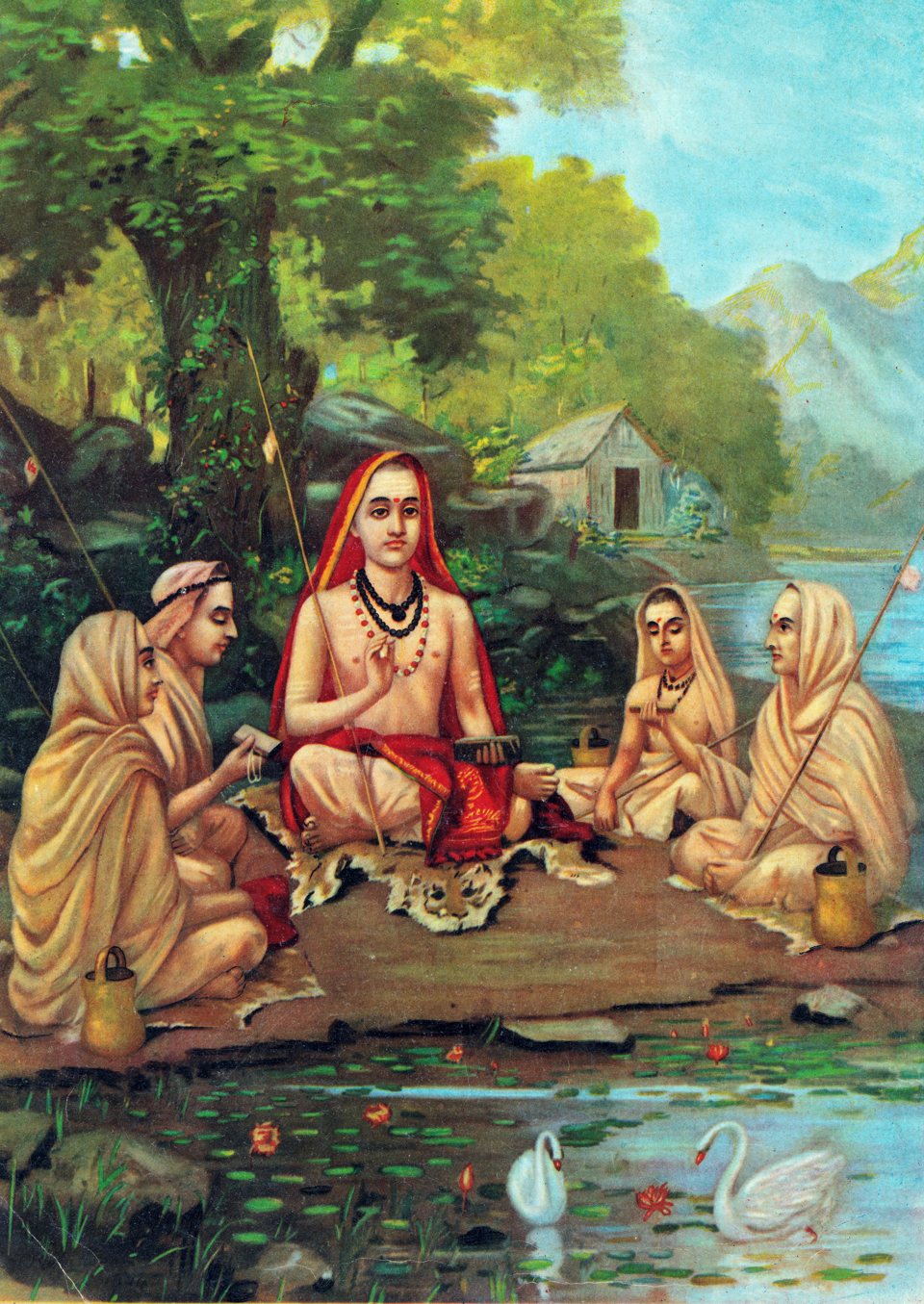
Ravi Varma Press, circa 1904. A later devotional depiction, not a lifetime portrait.Ravi Varma Press, circa 1904. This devotional print is public-domain historical artwork, not a lifetime portrait.
Ādi Śaṅkara was an influential Indian philosopher and commentator who is generally placed in the eighth century, although his precise dates remain debated. Advaita teaching existed before him; his commentaries gave the tradition an enduring systematic expression through close readings of the Upanishads, Bhagavad Gita and Brahma Sutras. Reliable records of his life are sparse, while later Shankara-vijaya biographies combine remembered lineage, instruction and miracle. The remaining chapters therefore identify traditional biography and later legend explicitly rather than treating every episode as documented history.
Original DHIH devotional illustration of the traditional birth narrative.
Traditional biographies place Śaṅkara's birth at Kaladi in Kerala and name his parents as Shivaguru and Aryamba. They tell that the couple prayed for a child and received a divine assurance before his birth, and they remember the young Śaṅkara as an unusually gifted student who mastered sacred learning early. His father's death during his childhood and Aryamba's care for him give the story its human setting. These details express how the tradition understands a life marked for teaching; surviving contemporary documents do not independently confirm the miraculous elements.
Original DHIH devotional illustration of the traditional renunciation story.
A famous traditional account says that a crocodile seized the young Śaṅkara while he was bathing in a river. Believing death was near, he asked Aryamba to permit him to take the vows of renunciation; when she consented, the animal released him. He then promised that he would return to perform her final rites. The episode dramatically joins filial duty with an irresistible spiritual vocation. It should be read as a hagiographic teaching story, not as an eyewitness report preserved from Śaṅkara's lifetime.
Original DHIH devotional illustration of a later extension to the crocodile legend.
Some later retellings extend the crocodile episode by saying that the animal was a Gandharva, a celestial musician, who had been placed under a curse associated with the sage Durvasa. Contact with Śaṅkara ended the curse, and the Gandharva rose again in a radiant form. In this devotional reading the encounter liberates both participants: Śaṅkara is released for the path of renunciation, and the hidden celestial being is released from an animal form. This elaboration is a later legend and is not uniform across the traditional biographies.
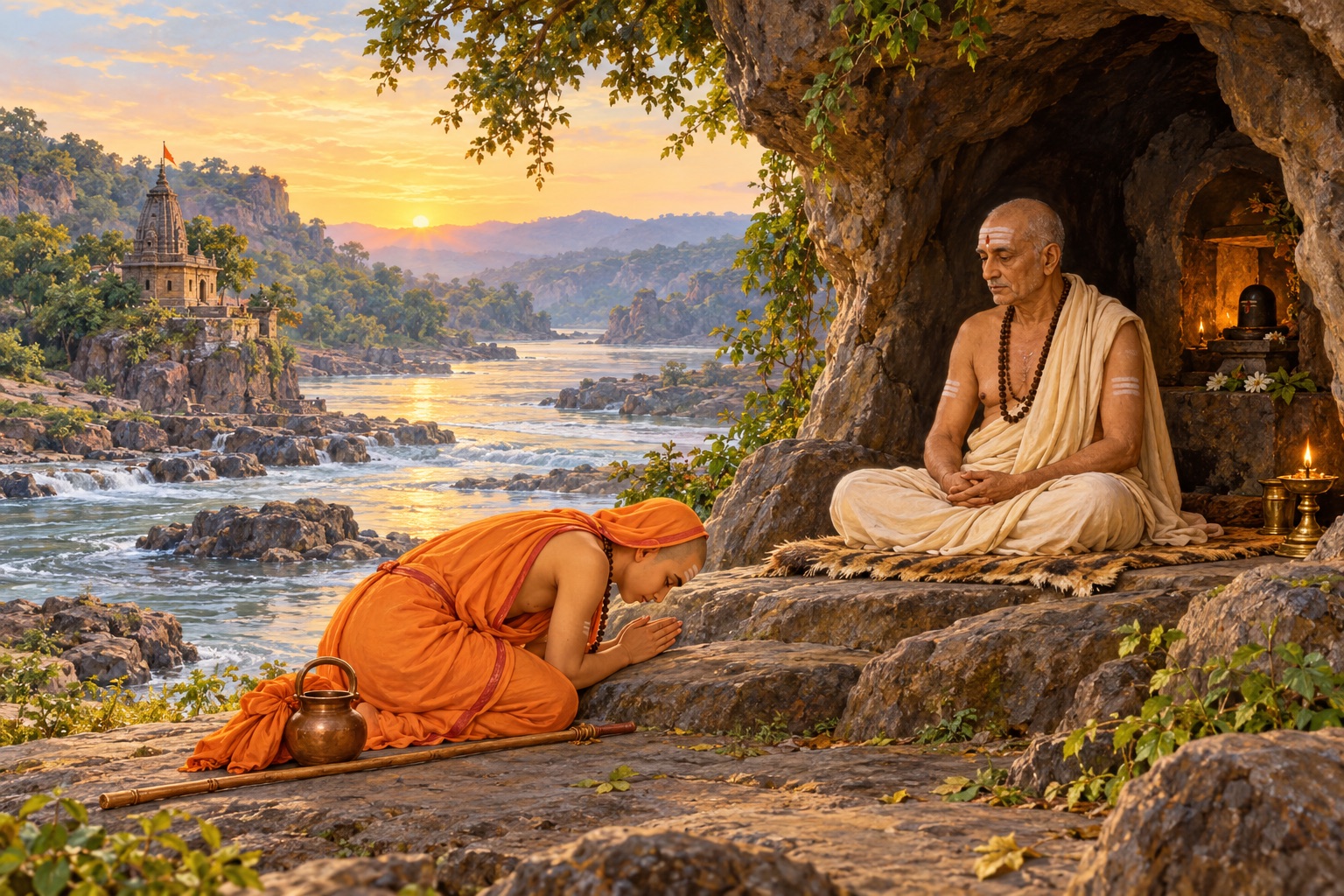
Original DHIH devotional illustration of the teacher-disciple meeting remembered by tradition.
Śaṅkara is traditionally connected with the teacher Govinda Bhagavatpada, and that teacher-disciple relationship belongs to the most stable outline of his life. Later biographies describe a journey to the Narmada, a meeting in a cave near Omkareshwar and formal initiation into the renunciant lineage. They also add dramatic scenes, including a flood contained in a water pot and a searching question about Śaṅkara's true identity. The historical centre is the transmission of Advaita learning from teacher to disciple; the scenic and miraculous details communicate the disciple's readiness and the teacher's recognition.
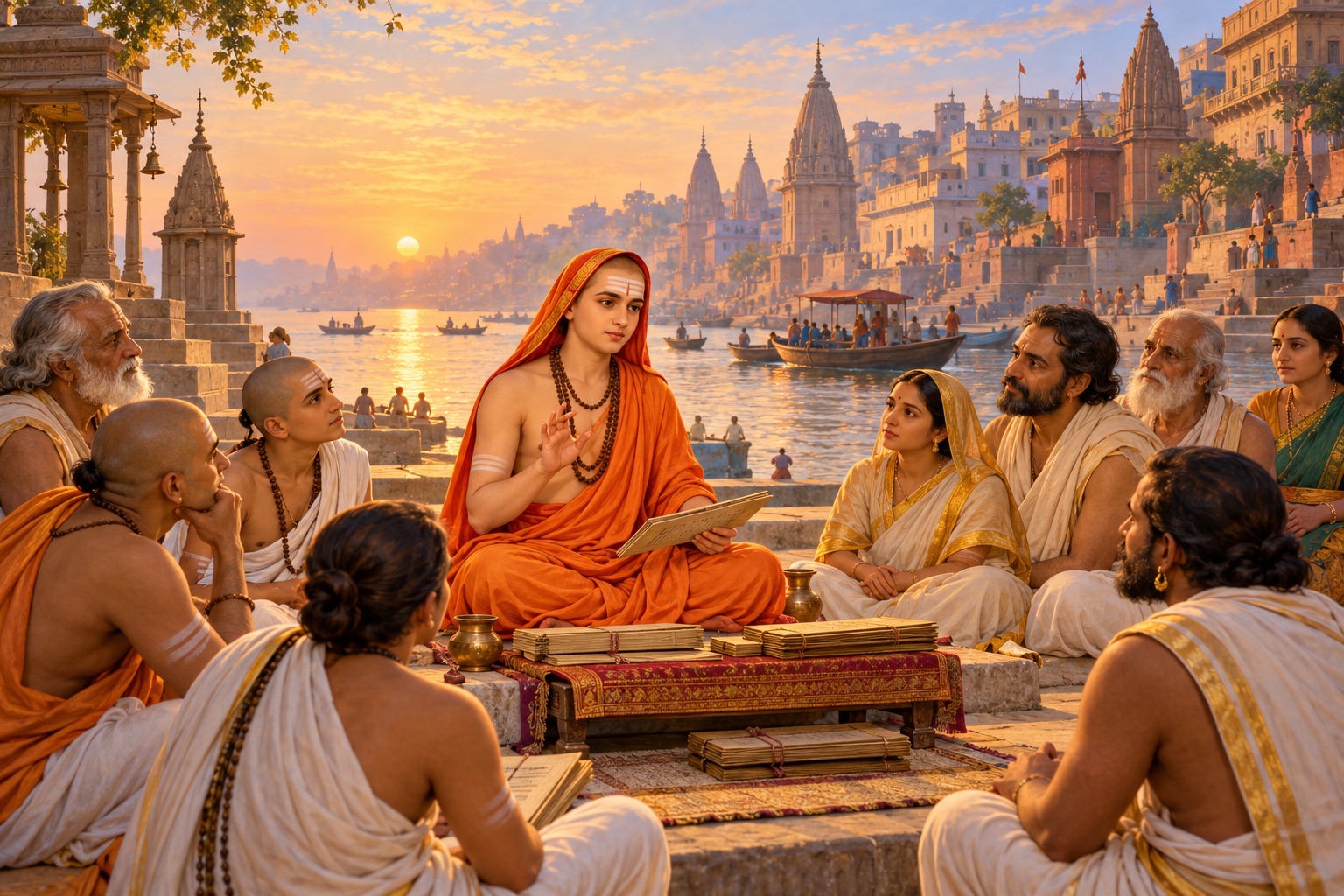
Original DHIH devotional illustration of Śaṅkara teaching in Kashi.
Traditional biographies remember Kashi as a major stage of Śaṅkara's public teaching, where students gathered and disciplined study was directed toward liberating insight. Stories set there include the encounter with a Chandala that tradition connects with Manisha Panchakam and the elderly grammarian associated with Bhaja Govindam. The attribution and exact chronology of individual works remain debated, so these episodes are best read as teaching narratives rather than a fixed travel diary. Their shared lesson is that Vedic learning must mature beyond social pride and technical display into recognition of the one Self and compassionate conduct.
READ WITH CONTEXT
Sources and limits
The prose and illustrations on this page were created for DHIH. Gurukula supplied the topic checklist only. Historical framing follows modern reference scholarship; named birthplace, family and lineage traditions were also cross-checked against the Sringeri Peetham account.