Search DHIH library

White Yajurveda · 18 MANTRAS

ईशोपनिषत्

Īśa Upanishad

The whole world is held by the Lord. Live and act without grasping, see the Self in every being, hold complementary kinds of knowledge together, and ask to be led by the good path.

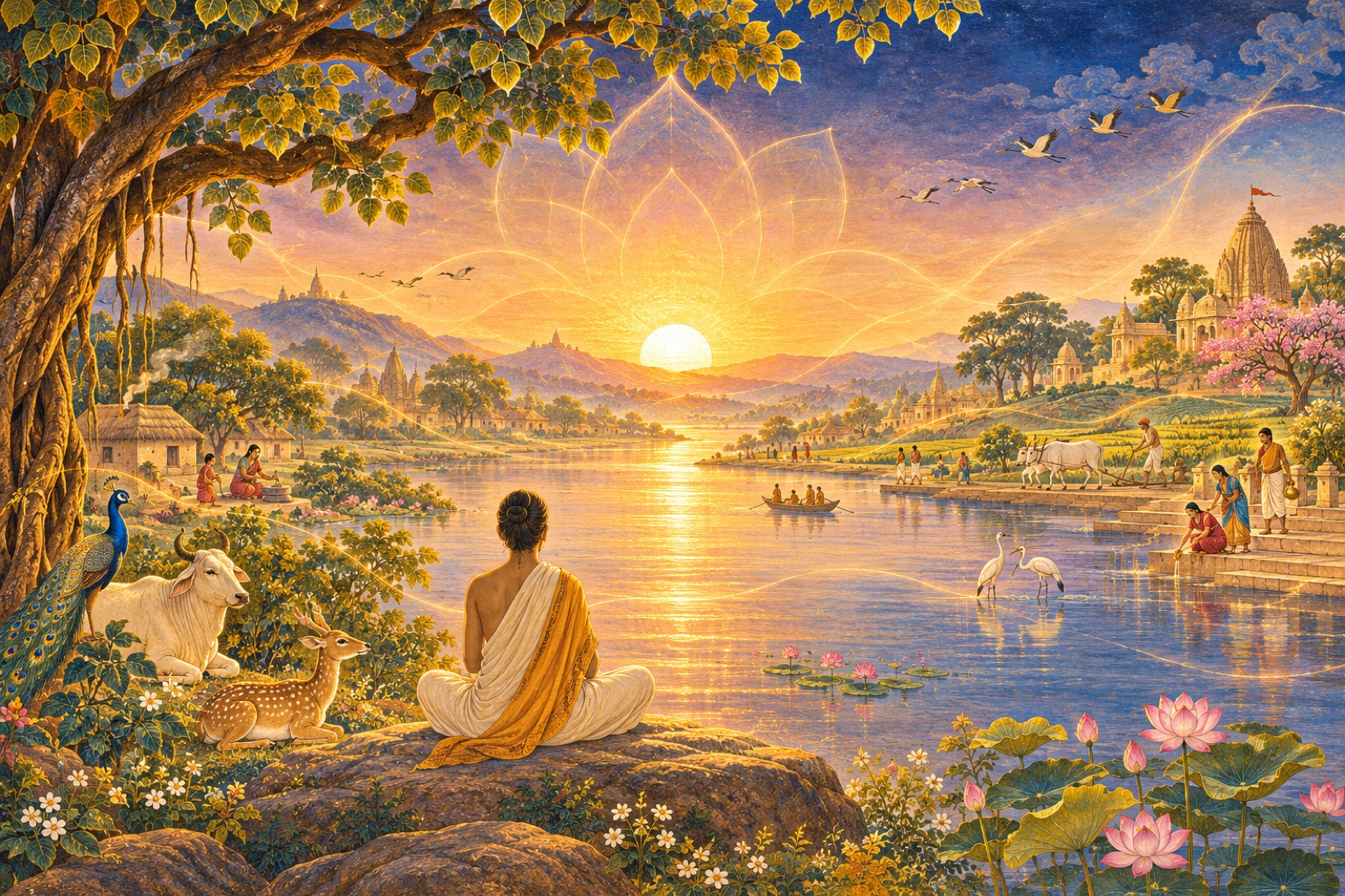
A seeker beside a river at sunrise, contemplating one sacred presence throughout the living world.
Original AI-generated DHIH contemplative illustration. Artistic interpretation, not historical evidence.

How this edition is arranged

The Sanskrit comes first. Every original line is immediately followed by its plain English sense. Open the optional pronunciation and the short meaning that gathers the complete passage.

MANTRA 1

#

ईशा वास्यमिदं सर्वं यत्किं च जगत्यां जगत्

Line 1All this—everything that moves within the moving world—is to be understood as pervaded by the Lord.

तेन त्यक्तेन भुञ्जीथा मा गृधः कस्य स्विद्धनम्

Line 2Enjoy and protect life through non-grasping; do not covet, for whose possession is wealth?

Roman pronunciation

īśā vāsyam idaṃ sarvaṃ yat kiṃ ca jagatyāṃ jagat
tena tyaktena bhuñjīthā mā gṛdhaḥ kasya svid dhanam

Short meaning of the whole passage

Participate fully in life while releasing the claim that anything is absolutely yours.

MANTRA 2

#

कुर्वन्नेवेह कर्माणि जिजीविषेच्छतं समाः

Line 1By doing one's work here, one may wish to live a hundred years.

एवं त्वयि नान्यथेतोऽस्ति न कर्म लिप्यते नरे

Line 2For you there is no other way of living so that action does not bind the person.

Roman pronunciation

kurvann eveha karmāṇi jijīviṣec chataṃ samāḥ
evaṃ tvayi nānyatheto'sti na karma lipyate nare

Short meaning of the whole passage

Work need not imprison the doer when it is performed without possessive attachment.

MANTRA 3

#

असुर्या नाम ते लोका अन्धेन तमसावृताः

Line 1Sunless are those worlds, covered by blinding darkness.

तांस्ते प्रेत्याभिगच्छन्ति ये के चात्महनो जनाः

Line 2To them go those who, through ignorance, deny or destroy awareness of the Self.

Roman pronunciation

asuryā nāma te lokā andhena tamasāvṛtāḥ
tāṃs te pretyābhigacchanti ye ke cātma-hano janāḥ

Short meaning of the whole passage

A life that refuses the inner Self is described as spiritual darkness.

MANTRA 4

#

अनेजदेकं मनसो जवीयो नैनद्देवा आप्नुवन्पूर्वमर्षत्

Line 1The One is unmoving yet swifter than the mind; the senses cannot overtake it, for it is already before them.

तद्धावतोऽन्यानत्येति तिष्ठत्तस्मिन्नपो मातरिश्वा दधाति

Line 2Standing still, it surpasses all who run; within it the cosmic life-power supports every activity.

Roman pronunciation

anejad ekaṃ manaso javīyo nainad devā āpnuvan pūrvam arṣat
tad dhāvato'nyān atyeti tiṣṭhat tasminn apo mātariśvā dadhāti

Short meaning of the whole passage

The Self is not an object that mind or senses can catch; it is the ever-present basis that makes their movement possible.

MANTRA 5

#

तदेजति तन्नैजति तद्दूरे तद्वन्तिके

Line 1It moves, and it does not move; it is far away, and it is very near.

तदन्तरस्य सर्वस्य तदु सर्वस्यास्य बाह्यतः

Line 2It is within all this, and it is also beyond all this.

Roman pronunciation

tad ejati tan naijati tad dūre tad v antike
tad antar asya sarvasya tad u sarvasyāsya bāhyataḥ

Short meaning of the whole passage

Reality cannot be confined to one opposite: it is intimately present yet never limited by the world.

MANTRA 6

#

यस्तु सर्वाणि भूतान्यात्मन्येवानुपश्यति

Line 1Whoever sees all beings in the Self alone,

सर्वभूतेषु चात्मानं ततो न विजुगुप्सते

Line 2and sees the Self in every being, no longer turns away from anyone.

Roman pronunciation

yas tu sarvāṇi bhūtāny ātmany evānupaśyati
sarva-bhūteṣu cātmānaṃ tato na vijugupsate

Short meaning of the whole passage

Seeing a shared Self removes the basis for contempt, exclusion and hatred.

MANTRA 7

#

यस्मिन्सर्वाणि भूतान्यात्मैवाभूद्विजानतः

Line 1For the one who knows and for whom every being has become the Self,

तत्र को मोहः कः शोक एकत्वमनुपश्यतः

Line 2what delusion and what sorrow can remain when unity is seen?

Roman pronunciation

yasmin sarvāṇi bhūtāny ātmaivābhūd vijānataḥ
tatra ko mohaḥ kaḥ śoka ekatvam anupaśyataḥ

Short meaning of the whole passage

Direct recognition of unity loosens both confusion and grief born from separation.

MANTRA 8

#

स पर्यगाच्छुक्रमकायमव्रणमस्नाविरं शुद्धमपापविद्धम्

Line 1That radiant reality is bodiless, uninjured, without sinews, pure and untouched by wrongdoing.

कविर्मनीषी परिभूः स्वयम्भूर्याथातथ्यतोऽर्थान्व्यदधाच्छाश्वतीभ्यः समाभ्यः

Line 2The seer, the wise one, all-surpassing and self-existent, orders things according to their nature through the enduring ages.

Roman pronunciation

sa paryagāc chukram akāyam avraṇam asnāviraṃ śuddham apāpa-viddham
kavir manīṣī paribhūḥ svayambhūr yāthātathyato'rthān vyadadhāc chāśvatībhyaḥ samābhyaḥ

Short meaning of the whole passage

The Self is described as pure awareness, independent of bodily limitation and the ground of cosmic order.

MANTRA 9

#

अन्धं तमः प्रविशन्ति ये अविद्यामुपासते

Line 1Those devoted only to ignorance or outward action enter blinding darkness.

ततो भूय इव ते तमो य उ विद्यायां रताः

Line 2Those delighted only in knowledge are said to enter a darkness deeper still.

Roman pronunciation

andhaṃ tamaḥ praviśanti ye avidyām upāsate
tato bhūya iva te tamo ya u vidyāyāṃ ratāḥ

Short meaning of the whole passage

The mantra warns against turning either practical life or contemplative knowledge into an isolated absolute.

MANTRA 10

#

अन्यदेवाहुर्विद्ययाऽन्यदाहुरविद्यया

Line 1The wise say that one result comes through knowledge and another through ignorance or action.

इति शुश्रुम धीराणां ये नस्तद्विचचक्षिरे

Line 2So we have heard from discerning teachers who explained this to us.

Roman pronunciation

anyad evāhur vidyayānyad āhur avidyayā
iti śuśruma dhīrāṇāṃ ye nas tad vicacakṣire

Short meaning of the whole passage

Knowledge and disciplined action serve different purposes and should not be confused.

MANTRA 11

#

विद्यां चाविद्यां च यस्तद्वेदोभयं सह

Line 1One who understands knowledge and action together,

अविद्यया मृत्युं तीर्त्वा विद्ययामृतमश्नुते

Line 2crosses death through action and tastes immortality through knowledge.

Roman pronunciation

vidyāṃ cāvidyāṃ ca yas tad vedobhayaṃ saha
avidyayā mṛtyuṃ tīrtvā vidyayāmṛtam aśnute

Short meaning of the whole passage

A mature path integrates responsible action with liberating insight.

MANTRA 12

#

अन्धं तमः प्रविशन्ति येऽसम्भूतिमुपासते

Line 1Those devoted only to the unmanifest enter blinding darkness.

ततो भूय इव ते तमो य उ सम्भूत्यां रताः

Line 2Those delighted only in the manifest are said to enter a darkness deeper still.

Roman pronunciation

andhaṃ tamaḥ praviśanti ye'sambhūtim upāsate
tato bhūya iva te tamo ya u sambhūtyāṃ ratāḥ

Short meaning of the whole passage

Neither the unseen source nor its visible expressions should be treated as the whole truth by itself.

MANTRA 13

#

अन्यदेवाहुः संभवादन्यदाहुरसंभवात्

Line 1One result is said to come from the manifest, and another from the unmanifest.

इति शुश्रुम धीराणां ये नस्तद्विचचक्षिरे

Line 2So we have heard from discerning teachers who explained this to us.

Roman pronunciation

anyad evāhuḥ sambhavād anyad āhur asambhavāt
iti śuśruma dhīrāṇāṃ ye nas tad vicacakṣire

Short meaning of the whole passage

The two dimensions have distinct roles, and wisdom attends carefully to both.

MANTRA 14

#

संभूतिं च विनाशं च यस्तद्वेदोभयं सह

Line 1One who understands manifestation and dissolution together,

विनाशेन मृत्युं तीर्त्वा संभूत्यामृतमश्नुते

Line 2crosses death through the perishable and tastes immortality through the source of becoming.

Roman pronunciation

sambhūtiṃ ca vināśaṃ ca yas tad vedobhayaṃ saha
vināśena mṛtyuṃ tīrtvā sambhūtyāmṛtam aśnute

Short meaning of the whole passage

Freedom involves seeing temporal forms clearly while recognizing the imperishable ground from which they arise.

MANTRA 15

#

हिरण्मयेन पात्रेण सत्यस्यापिहितं मुखम्

Line 1The face of truth is hidden by a brilliant golden covering.

तत्त्वं पूषन्नपावृणु सत्यधर्माय दृष्टये

Line 2O Nourisher, remove it so that one devoted to truth may behold.

Roman pronunciation

hiraṇmayena pātreṇa satyasyāpihitaṃ mukham
tat tvaṃ pūṣann apāvṛṇu satya-dharmāya dṛṣṭaye

Short meaning of the whole passage

Even radiant appearances can conceal the deepest truth; the seeker asks for unobstructed vision.

MANTRA 16

#

पूषन्नेकर्षे यम सूर्य प्राजापत्य व्यूह रश्मीन्समूह तेजः

Line 1O Nourisher, lone seer, controller, Sun and child of the Creator, gather your rays and draw in your blazing light.

यत्ते रूपं कल्याणतमं तत्ते पश्यामि योऽसावसौ पुरुषः सोऽहमस्मि

Line 2Let me behold your most auspicious form; the Person there—that am I.

Roman pronunciation

pūṣann ekarṣe yama sūrya prājāpatya vyūha raśmīn samūha tejaḥ
yat te rūpaṃ kalyāṇatamaṃ tat te paśyāmi yo'sāv asau puruṣaḥ so'ham asmi

Short meaning of the whole passage

Beyond the dazzling surface, the seeker recognizes identity with the innermost conscious reality.

MANTRA 17

#

वायुरनिलममृतमथेदं भस्मान्तं शरीरम्

Line 1Let the breath return to the immortal cosmic air, while this body comes at last to ashes.

ॐ क्रतो स्मर कृतं स्मर क्रतो स्मर कृतं स्मर

Line 2Om. O purposeful mind, remember; remember what has been done. Remember.

Roman pronunciation

vāyur anilam amṛtam athedaṃ bhasmāntaṃ śarīram
oṃ krato smara kṛtaṃ smara krato smara kṛtaṃ smara

Short meaning of the whole passage

At death, the body returns to nature while awareness turns toward truth and an honest remembrance of one's life.

MANTRA 18

#

अग्ने नय सुपथा राये अस्मान्विश्वानि देव वयुनानि विद्वान्

Line 1O Agni, lead us by the good path toward true abundance; divine knower, you understand every way.

युयोध्यस्मज्जुहुराणमेनो भूयिष्ठां ते नम उक्तिं विधेम

Line 2Remove from us the crooked wrong that misleads; to you we offer our fullest words of reverence.

Roman pronunciation

agne naya supathā rāye asmān viśvāni deva vayunāni vidvān
yuyodhy asmaj juhurāṇam eno bhūyiṣṭhāṃ te nama uktiṃ vidhema

Short meaning of the whole passage

The Upanishad closes as a practical prayer for guidance, purification and a truthful path.

THE WHOLE TEXT IN BRIEF

Central teaching

The whole world is held by the Lord. Live and act without grasping, see the Self in every being, hold complementary kinds of knowledge together, and ask to be led by the good path.

Text, meaning and source

Source edition: Works of Sri Sankaracharya, Volume 4: Upanishad Bhashya, Part 1. Sri Vani Vilas Press, 1910; Devanagari text cross-checked with Sanskrit Wikisource and GRETIL.

English layer: Original DHIH AI-assisted line senses and passage summaries, prepared for accessible reading and checked for complete line coverage. This is not a claim of human scholarly certification.

Rights: Public-domain historical Sanskrit edition; fresh DHIH Roman reading and English meaning.

← Return to the Principal Upanishads