Search DHIH library

Atharvaveda · 12 MANTRAS

माण्डूक्योपनिषत्

Māṇḍūkya Upanishad

The twelve mantras identify Om with the whole of experience and examine waking, dream, deep sleep and the nondual fourth, revealing the Self as the constant reality through every state.

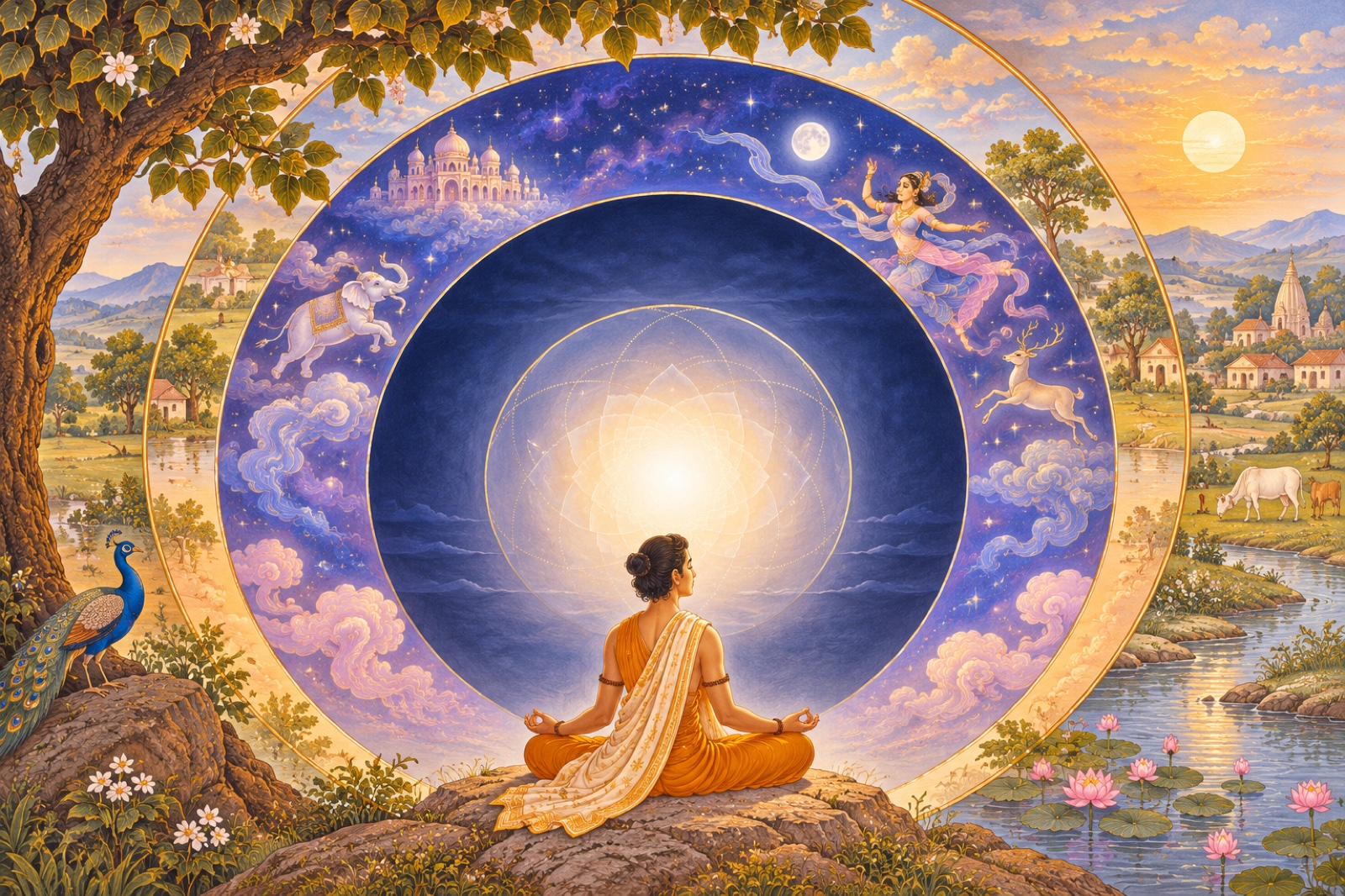
A seeker contemplating concentric fields symbolizing waking, dream, deep sleep and the silent fourth.
Original AI-generated DHIH contemplative illustration. Artistic interpretation, not historical evidence.

How this edition is arranged

The Sanskrit comes first. Every original line is immediately followed by its plain English sense. Open the optional pronunciation and the short meaning that gathers the complete passage.

MANTRA 1

#

ओमित्येतदक्षरमिदं सर्वं तस्योपव्याख्यानं भूतं भवद्भविष्यदिति सर्वमोंकार एव

Line 1Om—this syllable is all this. Past, present and future are indeed Om.

यच्चान्यत्त्रिकालातीतं तदप्योंकार एव

Line 2Whatever is beyond the three divisions of time is also Om.

Roman pronunciation

om ity etad akṣaram idaṃ sarvaṃ tasyopavyākhyānaṃ bhūtaṃ bhavad bhaviṣyad iti sarvam oṃkāra eva
yac cānyat trikālātītaṃ tad apy oṃkāra eva

Short meaning of the whole passage

Om is presented as a symbol embracing all experience and whatever transcends time.

MANTRA 2

#

सर्वं ह्येतद्ब्रह्मायमात्मा ब्रह्म सोऽयमात्मा चतुष्पात्

Line 1All this is truly Brahman. This Self is Brahman, and this Self is described as having four quarters.

Roman pronunciation

sarvaṃ hy etad brahmāyam ātmā brahma so'yam ātmā catuṣpāt

Short meaning of the whole passage

The universal reality and the innermost Self are one; the text now studies that Self through four aspects of experience.

MANTRA 3

#

जागरितस्थानो बहिःप्रज्ञः सप्ताङ्ग एकोनविंशतिमुखः स्थूलभुग्वैश्वानरः प्रथमः पादः

Line 1The first quarter is Vaiśvānara: awake, outwardly aware, with seven limbs and nineteen gateways, experiencing physical objects.

Roman pronunciation

jāgarita-sthāno bahiḥ-prajñaḥ saptāṅga ekonaviṃśati-mukhaḥ sthūla-bhug vaiśvānaraḥ prathamaḥ pādaḥ

Short meaning of the whole passage

The waking self engages the shared external world through the body, senses, vital powers and mind.

MANTRA 4

#

स्वप्नस्थानोऽन्तःप्रज्ञः सप्ताङ्ग एकोनविंशतिमुखः प्रविविक्तभुक्तैजसो द्वितीयः पादः

Line 1The second quarter is Taijasa: dreaming, inwardly aware, with seven limbs and nineteen gateways, experiencing subtle impressions.

Roman pronunciation

svapna-sthāno'ntaḥ-prajñaḥ saptāṅga ekonaviṃśati-mukhaḥ pravivikta-bhuk taijaso dvitīyaḥ pādaḥ

Short meaning of the whole passage

In dreams the same faculties turn inward and form a private world from impressions.

MANTRA 5

#

यत्र सुप्तो न कञ्चन कामं कामयते न कञ्चन स्वप्नं पश्यति तत्सुषुप्तम्

Line 1Deep sleep is where the sleeper desires no desire and sees no dream.

सुषुप्तस्थान एकीभूतः प्रज्ञानघन एवानन्दमयो ह्यानन्दभुक्चेतोमुखः प्राज्ञस्तृतीयः पादः

Line 2The third quarter is Prājña: unified in deep sleep, an undifferentiated mass of awareness, peaceful and enjoying rest, with mind as its doorway.

Roman pronunciation

yatra supto na kañcana kāmaṃ kāmayate na kañcana svapnaṃ paśyati tat suṣuptam
suṣupta-sthāna ekībhūtaḥ prajñāna-ghana evānandamayo hy ānanda-bhuk ceto-mukhaḥ prājñas tṛtīyaḥ pādaḥ

Short meaning of the whole passage

Deep sleep suspends the divided worlds of waking and dream, but it is still a causal condition rather than final realization.

MANTRA 6

#

एष सर्वेश्वर एष सर्वज्ञ एषोऽन्तर्याम्येष योनिः सर्वस्य प्रभवाप्ययौ हि भूतानाम्

Line 1This is the Lord of all, the knower of all, the inner guide and the source of everything; from this all beings arise and into this they return.

Roman pronunciation

eṣa sarveśvara eṣa sarvajña eṣo'ntaryāmy eṣa yoniḥ sarvasya prabhavāpyayau hi bhūtānām

Short meaning of the whole passage

The causal stillness encountered in deep sleep points toward the universal source and inner ruler.

MANTRA 7

#

नान्तःप्रज्ञं न बहिःप्रज्ञं नोभयतःप्रज्ञं न प्रज्ञानघनं न प्रज्ञं नाप्रज्ञम्

Line 1The fourth is not inwardly aware, outwardly aware, aware in both ways, an undifferentiated mass, ordinary knowing, or unknowing.

अदृश्यमव्यवहार्यमग्राह्यमलक्षणमचिन्त्यमव्यपदेश्यमेकात्मप्रत्ययसारं प्रपञ्चोपशमं शान्तं शिवमद्वैतं चतुर्थं मन्यन्ते

Line 2It is unseen, beyond transactions, ungraspable, without defining mark, unthinkable and indescribable; its essence is certainty of the one Self—the ending of appearance, peaceful, auspicious and nondual.

स आत्मा स विज्ञेयः

Line 3That is the Self. That is to be known.

Roman pronunciation

nāntaḥ-prajñaṃ na bahiḥ-prajñaṃ nobhayataḥ-prajñaṃ na prajñāna-ghanaṃ na prajñaṃ nāprajñam
adṛśyam avyavahāryam agrāhyam alakṣaṇam acintyam avyapadeśyam ekātma-pratyaya-sāraṃ prapañcopaśamaṃ śāntaṃ śivam advaitaṃ caturthaṃ manyante
sa ātmā sa vijñeyaḥ

Short meaning of the whole passage

Turīya is not another passing state. It is the nondual awareness that cannot be objectified and is present through all three states.

MANTRA 8

#

सोऽयमात्माध्यक्षरमोंकारोऽधिमात्रं पादा मात्रा मात्राश्च पादा अकार उकारो मकार इति

Line 1This Self, considered through syllables, is Om. Its quarters are the sound-units, and the sound-units are its quarters: A, U and M.

Roman pronunciation

so'yam ātmādhyakṣaram oṃkāro'dhimātraṃ pādā mātrā mātrāś ca pādā akāra ukāro makāra iti

Short meaning of the whole passage

The teaching now uses the audible structure of A-U-M as a contemplative map of experience.

MANTRA 9

#

जागरितस्थानो वैश्वानरोऽकारः प्रथमा मात्राप्तेरादिमत्त्वाद्वा

Line 1Vaiśvānara in the waking state is the first sound, A, because it pervades and comes first.

आप्नोति ह वै सर्वान्कामानादिश्च भवति य एवं वेद

Line 2One who understands this reaches worthy aims and becomes foremost.

Roman pronunciation

jāgarita-sthāno vaiśvānaro'kāraḥ prathamā mātrāpter ādimattvād vā
āpnoti ha vai sarvān kāmān ādiś ca bhavati ya evaṃ veda

Short meaning of the whole passage

The open sound A corresponds to waking, the first and most outwardly pervasive mode of experience.

MANTRA 10

#

स्वप्नस्थानस्तैजस उकारो द्वितीया मात्रोत्कर्षादुभयत्वाद्वा

Line 1Taijasa in the dream state is the second sound, U, because it rises between and shares qualities with both sides.

उत्कर्षति ह वै ज्ञानसंततिं

Line 2One who understands this raises the continuity of knowledge,

समानश्च भवति

Line 3becomes balanced toward all,

नास्याब्रह्मवित्कुले भवति य एवं वेद

Line 4and establishes a family in which knowledge of Brahman does not disappear.

Roman pronunciation

svapna-sthānas taijasa ukāro dvitīyā mātrotkarṣād ubhayatvād vā
utkarṣati ha vai jñāna-santatim
samānaś ca bhavati
nāsyābrahma-vit kule bhavati ya evaṃ veda

Short meaning of the whole passage

The mediating sound U corresponds to the inward dream state and symbolizes refinement, continuity and balance.

MANTRA 11

#

सुषुप्तस्थानः प्राज्ञो मकारस्तृतीया मात्रा मितेरपीतेर्वा

Line 1Prājña in deep sleep is the third sound, M, because it measures and gathers things into itself.

मिनोति ह वा इदं सर्वमपीतिश्च भवति य एवं वेद

Line 2One who understands this comprehends the whole and becomes its place of resolution.

Roman pronunciation

suṣupta-sthānaḥ prājño makāras tṛtīyā mātrā miter apīter vā
minoti ha vā idaṃ sarvam apītiś ca bhavati ya evaṃ veda

Short meaning of the whole passage

The closing sound M corresponds to deep sleep, where differentiated experience is gathered back into an unexpressed condition.

MANTRA 12

#

अमात्रश्चतुर्थोऽव्यवहार्यः प्रपञ्चोपशमः शिवोऽद्वैत एवमोंकार आत्मैव

Line 1The fourth is without a sound-unit: beyond transaction, the ending of appearance, auspicious and nondual. Thus Om is the Self itself.

संविशत्यात्मनात्मानं य एवं वेद

Line 2One who understands this enters the Self through the Self.

Roman pronunciation

amātraś caturtho'vyavahāryaḥ prapañcopaśamaḥ śivo'dvaita evam oṃkāra ātmaiva
saṃviśaty ātmanātmānaṃ ya evaṃ veda

Short meaning of the whole passage

The silence not measured as A, U or M points to nondual awareness, in which the seeker and the sought are not separate.

THE WHOLE TEXT IN BRIEF

Central teaching

The twelve mantras identify Om with the whole of experience and examine waking, dream, deep sleep and the nondual fourth, revealing the Self as the constant reality through every state.

Text, meaning and source

Source edition: Works of Sri Sankaracharya, Volume 5: Upanishad Bhashya, Part 2. Sri Vani Vilas Press, 1910; Devanagari text cross-checked with Sanskrit Wikisource and GRETIL.

English layer: Original DHIH AI-assisted line senses and passage summaries, prepared for accessible reading and checked for complete line coverage. This is not a claim of human scholarly certification.

Rights: Public-domain historical Sanskrit edition; fresh DHIH Roman reading and English meaning.

← Return to the Principal Upanishads