Home / Sundara Kanda / Chapter 1VĀLMĪKI RĀMĀYAṆA · CHAPTER 01
सुन्दरकाण्डम् · प्रथमः सर्गः
Hanuman crosses the ocean A journey of devotion, courage and a resourceful mind. Read the complete Sanskrit chapter, one line and one meaning at a time.
213 verses Sanskrit + English 5 illustrated scenes
An edition-specific reading with original English meanings. Source & reading notes
Show Roman text Larger text
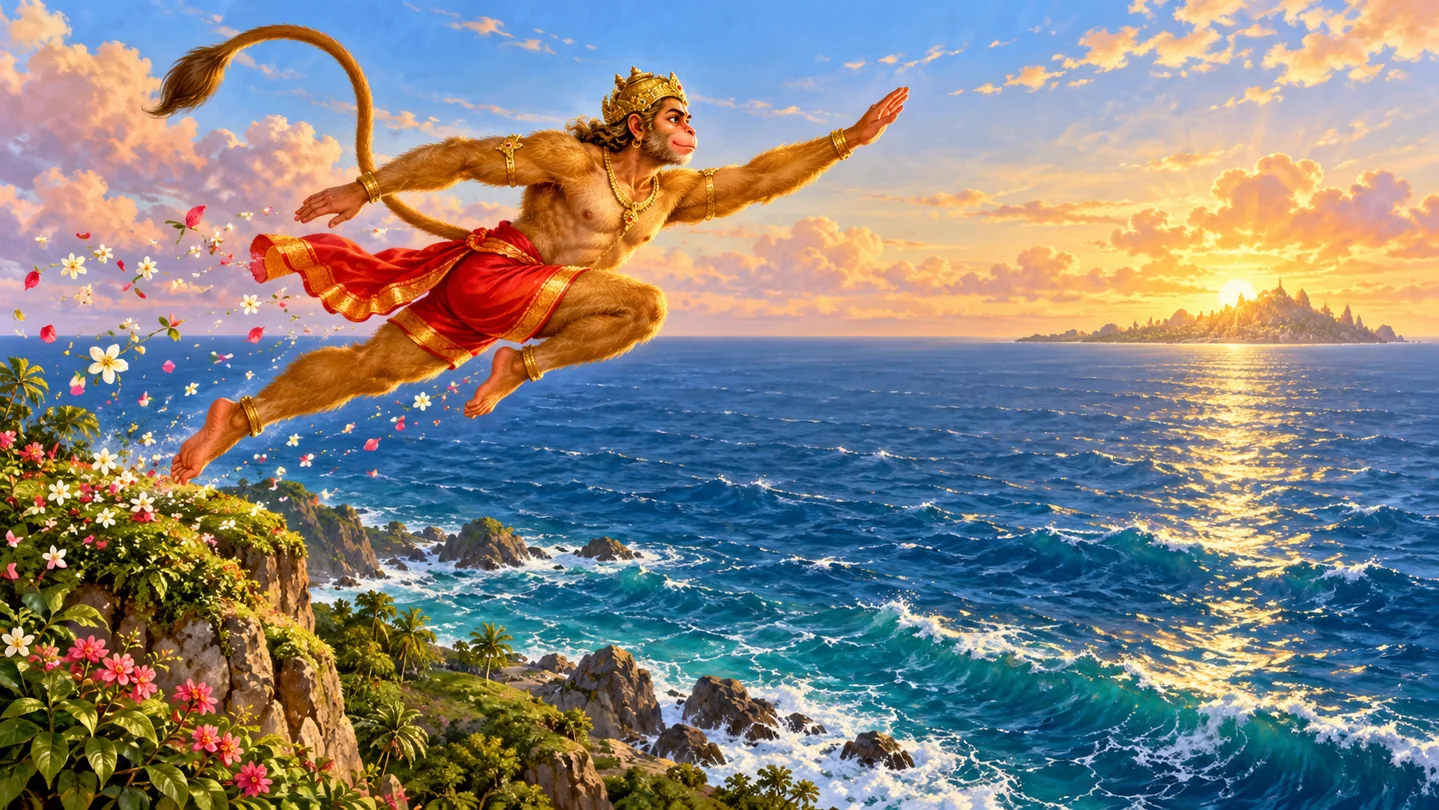
SCENE 01 · VERSES 1–86
The great leap Hanuman gathers his strength on Mount Mahendra and leaps towards Lanka in search of Sita.
Original DHIH illustration · artistic interpretation Verse 1 · 5.1.1 # Copy link ↗ ततो रावणनीतायाः सीतायाः शत्रुकर्षणः ।
tato rāvaṇanītāyāḥ sītāyāḥ śatrukarṣaṇaḥ |
Then Hanuman, the vanquisher of foes, sought Sita, whom Ravana had carried away.
इयेष पदमन्वेष्टुं चारणाचरिते पथि ॥
iyeṣa padamanveṣṭuṃ cāraṇācarite pathi ||
He resolved to discover her whereabouts by travelling the sky-path used by the celestial Charanas.
Verse 2 · 5.1.2 # Copy link ↗ दुष्करं निष्प्रतिद्वन्द्वं चिकीर्षन् कर्म वानरः ।
duṣkaraṃ niṣpratidvandvaṃ cikīrṣan karma vānaraḥ |
The vanara wished to accomplish a difficult deed without equal.
समुदग्रशिरोग्रीवो गवां पतिरिवाबभौ ॥
samudagraśirogrīvo gavāṃ patirivābabhau ||
With his head and neck held high, he looked like a mighty bull.
Verse 3 · 5.1.3 # Copy link ↗ अथ वैदूर्यवर्णेषु शाद्वलेषु महाबलः ।
atha vaidūryavarṇeṣu śādvaleṣu mahābalaḥ |
The immensely strong hero moved across grassy slopes the colour of beryl.
धीरः सलिलकल्पेषु विचचार यथासुखम् ॥
dhīraḥ salilakalpeṣu vicacāra yathāsukham ||
Calm and resolute, he wandered freely over lawns that looked like water.
Verse 4 · 5.1.4 # Copy link ↗ द्विजान् वित्रासयन् धीमानुरसा पादपान् हरन् ।
dvijān vitrāsayan dhīmānurasā pādapān haran |
The wise hero frightened birds and pushed down trees with his chest.
मृगांश्च सुबहून् निघ्नन् प्रवृद्ध इव केसरी ॥
mṛgāṃśca subahūn nighnan pravṛddha iva kesarī ||
Like a full-grown lion, he struck down many animals as he moved.
Verse 5 · 5.1.5 # Copy link ↗ नीललोहितमाञ्जिष्ठपद्मवर्णैः सितासितैः ।
nīlalohitamāñjiṣṭhapadmavarṇaiḥ sitāsitaiḥ |
The mountain bore blue, red, madder-red, lotus-coloured, white and dark hues.
स्वभावसिद्धैर्विमलैर्धातुभिः समलंकृतम् ॥
svabhāvasiddhairvimalairdhātubhiḥ samalaṃkṛtam ||
Its clear, naturally occurring mineral deposits adorned it.
Verse 6 · 5.1.6 # Copy link ↗ कामरूपिभिराविष्टमभीक्ष्णं सपरिच्छदैः ।
kāmarūpibhirāviṣṭamabhīkṣṇaṃ saparicchadaiḥ |
Shape-changing beings often inhabited it with their companions.
यक्षकिंनरगन्धर्वैर्देवकल्पैः सपन्नगैः ॥
yakṣakiṃnaragandharvairdevakalpaiḥ sapannagaiḥ ||
Yakshas, Kinnaras, Gandharvas and godlike serpents made their homes there.
Verse 7 · 5.1.7 # Copy link ↗ स तस्य गिरिवर्यस्य तले नागवरायुते ।
sa tasya girivaryasya tale nāgavarāyute |
At the foot of that great mountain, among its noble elephants, stood the foremost vanara.
तिष्ठन् कपिवरस्तत्र ह्रदे नाग इवाबभौ ॥
tiṣṭhan kapivarastatra hrade nāga ivābabhau ||
He appeared like an elephant standing in a lake.
Verse 8 · 5.1.8 # Copy link ↗ स सूर्याय महेन्द्राय पवनाय स्वयम्भुवे ।
sa sūryāya mahendrāya pavanāya svayambhuve |
To the Sun, great Indra, the Wind and the self-born Brahma,
भूतेभ्यश्चाञ्जलिं कृत्वा चकार गमने मतिम् ॥
bhūtebhyaścāñjaliṃ kṛtvā cakāra gamane matim ||
and to all beings, he joined his palms before resolving to depart.
Verse 9 · 5.1.9 # Copy link ↗ अञ्जलिं प्राङ्मुखं कुर्वन् पवनायात्मयोनये ।
añjaliṃ prāṅmukhaṃ kurvan pavanāyātmayonaye |
Facing east, he offered joined palms to the Wind, the source of his birth.
ततो हि ववृधे गन्तुं दक्षिणो दक्षिणां दिशम् ॥
tato hi vavṛdhe gantuṃ dakṣiṇo dakṣiṇāṃ diśam ||
Then the capable hero enlarged himself to travel south.
Short meaning After honouring his father, Hanuman prepares his body for the crossing.
Verse 10 · 5.1.10 # Copy link ↗ प्लवगप्रवरैर्दृष्टः प्लवने कृतनिश्चयः ।
plavagapravarairdṛṣṭaḥ plavane kṛtaniścayaḥ |
The foremost vanaras watched him, firmly resolved to leap.
ववृधे रामवृद्ध्यर्थं समुद्र इव पर्वसु ॥
vavṛdhe rāmavṛddhyarthaṃ samudra iva parvasu ||
For Rama's success he grew, like the ocean swelling at the lunar turning points.
Verse 11 · 5.1.11 # Copy link ↗ निष्प्रमाणशरीरः सँल्लिलङ्घयिषुरर्णवम् ।
niṣpramāṇaśarīraḥ sam̐llilaṅghayiṣurarṇavam |
His body became immeasurably large as he prepared to cross the sea.
बाहुभ्यां पीडयामास चरणाभ्यां च पर्वतम् ॥
bāhubhyāṃ pīḍayāmāsa caraṇābhyāṃ ca parvatam ||
He pressed the mountain with both arms and both feet.
Verse 12 · 5.1.12 # Copy link ↗ स चचालाचलश्चाशु मुहूर्तं कपिपीडितः ।
sa cacālācalaścāśu muhūrtaṃ kapipīḍitaḥ |
Pressed by the vanara, the motionless mountain suddenly shook.
तरूणां पुष्पिताग्राणां सर्वं पुष्पमशातयत् ॥
tarūṇāṃ puṣpitāgrāṇāṃ sarvaṃ puṣpamaśātayat ||
It shook loose all the flowers from the trees' blossoming crowns.
Verse 13 · 5.1.13 # Copy link ↗ तेन पादपमुक्तेन पुष्पौघेण सुगन्धिना ।
tena pādapamuktena puṣpaugheṇa sugandhinā |
The fragrant mass of blossoms released by the trees
सर्वतः संवृतः शैलो बभौ पुष्पमयो यथा ॥
sarvataḥ saṃvṛtaḥ śailo babhau puṣpamayo yathā ||
covered the mountain on every side, making it seem made of flowers.
Verse 14 · 5.1.14 # Copy link ↗ तेन चोत्तमवीर्येण पीड्यमानः स पर्वतः ।
tena cottamavīryeṇa pīḍyamānaḥ sa parvataḥ |
Pressed by that hero of incomparable strength, the mountain
सलिलं सम्प्रसुस्राव मदमत्त इव द्विपः ॥
salilaṃ samprasusrāva madamatta iva dvipaḥ ||
sent out streams of water, like a rutting elephant exuding fluid.
Verse 15 · 5.1.15 # Copy link ↗ पीड्यमानस्तु बलिना महेन्द्रस्तेन पर्वतः ।
pīḍyamānastu balinā mahendrastena parvataḥ |
As powerful Hanuman pressed Mount Mahendra,
रीतीर्निर्वर्तयामास काञ्चनाञ्जनराजतीः ॥
rītīrnirvartayāmāsa kāñcanāñjanarājatīḥ ||
it released streams of gold-coloured, dark and silvery mineral matter.
Verse 16 · 5.1.16 # Copy link ↗ मुमोच च शिलाः शैलो विशालाः समनःशिलाः ।
mumoca ca śilāḥ śailo viśālāḥ samanaḥśilāḥ |
The mountain shed great rocks containing red mineral deposits.
मध्यमेनार्चिषा जुष्टो धूमराजीरिवानलः ॥
madhyamenārciṣā juṣṭo dhūmarājīrivānalaḥ ||
It resembled a fire casting out trails of smoke from its burning centre.
Verse 17 · 5.1.17 # Copy link ↗ हरिणा पीड्यमानेन पीड्यमानानि सर्वतः ।
hariṇā pīḍyamānena pīḍyamānāni sarvataḥ |
As the vanara pressed down, creatures dwelling in the caves were squeezed on every side.
गुहाविष्टानि सत्त्वानि विनेदुर्विकृतैः स्वरैः ॥
guhāviṣṭāni sattvāni vinedurvikṛtaiḥ svaraiḥ ||
They cried out in strange and frightened voices.
Verse 18 · 5.1.18 # Copy link ↗ स महान् सत्त्वसन्नादः शैलपीडानिमित्तजः ।
sa mahān sattvasannādaḥ śailapīḍānimittajaḥ |
The great uproar of those creatures, caused by the mountain's distress,
पृथिवीं पूरयामास दिशश्चोपवनानि च ॥
pṛthivīṃ pūrayāmāsa diśaścopavanāni ca ||
filled the earth, every direction and the surrounding groves.
Verse 19 · 5.1.19 # Copy link ↗ शिरोभिः पृथुभिर्नागा व्यक्तस्वस्तिकलक्षणैः ।
śirobhiḥ pṛthubhirnāgā vyaktasvastikalakṣaṇaiḥ |
Serpents with broad heads bearing distinct auspicious markings
वमन्तः पावकं घोरं ददंशुर्दशनैः शिलाः ॥
vamantaḥ pāvakaṃ ghoraṃ dadaṃśurdaśanaiḥ śilāḥ ||
breathed dreadful fire and bit the rocks with their fangs.
Verse 20 · 5.1.20 # Copy link ↗ तास्तदा सविषैर्दष्टाः कुपितैस्तैर्महाशिलाः ।
tāstadā saviṣairdaṣṭāḥ kupitaistairmahāśilāḥ |
Bitten by those angry, venomous serpents, the great rocks
जज्वलुः पावकोद्दीप्ता बिभिदुश्च सहस्रधा ॥
jajvaluḥ pāvakoddīptā bibhiduśca sahasradhā ||
blazed with fire and shattered into a thousand pieces.
Verse 21 · 5.1.21 # Copy link ↗ यानि त्वौषधजालानि तस्मिञ्जातानि पर्वते ।
yāni tvauṣadhajālāni tasmiñjātāni parvate |
The many medicinal plants growing upon that mountain,
विषघ्नान्यपि नागानां न शेकुः शमितुं विषम् ॥
viṣaghnānyapi nāgānāṃ na śekuḥ śamituṃ viṣam ||
even those that countered poison, could not quell the serpents' venom.
Verse 22 · 5.1.22 # Copy link ↗ भिद्यतेऽयं गिरिर्भूतैरिति मत्वा तपस्विनः ।
bhidyate’yaṃ girirbhūtairiti matvā tapasvinaḥ |
Thinking that mighty beings were breaking the mountain, its ascetics were alarmed.
त्रस्ता विद्याधरास्तस्मादुत्पेतुः स्त्रीगणैः सह ॥
trastā vidyādharāstasmādutpetuḥ strīgaṇaiḥ saha ||
The frightened Vidyadharas rose from it with their womenfolk.
Verse 23 · 5.1.23 # Copy link ↗ पानभूमिगतं हित्वा हैममासवभाजनम् ।
pānabhūmigataṃ hitvā haimamāsavabhājanam |
They abandoned the golden wine vessel in their drinking place,
पात्राणि च महार्हाणि करकांश्च हिरण्मयान् ॥
pātrāṇi ca mahārhāṇi karakāṃśca hiraṇmayān ||
their costly dishes and their golden cups,
Verse 24 · 5.1.24 # Copy link ↗ लेह्यानुच्चावचान् भक्ष्यान् मांसानि विविधानि च ।
lehyānuccāvacān bhakṣyān māṃsāni vividhāni ca |
their various savoury foods, delicacies and kinds of meat,
आर्षभाणि च चर्माणि खड्गांश्च कनकत्सरून् ॥
ārṣabhāṇi ca carmāṇi khaḍgāṃśca kanakatsarūn ||
their bull hides and their swords with golden handles.
Verse 25 · 5.1.25 # Copy link ↗ कृतकण्ठगुणाः क्षीबा रक्तमाल्यानुलेपनाः ।
kṛtakaṇṭhaguṇāḥ kṣībā raktamālyānulepanāḥ |
Wearing necklaces, red garlands and red perfumes, still flushed with drink,
रक्ताक्षाः पुष्कराक्षाश्च गगनं प्रतिपेदिरे ॥
raktākṣāḥ puṣkarākṣāśca gaganaṃ pratipedire ||
the red-eyed, lotus-eyed beings rose into the sky.
Verse 26 · 5.1.26 # Copy link ↗ हारनूपुरकेयूरपारिहार्यधराः स्त्रियः ।
hāranūpurakeyūrapārihāryadharāḥ striyaḥ |
Their women wore necklaces, anklets, armlets and bracelets.
विस्मिताः सस्मितास्तस्थुराकाशे रमणौः सह ॥
vismitāḥ sasmitāstasthurākāśe ramaṇauḥ saha ||
Amazed yet smiling, they stood in the sky with their companions.
Verse 27 · 5.1.27 # Copy link ↗ दर्शयन्तो महाविद्यां विद्याधरमहर्षयः ।
darśayanto mahāvidyāṃ vidyādharamaharṣayaḥ |
Displaying their great powers, the Vidyadhara sages
सहितास्तस्थुराकाशे वीक्षांचक्रुश्च पर्वतम् ॥
sahitāstasthurākāśe vīkṣāṃcakruśca parvatam ||
remained together in the sky and looked down at the mountain.
Verse 28 · 5.1.28 # Copy link ↗ शुश्रुवुश्च तदा शब्दमृषीणां भावितात्मनाम् ।
śuśruvuśca tadā śabdamṛṣīṇāṃ bhāvitātmanām |
Then they heard the voices of sages whose minds were purified,
चारणानां च सिद्धानां स्थितानां विमलेऽम्बरे ॥
cāraṇānāṃ ca siddhānāṃ sthitānāṃ vimale’mbare ||
and of Charanas and Siddhas standing in the clear sky.
Verse 29 · 5.1.29 # Copy link ↗ एष पर्वतसंकाशो हनुमान् मारुतात्मजः ।
eṣa parvatasaṃkāśo hanumān mārutātmajaḥ |
“This mountain-like figure is Hanuman, son of the Wind.
तितीर्षति महावेगः समुद्रं वरुणालयम् ॥
titīrṣati mahāvegaḥ samudraṃ varuṇālayam ||
With tremendous speed he intends to cross the ocean, Varuna's dwelling.
Verse 30 · 5.1.30 # Copy link ↗ रामार्थं वानरार्थं च चिकीर्षन् कर्म दुष्करम् ।
rāmārthaṃ vānarārthaṃ ca cikīrṣan karma duṣkaram |
For Rama and the vanaras he wishes to perform this difficult deed.
समुद्रस्य परं पारं दुष्प्रापं प्राप्तुमिच्छति ॥
samudrasya paraṃ pāraṃ duṣprāpaṃ prāptumicchati ||
He seeks the distant shore of the ocean, so hard to reach.”
Verse 31 · 5.1.31 # Copy link ↗ इति विद्याधरा वाचः श्रुत्वा तेषां तपस्विनाम् ।
iti vidyādharā vācaḥ śrutvā teṣāṃ tapasvinām |
Hearing these words from the ascetics, the Vidyadharas
तमप्रमेयं ददृशुः पर्वते वानरर्षभम् ॥
tamaprameyaṃ dadṛśuḥ parvate vānararṣabham ||
looked upon the immeasurably great vanara standing on the mountain.
Verse 32 · 5.1.32 # Copy link ↗ दुधुवे च स रोमाणि चकम्पे चानलोपमः ।
dudhuve ca sa romāṇi cakampe cānalopamaḥ |
He shook his hair and quivered like flame.
ननाद च महानादं सुमहानिव तोयदः ॥
nanāda ca mahānādaṃ sumahāniva toyadaḥ ||
He gave a mighty roar, like a vast rain cloud.
Verse 33 · 5.1.33 # Copy link ↗ आनुपूर्व्या च वृत्तं तल्लाङ्गूलं रोमभिश्चितम् ।
ānupūrvyā ca vṛttaṃ tallāṅgūlaṃ romabhiścitam |
Preparing to leap, he swung his rounded, tapering, hairy tail,
उत्पतिष्यन् विचिक्षेप पक्षिराज इवोरगम् ॥
utpatiṣyan vicikṣepa pakṣirāja ivoragam ||
as the king of birds might whirl a serpent.
Verse 34 · 5.1.34 # Copy link ↗ तस्य लाङ्गूलमाविद्धमतिवेगस्य पृष्ठतः ।
tasya lāṅgūlamāviddhamativegasya pṛṣṭhataḥ |
His tail, swept behind his swiftly moving body,
ददृशे गरुडेनेव ह्रियमाणो महोरगः ॥
dadṛśe garuḍeneva hriyamāṇo mahoragaḥ ||
looked like a great serpent being carried by Garuda.
Verse 35 · 5.1.35 # Copy link ↗ बाहू संस्तम्भयामास महापरिघसंनिभौ ।
bāhū saṃstambhayāmāsa mahāparighasaṃnibhau |
He stiffened his arms, which resembled enormous iron bars.
आससाद कपिः कट्यां चरणौ संचुकोच च ॥
āsasāda kapiḥ kaṭyāṃ caraṇau saṃcukoca ca ||
He lowered his body at the hips and drew in his legs.
Verse 36 · 5.1.36 # Copy link ↗ संहृत्य च भुजौ श्रीमांस्तथैव च शिरोधराम् ।
saṃhṛtya ca bhujau śrīmāṃstathaiva ca śirodharām |
Drawing in his arms and his neck, the glorious hero
तेजः सत्त्वं तथा वीर्यमाविवेश स वीर्यवान् ॥
tejaḥ sattvaṃ tathā vīryamāviveśa sa vīryavān ||
gathered his radiance, courage and strength within himself.
Verse 37 · 5.1.37 # Copy link ↗ मार्गमालोकयन् दूरादूर्ध्वप्रणिहितेक्षणः ।
mārgamālokayan dūrādūrdhvapraṇihitekṣaṇaḥ |
Looking far along his route, with his eyes turned upward,
रुरोध हृदये प्राणानाकाशमवलोकयन् ॥
rurodha hṛdaye prāṇānākāśamavalokayan ||
he held his breath within his chest and gazed into the sky.
Verse 38 · 5.1.38 # Copy link ↗ पद्भ्यां दृढमवस्थानं कृत्वा स कपिकुञ्जरः ।
padbhyāṃ dṛḍhamavasthānaṃ kṛtvā sa kapikuñjaraḥ |
The foremost vanara planted his feet firmly.
निकुच्य कर्णौ हनुमानुत्पतिष्यन् महाबलः ॥
nikucya karṇau hanumānutpatiṣyan mahābalaḥ ||
Strong Hanuman drew back his ears as he prepared to spring.
Verse 39 · 5.1.39 # Copy link ↗ वानरान् वानरश्रेष्ठ इदं वचनमब्रवीत् ।
vānarān vānaraśreṣṭha idaṃ vacanamabravīt |
The best of the vanaras spoke these words to his companions:
यथा राघवनिर्मुक्तः शरः श्वसनविक्रमः ॥
yathā rāghavanirmuktaḥ śaraḥ śvasanavikramaḥ ||
“As an arrow released by Rama travels with the force of the wind,
Verse 40 · 5.1.40 # Copy link ↗ गच्छेत् तद्वद् गमिष्यामि लंकां रावणपालिताम् ।
gacchet tadvad gamiṣyāmi laṃkāṃ rāvaṇapālitām |
so I shall go to Lanka, ruled by Ravana.
नहि द्रक्ष्यामि यदि तां लंकायां जनकात्मजाम् ॥
nahi drakṣyāmi yadi tāṃ laṃkāyāṃ janakātmajām ||
If I do not find Janaka's daughter there in Lanka,
Verse 41 · 5.1.41 # Copy link ↗ अनेनैव हि वेगेन गमिष्यामि सुरालयम् ।
anenaiva hi vegena gamiṣyāmi surālayam |
with this same speed I shall go to the realm of the gods.
यदि वा त्रिदिवे सीतां न द्रक्ष्यामि कृतश्रमः ॥
yadi vā tridive sītāṃ na drakṣyāmi kṛtaśramaḥ ||
If, despite my efforts, I do not find Sita in heaven either,
Verse 42 · 5.1.42 # Copy link ↗ बद्ध्वा राक्षसराजानमानयिष्यामि रावणम् ।
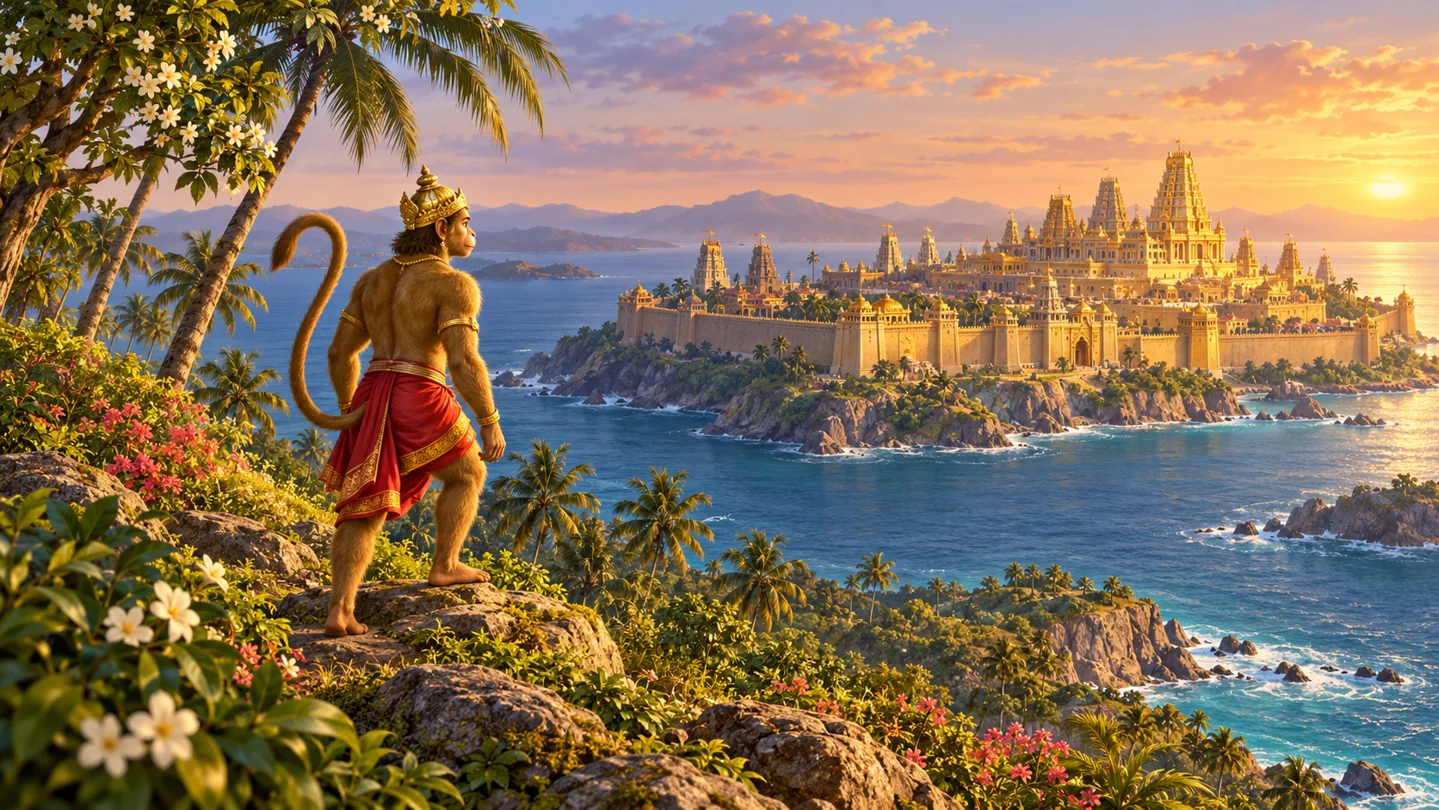
baddhvā rākṣasarājānamānayiṣyāmi rāvaṇam |
I shall bind Ravana, king of the rakshasas, and bring him here.
सर्वथा कृतकार्योऽहमेष्यामि सह सीतया ॥
sarvathā kṛtakāryo’hameṣyāmi saha sītayā ||
In every way I shall fulfil the task and return with Sita,
Verse 43 · 5.1.43 # Copy link ↗ आनयिष्यामि वा लंकां समुत्पाट्य सरावणाम् ।
ānayiṣyāmi vā laṃkāṃ samutpāṭya sarāvaṇām |
or uproot Lanka together with Ravana and bring it back.”
एवमुक्त्वा तु हनुमान् वानरो वानरोत्तमः ॥
evamuktvā tu hanumān vānaro vānarottamaḥ ||
Having spoken thus, Hanuman, foremost among the vanaras,
Verse 44 · 5.1.44 # Copy link ↗ उत्पपाताथ वेगेन वेगवानविचारयन् ।
utpapātātha vegena vegavānavicārayan |
sprang forward with great speed and without hesitation.
सुपर्णमिव चात्मानं मेने स कपिकुञ्जरः ॥
suparṇamiva cātmānaṃ mene sa kapikuñjaraḥ ||
The mighty vanara thought himself like Garuda.
Verse 45 · 5.1.45 # Copy link ↗ समुत्पतति वेगात् तु वेगात् ते नगरोहिणः ।
samutpatati vegāt tu vegāt te nagarohiṇaḥ |
As he rose swiftly, the trees growing on the mountain
संहृत्य विटपान् सर्वान् समुत्पेतुः समन्ततः ॥
saṃhṛtya viṭapān sarvān samutpetuḥ samantataḥ ||
drew their branches together and flew up around him under that force.
Verse 46 · 5.1.46 # Copy link ↗ स मत्तकोयष्टिभकान् पादपान् पुष्पशालिनः ।
sa mattakoyaṣṭibhakān pādapān puṣpaśālinaḥ |
Bearing flowering trees with their excited birds,
उद्वहन्नुरुवेगेन जगाम विमलेऽम्बरे ॥
udvahannuruvegena jagāma vimale’mbare ||
he travelled through the clear sky with the power of his thighs.
Verse 47 · 5.1.47 # Copy link ↗ ऊरुवेगोत्थिता वृक्षा मुहूर्तं कपिमन्वयुः ।
ūruvegotthitā vṛkṣā muhūrtaṃ kapimanvayuḥ |
The trees lifted by the force of his thighs followed him briefly,
प्रस्थितं दीर्घमध्वानं स्वबन्धुमिव बान्धवाः ॥
prasthitaṃ dīrghamadhvānaṃ svabandhumiva bāndhavāḥ ||
like relatives accompanying a loved one setting out on a long journey.
Verse 48 · 5.1.48 # Copy link ↗ तमूरुवेगोन्मथिताः सालाश्चान्ये नगोत्तमाः ।
tamūruvegonmathitāḥ sālāścānye nagottamāḥ |
The sal trees and other great trees, uprooted by his powerful movement,
अनुजग्मुर्हनूमन्तं सैन्या इव महीपतिम् ॥
anujagmurhanūmantaṃ sainyā iva mahīpatim ||
followed Hanuman as an army follows its king.
Verse 49 · 5.1.49 # Copy link ↗ सुपुष्पिताग्रैर्बहुभिः पादपैरन्वितः कपिः ।
supuṣpitāgrairbahubhiḥ pādapairanvitaḥ kapiḥ |
Surrounded by many trees crowned with beautiful flowers,
हनूमान् पर्वताकारो बभूवाद्भुतदर्शनः ॥
hanūmān parvatākāro babhūvādbhutadarśanaḥ ||
mountain-sized Hanuman presented a wondrous sight.
Verse 50 · 5.1.50 # Copy link ↗ सारवन्तोऽथ ये वृक्षा न्यमज्जँल्लवणाम्भसि ।
sāravanto’tha ye vṛkṣā nyamajjam̐llavaṇāmbhasi |
The heavy, solid trees then sank into the salt sea,
भयादिव महेन्द्रस्य पर्वता वरुणालये ॥
bhayādiva mahendrasya parvatā varuṇālaye ||
like mountains hiding in Varuna's realm out of fear of Indra.
Verse 51 · 5.1.51 # Copy link ↗ स नानाकुसुमैः कीर्णः कपिः साङ्कुरकोरकैः ।
sa nānākusumaiḥ kīrṇaḥ kapiḥ sāṅkurakorakaiḥ |
Covered in different flowers, young shoots and buds, the vanara
शुशुभे मेघसंकाशः खद्योतैरिव पर्वतः ॥
śuśubhe meghasaṃkāśaḥ khadyotairiva parvataḥ ||
shone like a cloud, or a mountain lit by fireflies.
Verse 52 · 5.1.52 # Copy link ↗ विमुक्तास्तस्य वेगेन मुक्त्वा पुष्पाणि ते द्रुमाः ।
vimuktāstasya vegena muktvā puṣpāṇi te drumāḥ |
Released from his force, the trees shed their flowers
व्यवशीर्यन्त सलिले निवृत्ताः सुहृदो यथा ॥
vyavaśīryanta salile nivṛttāḥ suhṛdo yathā ||
and fell apart in the water, like friends turning back after a farewell.
Verse 53 · 5.1.53 # Copy link ↗ लघुत्वेनोपपन्नं तद् विचित्रं सागरेऽपतत् ।
laghutvenopapannaṃ tad vicitraṃ sāgare’patat |
Their light, many-coloured blossoms fell upon the sea.
द्रुमाणां विविधं पुष्पं कपिवायुसमीरितम् ।
drumāṇāṃ vividhaṃ puṣpaṃ kapivāyusamīritam |
The flowers of different trees were scattered by the wind of his passage.
ताराचितमिवाकाशं प्रबभौ स महार्णवः ॥
tārācitamivākāśaṃ prababhau sa mahārṇavaḥ ||
The great ocean shone like a sky strewn with stars.
Verse 54 · 5.1.54 # Copy link ↗ पुष्पौघेण सुगन्धेन नानावर्णेन वानरः ।
puṣpaugheṇa sugandhena nānāvarṇena vānaraḥ |
Covered with fragrant blossoms of many colours, the vanara
बभौ मेघ इवोद्यन् वै विद्युद्गणविभूषितः ॥
babhau megha ivodyan vai vidyudgaṇavibhūṣitaḥ ||
looked like a rising cloud adorned with flashes of lightning.
Verse 55 · 5.1.55 # Copy link ↗ तस्य वेगसमुद्भूतैः पुष्पैस्तोयमदृश्यत ।
tasya vegasamudbhūtaiḥ puṣpaistoyamadṛśyata |
The water, covered with blossoms scattered by his speed,
ताराभिरिव रामाभिरुदिताभिरिवाम्बरम् ॥
tārābhiriva rāmābhiruditābhirivāmbaram ||
looked like the sky filled with lovely rising stars.
Verse 56 · 5.1.56 # Copy link ↗ तस्याम्बरगतौ बाहू ददृशाते प्रसारितौ ।
tasyāmbaragatau bāhū dadṛśāte prasāritau |
His two outstretched arms appeared in the sky
पर्वताग्राद् विनिष्क्रान्तौ पञ्चास्याविव पन्नगौ ॥
parvatāgrād viniṣkrāntau pañcāsyāviva pannagau ||
like five-headed serpents emerging from a mountain peak.
Verse 57 · 5.1.57 # Copy link ↗ पिबन्निव बभौ चापि सोर्मिजालं महार्णवम् ।
pibanniva babhau cāpi sormijālaṃ mahārṇavam |
The great vanara seemed to drink up the ocean and its waves.
पिपासुरिव चाकाशं ददृशे स महाकपिः ॥
pipāsuriva cākāśaṃ dadṛśe sa mahākapiḥ ||
He seemed eager to drink up the sky as well.
Verse 58 · 5.1.58 # Copy link ↗ तस्य विद्युत्प्रभाकारे वायुमार्गानुसारिणः ।
tasya vidyutprabhākāre vāyumārgānusāriṇaḥ |
As he followed the path of the wind, his lightning-bright eyes
नयने विप्रकाशेते पर्वतस्थाविवानलौ ॥
nayane viprakāśete parvatasthāvivānalau ||
shone like two fires burning upon a mountain.
Verse 59 · 5.1.59 # Copy link ↗ पिङ्गे पिङ्गाक्षमुख्यस्य बृहती परिमण्डले ।
piṅge piṅgākṣamukhyasya bṛhatī parimaṇḍale |
The great, round, tawny eyes of the foremost tawny-eyed vanara
चक्षुषी सम्प्रकाशेते चन्द्रसूर्याविव स्थितौ ॥
cakṣuṣī samprakāśete candrasūryāviva sthitau ||
shone like the sun and moon standing together.
Verse 60 · 5.1.60 # Copy link ↗ मुखं नासिकया तस्य ताम्रया ताम्रमाबभौ ।
mukhaṃ nāsikayā tasya tāmrayā tāmramābabhau |
His face glowed copper-red around his copper-coloured nose,
संध्यया समभिस्पृष्टं यथा स्यात् सूर्यमण्डलम् ॥
saṃdhyayā samabhispṛṣṭaṃ yathā syāt sūryamaṇḍalam ||
like the sun's disc touched by twilight.
Verse 61 · 5.1.61 # Copy link ↗ लाङ्गूलं च समाविद्धं प्लवमानस्य शोभते ।
lāṅgūlaṃ ca samāviddhaṃ plavamānasya śobhate |
The Wind's son swept his tail high as he flew.
अम्बरे वायुपुत्रस्य शक्रध्वज इवोच्छ्रितम् ॥
ambare vāyuputrasya śakradhvaja ivocchritam ||
It shone in the sky like Indra's raised banner.
Verse 62 · 5.1.62 # Copy link ↗ लाङ्गूलचक्रो हनुमान् शुक्लदंष्ट्रोऽनिलात्मजः ।
lāṅgūlacakro hanumān śukladaṃṣṭro’nilātmajaḥ |
Wise Hanuman, son of the Wind, with white teeth and a circling tail,
व्यरोचत महाप्राज्ञः परिवेषीव भास्करः ॥
vyarocata mahāprājñaḥ pariveṣīva bhāskaraḥ ||
shone like the sun surrounded by a halo.
Verse 63 · 5.1.63 # Copy link ↗ स्फिग्देशेनातिताम्रेण रराज स महाकपिः ।
sphigdeśenātitāmreṇa rarāja sa mahākapiḥ |
The great vanara's deeply reddish hindquarters gleamed,
महता दारितेनेव गिरिर्गैरिकधातुना ॥
mahatā dāriteneva girirgairikadhātunā ||
like a mountain split open to reveal a great vein of red ochre.
Verse 64 · 5.1.64 # Copy link ↗ तस्य वानरसिंहस्य प्लवमानस्य सागरम् ।
tasya vānarasiṃhasya plavamānasya sāgaram |
As that lion among vanaras crossed the ocean,
कक्षान्तरगतो वायुर्जीमूत इव गर्जति ॥
kakṣāntaragato vāyurjīmūta iva garjati ||
the wind passing beneath his arms roared like a rain cloud.
Verse 65 · 5.1.65 # Copy link ↗ खे यथा निपतत्युल्का उत्तरान्ताद् विनिःसृता ।
khe yathā nipatatyulkā uttarāntād viniḥsṛtā |
Like a meteor falling through the sky from the northern region,
दृश्यते सानुबन्धा च तथा स कपिकुञ्जरः ॥
dṛśyate sānubandhā ca tathā sa kapikuñjaraḥ ||
visible with its trailing streak, so appeared the mighty vanara.
Verse 66 · 5.1.66 # Copy link ↗ पतत्पतङ्गसंकाशो व्यायतः शुशुभे कपिः ।
patatpataṅgasaṃkāśo vyāyataḥ śuśubhe kapiḥ |
Stretched out like a bird in flight, the vanara shone,
प्रवृद्ध इव मातङ्गः कक्ष्यया बध्यमानया ॥
pravṛddha iva mātaṅgaḥ kakṣyayā badhyamānayā ||
like a huge elephant held around the body by a girdle.
Verse 67 · 5.1.67 # Copy link ↗ उपरिष्टाच्छरीरेण च्छायया चावगाढया ।
upariṣṭāccharīreṇa cchāyayā cāvagāḍhayā |
With his body above and his shadow deep upon the sea,
सागरे मारुताविष्टा नौरिवासीत् तदा कपिः ॥
sāgare mārutāviṣṭā naurivāsīt tadā kapiḥ ||
the vanara looked like a ship driven across the ocean by wind.
Verse 68 · 5.1.68 # Copy link ↗ यं यं देशं समुद्रस्य जगाम स महाकपिः ।
yaṃ yaṃ deśaṃ samudrasya jagāma sa mahākapiḥ |
Every part of the ocean over which the great vanara passed
स तु तस्याङ्गवेगेन सोन्माद इव लक्ष्यते ॥
sa tu tasyāṅgavegena sonmāda iva lakṣyate ||
seemed driven into frenzy by the force of his body.
Verse 69 · 5.1.69 # Copy link ↗ सागरस्योर्मिजालानामुरसा शैलवर्ष्मणाम् ।
sāgarasyormijālānāmurasā śailavarṣmaṇām |
Striking mountain-sized ocean waves with his chest,
अभिध्नंस्तु महावेगः पुप्लुवे स महाकपिः ॥
abhidhnaṃstu mahāvegaḥ pupluve sa mahākapiḥ ||
the great vanara sped onward.
Verse 70 · 5.1.70 # Copy link ↗ कपिवातश्च बलवान् मेघवातश्च निर्गतः ।
kapivātaśca balavān meghavātaśca nirgataḥ |
The strong wind of his passage and the wind issuing from the clouds
सागरं भीमनिर्ह्रादं कम्पयामासतुर्भृशम् ॥
sāgaraṃ bhīmanirhrādaṃ kampayāmāsaturbhṛśam ||
shook the ocean violently, making it roar.
Verse 71 · 5.1.71 # Copy link ↗ विकर्षन्नूर्मिजालानि बृहन्ति लवणाम्भसि ।
vikarṣannūrmijālāni bṛhanti lavaṇāmbhasi |
Dragging apart the great waves of salt water,
पुप्लुवे कपिशार्दूलो विकिरन्निव रोदसी ॥
pupluve kapiśārdūlo vikiranniva rodasī ||
the foremost vanara flew as though scattering heaven and earth.
Verse 72 · 5.1.72 # Copy link ↗ मेरुमन्दरसंकाशानुद्गतान् सुमहार्णवे ।
merumandarasaṃkāśānudgatān sumahārṇave |
He swiftly passed waves rising in the great ocean like Mount Meru and Mount Mandara,
अत्यक्रामन्महावेगस्तरङ्गान् गणयन्निव ॥
atyakrāmanmahāvegastaraṅgān gaṇayanniva ||
as though counting them as he went.
Verse 73 · 5.1.73 # Copy link ↗ तस्य वेगसमुद्घुष्टं जलं सजलदं तदा ।
tasya vegasamudghuṣṭaṃ jalaṃ sajaladaṃ tadā |
The water tossed into the air by his speed, together with the clouds,
अम्बरस्थं विबभ्राजे शरदभ्रमिवाततम् ॥
ambarasthaṃ vibabhrāje śaradabhramivātatam ||
spread shining across the sky like an autumn cloud.
Verse 74 · 5.1.74 # Copy link ↗ तिमिनक्रझषाः कूर्मा दृश्यन्ते विवृतास्तदा ।
timinakrajhaṣāḥ kūrmā dṛśyante vivṛtāstadā |
Whales, crocodiles, great fish and turtles became exposed,
वस्त्रापकर्षणेनेव शरीराणि शरीरिणाम् ॥
vastrāpakarṣaṇeneva śarīrāṇi śarīriṇām ||
like bodies revealed when clothing is drawn away.
Verse 75 · 5.1.75 # Copy link ↗ क्रममाणं समीक्ष्याथ भुजगाः सागरंगमाः ।
kramamāṇaṃ samīkṣyātha bhujagāḥ sāgaraṃgamāḥ |
The serpents living in the ocean saw the mighty vanara travelling
व्योम्नि तं कपिशार्दूलं सुपर्णमिव मेनिरे ॥
vyomni taṃ kapiśārdūlaṃ suparṇamiva menire ||
through the sky and thought him Garuda.
Short meaning Sea serpents mistake Hanuman for their powerful enemy, the bird Garuda.
Verse 76 · 5.1.76 # Copy link ↗ दशयोजनविस्तीर्णा त्रिंशद्योजनमायता ।
daśayojanavistīrṇā triṃśadyojanamāyatā |
His shadow was ten yojanas broad and thirty yojanas long.
छाया वानरसिंहस्य जवे चारुतराभवत् ॥
chāyā vānarasiṃhasya jave cārutarābhavat ||
As that lion among vanaras sped on, it became a remarkable sight.
Short meaning The poem measures his enormous shadow in the traditional unit, the yojana.
Verse 77 · 5.1.77 # Copy link ↗ श्वेताभ्रघनराजीव वायुपुत्रानुगामिनी ।
śvetābhraghanarājīva vāyuputrānugāminī |
Like a bank of white clouds following the Wind's son,
तस्य सा शुशुभे छाया पतिता लवणाम्भसि ॥
tasya sā śuśubhe chāyā patitā lavaṇāmbhasi ||
his shadow lay beautifully upon the salt sea.
Verse 78 · 5.1.78 # Copy link ↗ शुशुभे स महातेजा महाकायो महाकपिः ।
śuśubhe sa mahātejā mahākāyo mahākapiḥ |
The brilliant, vast-bodied vanara shone
वायुमार्गे निरालम्बे पक्षवानिव पर्वतः ॥
vāyumārge nirālambe pakṣavāniva parvataḥ ||
in the unsupported sky like a mountain with wings.
Verse 79 · 5.1.79 # Copy link ↗ येनासौ याति बलवान् वेगेन कपिकुञ्जरः ।
yenāsau yāti balavān vegena kapikuñjaraḥ |
Wherever the powerful vanara hurried on,
तेन मार्गेण सहसा द्रोणीकृत इवार्णवः ॥
tena mārgeṇa sahasā droṇīkṛta ivārṇavaḥ ||
the ocean beneath his route seemed suddenly hollowed into a trough.
Verse 80 · 5.1.80 # Copy link ↗ आपाते पक्षिसङ्घानां पक्षिराज इव व्रजन् ।
āpāte pakṣisaṅghānāṃ pakṣirāja iva vrajan |
Moving among flocks of birds like their king,
हनुमान् मेघजालानि प्रकर्षन् मारुतो यथा ॥
hanumān meghajālāni prakarṣan māruto yathā ||
Hanuman pulled cloud banks along as the wind does.
Verse 81 · 5.1.81 # Copy link ↗ पाण्डुरारुणवर्णानि नीलमञ्जिष्ठकानि च ।
pāṇḍurāruṇavarṇāni nīlamañjiṣṭhakāni ca |
White, reddish, blue and madder-coloured
कपिनाऽऽकृष्यमाणानि महाभ्राणि चकाशिरे ॥
kapinā’’kṛṣyamāṇāni mahābhrāṇi cakāśire ||
clouds gleamed as the vanara drew them along.
Verse 82 · 5.1.82 # Copy link ↗ प्रविशन्नभ्रजालानि निष्पतंश्च पुनः पुनः ।
praviśannabhrajālāni niṣpataṃśca punaḥ punaḥ |
Entering masses of cloud and emerging again and again,
प्रच्छन्नश्च प्रकाशश्च चन्द्रमा इव दृश्यते ॥
pracchannaśca prakāśaśca candramā iva dṛśyate ||
he appeared like the moon, now hidden and now revealed.
Verse 83 · 5.1.83 # Copy link ↗ प्लवमानं तु तं दृष्ट्वा प्लवगं त्वरितं तदा ।
plavamānaṃ tu taṃ dṛṣṭvā plavagaṃ tvaritaṃ tadā |
Seeing the vanara flying so swiftly,
ववृषुस्तत्र पुष्पाणि देवगन्धर्वचारणाः ॥
vavṛṣustatra puṣpāṇi devagandharvacāraṇāḥ ||
the gods, Gandharvas and Charanas showered flowers upon him.
Verse 84 · 5.1.84 # Copy link ↗ तताप नहि तं सूर्यः प्लवन्तं वानरेश्वरम् ।
tatāpa nahi taṃ sūryaḥ plavantaṃ vānareśvaram |
The Sun did not scorch the flying lord of vanaras.
सिषेवे च तदा वायू रामकार्यार्थसिद्धये ॥
siṣeve ca tadā vāyū rāmakāryārthasiddhaye ||
The Wind served him, helping Rama's purpose succeed.
Verse 85 · 5.1.85 # Copy link ↗ ऋषयस्तुष्टुवुश्चैनं प्लवमानं विहायसा ।
ṛṣayastuṣṭuvuścainaṃ plavamānaṃ vihāyasā |
The sages praised him as he crossed the sky.
जगुश्च देवगन्धर्वाः प्रशंसन्तो वनौकसम् ॥
jaguśca devagandharvāḥ praśaṃsanto vanaukasam ||
Divine Gandharvas sang in honour of the forest-dwelling hero.
Verse 86 · 5.1.86 # Copy link ↗ नागाश्च तुष्टुवुर्यक्षा रक्षांसि विविधानि च ।
nāgāśca tuṣṭuvuryakṣā rakṣāṃsi vividhāni ca |
Nagas, Yakshas and many kinds of rakshasas also praised him.
प्रेक्ष्य सर्वे कपिवरं सहसा विगतक्लमम् ॥
prekṣya sarve kapivaraṃ sahasā vigataklamam ||
All watched the foremost vanara move swiftly without weariness.
SCENE 02 · VERSES 87–143
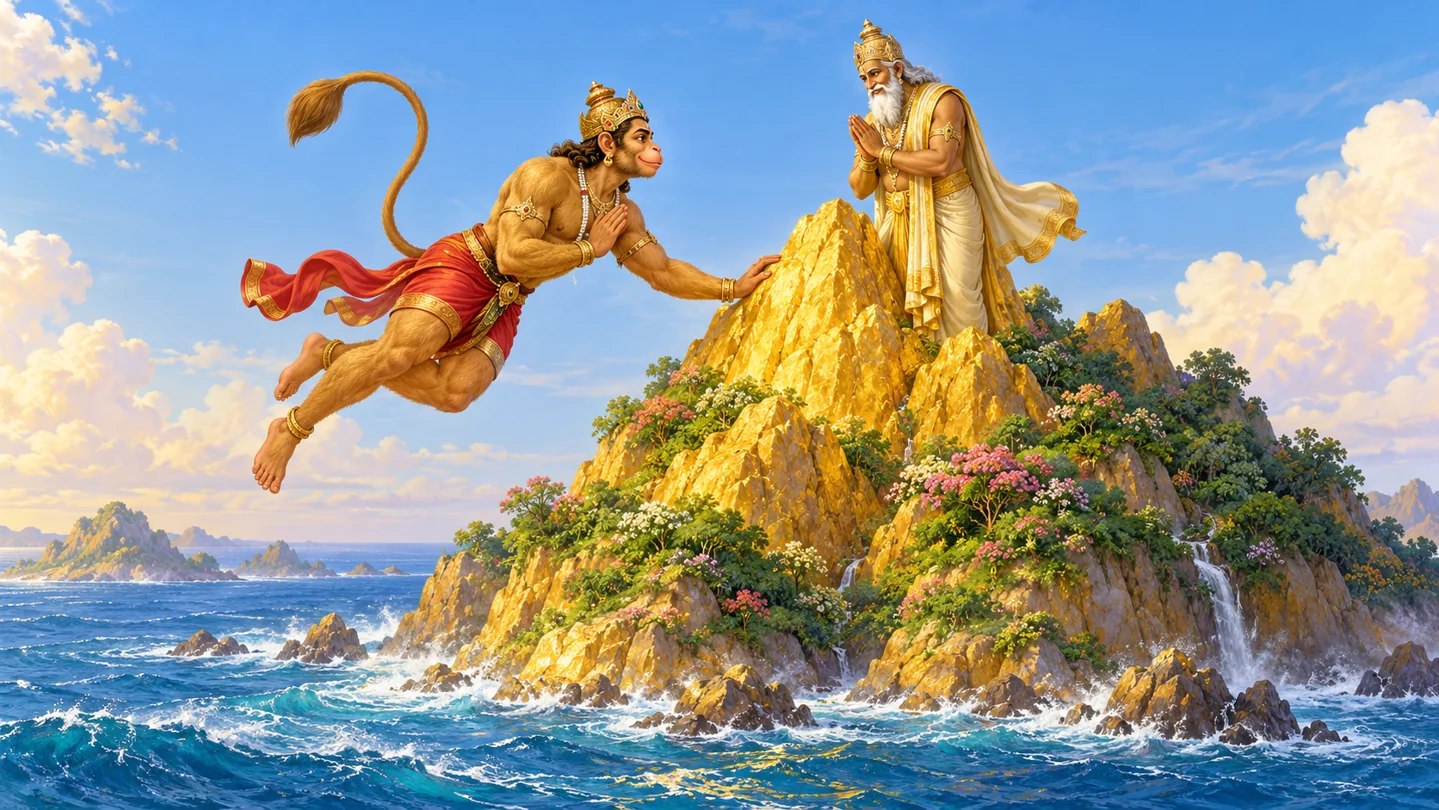
Mainaka’s welcome The ocean remembers a kindness. A golden mountain rises to offer the traveller rest.
Original DHIH illustration · artistic interpretation Verse 87 · 5.1.87 # Copy link ↗ तस्मिन् प्लवगशार्दूले प्लवमाने हनूमति ।
tasmin plavagaśārdūle plavamāne hanūmati |
While mighty Hanuman was flying,
इक्ष्वाकुकुलमानार्थी चिन्तयामास सागरः ॥
ikṣvākukulamānārthī cintayāmāsa sāgaraḥ ||
the Ocean, wishing to honour the Ikshvaku dynasty, began to reflect.
Verse 88 · 5.1.88 # Copy link ↗ साहाय्यं वानरेन्द्रस्य यदि नाहं हनूमतः ।
sāhāyyaṃ vānarendrasya yadi nāhaṃ hanūmataḥ |
“If I do not offer help to Hanuman, lord among the vanaras,
करिष्यामि भविष्यामि सर्ववाच्यो विवक्षताम् ॥
kariṣyāmi bhaviṣyāmi sarvavācyo vivakṣatām ||
all who speak of this will find fault with me.
Verse 89 · 5.1.89 # Copy link ↗ अहमिक्ष्वाकुनाथेन सगरेण विवर्धितः ।
ahamikṣvākunāthena sagareṇa vivardhitaḥ |
King Sagara of the Ikshvaku line enlarged me.
इक्ष्वाकुसचिवश्चायं तन्नार्हत्यवसादितुम् ॥
ikṣvākusacivaścāyaṃ tannārhatyavasāditum ||
This one serves that same line; he should not be allowed to suffer.
Verse 90 · 5.1.90 # Copy link ↗ तथा मया विधातव्यं विश्रमेत यथा कपिः ।
tathā mayā vidhātavyaṃ viśrameta yathā kapiḥ |
I must arrange a place where the vanara can rest.
शेषं च मयि विश्रान्तः सुखी सोऽतितरिष्यति ॥
śeṣaṃ ca mayi viśrāntaḥ sukhī so’titariṣyati ||
After resting upon me, he will cross the remaining distance more easily.”
Verse 91 · 5.1.91 # Copy link ↗ इति कृत्वा मतिं साध्वीं समुद्रश्छन्नमम्भसि ।
iti kṛtvā matiṃ sādhvīṃ samudraśchannamambhasi |
Having formed this generous resolve, the Ocean addressed
हिरण्यनाभं मैनाकमुवाच गिरिसत्तमम् ॥
hiraṇyanābhaṃ mainākamuvāca girisattamam ||
golden-hearted Mainaka, the noble mountain hidden beneath the water.
Verse 92 · 5.1.92 # Copy link ↗ त्वमिहासुरसङ्घानां देवराज्ञा महात्मना ।
tvamihāsurasaṅghānāṃ devarājñā mahātmanā |
“The noble king of the gods placed you here as a barrier
पातालनिलयानां हि परिघः संनिवेशितः ॥
pātālanilayānāṃ hi parighaḥ saṃniveśitaḥ ||
against the hosts of asuras dwelling in the lower world.
Verse 93 · 5.1.93 # Copy link ↗ त्वमेषां ज्ञातवीर्याणां पुनरेवोत्पतिष्यताम् ।
tvameṣāṃ jñātavīryāṇāṃ punarevotpatiṣyatām |
You stand across the entrance to boundless Patala,
पातालस्याप्रमेयस्य द्वारमावृत्य तिष्ठसि ॥
pātālasyāprameyasya dvāramāvṛtya tiṣṭhasi ||
preventing those beings of well-known strength from rising out again.
Verse 94 · 5.1.94 # Copy link ↗ तिर्यगूर्ध्वमधश्चैव शक्तिस्ते शैल वर्धितुम् ।
tiryagūrdhvamadhaścaiva śaktiste śaila vardhitum |
Mountain, you have the power to grow sideways, upward and downward.
तस्मात् संचोदयामि त्वामुत्तिष्ठ गिरिसत्तम ॥
tasmāt saṃcodayāmi tvāmuttiṣṭha girisattama ||
Therefore I urge you: rise, noblest of mountains!
Verse 95 · 5.1.95 # Copy link ↗ स एष कपिशार्दूलस्त्वामुपर्येति वीर्यवान् ।
sa eṣa kapiśārdūlastvāmuparyeti vīryavān |
This heroic foremost vanara is passing above you.
हनूमान् रामकार्यार्थी भीमकर्मा खमाप्लुतः ॥
hanūmān rāmakāryārthī bhīmakarmā khamāplutaḥ ||
Hanuman has leapt into the sky to perform Rama's mighty task.
Verse 96 · 5.1.96 # Copy link ↗ अस्य साह्यं मया कार्यमिक्ष्वाकुकुलवर्तिनः ।
asya sāhyaṃ mayā kāryamikṣvākukulavartinaḥ |
I must help this servant of the Ikshvaku line.
मम इक्ष्वाकवः पूज्याः परं पूज्यतमास्तव ॥
mama ikṣvākavaḥ pūjyāḥ paraṃ pūjyatamāstava ||
The Ikshvakus deserve my reverence, and yours even more.
Verse 97 · 5.1.97 # Copy link ↗ कुरु साचिव्यमस्माकं न नः कार्यमतिक्रमेत् ।
kuru sācivyamasmākaṃ na naḥ kāryamatikramet |
Assist us; do not let our purpose go unfulfilled.
कर्तव्यमकृतं कार्यं सतां मन्युमुदीरयेत् ॥
kartavyamakṛtaṃ kāryaṃ satāṃ manyumudīrayet ||
Leaving a duty undone rightly displeases good people.
Verse 98 · 5.1.98 # Copy link ↗ सलिलादूर्ध्वमुत्तिष्ठ तिष्ठत्वेष कपिस्त्वयि ।
salilādūrdhvamuttiṣṭha tiṣṭhatveṣa kapistvayi |
Rise above the water and let this vanara stand upon you.
अस्माकमतिथिश्चैव पूज्यश्च प्लवतां वरः ॥
asmākamatithiścaiva pūjyaśca plavatāṃ varaḥ ||
The best of leapers is our guest and deserves honour.
Verse 99 · 5.1.99 # Copy link ↗ चामीकरमहानाभ देवगन्धर्वसेवित ।
cāmīkaramahānābha devagandharvasevita |
Golden-hearted mountain, attended by gods and Gandharvas,
हनूमाँस्त्वयि विश्रान्तस्ततः शेषं गमिष्यति ॥
hanūmām̐stvayi viśrāntastataḥ śeṣaṃ gamiṣyati ||
Hanuman can rest on you and then complete the remaining journey.
Short meaning The proposed rest is meant to support, not interrupt, the mission.
Verse 100 · 5.1.100 # Copy link ↗ काकुत्स्थस्यानृशंस्यं च मैथिल्याश्च विवासनम् ।
kākutsthasyānṛśaṃsyaṃ ca maithilyāśca vivāsanam |
Consider Rama's kindness, the exile of Maithili,
श्रमं च प्लवगेन्द्रस्य समीक्ष्योत्थातुमर्हसि ॥
śramaṃ ca plavagendrasya samīkṣyotthātumarhasi ||
and the exertion of the vanara chief; you should rise to help.”
Short meaning The Ocean appeals to compassion for Rama, Sita and Hanuman.
Verse 101 · 5.1.101 # Copy link ↗ हिरण्यगर्भो मैनाको निशम्य लवणाम्भसः ।
hiraṇyagarbho maināko niśamya lavaṇāmbhasaḥ |
Hearing the salt Ocean's words, golden-hearted Mainaka,
उत्पपात जलात् तूर्णं महाद्रुमलतावृतः ॥
utpapāta jalāt tūrṇaṃ mahādrumalatāvṛtaḥ ||
covered in tall trees and creepers, quickly rose out of the water.
Verse 102 · 5.1.102 # Copy link ↗ स सागरजलं भित्त्वा बभूवात्युच्छ्रितस्तदा ।
sa sāgarajalaṃ bhittvā babhūvātyucchritastadā |
Breaking through the ocean's water, he towered upward,
यथा जलधरं भित्त्वा दीप्तरश्मिर्दिवाकरः ॥
yathā jaladharaṃ bhittvā dīptaraśmirdivākaraḥ ||
like the radiant Sun breaking through a cloud.
Verse 103 · 5.1.103 # Copy link ↗ स महात्मा मुहूर्तेन पर्वतः सलिलावृतः ।
sa mahātmā muhūrtena parvataḥ salilāvṛtaḥ |
In a moment that noble mountain, previously covered by water,
दर्शयामास शृङ्गाणि सागरेण नियोजितः ॥
darśayāmāsa śṛṅgāṇi sāgareṇa niyojitaḥ ||
displayed its peaks as the Ocean had requested.
Verse 104 · 5.1.104 # Copy link ↗ शातकुम्भमयैः शृङ्गैः सकिंनरमहोरगैः ।
śātakumbhamayaiḥ śṛṅgaiḥ sakiṃnaramahoragaiḥ |
His golden peaks, inhabited by Kinnaras and great serpents,
आदित्योदयसंकाशैरुल्लिखद्भिरिवाम्बरम् ॥
ādityodayasaṃkāśairullikhadbhirivāmbaram ||
gleamed like the rising Sun and seemed to scratch the sky.
Verse 105 · 5.1.105 # Copy link ↗ तस्य जाम्बूनदैः शृङ्गैः पर्वतस्य समुत्थितैः ।
tasya jāmbūnadaiḥ śṛṅgaiḥ parvatasya samutthitaiḥ |
As that mountain's golden peaks rose up,
आकाशं शस्त्रसंकाशमभवत् काञ्चनप्रभम् ॥
ākāśaṃ śastrasaṃkāśamabhavat kāñcanaprabham ||
the steel-bright sky took on a golden glow.
Verse 106 · 5.1.106 # Copy link ↗ जातरूपमयैः शृङ्गैर्भ्राजमानैर्महाप्रभैः ।
jātarūpamayaiḥ śṛṅgairbhrājamānairmahāprabhaiḥ |
With his bright, radiant peaks of gold,
आदित्यशतसंकाशः सोऽभवद् गिरिसत्तमः ॥
ādityaśatasaṃkāśaḥ so’bhavad girisattamaḥ ||
the noble mountain looked like a hundred suns.
Verse 107 · 5.1.107 # Copy link ↗ समुत्थितमसङ्गेन हनूमानग्रतः स्थितम् ।
samutthitamasaṅgena hanūmānagrataḥ sthitam |
Hanuman saw him rise directly and stand before him
मध्ये लवणतोयस्य विघ्नोऽयमिति निश्चितः ॥
madhye lavaṇatoyasya vighno’yamiti niścitaḥ ||
in the middle of the salt ocean, and decided that this was an obstacle.
Verse 108 · 5.1.108 # Copy link ↗ स तमुच्छ्रितमत्यर्थं महावेगो महाकपिः ।
sa tamucchritamatyarthaṃ mahāvego mahākapiḥ |
The great, swift vanara struck the towering mountain with his chest,
उरसा पातयामास जीमूतमिव मारुतः ॥
urasā pātayāmāsa jīmūtamiva mārutaḥ ||
as the wind might drive away a rain cloud.
Verse 109 · 5.1.109 # Copy link ↗ स तदासादितस्तेन कपिना पर्वतोत्तमः ।
sa tadāsāditastena kapinā parvatottamaḥ |
Struck by the vanara, the noble mountain
बुद्ध्वा तस्य हरेर्वेगं जहर्ष च ननाद च ॥
buddhvā tasya harervegaṃ jaharṣa ca nanāda ca ||
recognised his speed and strength, rejoiced and gave a great cry.
Verse 110 · 5.1.110 # Copy link ↗ तमाकाशगतं वीरमाकाशे समुपस्थितः ।
tamākāśagataṃ vīramākāśe samupasthitaḥ |
Rising to meet the hero in the sky,
प्रीतो हृष्टमना वाक्यमब्रवीत् पर्वतः कपिम् ॥
prīto hṛṣṭamanā vākyamabravīt parvataḥ kapim ||
the pleased and joyful mountain addressed the vanara.
Verse 111 · 5.1.111 # Copy link ↗ मानुषं धारयन् रूपमात्मनः शिखरे स्थितः ।
mānuṣaṃ dhārayan rūpamātmanaḥ śikhare sthitaḥ |
Taking human form and standing upon his own summit, he said:
दुष्करं कृतवान् कर्म त्वमिदं वानरोत्तम ॥
duṣkaraṃ kṛtavān karma tvamidaṃ vānarottama ||
“Best of vanaras, you have accomplished a difficult deed.
Verse 112 · 5.1.112 # Copy link ↗ निपत्य मम शृङ्गेषु सुखं विश्रम्य गम्यताम् ।
nipatya mama śṛṅgeṣu sukhaṃ viśramya gamyatām |
Land upon my peaks, rest comfortably, and then go on.
राघवस्य कुले जातैरुदधिः परिवर्धितः ॥
rāghavasya kule jātairudadhiḥ parivardhitaḥ ||
The ocean was enlarged by those born in Raghava's lineage.
Verse 113 · 5.1.113 # Copy link ↗ स त्वां रामहिते युक्तं प्रत्यर्चयति सागरः ।
sa tvāṃ rāmahite yuktaṃ pratyarcayati sāgaraḥ |
This ocean therefore honours you, who are devoted to Rama's welfare.
कृते च प्रतिकर्तव्यमेष धर्मः सनातनः ॥
kṛte ca pratikartavyameṣa dharmaḥ sanātanaḥ ||
Returning a kindness is an enduring duty.
Verse 114 · 5.1.114 # Copy link ↗ सोऽयं तत्प्रतिकारार्थी त्वत्तः सम्मानमर्हति ।
so’yaṃ tatpratikārārthī tvattaḥ sammānamarhati |
Wishing to repay that kindness, he deserves your regard.
त्वन्निमित्तमनेनाहं बहुमानात् प्रचोदितः ॥
tvannimittamanenāhaṃ bahumānāt pracoditaḥ ||
Out of great respect, he has sent me to help you.
Verse 115 · 5.1.115 # Copy link ↗ योजनानां शतं चापि कपिरेष खमाप्लुतः ।
yojanānāṃ śataṃ cāpi kapireṣa khamāplutaḥ |
‘This vanara has leapt into the sky to cross a hundred yojanas.
तव सानुषु विश्रान्तः शेषं प्रक्रमतामिति ॥
tava sānuṣu viśrāntaḥ śeṣaṃ prakramatāmiti ||
Let him rest upon your slopes and then finish the journey,’ he said.
Verse 116 · 5.1.116 # Copy link ↗ तिष्ठ त्वं हरिशार्दूल मयि विश्रम्य गम्यताम् ।
tiṣṭha tvaṃ hariśārdūla mayi viśramya gamyatām |
Stay here, tiger among vanaras; rest upon me and then continue.
तदिदं गन्धवत् स्वादु कन्दमूलफलं बहु ॥
tadidaṃ gandhavat svādu kandamūlaphalaṃ bahu ||
Here are plentiful fragrant, tasty tubers, roots and fruits.
Verse 117 · 5.1.117 # Copy link ↗ तदास्वाद्य हरिश्रेष्ठ विश्रान्तोऽथ गमिष्यसि ।
tadāsvādya hariśreṣṭha viśrānto’tha gamiṣyasi |
Enjoy them, foremost vanara, and go on after resting.
अस्माकमपि सम्बन्धः कपिमुख्य त्वयास्ति वै ।
asmākamapi sambandhaḥ kapimukhya tvayāsti vai |
Chief of vanaras, there is also a bond between us,
प्रख्यातस्त्रिषु लोकेषु महागुणपरिग्रहः ॥
prakhyātastriṣu lokeṣu mahāguṇaparigrahaḥ ||
a bond of great merit, celebrated in the three worlds.
Verse 118 · 5.1.118 # Copy link ↗ वेगवन्तः प्लवन्तो ये प्लवगा मारुतात्मज ।
vegavantaḥ plavanto ye plavagā mārutātmaja |
Son of the Wind, among the swift-moving vanaras who leap,
तेषां मुख्यतमं मन्ये त्वामहं कपिकुञ्जर ॥
teṣāṃ mukhyatamaṃ manye tvāmahaṃ kapikuñjara ||
I consider you the very foremost, mighty one.
Verse 119 · 5.1.119 # Copy link ↗ अतिथिः किल पूजार्हः प्राकृतोऽपि विजानता ।
atithiḥ kila pūjārhaḥ prākṛto’pi vijānatā |
Anyone who wishes to understand dharma should honour even an ordinary guest.
धर्मं जिज्ञासमानेन किं पुनर्यादृशो भवान् ॥
dharmaṃ jijñāsamānena kiṃ punaryādṛśo bhavān ||
How much more, then, a guest such as you!
Short meaning Hospitality is a duty even towards an ordinary guest, and especially towards Hanuman.
Verse 120 · 5.1.120 # Copy link ↗ त्वं हि देववरिष्ठस्य मारुतस्य महात्मनः ।
tvaṃ hi devavariṣṭhasya mārutasya mahātmanaḥ |
You are the son of the great Wind, foremost among the gods.
पुत्रस्तस्यैव वेगेन सदृशः कपिकुञ्जर ॥
putrastasyaiva vegena sadṛśaḥ kapikuñjara ||
Mighty vanara, you equal him in speed.
Verse 121 · 5.1.121 # Copy link ↗ पूजिते त्वयि धर्मज्ञे पूजां प्राप्नोति मारुतः ।
pūjite tvayi dharmajñe pūjāṃ prāpnoti mārutaḥ |
When you, who know dharma, are honoured, the Wind is honoured too.
तस्मात् त्वं पूजनीयो मे शृणु चाप्यत्र कारणम् ॥
tasmāt tvaṃ pūjanīyo me śṛṇu cāpyatra kāraṇam ||
That is why I should honour you; hear also my reason.
Short meaning Honouring Hanuman also honours his father, the Wind.
Verse 122 · 5.1.122 # Copy link ↗ पूर्वं कृतयुगे तात पर्वताः पक्षिणोऽभवन् ।
pūrvaṃ kṛtayuge tāta parvatāḥ pakṣiṇo’bhavan |
Long ago, dear one, in the Krita age, mountains had wings.
तेऽपि जग्मुर्दिशः सर्वा गरुडा इव वेगिनः ॥
te’pi jagmurdiśaḥ sarvā garuḍā iva veginaḥ ||
They travelled swiftly in every direction, like Garuda.
Verse 123 · 5.1.123 # Copy link ↗ ततस्तेषु प्रयातेषु देवसङ्घाः सहर्षिभिः ।
tatasteṣu prayāteṣu devasaṅghāḥ saharṣibhiḥ |
As they moved, the gods, the sages
भूतानि च भयं जग्मुस्तेषां पतनशङ्कया ॥
bhūtāni ca bhayaṃ jagmusteṣāṃ patanaśaṅkayā ||
and other beings feared that the mountains might fall upon them.
Verse 124 · 5.1.124 # Copy link ↗ ततः क्रुद्धः सहस्राक्षः पर्वतानां शतक्रतुः ।
tataḥ kruddhaḥ sahasrākṣaḥ parvatānāṃ śatakratuḥ |
Then the thousand-eyed Indra became angry.
पक्षांश्चिच्छेद वज्रेण ततः शतसहस्रशः ॥
pakṣāṃściccheda vajreṇa tataḥ śatasahasraśaḥ ||
With his thunderbolt he cut off the wings of mountains by the thousands.
Verse 125 · 5.1.125 # Copy link ↗ स मामुपगतः क्रुद्धो वज्रमुद्यम्य देवराट् ।
sa māmupagataḥ kruddho vajramudyamya devarāṭ |
The angry king of the gods approached me with his thunderbolt raised.
ततोऽहं सहसा क्षिप्तः श्वसनेन महात्मना ॥
tato’haṃ sahasā kṣiptaḥ śvasanena mahātmanā ||
Then the great Wind suddenly swept me away.
Short meaning When Indra approached Mainaka, the Wind carried the mountain away.
Verse 126 · 5.1.126 # Copy link ↗ अस्मिँल्लवणतोये च प्रक्षिप्तः प्लवगोत्तम ।
asmim̐llavaṇatoye ca prakṣiptaḥ plavagottama |
He cast me into this salt sea, best of vanaras.
गुप्तपक्षः समग्रश्च तव पित्राभिरक्षितः ॥
guptapakṣaḥ samagraśca tava pitrābhirakṣitaḥ ||
Your father protected me, keeping my wings hidden and intact.
Short meaning The Wind hid Mainaka safely in the sea, preserving his wings.
Verse 127 · 5.1.127 # Copy link ↗ ततोऽहं मानयामि त्वां मान्योऽसि मम मारुते ।
tato’haṃ mānayāmi tvāṃ mānyo’si mama mārute |
So I honour you, son of the Wind; you deserve my respect.
त्वया ममैष सम्बन्धः कपिमुख्य महागुणः ॥
tvayā mamaiṣa sambandhaḥ kapimukhya mahāguṇaḥ ||
Foremost vanara, this is the strong bond between us.
Verse 128 · 5.1.128 # Copy link ↗ अस्मिन् नेवंगते कार्ये सागरस्य ममैव च ।
asmin nevaṃgate kārye sāgarasya mamaiva ca |
Since matters stand thus for the ocean and for me,
प्रीतिं प्रीतमनाः कर्तुं त्वमर्हसि महामते ॥
prītiṃ prītamanāḥ kartuṃ tvamarhasi mahāmate ||
wise one, kindly give us this happiness with a willing heart.
Verse 129 · 5.1.129 # Copy link ↗ श्रमं मोक्षय पूजां च गृहाण हरिसत्तम ।
śramaṃ mokṣaya pūjāṃ ca gṛhāṇa harisattama |
Ease your weariness and accept our welcome, finest vanara.
प्रीतिं च मम मान्यस्य प्रीतोऽस्मि तव दर्शनात् ॥
prītiṃ ca mama mānyasya prīto’smi tava darśanāt ||
Grant me this joy, for seeing you has made me glad.”
Verse 130 · 5.1.130 # Copy link ↗ एवमुक्तः कपिश्रेष्ठस्तं नगोत्तममब्रवीत् ।
evamuktaḥ kapiśreṣṭhastaṃ nagottamamabravīt |
When the great mountain had spoken, the foremost vanara replied:
प्रीतोऽस्मि कृतमातिथ्यं मन्युरेषोऽपनीयताम् ॥
prīto’smi kṛtamātithyaṃ manyureṣo’panīyatām ||
“I am delighted and consider your hospitality already received; please do not be disappointed.
Verse 131 · 5.1.131 # Copy link ↗ त्वरते कार्यकालो मे अहश्चाप्यतिवर्तते ।
tvarate kāryakālo me ahaścāpyativartate |
My task is urgent, and the day is passing.
प्रतिज्ञा च मया दत्ता न स्थातव्यमिहान्तरा ॥
pratijñā ca mayā dattā na sthātavyamihāntarā ||
I have also given my word that I will not stop along the way.”
Verse 132 · 5.1.132 # Copy link ↗ इत्युक्त्वा पाणिना शैलमालभ्य हरिपुङ्गवः ।
ityuktvā pāṇinā śailamālabhya haripuṅgavaḥ |
Having spoken, the mighty vanara touched the mountain with his hand.
जगामाकाशमाविश्य वीर्यवान् प्रहसन्निव ॥
jagāmākāśamāviśya vīryavān prahasanniva ||
Then, smiling, he rose into the sky and went on.
Verse 133 · 5.1.133 # Copy link ↗ स पर्वतसमुद्राभ्यां बहुमानादवेक्षितः ।
sa parvatasamudrābhyāṃ bahumānādavekṣitaḥ |
The mountain and ocean watched him with great respect.
पूजितश्चोपपन्नाभिराशीर्भिरभिनन्दितः ॥
pūjitaścopapannābhirāśīrbhirabhinanditaḥ ||
They honoured him and greeted him with fitting blessings.
Verse 134 · 5.1.134 # Copy link ↗ अथोर्ध्वं दूरमागत्य हित्वा शैलमहार्णवौ ।
athordhvaṃ dūramāgatya hitvā śailamahārṇavau |
Rising far above and leaving the mountain and ocean behind,
पितुः पन्थानमासाद्य जगाम विमलेऽम्बरे ॥
pituḥ panthānamāsādya jagāma vimale’mbare ||
he took his father's path through the clear sky.
Short meaning He follows the clear aerial path associated with his father, the Wind.
Verse 135 · 5.1.135 # Copy link ↗ भूयश्चोर्ध्वं गतिं प्राप्य गिरिं तमवलोकयन् ।
bhūyaścordhvaṃ gatiṃ prāpya giriṃ tamavalokayan |
Climbing still higher and looking back at the mountain,
वायुसूनुर्निरालम्बो जगाम कपिकुञ्जरः ॥
vāyusūnurnirālambo jagāma kapikuñjaraḥ ||
the Wind's son travelled without support through the air.
Verse 136 · 5.1.136 # Copy link ↗ तद् द्वितीयं हनुमतो दृष्ट्वा कर्म सुदुष्करम् ।
tad dvitīyaṃ hanumato dṛṣṭvā karma suduṣkaram |
Seeing this second difficult deed of Hanuman,
प्रशशंसुः सुराः सर्वे सिद्धाश्च परमर्षयः ॥
praśaśaṃsuḥ surāḥ sarve siddhāśca paramarṣayaḥ ||
all the gods, perfected beings and great sages praised him.
Verse 137 · 5.1.137 # Copy link ↗ देवताश्चाभवन् हृष्टास्तत्रस्थास्तस्य कर्मणा ।
devatāścābhavan hṛṣṭāstatrasthāstasya karmaṇā |
The gods there rejoiced at what the golden-peaked mountain had done.
काञ्चनस्य सुनाभस्य सहस्राक्षश्च वासवः ॥
kāñcanasya sunābhasya sahasrākṣaśca vāsavaḥ ||
So too did thousand-eyed Vasava, king of the gods.
Verse 138 · 5.1.138 # Copy link ↗ उवाच वचनं धीमान् परितोषात् सगद्गदम् ।
uvāca vacanaṃ dhīmān paritoṣāt sagadgadam |
Wise Indra himself, the husband of Shachi, spoke to that excellent mountain,
सुनाभं पर्वतश्रेष्ठं स्वयमेव शचीपतिः ॥
sunābhaṃ parvataśreṣṭhaṃ svayameva śacīpatiḥ ||
his voice trembling with delight.
Verse 139 · 5.1.139 # Copy link ↗ हिरण्यनाभ शैलेन्द्र परितुष्टोऽस्मि ते भृशम् ।
hiraṇyanābha śailendra parituṣṭo’smi te bhṛśam |
“Golden-peaked lord of mountains, I am greatly pleased with you.
अभयं ते प्रयच्छामि गच्छ सौम्य यथासुखम् ॥
abhayaṃ te prayacchāmi gaccha saumya yathāsukham ||
I grant you freedom from fear; go in peace wherever you wish.
Verse 140 · 5.1.140 # Copy link ↗ साह्यं कृतं ते सुमहद् विश्रान्तस्य हनूमतः ।
sāhyaṃ kṛtaṃ te sumahad viśrāntasya hanūmataḥ |
You offered great help and a place of rest to Hanuman,
क्रमतो योजनशतं निर्भयस्य भये सति ॥
kramato yojanaśataṃ nirbhayasya bhaye sati ||
who fearlessly travels a hundred yojanas despite the dangers.
Verse 141 · 5.1.141 # Copy link ↗ रामस्यैष हितायैव याति दाशरथेः कपिः ।
rāmasyaiṣa hitāyaiva yāti dāśaratheḥ kapiḥ |
This vanara goes for the welfare of Rama, son of Dasharatha.
सत्क्रियां कुर्वता शक्त्या तोषितोऽस्मि दृढं त्वया ॥
satkriyāṃ kurvatā śaktyā toṣito’smi dṛḍhaṃ tvayā ||
By honouring him as fully as you could, you have greatly pleased me.”
Verse 142 · 5.1.142 # Copy link ↗ स तत् प्रहर्षमलभद् विपुलं पर्वतोत्तमः ।
sa tat praharṣamalabhad vipulaṃ parvatottamaḥ |
The excellent mountain felt immense joy
देवतानां पतिं दृष्ट्वा परितुष्टं शतक्रतुम् ॥
devatānāṃ patiṃ dṛṣṭvā parituṣṭaṃ śatakratum ||
on seeing the lord of the gods so pleased.
Verse 143 · 5.1.143 # Copy link ↗ स वै दत्तवरः शैलो बभूवावस्थितस्तदा ।
sa vai dattavaraḥ śailo babhūvāvasthitastadā |
Having received that boon, the mountain remained there.
हनूमांश्च मुहूर्तेन व्यतिचक्राम सागरम् ॥
hanūmāṃśca muhūrtena vyaticakrāma sāgaram ||
Meanwhile, Hanuman continued swiftly over the ocean.
SCENE 03 · VERSES 144–183
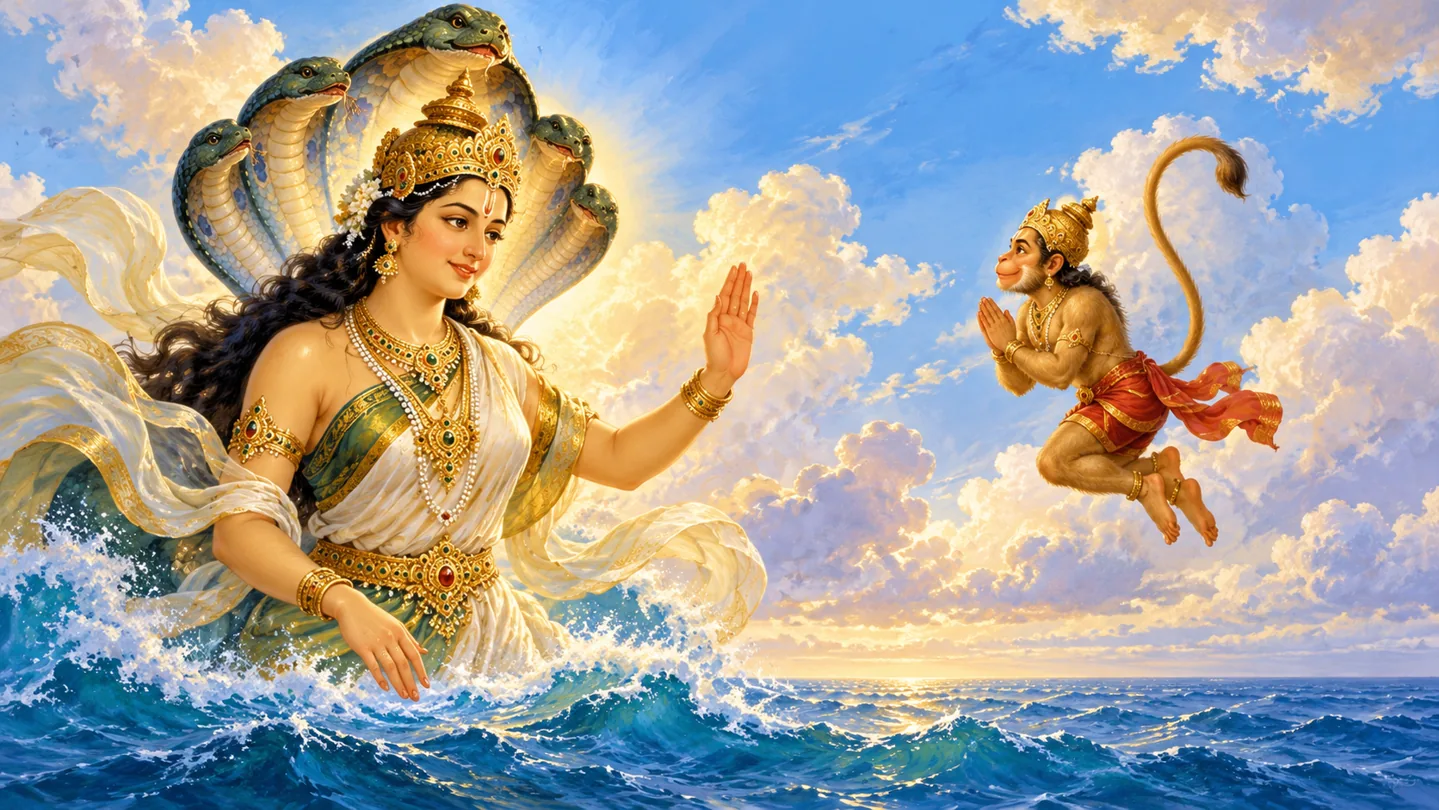
Surasa’s test An obstacle calls for more than strength. Hanuman meets Surasa’s challenge with ingenuity.
Original DHIH illustration · artistic interpretation Verse 144 · 5.1.144 # Copy link ↗ ततो देवाः सगन्धर्वाः सिद्धाश्च परमर्षयः ।
tato devāḥ sagandharvāḥ siddhāśca paramarṣayaḥ |
Then the gods, gandharvas, perfected beings and great sages
अब्रुवन् सूर्यसंकाशां सुरसां नागमातरम् ॥
abruvan sūryasaṃkāśāṃ surasāṃ nāgamātaram ||
spoke to Surasa, mother of serpents, radiant as the sun.
Verse 145 · 5.1.145 # Copy link ↗ अयं वातात्मजः श्रीमान् प्लवते सागरोपरि ।
ayaṃ vātātmajaḥ śrīmān plavate sāgaropari |
“This splendid son of the Wind, named Hanuman, is flying over the sea.
हनूमान् नाम तस्य त्वं मुहूर्तं विघ्नमाचर ॥
hanūmān nāma tasya tvaṃ muhūrtaṃ vighnamācara ||
Place a brief obstacle in his way.
Verse 146 · 5.1.146 # Copy link ↗ राक्षसं रूपमास्थाय सुघोरं पर्वतोपमम् ।
rākṣasaṃ rūpamāsthāya sughoraṃ parvatopamam |
Assume a fearsome, mountain-sized rakshasa form,
दंष्ट्राकरालं पिङ्गाक्षं वक्त्रं कृत्वा नभःस्पृशम् ॥
daṃṣṭrākarālaṃ piṅgākṣaṃ vaktraṃ kṛtvā nabhaḥspṛśam ||
with terrible fangs, tawny eyes and a mouth reaching to the sky.
Verse 147 · 5.1.147 # Copy link ↗ बलमिच्छामहे ज्ञातुं भूयश्चास्य पराक्रमम् ।
balamicchāmahe jñātuṃ bhūyaścāsya parākramam |
We wish to test his strength and courage further.
त्वां विजेष्यत्युपायेन विषादं वा गमिष्यति ॥
tvāṃ vijeṣyatyupāyena viṣādaṃ vā gamiṣyati ||
Will he overcome you by resourcefulness, or lose heart?”
Verse 148 · 5.1.148 # Copy link ↗ एवमुक्ता तु सा देवी दैवतैरभिसत्कृता ।
evamuktā tu sā devī daivatairabhisatkṛtā |
Thus addressed and honoured by the gods, the goddess Surasa
समुद्रमध्ये सुरसा बिभ्रती राक्षसं वपुः ॥
samudramadhye surasā bibhratī rākṣasaṃ vapuḥ ||
took a rakshasa form in the middle of the sea.
Verse 149 · 5.1.149 # Copy link ↗ विकृतं च विरूपं च सर्वस्य च भयावहम् ।
vikṛtaṃ ca virūpaṃ ca sarvasya ca bhayāvaham |
With a strange, misshapen appearance terrifying to all,
प्लवमानं हनूमन्तमावृत्येदमुवाच ह ॥
plavamānaṃ hanūmantamāvṛtyedamuvāca ha ||
she blocked the flying Hanuman and spoke.
Verse 150 · 5.1.150 # Copy link ↗ मम भक्ष्यः प्रदिष्टस्त्वमीश्वरैर्वानरर्षभ ।
mama bhakṣyaḥ pradiṣṭastvamīśvarairvānararṣabha |
“Best of vanaras, the gods have appointed you as my food.
अहं त्वां भक्षयिष्यामि प्रविशेदं ममाननम् ॥
ahaṃ tvāṃ bhakṣayiṣyāmi praviśedaṃ mamānanam ||
I shall eat you; enter this mouth of mine.
Verse 151 · 5.1.151 # Copy link ↗ वर एष पुरा दत्तो मम धात्रेति सत्वरा ।
vara eṣa purā datto mama dhātreti satvarā |
The Creator granted me this boon long ago.”
व्यादाय वक्त्रं विपुलं स्थिता सा मारुतेः पुरः ॥
vyādāya vaktraṃ vipulaṃ sthitā sā māruteḥ puraḥ ||
She quickly opened her enormous mouth and stood before the Wind's son.
Verse 152 · 5.1.152 # Copy link ↗ एवमुक्तः सुरसया प्रहृष्टवदनोऽब्रवीत् ।
evamuktaḥ surasayā prahṛṣṭavadano’bravīt |
Addressed by Surasa, Hanuman replied with a cheerful face:
रामो दाशरथिर्नाम प्रविष्टो दण्डकावनम् ।
rāmo dāśarathirnāma praviṣṭo daṇḍakāvanam |
“Rama, son of Dasharatha, entered the Dandaka forest
लक्ष्मणेन सह भ्रात्रा वैदेह्या चापि भार्यया ॥
lakṣmaṇena saha bhrātrā vaidehyā cāpi bhāryayā ||
with his brother Lakshmana and his wife, the princess of Videha.
Verse 153 · 5.1.153 # Copy link ↗ अन्यकार्यविषक्तस्य बद्धवैरस्य राक्षसैः ।
anyakāryaviṣaktasya baddhavairasya rākṣasaiḥ |
While he was occupied elsewhere, having become the rakshasas' enemy,
तस्य सीता हृता भार्या रावणेन यशस्विनी ॥
tasya sītā hṛtā bhāryā rāvaṇena yaśasvinī ||
Ravana carried away his celebrated wife Sita.
Verse 154 · 5.1.154 # Copy link ↗ तस्याः सकाशं दूतोऽहं गमिष्ये रामशासनात् ।
tasyāḥ sakāśaṃ dūto’haṃ gamiṣye rāmaśāsanāt |
At Rama's command, I am going to her as his messenger.
कर्तुमर्हसि रामस्य साह्यं विषयवासिनि ॥
kartumarhasi rāmasya sāhyaṃ viṣayavāsini ||
You who dwell in this region should help Rama.
Verse 155 · 5.1.155 # Copy link ↗ अथवा मैथिलीं दृष्ट्वा रामं चाक्लिष्टकारिणम् ।
athavā maithilīṃ dṛṣṭvā rāmaṃ cākliṣṭakāriṇam |
Or, after seeing Sita of Mithila and Rama of tireless deeds,
आगमिष्यामि ते वक्त्रं सत्यं प्रतिशृणोमि ते ॥
āgamiṣyāmi te vaktraṃ satyaṃ pratiśṛṇomi te ||
I shall return to enter your mouth; I promise you this truthfully.”
Verse 156 · 5.1.156 # Copy link ↗ एवमुक्ता हनुमता सुरसा कामरूपिणी ।
evamuktā hanumatā surasā kāmarūpiṇī |
When Hanuman spoke thus, Surasa, who could change her form, replied:
अब्रवीन्नातिवर्तेन्मां कश्चिदेष वरो मम ॥
abravīnnātivartenmāṃ kaścideṣa varo mama ||
“No one may pass me by: that is my boon.”
Verse 157 · 5.1.157 # Copy link ↗ तं प्रयान्तं समुद्वीक्ष्य सुरसा वाक्यमब्रवीत् ।
taṃ prayāntaṃ samudvīkṣya surasā vākyamabravīt |
Seeing Hanuman trying to continue, Surasa spoke again.
बलं जिज्ञासमाना सा नागमाता हनूमतः ॥
balaṃ jijñāsamānā sā nāgamātā hanūmataḥ ||
The mother of serpents wished to learn the measure of his strength.
Verse 158 · 5.1.158 # Copy link ↗ निविश्य वदनं मेऽद्य गन्तव्यं वानरोत्तम ।
niviśya vadanaṃ me’dya gantavyaṃ vānarottama |
“Foremost vanara, you may go only after entering my mouth today.
वर एष पुरा दत्तो मम धात्रेति सत्वरा ॥
vara eṣa purā datto mama dhātreti satvarā ||
The Creator granted me this boon long ago.”
Verse 159 · 5.1.159 # Copy link ↗ व्यादाय विपुलं वक्त्रं स्थिता सा मारुतेःपुरः ।
vyādāya vipulaṃ vaktraṃ sthitā sā māruteḥpuraḥ |
She swiftly opened her vast mouth and stood before the Wind's son.
एवमुक्तः सुरसया क्रुद्धो वानरपुंगवः ॥
evamuktaḥ surasayā kruddho vānarapuṃgavaḥ ||
At these words from Surasa, the foremost vanara grew angry.
Verse 160 · 5.1.160 # Copy link ↗ अब्रवीत् कुरु वै वक्त्रं येन मां विषहिष्यसि ।
abravīt kuru vai vaktraṃ yena māṃ viṣahiṣyasi |
He said, “Make your mouth large enough to contain me.”
इत्युक्त्वा सुरसां क्रुद्धो दशयोजनमायताम् ॥
ityuktvā surasāṃ kruddho daśayojanamāyatām ||
Having said this to Surasa, whose form extended ten yojanas,
Verse 161 · 5.1.161 # Copy link ↗ दशयोजनविस्तारो हनूमानभवत् तदा ।
daśayojanavistāro hanūmānabhavat tadā |
Hanuman then made himself ten yojanas across.
तं दृष्ट्वा मेघसंकाशं दशयोजनमायतम् ।
taṃ dṛṣṭvā meghasaṃkāśaṃ daśayojanamāyatam |
Seeing him like a cloud, extending ten yojanas,
चकार सुरसाप्यास्यं विंशद् योजनमायतम् ॥
cakāra surasāpyāsyaṃ viṃśad yojanamāyatam ||
Surasa made her mouth twenty yojanas wide.
Short meaning As Hanuman grows, Surasa makes her mouth still larger.
Verse 162 · 5.1.162 # Copy link ↗ हनूमांस्तु ततः क्रुद्धस्त्रिंशद् योजनमायतः ।
hanūmāṃstu tataḥ kruddhastriṃśad yojanamāyataḥ |
Then Hanuman, stirred to anger, extended thirty yojanas.
चकार सुरसा वक्त्रं चत्वारिंशत् तथोच्छ्रितम् ॥
cakāra surasā vaktraṃ catvāriṃśat tathocchritam ||
Surasa made her mouth forty yojanas high.
Verse 163 · 5.1.163 # Copy link ↗ बभूव हनुमान् वीरः पञ्चाशद् योजनोच्छ्रितः ।
babhūva hanumān vīraḥ pañcāśad yojanocchritaḥ |
The heroic Hanuman became fifty yojanas tall.
चकार सुरसा वक्त्रं षष्टिं योजनमुच्छ्रितम् ॥
cakāra surasā vaktraṃ ṣaṣṭiṃ yojanamucchritam ||
Surasa opened her mouth to a height of sixty yojanas.
Verse 164 · 5.1.164 # Copy link ↗ तदैव हनुमान् वीरः सप्ततिं योजनोच्छ्रितः ।
tadaiva hanumān vīraḥ saptatiṃ yojanocchritaḥ |
At once the heroic Hanuman became seventy yojanas tall.
चकार सुरसा वक्त्रमशीतिं योजनोच्छ्रितम् ॥
cakāra surasā vaktramaśītiṃ yojanocchritam ||
Surasa opened her mouth eighty yojanas high.
Verse 165 · 5.1.165 # Copy link ↗ हनूमाननलप्रख्यो नवतिं योजनोच्छ्रितः ।
hanūmānanalaprakhyo navatiṃ yojanocchritaḥ |
Hanuman, shining like fire, became ninety yojanas tall.
चकार सुरसा वक्त्रं शतयोजनमायतम् ॥
cakāra surasā vaktraṃ śatayojanamāyatam ||
Surasa made her mouth a hundred yojanas wide.
Short meaning Surasa's mouth reaches a hundred yojanas, prompting a different solution.
Verse 166 · 5.1.166 # Copy link ↗ तद् दृष्ट्वा व्यादितं त्वास्यं वायुपुत्रः स बुद्धिमान् ।
tad dṛṣṭvā vyāditaṃ tvāsyaṃ vāyuputraḥ sa buddhimān |
The wise son of the Wind saw Surasa's mouth spread open,
दीर्घजिह्वं सुरसया सुभीमं नरकोपमम् ॥
dīrghajihvaṃ surasayā subhīmaṃ narakopamam ||
with its long tongue, fearsome as the underworld.
Verse 167 · 5.1.167 # Copy link ↗ स संक्षिप्यात्मनः कायं जीमूत इव मारुतिः ।
sa saṃkṣipyātmanaḥ kāyaṃ jīmūta iva mārutiḥ |
Then the Wind's son shrank his body like a contracting cloud.
तस्मिन् मुहूर्ते हनुमान् बभूवाङ्गुष्ठमात्रकः ॥
tasmin muhūrte hanumān babhūvāṅguṣṭhamātrakaḥ ||
In that instant Hanuman became no larger than a thumb.
Verse 168 · 5.1.168 # Copy link ↗ सोऽभिपद्याथ तद्वक्त्रं निष्पत्य च महाबलः ।
so’bhipadyātha tadvaktraṃ niṣpatya ca mahābalaḥ |
The mighty one entered her mouth and immediately flew out.
अन्तरिक्षे स्थितः श्रीमानिदं वचनमब्रवीत् ॥
antarikṣe sthitaḥ śrīmānidaṃ vacanamabravīt ||
Standing in the sky, the splendid Hanuman spoke these words:
Verse 169 · 5.1.169 # Copy link ↗ प्रविष्टोऽस्मि हि ते वक्त्रं दाक्षायणि नमोऽस्तुते ।
praviṣṭo’smi hi te vaktraṃ dākṣāyaṇi namo’stute |
“Daughter of Daksha, I have entered your mouth; my respects to you.
गमिष्ये यत्र वैदेही सत्यश्चासीद् वरस्तव ॥
gamiṣye yatra vaidehī satyaścāsīd varastava ||
I shall go where Sita is, and your boon has proved true.”
Verse 170 · 5.1.170 # Copy link ↗ तं दृष्ट्वा वदनान्मुक्तं चन्द्रं राहुमुखादिव ।
taṃ dṛṣṭvā vadanānmuktaṃ candraṃ rāhumukhādiva |
Seeing him free of her mouth like the moon released from Rahu,
अब्रवीत् सुरसा देवी स्वेन रूपेण वानरम् ॥
abravīt surasā devī svena rūpeṇa vānaram ||
the goddess Surasa resumed her own form and addressed him.
Short meaning The test ends, and Surasa reveals her gracious form.
Verse 171 · 5.1.171 # Copy link ↗ अर्थसिद्ध्यै हरिश्रेष्ठ गच्छ सौम्य यथासुखम् ।
arthasiddhyai hariśreṣṭha gaccha saumya yathāsukham |
“Go happily, gentle and foremost vanara, to accomplish your purpose.
समानय च वैदेहीं राघवेण महात्मना ॥
samānaya ca vaidehīṃ rāghaveṇa mahātmanā ||
Bring Sita and the great Rama together again.”
Verse 172 · 5.1.172 # Copy link ↗ तत् तृतीयं हनुमतो दृष्ट्वा कर्म सुदुष्करम् ।
tat tṛtīyaṃ hanumato dṛṣṭvā karma suduṣkaram |
Seeing this third difficult deed of Hanuman,
साधुसाध्विति भूतानि प्रशशंसुस्तदा हरिम् ॥
sādhusādhviti bhūtāni praśaśaṃsustadā harim ||
the beings praised the vanara, crying, “Well done! Well done!”
Verse 173 · 5.1.173 # Copy link ↗ स सागरमनाधृष्यमभ्येत्य वरुणालयम् ।
sa sāgaramanādhṛṣyamabhyetya varuṇālayam |
Crossing the unassailable ocean, the dwelling of Varuna,
जगामाकाशमाविश्य वेगेन गरुडोपमः ॥
jagāmākāśamāviśya vegena garuḍopamaḥ ||
he travelled swiftly through the sky like Garuda.
Verse 174 · 5.1.174 # Copy link ↗ सेविते वारिधाराभिः पतगैश्च निषेविते ।
sevite vāridhārābhiḥ patagaiśca niṣevite |
He passed through a sky frequented by rain-bearing clouds and birds,
चरिते कैशिकाचार्यैरैरावतनिषेविते ॥
carite kaiśikācāryairairāvataniṣevite ||
visited by masters of celestial music and by Airavata,
Verse 175 · 5.1.175 # Copy link ↗ सिंहकुञ्जरशार्दूलपतगोरगवाहनैः ।
siṃhakuñjaraśārdūlapatagoragavāhanaiḥ |
adorned with shining aerial chariots that travelled through it,
विमानैः सम्पतद्भिश्च विमलैः समलंकृते ॥
vimānaiḥ sampatadbhiśca vimalaiḥ samalaṃkṛte ||
with lions, elephants, tigers, birds and serpents as their mounts,
Verse 176 · 5.1.176 # Copy link ↗ वज्राशनिसमस्पर्शैः पावकैरिव शोभिते ।
vajrāśanisamasparśaiḥ pāvakairiva śobhite |
brilliant as fire and fierce to the touch as thunderbolts,
कृतपुण्यैर्महाभागैः स्वर्गजिद्भिरधिष्ठिते ॥
kṛtapuṇyairmahābhāgaiḥ svargajidbhiradhiṣṭhite ||
occupied by fortunate beings whose good deeds had won heaven,
Verse 177 · 5.1.177 # Copy link ↗ वहता हव्यमत्यन्तं सेविते चित्रभानुना ।
vahatā havyamatyantaṃ sevite citrabhānunā |
through which the many-rayed fire carries sacrificial offerings,
ग्रहनक्षत्रचन्द्रार्कतारागणविभूषिते ॥
grahanakṣatracandrārkatārāgaṇavibhūṣite ||
and which is decorated with planets, constellations, the moon, sun and stars,
Verse 178 · 5.1.178 # Copy link ↗ महर्षिगणगन्धर्वनागयक्षसमाकुले ।
maharṣigaṇagandharvanāgayakṣasamākule |
filled with great sages, gandharvas, nagas and yakshas,
विविक्ते विमले विश्वे विश्वावसुनिषेविते ॥
vivikte vimale viśve viśvāvasuniṣevite ||
yet spacious, clear and all-encompassing, visited by Vishvavasu,
Verse 179 · 5.1.179 # Copy link ↗ देवराजगजाक्रान्ते चन्द्रसूर्यपथे शिवे ।
devarājagajākrānte candrasūryapathe śive |
traversed by the king of the gods' elephant, the auspicious path of sun and moon,
विताने जीवलोकस्य वितते ब्रह्मनिर्मिते ॥
vitāne jīvalokasya vitate brahmanirmite ||
the wide canopy of the living world, fashioned by Brahma,
Verse 180 · 5.1.180 # Copy link ↗ बहुशः सेविते वीरैर्विद्याधरगणैर्वृते ।
bahuśaḥ sevite vīrairvidyādharagaṇairvṛte |
often visited by heroes and surrounded by hosts of vidyadharas.
जगाम वायुमार्गे च गरुत्मानिव मारुतिः ॥
jagāma vāyumārge ca garutmāniva mārutiḥ ||
Along this path of the wind, the Wind's son travelled like Garuda.
Verse 181 · 5.1.181 # Copy link ↗ हनुमान् मेघजालानि प्राकर्षन् मारुतो यथा ।
hanumān meghajālāni prākarṣan māruto yathā |
Like the wind, Hanuman drew along masses of clouds,
कालागुरुसवर्णानि रक्तपीतसितानि च ॥
kālāgurusavarṇāni raktapītasitāni ca ||
dark as black aloe wood, and red, yellow and white.
Verse 182 · 5.1.182 # Copy link ↗ कपिना कृष्यमाणानि महाभ्राणि चकाशिरे ।
kapinā kṛṣyamāṇāni mahābhrāṇi cakāśire |
The great clouds drawn along by the vanara shone.
प्रविशन्नभ्रजालानि निष्पतंश्च पुनः पुनः ॥
praviśannabhrajālāni niṣpataṃśca punaḥ punaḥ ||
He entered the cloud masses and emerged again and again.
Verse 183 · 5.1.183 # Copy link ↗ प्रावृषीन्दुरिवाभाति निष्पतन् प्रविशंस्तदा ।
prāvṛṣīndurivābhāti niṣpatan praviśaṃstadā |
Appearing and disappearing, he shone like the moon in the rainy season.
प्रदृश्यमानः सर्वत्र हनूमान् मारुतात्मजः ॥
pradṛśyamānaḥ sarvatra hanūmān mārutātmajaḥ ||
Hanuman, son of the Wind, could be seen in every direction.
SCENE 04 · VERSES 184–202
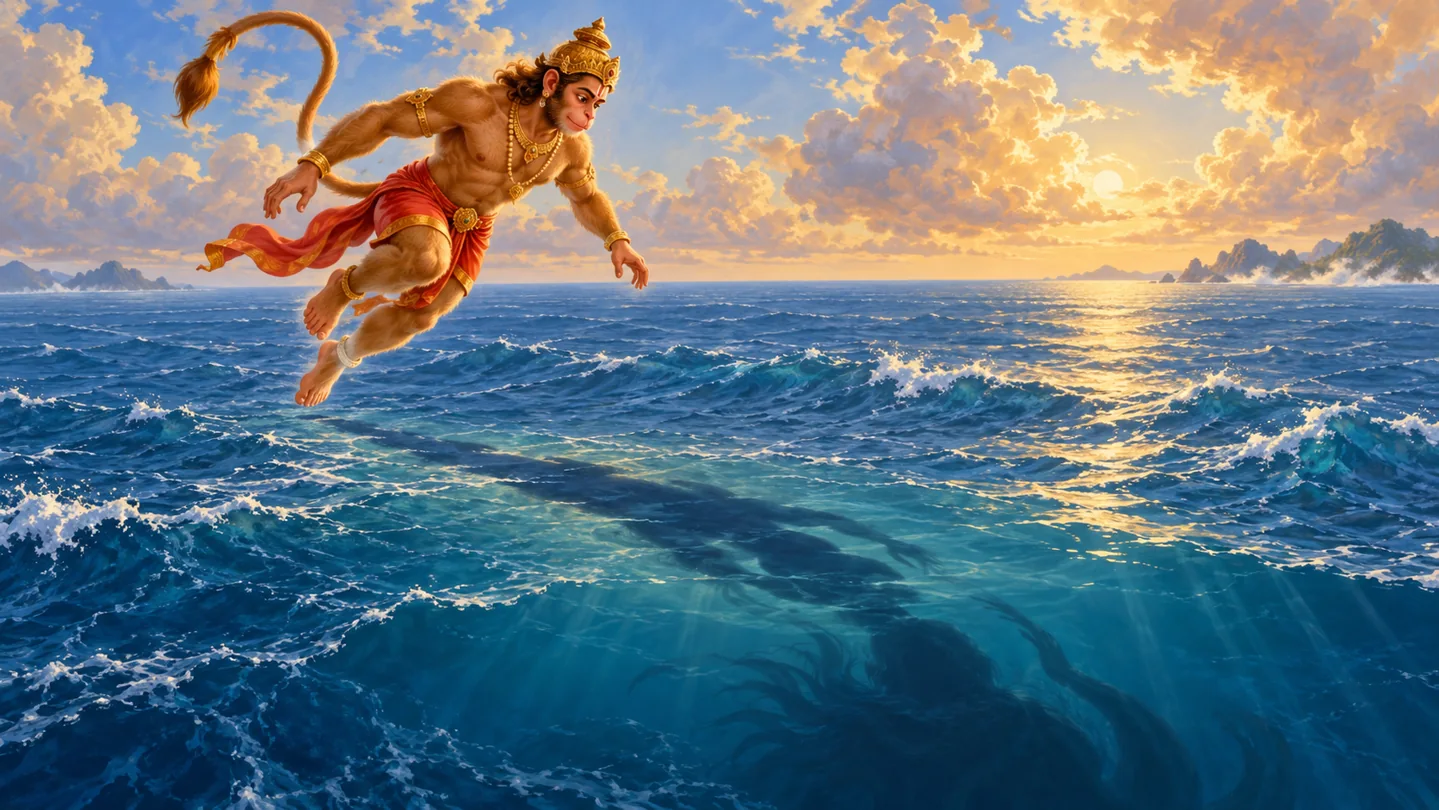
The shadow-catcher Held back in mid-flight, Hanuman observes carefully, recognises Simhika and confronts the danger.
Original DHIH illustration · artistic interpretation Verse 184 · 5.1.184 # Copy link ↗ भेजेऽम्बरं निरालम्बं पक्षयुक्त इवाद्रिराट् ।
bheje’mbaraṃ nirālambaṃ pakṣayukta ivādrirāṭ |
He travelled through the unsupported sky like a winged king of mountains.
प्लवमानं तु तं दृष्ट्वा सिंहिका नाम राक्षसी ॥
plavamānaṃ tu taṃ dṛṣṭvā siṃhikā nāma rākṣasī ||
Seeing him flying, a rakshasi named Simhika
Verse 185 · 5.1.185 # Copy link ↗ मनसा चिन्तयामास प्रवृद्धा कामरूपिणी ।
manasā cintayāmāsa pravṛddhā kāmarūpiṇī |
— a powerful being able to change her form — thought to herself:
अद्य दीर्घस्य कालस्य भविष्याम्यहमाशिता ॥
adya dīrghasya kālasya bhaviṣyāmyahamāśitā ||
“Today, after a long time, I shall have a meal.
Verse 186 · 5.1.186 # Copy link ↗ इदं मम महासत्त्वं चिरस्य वशमागतम् ।
idaṃ mama mahāsattvaṃ cirasya vaśamāgatam |
This mighty creature has finally come within my reach.”
इति संचिन्त्य मनसा च्छायामस्य समाक्षिपत् ॥
iti saṃcintya manasā cchāyāmasya samākṣipat ||
Thinking this, she seized his shadow.
Verse 187 · 5.1.187 # Copy link ↗ छायायां गृह्यमाणायां चिन्तयामास वानरः ।
chāyāyāṃ gṛhyamāṇāyāṃ cintayāmāsa vānaraḥ |
As his shadow was caught, the vanara thought:
समाक्षिप्तोऽस्मि सहसा पङ्गूकृतपराक्रमः ॥
samākṣipto’smi sahasā paṅgūkṛtaparākramaḥ ||
“I have suddenly been held back; my strength can no longer carry me forward,
Verse 188 · 5.1.188 # Copy link ↗ प्रतिलोमेन वातेन महानौरिव सागरे ।
pratilomena vātena mahānauriva sāgare |
like a great ship at sea driven against an opposing wind.”
तिर्यगूर्ध्वमधश्चैव वीक्षमाणस्तदा कपिः ॥
tiryagūrdhvamadhaścaiva vīkṣamāṇastadā kapiḥ ||
Then the vanara looked sideways, above and below.
Verse 189 · 5.1.189 # Copy link ↗ ददर्श स महासत्त्वमुत्थितं लवणाम्भसि ।
dadarśa sa mahāsattvamutthitaṃ lavaṇāmbhasi |
He saw a huge being rising from the salt water.
तद् दृष्ट्वा चिन्तयामास मारुतिर्विकृताननाम् ॥
tad dṛṣṭvā cintayāmāsa mārutirvikṛtānanām ||
Seeing her distorted face, the Wind's son reflected:
Verse 190 · 5.1.190 # Copy link ↗ कपिराज्ञा यथाख्यातं सत्त्वमद्भुतदर्शनम् ।
kapirājñā yathākhyātaṃ sattvamadbhutadarśanam |
“This must be the strange-looking, powerful shadow-grasper
छायाग्राहि महावीर्यं तदिदं नात्र संशयः ॥
chāyāgrāhi mahāvīryaṃ tadidaṃ nātra saṃśayaḥ ||
described by the vanara king; there is no doubt.”
Verse 191 · 5.1.191 # Copy link ↗ स तां बुद्ध्वार्थतत्त्वेन सिंहिकां मतिमान् कपिः ।
sa tāṃ buddhvārthatattvena siṃhikāṃ matimān kapiḥ |
The wise vanara correctly recognised her as Simhika.
व्यवर्धत महाकायः प्रावृषीव बलाहकः ॥
vyavardhata mahākāyaḥ prāvṛṣīva balāhakaḥ ||
Then his great body expanded like a monsoon cloud.
Verse 192 · 5.1.192 # Copy link ↗ तस्य सा कायमुद्वीक्ष्य वर्धमानं महाकपेः ।
tasya sā kāyamudvīkṣya vardhamānaṃ mahākapeḥ |
Seeing the great vanara's body growing,
वक्त्रं प्रसारयामास पातालाम्बरसंनिभम् ॥
vaktraṃ prasārayāmāsa pātālāmbarasaṃnibham ||
she opened her mouth until it seemed to span the underworld and sky.
Verse 193 · 5.1.193 # Copy link ↗ घनराजीव गर्जन्ती वानरं समभिद्रवत् ।
ghanarājīva garjantī vānaraṃ samabhidravat |
Roaring like a bank of clouds, she rushed towards the vanara.
स ददर्श ततस्तस्या विकृतं सुमहन्मुखम् ॥
sa dadarśa tatastasyā vikṛtaṃ sumahanmukham ||
He then saw her immense and misshapen mouth,
Verse 194 · 5.1.194 # Copy link ↗ कायमात्रं च मेधावी मर्माणि च महाकपिः ।
kāyamātraṃ ca medhāvī marmāṇi ca mahākapiḥ |
her body's extent, and her vulnerable points, for he was wise.
स तस्या विकृते वक्त्रे वज्रसंहननः कपिः ॥
sa tasyā vikṛte vaktre vajrasaṃhananaḥ kapiḥ ||
Into her distorted mouth the vanara, whose frame was hard as a thunderbolt,
Verse 195 · 5.1.195 # Copy link ↗ संक्षिप्य मुहुरात्मानं निपपात महाकपिः ।
saṃkṣipya muhurātmānaṃ nipapāta mahākapiḥ |
suddenly plunged, shrinking himself repeatedly.
आस्ये तस्या निमज्जन्तं ददृशुः सिद्धचारणाः ॥
āsye tasyā nimajjantaṃ dadṛśuḥ siddhacāraṇāḥ ||
Perfected beings and celestial bards saw him sinking into her mouth,
Verse 196 · 5.1.196 # Copy link ↗ ग्रस्यमानं यथा चन्द्रं पूर्णं पर्वणि राहुणा ।
grasyamānaṃ yathā candraṃ pūrṇaṃ parvaṇi rāhuṇā |
like the full moon being swallowed by Rahu at an eclipse.
ततस्तस्या नखैस्तीक्ष्णैर्मर्माण्युत्कृत्य वानरः ॥
tatastasyā nakhaistīkṣṇairmarmāṇyutkṛtya vānaraḥ ||
Then the vanara tore her vital parts with his sharp nails,
Verse 197 · 5.1.197 # Copy link ↗ उत्पपाताथ वेगेन मनःसम्पातविक्रमः ।
utpapātātha vegena manaḥsampātavikramaḥ |
and sprang out swiftly, with the speed of thought.
तां तु दिष्ट्या च धृत्या च दाक्षिण्येन निपात्य सः ॥
tāṃ tu diṣṭyā ca dhṛtyā ca dākṣiṇyena nipātya saḥ ||
Having brought her down through fortune, resolve and skill,
Verse 198 · 5.1.198 # Copy link ↗ कपिप्रवीरो वेगेन ववृधे पुनरात्मवान् ।
kapipravīro vegena vavṛdhe punarātmavān |
the self-controlled vanara hero rapidly grew large again.
हृतहृत्सा हनुमता पपात विधुराम्भसि ।
hṛtahṛtsā hanumatā papāta vidhurāmbhasi |
With her heart destroyed by Hanuman, she fell stricken into the water.
स्वयंभुवैव हनुमान् सृष्टस्तस्या निपातने ॥
svayaṃbhuvaiva hanumān sṛṣṭastasyā nipātane ||
It was as though the Creator had made Hanuman for her destruction.
Verse 199 · 5.1.199 # Copy link ↗ तां हतां वानरेणाशु पतितां वीक्ष्य सिंहिकाम् ।
tāṃ hatāṃ vānareṇāśu patitāṃ vīkṣya siṃhikām |
Seeing Simhika slain by the vanara and quickly fallen,
भूतान्याकाशचारीणि तमूचुः प्लवगोत्तमम् ॥
bhūtānyākāśacārīṇi tamūcuḥ plavagottamam ||
the beings who travelled in the sky addressed the foremost leaper:
Verse 200 · 5.1.200 # Copy link ↗ भीममद्य कृतं कर्म महत्सत्त्वं त्वया हतम् ।
bhīmamadya kṛtaṃ karma mahatsattvaṃ tvayā hatam |
“You have done a formidable deed today and slain a mighty being.
साधयार्थमभिप्रेतमरिष्टं प्लवतां वर ॥
sādhayārthamabhipretamariṣṭaṃ plavatāṃ vara ||
Best of leapers, fulfil your intended purpose without harm.
Verse 201 · 5.1.201 # Copy link ↗ यस्य त्वेतानि चत्वारि वानरेन्द्र यथा तव ।
yasya tvetāni catvāri vānarendra yathā tava |
One who possesses these four qualities as you do, foremost vanara
धृतिर्दृष्टिर्मतिर्दाक्ष्यं स कर्मसु न सीदति ॥
dhṛtirdṛṣṭirmatirdākṣyaṃ sa karmasu na sīdati ||
— resolve, observation, understanding and skill — does not fail in his undertakings.”
Verse 202 · 5.1.202 # Copy link ↗ स तैः सम्पूजितः पूज्यः प्रतिपन्नप्रयोजनैः ।
sa taiḥ sampūjitaḥ pūjyaḥ pratipannaprayojanaiḥ |
Honoured by those worthy beings who understood his purpose,
जगामाकाशमाविश्य पन्नगाशनवत् कपिः ॥
jagāmākāśamāviśya pannagāśanavat kapiḥ ||
the vanara entered the sky and went on like Garuda, eater of serpents.
Short meaning Supported by their praise, Hanuman continues towards his goal.
SCENE 05 · VERSES 203–213
The far shore Lanka comes into view. Hanuman chooses a smaller form and prepares for the search ahead.
Original DHIH illustration · artistic interpretation Verse 203 · 5.1.203 # Copy link ↗ प्राप्तभूयिष्ठपारस्तु सर्वतः परिलोकयन् ।
prāptabhūyiṣṭhapārastu sarvataḥ parilokayan |
Now almost at the far shore, he looked in every direction.
योजनानां शतस्यान्ते वनराजीं ददर्श सः ॥
yojanānāṃ śatasyānte vanarājīṃ dadarśa saḥ ||
At the end of a hundred yojanas, he saw a stretch of forest.
Verse 204 · 5.1.204 # Copy link ↗ ददर्श च पतन्नेव विविधद्रुमभूषितम् ।
dadarśa ca patanneva vividhadrumabhūṣitam |
While still in flight, the foremost vanara saw
द्वीपं शाखामृगश्रेष्ठो मलयोपवनानि च ॥
dvīpaṃ śākhāmṛgaśreṣṭho malayopavanāni ca ||
an island adorned with many kinds of trees and the groves of Malaya.
Verse 205 · 5.1.205 # Copy link ↗ सागरं सागरानूपान् सागरानूपजान् द्रुमान् ।
sāgaraṃ sāgarānūpān sāgarānūpajān drumān |
He saw the ocean, its shores and the trees growing along them,
सागरस्य च पत्नीनां मुखान्यपि विलोकयत् ॥
sāgarasya ca patnīnāṃ mukhānyapi vilokayat ||
and the mouths of the rivers, poetically called the ocean's wives.
Short meaning The shore, trees and river mouths form a detailed coastal scene.
Verse 206 · 5.1.206 # Copy link ↗ स महामेघसंकाशं समीक्ष्यात्मानमात्मवान् ।
sa mahāmeghasaṃkāśaṃ samīkṣyātmānamātmavān |
The self-controlled one examined his own body, vast as a great cloud,
निरुन्धन्तमिवाकाशं चकार मतिमान् मतिम् ॥
nirundhantamivākāśaṃ cakāra matimān matim ||
seeming to block the sky, and considered what to do.
Verse 207 · 5.1.207 # Copy link ↗ कायवृद्धिं प्रवेगं च मम दृष्ट्वैव राक्षसाः ।
kāyavṛddhiṃ pravegaṃ ca mama dṛṣṭvaiva rākṣasāḥ |
“Seeing my enormous body and speed,
मयि कौतूहलं कुर्युरिति मेने महामतिः ॥
mayi kautūhalaṃ kuryuriti mene mahāmatiḥ ||
the rakshasas would become curious about me,” the wise one thought.
Verse 208 · 5.1.208 # Copy link ↗ ततः शरीरं संक्षिप्य तन्महीधरसंनिभम् ।
tataḥ śarīraṃ saṃkṣipya tanmahīdharasaṃnibham |
So he contracted his mountain-like body
पुनः प्रकृतिमापेदे वीतमोह इवात्मवान् ॥
punaḥ prakṛtimāpede vītamoha ivātmavān ||
and returned to his natural form, like a disciplined person free from delusion.
Short meaning He chooses a form suited to careful, unobtrusive action.
Verse 209 · 5.1.209 # Copy link ↗ तद्रूपमतिसंक्षिप्य हनूमान् प्रकृतौ स्थितः ।
tadrūpamatisaṃkṣipya hanūmān prakṛtau sthitaḥ |
Hanuman reduced that vast shape and stood in his natural form,
त्रीन् क्रमानिव विक्रम्य बलिवीर्यहरो हरिः ॥
trīn kramāniva vikramya balivīryaharo hariḥ ||
like Vishnu after taking three strides and overcoming Bali's power.
Verse 210 · 5.1.210 # Copy link ↗ स चारुनानाविधरूपधारी
sa cārunānāvidharūpadhārī
He who could assume many beautiful forms
परं समासाद्य समुद्रतीरम् ।
paraṃ samāsādya samudratīram |
reached the far shore of the sea,
परैरशक्यं प्रतिपन्नरूपः
parairaśakyaṃ pratipannarūpaḥ
adopting a form that others could not readily overcome,
समीक्षितात्मा समवेक्षितार्थः ॥
samīkṣitātmā samavekṣitārthaḥ ||
having considered himself and carefully understood his purpose.
Verse 211 · 5.1.211 # Copy link ↗ ततः स लम्बस्य गिरेः समृद्धे
tataḥ sa lambasya gireḥ samṛddhe
Then on the splendid, varied summit
विचित्रकूटे निपपात कूटे ।
vicitrakūṭe nipapāta kūṭe |
of Mount Lamba he alighted,
सकेतकोद्दालकनारिकेले
saketakoddālakanārikele
amid ketaka, uddalaka and coconut trees,
महाभ्रकूटप्रतिमो महात्मा ॥
mahābhrakūṭapratimo mahātmā ||
that great one who resembled a mass of clouds.
Verse 212 · 5.1.212 # Copy link ↗ ततस्तु सम्प्राप्य समुद्रतीरं
tatastu samprāpya samudratīraṃ
Having reached the ocean's shore
समीक्ष्य लंकां गिरिवर्यमूर्ध्नि ।
samīkṣya laṃkāṃ girivaryamūrdhni |
and surveyed Lanka upon the mountain's summit,
कपिस्तु तस्मिन् निपपात पर्वते
kapistu tasmin nipapāta parvate
the vanara descended on that mountain,
विधूय रूपं व्यथयन्मृगद्विजान् ॥
vidhūya rūpaṃ vyathayanmṛgadvijān ||
casting off his huge form and startling the animals and birds.
Verse 213 · 5.1.213 # Copy link ↗ स सागरं दानवपन्नगायुतं
sa sāgaraṃ dānavapannagāyutaṃ
He had crossed by his strength the sea, filled with danavas and serpents
बलेन विक्रम्य महोर्मिमालिनम् ।
balena vikramya mahormimālinam |
and crowned with rows of mighty waves.
निपत्य तीरे च महोदधेस्तदा
nipatya tīre ca mahodadhestadā
Landing then upon the great ocean's shore,
ददर्श लंकाममरावतीमिव ॥
dadarśa laṃkāmamarāvatīmiva ||
he saw Lanka, like the celestial city of Amaravati.
About this reading Vālmīki Rāmāyaṇa, Sundara Kanda, chapter 1. This reading follows Sanskrit Wikisource revision 354113 , with all 213 numbered verses . Verse divisions and wording vary between editions.
The Sanskrit is preserved with normalized display spacing and line breaks. Some sentences continue across verse boundaries; the English follows that continuity. A yojana is a traditional distance unit, retained without assigning a modern measurement. Shape-changing and celestial beings belong to the epic’s sacred narrative.
English line senses and short meanings are original AI-assisted DHIH renderings checked against this Sanskrit reading; they are not a word-for-word grammatical commentary or a claim of human scholarly certification. Roman transliteration is generated mechanically in IAST. Names may also appear in familiar English spellings.
Sanskrit transcription credit: Wikisource contributors, revision history . The adapted reading text and DHIH English on this chapter page are offered under CC BY-SA 4.0 . The ancient Sanskrit work is in the public domain. Illustrations are separately commissioned AI-generated DHIH artwork.
The epic’s battle with Simhika and other violent details are deliberately simplified without graphic description. In the complete Sanskrit episode, Hanuman kills Simhika. The Surasa scene illustrates the blessing after her test. The picture story is a separately labelled adaptation for reading with a grown-up. Audio will be added only when suitable recording permissions are available.