Home / Sundara Kanda / Chapter 2VĀLMĪKI RĀMĀYAṆA · CHAPTER 02
सुन्दरकाण्डम् · द्वितीयः सर्गः
Hanuman surveys Lanka Strength has brought Hanuman to Lanka. Now he observes, chooses his moment and makes a careful plan to find Sita.
58 verses Sanskrit + English 3 illustrated scenes
An edition-specific reading with original English meanings. Source & reading notes
Show Roman text Larger text
SCENE 01 · VERSES 1–25
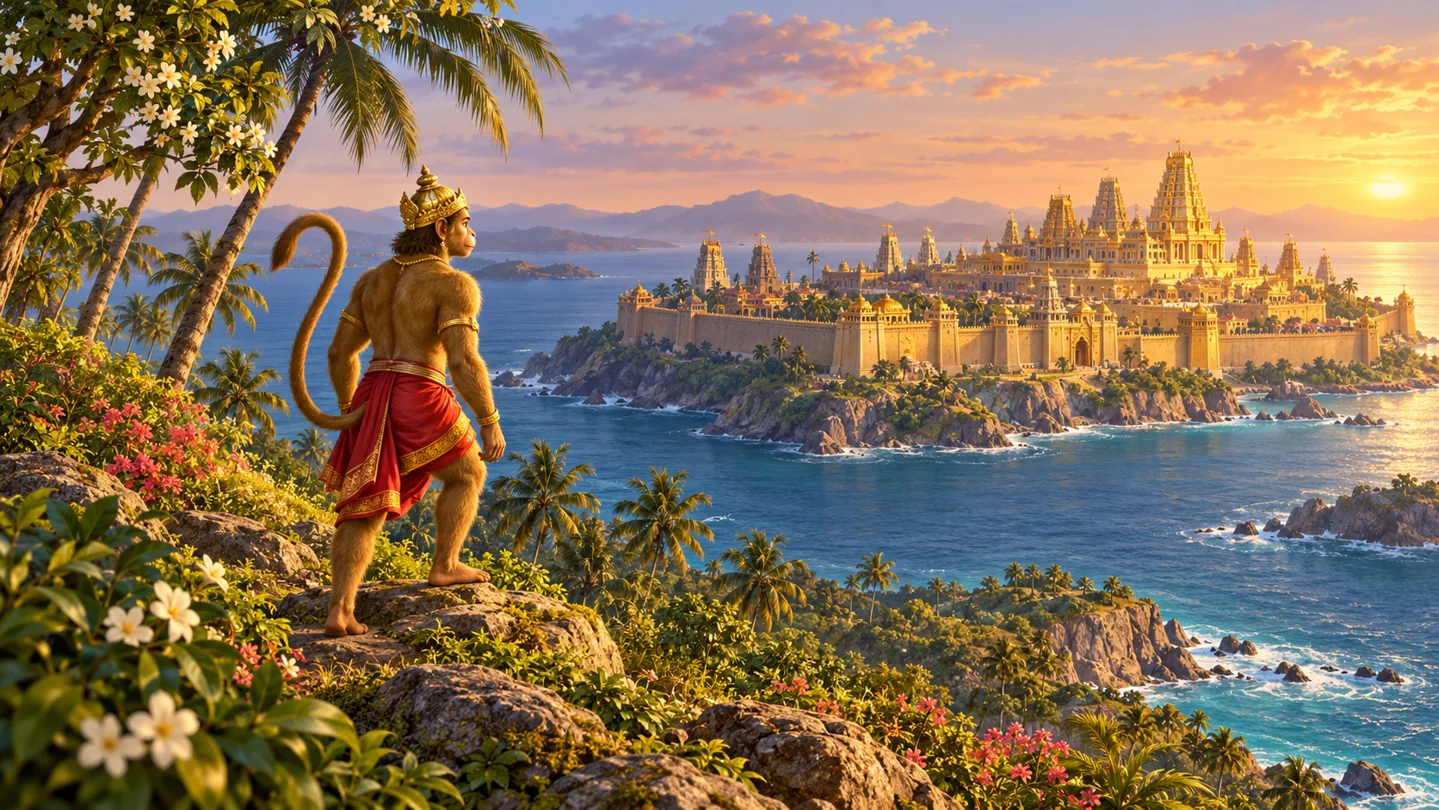
A city of gardens and towers From Trikuta, Hanuman sees flowering gardens, shining palaces and carefully guarded walls.
Original DHIH illustration · artistic interpretation Verse 1 · 5.2.1 # Copy link ↗ स सागरमनाधृष्यमतिक्रम्य महाबलः ।
sa sāgaramanādhṛṣyamatikramya mahābalaḥ |
Having crossed the formidable ocean, the immensely strong Hanuman
त्रिकूटस्य तटे लंकां स्थितः स्वस्थो ददर्श ह ॥
trikūṭasya taṭe laṃkāṃ sthitaḥ svastho dadarśa ha ||
stood calmly on the slope of Trikuta and looked upon Lanka.
Short meaning After the ocean crossing, Hanuman pauses on Trikuta to survey Lanka.
Verse 2 · 5.2.2 # Copy link ↗ ततः पादपमुक्तेन पुष्पवर्षेण वीर्यवान् ।
tataḥ pādapamuktena puṣpavarṣeṇa vīryavān |
A shower of flowers shaken loose from the trees fell upon the valiant one.
अभिवृष्टस्ततस्तत्र बभौ पुष्पमयो हरिः ॥
abhivṛṣṭastatastatra babhau puṣpamayo hariḥ ||
Covered in those blossoms, the vanara seemed to be made of flowers.
Verse 3 · 5.2.3 # Copy link ↗ योजनानां शतं श्रीमांस्तीर्त्वाप्युत्तमविक्रमः ।
yojanānāṃ śataṃ śrīmāṃstīrtvāpyuttamavikramaḥ |
Though the glorious hero of outstanding courage had crossed a hundred yojanas,
अनिःश्वसन् कपिस्तत्र न ग्लानिमधिगच्छति ॥
aniḥśvasan kapistatra na glānimadhigacchati ||
he was neither breathless nor overcome by weariness.
Verse 4 · 5.2.4 # Copy link ↗ शतान्यहं योजनानां क्रमेयं सुबहून्यपि ।
śatānyahaṃ yojanānāṃ krameyaṃ subahūnyapi |
“I could cross even many hundreds of yojanas;
किं पुनः सागरस्यान्तं संख्यातं शतयोजनम् ॥
kiṃ punaḥ sāgarasyāntaṃ saṃkhyātaṃ śatayojanam ||
how much less difficult was this ocean, measured at a hundred yojanas!”
Verse 5 · 5.2.5 # Copy link ↗ स तु वीर्यवतां श्रेष्ठः प्लवतामपि चोत्तमः ।
sa tu vīryavatāṃ śreṣṭhaḥ plavatāmapi cottamaḥ |
Foremost among the courageous and the best of leapers,
जगाम वेगवाँल्लंकां लङ्घयित्वा महोदधिम् ॥
jagāma vegavām̐llaṃkāṃ laṅghayitvā mahodadhim ||
he sped towards Lanka after crossing the great sea.
Verse 6 · 5.2.6 # Copy link ↗ शाद्वलानि च नीलानि गन्धवन्ति वनानि च ।
śādvalāni ca nīlāni gandhavanti vanāni ca |
He passed through blue-green meadows and fragrant woods,
मधुमन्ति च मध्येन जगाम नगवन्ति च ॥
madhumanti ca madhyena jagāma nagavanti ca ||
rich in honey and filled with trees and hills.
Verse 7 · 5.2.7 # Copy link ↗ शैलांश्च तरुसंछन्नान् वनराजीश्च पुष्पिताः ।
śailāṃśca tarusaṃchannān vanarājīśca puṣpitāḥ |
Tree-covered hills and stretches of flowering woodland
अभिचक्राम तेजस्वी हनूमान् प्लवगर्षभः ॥
abhicakrāma tejasvī hanūmān plavagarṣabhaḥ ||
were crossed by radiant Hanuman, foremost among the leaping vanaras.
Verse 8 · 5.2.8 # Copy link ↗ स तस्मिन्नचले तिष्ठन् वनान्युपवनानि च ।
sa tasminnacale tiṣṭhan vanānyupavanāni ca |
Standing on that mountain, the son of the Wind saw forests and gardens;
स नगाग्रे स्थितां लंकां ददर्श पवनात्मजः ॥
sa nagāgre sthitāṃ laṃkāṃ dadarśa pavanātmajaḥ ||
he also saw Lanka standing upon the mountain's summit.
Verse 9 · 5.2.9 # Copy link ↗ सरलान् कर्णिकारांश्च खर्जूरांश्च सुपुष्पितान् ।
saralān karṇikārāṃśca kharjūrāṃśca supuṣpitān |
He saw sarala and karnikara trees, and date palms in full bloom,
प्रियालान् मुचुलिन्दांश्च कुटजान् केतकानपि ॥
priyālān muculindāṃśca kuṭajān ketakānapi ||
priyala, muchulinda, kutaja and ketaka trees;
Verse 10 · 5.2.10 # Copy link ↗ प्रियङ्गून् गन्धपूर्णांश्च नीपान् सप्तच्छदांस्तथा ।
priyaṅgūn gandhapūrṇāṃśca nīpān saptacchadāṃstathā |
fragrant priyangu, nipa and saptachchhada trees,
असनान् कोविदारांश्च करवीरांश्च पुष्पितान् ॥
asanān kovidārāṃśca karavīrāṃśca puṣpitān ||
asana, kovidara and flowering karavira trees;
Verse 11 · 5.2.11 # Copy link ↗ पुष्पभारनिबद्धांश्च तथा मुकुलितानपि ।
puṣpabhāranibaddhāṃśca tathā mukulitānapi |
trees weighed down with flowers, and others still covered in buds,
पादपान् विहगाकीर्णान् पवनाधूतमस्तकान् ॥
pādapān vihagākīrṇān pavanādhūtamastakān ||
crowded with birds, their crowns stirred by the wind;
Verse 12 · 5.2.12 # Copy link ↗ हंसकारण्डवाकीर्णा वापीः पद्मोत्पलावृताः ।
haṃsakāraṇḍavākīrṇā vāpīḥ padmotpalāvṛtāḥ |
he saw ponds full of swans and waterbirds, covered with lotuses and water-lilies,
आक्रीडान् विविधान् रम्यान् विविधांश्च जलाशयान् ॥
ākrīḍān vividhān ramyān vividhāṃśca jalāśayān ||
lovely pleasure grounds of many kinds, and various reservoirs;
Short meaning The gardens include abundant water, flowers and birds.
Verse 13 · 5.2.13 # Copy link ↗ संततान् विविधैर्वृक्षैः सर्वर्तुफलपुष्पितैः ।
saṃtatān vividhairvṛkṣaiḥ sarvartuphalapuṣpitaiḥ |
Thick with many kinds of trees bearing flowers and fruit in every season,
उद्यानानि च रम्याणि ददर्श कपिकुञ्जरः ॥
udyānāni ca ramyāṇi dadarśa kapikuñjaraḥ ||
the delightful gardens came into the mighty vanara’s view.
Verse 14 · 5.2.14 # Copy link ↗ समासाद्य च लक्ष्मीवाँल्लंकां रावणपालिताम् ।
samāsādya ca lakṣmīvām̐llaṃkāṃ rāvaṇapālitām |
The splendid hero approached Lanka, ruled by Ravana,
परिखाभिः सपद्माभिः सोत्पलाभिरलंकृताम् ॥
parikhābhiḥ sapadmābhiḥ sotpalābhiralaṃkṛtām ||
adorned with moats containing lotuses and water-lilies.
Verse 15 · 5.2.15 # Copy link ↗ सीतापहरणात् तेन रावणेन सुरक्षिताम् ।
sītāpaharaṇāt tena rāvaṇena surakṣitām |
Since abducting Sita, Ravana had kept the city closely guarded,
समन्ताद् विचरद्भिश्च राक्षसैरुग्रधन्वभिः ॥
samantād vicaradbhiśca rākṣasairugradhanvabhiḥ ||
with rakshasas carrying formidable bows patrolling on every side.
Verse 16 · 5.2.16 # Copy link ↗ काञ्चनेनावृतां रम्यां प्राकारेण महापुरीम् ।
kāñcanenāvṛtāṃ ramyāṃ prākāreṇa mahāpurīm |
The lovely, great city was enclosed by a golden rampart,
गृहैश्च गिरिसंकाशैः शारदाम्बुदसंनिभैः ॥
gṛhaiśca girisaṃkāśaiḥ śāradāmbudasaṃnibhaiḥ ||
and filled with mountain-like houses as pale as autumn clouds.
Verse 17 · 5.2.17 # Copy link ↗ पाण्डुराभिः प्रतोलीभिरुच्चाभिरभिसंवृताम् ।
pāṇḍurābhiḥ pratolībhiruccābhirabhisaṃvṛtām |
It was surrounded by lofty, pale gateways,
अट्टालकशताकीर्णां पताकाध्वजशोभिताम् ॥
aṭṭālakaśatākīrṇāṃ patākādhvajaśobhitām ||
crowded with hundreds of towers, and adorned with banners and standards.
Short meaning Hanuman surveys the gates, towers and fluttering flags.
Verse 18 · 5.2.18 # Copy link ↗ तोरणैः काञ्चनैर्दिव्यैर्लतापङ्क्तिविराजितैः ।
toraṇaiḥ kāñcanairdivyairlatāpaṅktivirājitaiḥ |
With splendid golden arches bright with rows of creeper designs,
ददर्श हनुमाँल्लंकां देवो देवपुरीमिव ॥
dadarśa hanumām̐llaṃkāṃ devo devapurīmiva ||
Lanka appeared to Hanuman as a celestial city might appear to a god.
Verse 19 · 5.2.19 # Copy link ↗ गिरिमूर्ध्नि स्थितां लंकां पाण्डुरैर्भवनैः शुभैः ।
girimūrdhni sthitāṃ laṃkāṃ pāṇḍurairbhavanaiḥ śubhaiḥ |
The glorious vanara saw Lanka on the mountain's crest,
ददर्श स कपिः श्रीमान् पुरीमाकाशगामिव ॥
dadarśa sa kapiḥ śrīmān purīmākāśagāmiva ||
its beautiful pale buildings making it seem to travel through the sky.
Verse 20 · 5.2.20 # Copy link ↗ पालितां राक्षसेन्द्रेण निर्मितां विश्वकर्मणा ।
pālitāṃ rākṣasendreṇa nirmitāṃ viśvakarmaṇā |
Guarded by the rakshasa king and built by Vishvakarma,
प्लवमानामिवाकाशे ददर्श हनुमान् कपिः ॥
plavamānāmivākāśe dadarśa hanumān kapiḥ ||
Lanka appeared to Hanuman to float in the sky.
Verse 21 · 5.2.21 # Copy link ↗ वप्रप्राकारजघनां विपुलाम्बुवनाम्बराम् ।
vapraprākārajaghanāṃ vipulāmbuvanāmbarām |
Its ramparts and walls were like hips, its broad waters and forests like clothing;
शतघ्नीशूलकेशान्तामट्टालकावतंसकाम् ॥
śataghnīśūlakeśāntāmaṭṭālakāvataṃsakām ||
its defensive engines and spears were like hair, and its towers like ornaments.
Verse 22 · 5.2.22 # Copy link ↗ मनसेव कृतां लंकां निर्मितां विश्वकर्मणा ।
manaseva kṛtāṃ laṃkāṃ nirmitāṃ viśvakarmaṇā |
Lanka, built by Vishvakarma, seemed shaped by thought itself.
द्वारमुत्तरमासाद्य चिन्तयामास वानरः ॥
dvāramuttaramāsādya cintayāmāsa vānaraḥ ||
Reaching its northern gate, the vanara began to consider his course.
Short meaning At the northern gate, Hanuman turns from admiration to planning.
Verse 23 · 5.2.23 # Copy link ↗ कैलासनिलयप्रख्यमालिखन्तमिवाम्बरम् ।
kailāsanilayaprakhyamālikhantamivāmbaram |
Its splendid buildings rose like the dwellings of Kailasa, seeming to scrape the sky;
ध्रियमाणमिवाकाशमुच्छ्रितैर्भवनोत्तमैः ॥
dhriyamāṇamivākāśamucchritairbhavanottamaiḥ ||
their height made it appear that the heavens themselves were held aloft.
Verse 24 · 5.2.24 # Copy link ↗ सम्पूर्णा राक्षसैर्घोरैर्नागैर्भोगवतीमिव ।
sampūrṇā rākṣasairghorairnāgairbhogavatīmiva |
It was filled with fearsome rakshasas, like Bhogavati with serpents:
अचिन्त्यां सुकृतां स्पष्टां कुबेराध्युषितां पुरा ॥
acintyāṃ sukṛtāṃ spaṣṭāṃ kuberādhyuṣitāṃ purā ||
a wondrous, beautifully built, conspicuous city once inhabited by Kubera.
Verse 25 · 5.2.25 # Copy link ↗ दंष्ट्राभिर्बहुभिः शूरैः शूलपट्टिशपाणिभिः ।
daṃṣṭrābhirbahubhiḥ śūraiḥ śūlapaṭṭiśapāṇibhiḥ |
Many brave, fearsome, fanged rakshasas, holding spears and bladed polearms,
रक्षितां राक्षसैर्घोरैर्गुहामाशीविषैरिव ॥
rakṣitāṃ rākṣasairghorairguhāmāśīviṣairiva ||
guarded it as venomous snakes guard a cave.
SCENE 02 · VERSES 26–48
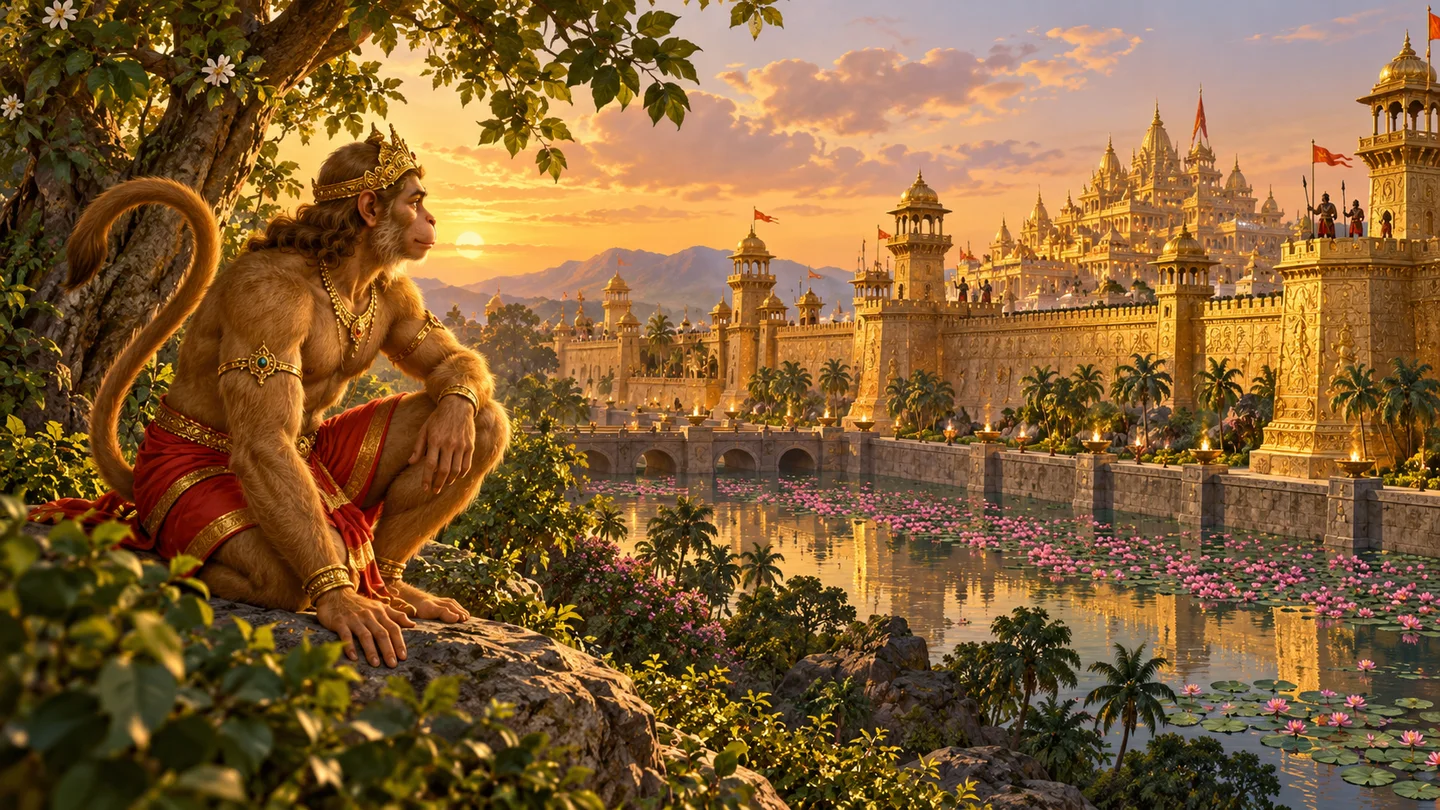
First, find Sita He weighs the dangers, returns to his immediate purpose and waits for the right moment.
Original DHIH illustration · artistic interpretation Verse 26 · 5.2.26 # Copy link ↗ तस्याश्च महतीं गुप्तिं सागरं च निरीक्ष्य सः ।
tasyāśca mahatīṃ guptiṃ sāgaraṃ ca nirīkṣya saḥ |
Having examined its strong defences and the surrounding ocean,
रावणं च रिपुं घोरं चिन्तयामास वानरः ॥
rāvaṇaṃ ca ripuṃ ghoraṃ cintayāmāsa vānaraḥ ||
the vanara reflected upon Ravana, that dreadful enemy.
Verse 27 · 5.2.27 # Copy link ↗ आगत्यापीह हरयो भविष्यन्ति निरर्थकाः ।
āgatyāpīha harayo bhaviṣyanti nirarthakāḥ |
“Even if the vanaras reach this place, their efforts may be fruitless.
नहि युद्धेन वै लंका शक्या जेतुं सुरैरपि ॥
nahi yuddhena vai laṃkā śakyā jetuṃ surairapi ||
Even the gods could not easily conquer Lanka in battle.”
Verse 28 · 5.2.28 # Copy link ↗ इमां त्वविषमां लंकां दुर्गां रावणपालिताम् ।
imāṃ tvaviṣamāṃ laṃkāṃ durgāṃ rāvaṇapālitām |
“This Lanka, guarded by Ravana, is a formidable, fortified city.
प्राप्यापि सुमहाबाहुः किं करिष्यति राघवः ॥
prāpyāpi sumahābāhuḥ kiṃ kariṣyati rāghavaḥ ||
Even if mighty-armed Rama reaches it, what will he do?”
Verse 29 · 5.2.29 # Copy link ↗ अवकाशो न साम्नस्तु राक्षसेष्वभिगम्यते ।
avakāśo na sāmnastu rākṣaseṣvabhigamyate |
“I can see no opening here for conciliation with the rakshasas,
न दानस्य न भेदस्य नैव युद्धस्य दृश्यते ॥
na dānasya na bhedasya naiva yuddhasya dṛśyate ||
nor for gifts, division among them, or outright war.”
Verse 30 · 5.2.30 # Copy link ↗ चतुर्णामेव हि गतिर्वानराणां तरस्विनाम् ।
caturṇāmeva hi gatirvānarāṇāṃ tarasvinām |
“Only four swift vanaras could make this journey:
वालिपुत्रस्य नीलस्य मम राज्ञश्च धीमतः ॥
vāliputrasya nīlasya mama rājñaśca dhīmataḥ ||
Vali's son, Nila, myself and our wise king.”
Short meaning He identifies Angada, Nila, himself and Sugriva as capable of reaching Lanka in this reflection.
Verse 31 · 5.2.31 # Copy link ↗ यावज्जानामि वैदेहीं यदि जीवति वा न वा ।
yāvajjānāmi vaidehīṃ yadi jīvati vā na vā |
“First I must learn about Vaidehi, whether she is alive or not.
तत्रैव चिन्तयिष्यामि दृष्ट्वा तां जनकात्मजाम् ॥
tatraiva cintayiṣyāmi dṛṣṭvā tāṃ janakātmajām ||
After seeing Janaka's daughter, I shall consider the rest.”
Verse 32 · 5.2.32 # Copy link ↗ ततः स चिन्तयामास मुहूर्तं कपिकुञ्जरः ।
tataḥ sa cintayāmāsa muhūrtaṃ kapikuñjaraḥ |
Then the mighty vanara stood for a while upon that mountain peak
गिरेः शृङ्गे स्थितस्तस्मिन् रामस्याभ्युदयं ततः ॥
gireḥ śṛṅge sthitastasmin rāmasyābhyudayaṃ tataḥ ||
and reflected on how to advance Rama's cause.
Verse 33 · 5.2.33 # Copy link ↗ अनेन रूपेण मया न शक्या रक्षसां पुरी ।
anena rūpeṇa mayā na śakyā rakṣasāṃ purī |
“In this form I cannot enter the rakshasas' city,
प्रवेष्टुं राक्षसैर्गुप्ता क्रूरैर्बलसमन्वितैः ॥
praveṣṭuṃ rākṣasairguptā krūrairbalasamanvitaiḥ ||
guarded as it is by fierce and powerful rakshasas.”
Verse 34 · 5.2.34 # Copy link ↗ महौजसो महावीर्या बलवन्तश्च राक्षसाः ।
mahaujaso mahāvīryā balavantaśca rākṣasāḥ |
“These rakshasas possess immense energy, valour and strength.
वञ्चनीया मया सर्वे जानकीं परिमार्गता ॥
vañcanīyā mayā sarve jānakīṃ parimārgatā ||
In searching for Janaki, I must avoid the notice of every one of them.”
Verse 35 · 5.2.35 # Copy link ↗ लक्ष्यालक्ष्येण रूपेण रात्रौ लंकापुरी मया ।
lakṣyālakṣyeṇa rūpeṇa rātrau laṃkāpurī mayā |
“At night I should enter Lanka in a form scarcely visible;
प्राप्तकालं प्रवेष्टुं मे कृत्यं साधयितुं महत् ॥
prāptakālaṃ praveṣṭuṃ me kṛtyaṃ sādhayituṃ mahat ||
the time has come for me to accomplish my great task.”
Verse 36 · 5.2.36 # Copy link ↗ तां पुरीं तादृशीं दृष्ट्वा दुराधर्षां सुरासुरैः ।
tāṃ purīṃ tādṛśīṃ dṛṣṭvā durādharṣāṃ surāsuraiḥ |
Seeing that city, difficult for gods and asuras alike to assail,
हनूमांश्चिन्तयामास विनिःश्वस्य मुहुर्मुहुः ॥
hanūmāṃścintayāmāsa viniḥśvasya muhurmuhuḥ ||
Hanuman thought deeply, drawing breath again and again.
Verse 37 · 5.2.37 # Copy link ↗ केनोपायेन पश्येयं मैथिलीं जनकात्मजाम् ।
kenopāyena paśyeyaṃ maithilīṃ janakātmajām |
“By what means can I see Maithili, Janaka's daughter,
अदृष्टो राक्षसेन्द्रेण रावणेन दुरात्मना ॥
adṛṣṭo rākṣasendreṇa rāvaṇena durātmanā ||
without being seen by the wicked rakshasa king Ravana?”
Verse 38 · 5.2.38 # Copy link ↗ न विनश्येत् कथं कार्यं रामस्य विदितात्मनः ।
na vinaśyet kathaṃ kāryaṃ rāmasya viditātmanaḥ |
“How can I preserve the mission of self-possessed Rama?
एकामेकस्तु पश्येयं रहिते जनकात्मजाम् ॥
ekāmekastu paśyeyaṃ rahite janakātmajām ||
How can I meet Janaka's daughter alone, in a secluded place?”
Verse 39 · 5.2.39 # Copy link ↗ भूताश्चार्था विनश्यन्ति देशकालविरोधिताः ।
bhūtāścārthā vinaśyanti deśakālavirodhitāḥ |
“Even well-advanced undertakings, mishandled in place or time, can disappear
विक्लवं दूतमासाद्य तमः सूर्योदये यथा ॥
viklavaṃ dūtamāsādya tamaḥ sūryodaye yathā ||
on reaching an unsteady messenger, like darkness at sunrise.”
Verse 40 · 5.2.40 # Copy link ↗ अर्थानर्थान्तरे बुद्धिर्निश्चितापि न शोभते ।
arthānarthāntare buddhirniścitāpi na śobhate |
“Even a settled judgement loses its value when wavering between benefit and harm.
घातयन्तीह कार्याणि दूताः पण्डितमानिनः ॥
ghātayantīha kāryāṇi dūtāḥ paṇḍitamāninaḥ ||
Messengers who imagine themselves wise can ruin the tasks entrusted to them.”
Verse 41 · 5.2.41 # Copy link ↗ न विनश्येत् कथं कार्यं वैक्लव्यं न कथं भवेत् ।
na vinaśyet kathaṃ kāryaṃ vaiklavyaṃ na kathaṃ bhavet |
“How can I keep the task from failing and prevent confusion?
लङ्घनं च समुद्रस्य कथं नु न भवेद् वृथा ॥
laṅghanaṃ ca samudrasya kathaṃ nu na bhaved vṛthā ||
How can I make sure that crossing the ocean has not been in vain?”
Verse 42 · 5.2.42 # Copy link ↗ मयि दृष्टे तु रक्षोभी रामस्य विदितात्मनः ।
mayi dṛṣṭe tu rakṣobhī rāmasya viditātmanaḥ |
“If the rakshasas see me, this mission of self-possessed Rama,
भवेद् व्यर्थमिदं कार्यं रावणानर्थमिच्छतः ॥
bhaved vyarthamidaṃ kāryaṃ rāvaṇānarthamicchataḥ ||
who seeks Ravana's downfall, could become fruitless.”
Verse 43 · 5.2.43 # Copy link ↗ नहि शक्यं क्वचित् स्थातुमविज्ञातेन राक्षसैः ।
nahi śakyaṃ kvacit sthātumavijñātena rākṣasaiḥ |
“It is impossible to stay anywhere unnoticed by the rakshasas,
अपि राक्षसरूपेण किमुतान्येन केनचित् ॥
api rākṣasarūpeṇa kimutānyena kenacit ||
even in a rakshasa's form—how much more so in any other shape!”
Verse 44 · 5.2.44 # Copy link ↗ वायुरप्यत्र नाज्ञातश्चरेदिति मतिर्मम ।
vāyurapyatra nājñātaścarediti matirmama |
“I think even the wind could not move here without being noticed.
नह्यत्राविदितं किंचिद् रक्षसां भीमकर्मणाम् ॥
nahyatrāviditaṃ kiṃcid rakṣasāṃ bhīmakarmaṇām ||
Nothing here escapes these rakshasas of fearsome deeds.”
Verse 45 · 5.2.45 # Copy link ↗ इहाहं यदि तिष्ठामि स्वेन रूपेण संवृतः ।
ihāhaṃ yadi tiṣṭhāmi svena rūpeṇa saṃvṛtaḥ |
“If I remain here in my present form,
विनाशमुपयास्यामि भर्तुरर्थश्च हास्यति ॥
vināśamupayāsyāmi bharturarthaśca hāsyati ||
I shall meet destruction, and my master's purpose will suffer.”
Verse 46 · 5.2.46 # Copy link ↗ तदहं स्वेन रूपेण रजन्यां ह्रस्वतां गतः ।
tadahaṃ svena rūpeṇa rajanyāṃ hrasvatāṃ gataḥ |
“Therefore, retaining my own form but becoming small,
लंकामभिपतिष्यामि राघवस्यार्थसिद्धये ॥
laṃkāmabhipatiṣyāmi rāghavasyārthasiddhaye ||
I shall enter Lanka at night to accomplish Rama's purpose.”
Verse 47 · 5.2.47 # Copy link ↗ रावणस्य पुरीं रात्रौ प्रविश्य सुदुरासदाम् ।
rāvaṇasya purīṃ rātrau praviśya sudurāsadām |
“Entering Ravana's hard-to-approach city at night,
प्रविश्य भवनं सर्वं द्रक्ष्यामि जनकात्मजाम् ॥
praviśya bhavanaṃ sarvaṃ drakṣyāmi janakātmajām ||
I shall search every dwelling and find Janaka's daughter.”
Verse 48 · 5.2.48 # Copy link ↗ इति निश्चित्य हनुमान् सूर्यस्यास्तमयं कपिः ।
iti niścitya hanumān sūryasyāstamayaṃ kapiḥ |
Having decided, the heroic vanara Hanuman waited for sunset,
आचकाङ्क्षे तदा वीरो वैदेह्या दर्शनोत्सुकः ॥
ācakāṅkṣe tadā vīro vaidehyā darśanotsukaḥ ||
eager to obtain a sight of Vaidehi.
SCENE 03 · VERSES 49–58
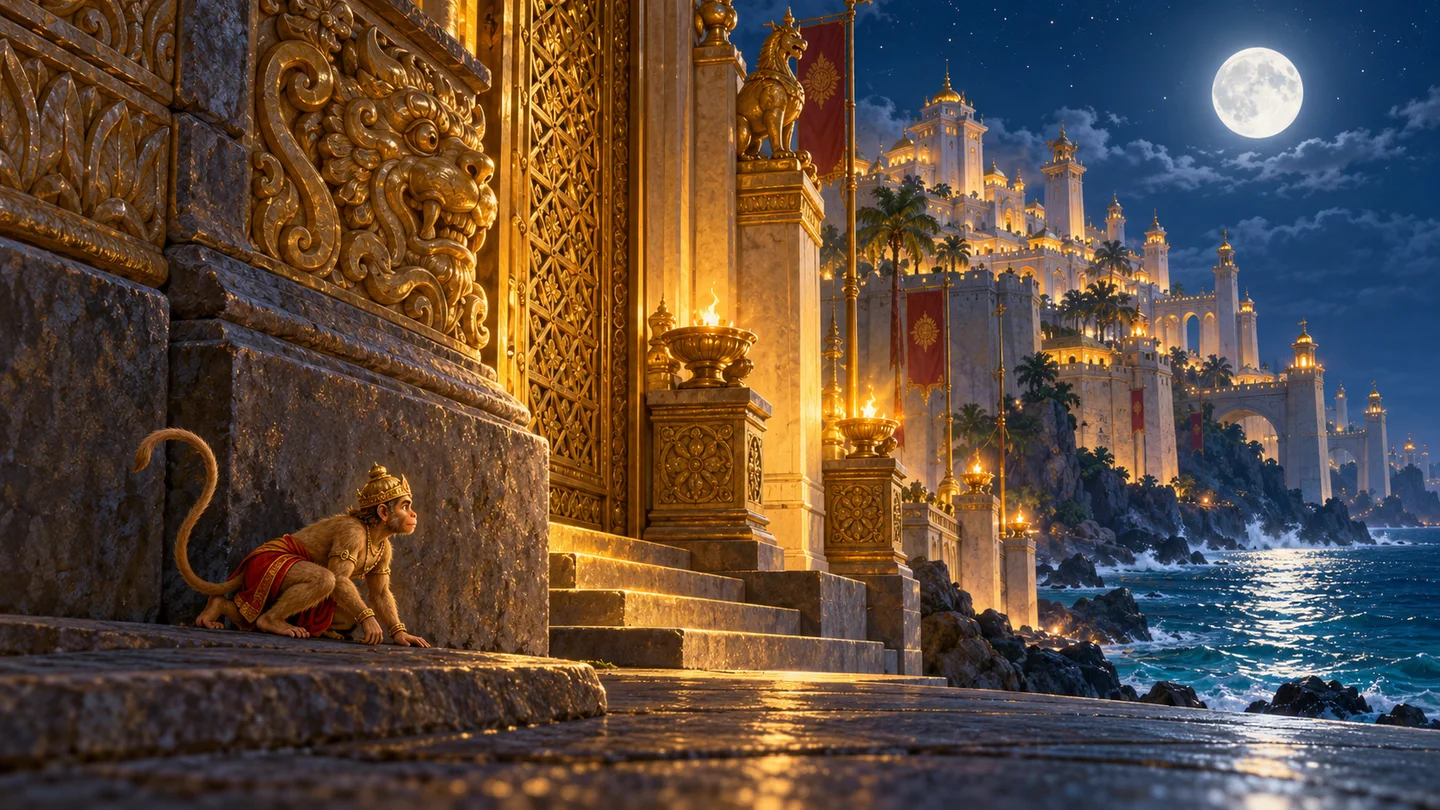
Small beneath the moon At sunset Hanuman becomes the size of a cat. The rising moon lights his approach to the city.
Original DHIH illustration · artistic interpretation Verse 49 · 5.2.49 # Copy link ↗ सूर्ये चास्तं गते रात्रौ देहं संक्षिप्य मारुतिः ।
sūrye cāstaṃ gate rātrau dehaṃ saṃkṣipya mārutiḥ |
When the sun had set and night arrived, the Wind's son reduced his body.
वृषदंशकमात्रोऽथ बभूवाद्भुतदर्शनः ॥
vṛṣadaṃśakamātro’tha babhūvādbhutadarśanaḥ ||
His wondrous appearance was now only the size of a cat.
Verse 50 · 5.2.50 # Copy link ↗ प्रदोषकाले हनुमांस्तूर्णमुत्पत्य वीर्यवान् ।
pradoṣakāle hanumāṃstūrṇamutpatya vīryavān |
At dusk the valiant Hanuman sprang forward swiftly
प्रविवेश पुरीं रम्यां प्रविभक्तमहापथाम् ॥
praviveśa purīṃ ramyāṃ pravibhaktamahāpathām ||
and entered the lovely city with its well-laid-out main roads.
Short meaning With his plan settled, Hanuman begins entering Lanka at night.
Verse 51 · 5.2.51 # Copy link ↗ प्रासादमालाविततां स्तम्भैः काञ्चनसंनिभैः ।
prāsādamālāvitatāṃ stambhaiḥ kāñcanasaṃnibhaiḥ |
Rows of palaces stretched out, with columns shining like gold
शातकुम्भनिभैर्जालैर्गन्धर्वनगरोपमाम् ॥
śātakumbhanibhairjālairgandharvanagaropamām ||
and golden latticework, making the city resemble a city of Gandharvas.
Verse 52 · 5.2.52 # Copy link ↗ सप्तभौमाष्टभौमैश्च स ददर्श महापुरीम् ।
saptabhaumāṣṭabhaumaiśca sa dadarśa mahāpurīm |
He saw great buildings of seven and eight storeys,
तलैः स्फटिकसंकीर्णैः कार्तस्वरविभूषितैः ॥
talaiḥ sphaṭikasaṃkīrṇaiḥ kārtasvaravibhūṣitaiḥ ||
with crystal-inlaid floors and golden adornments.
Verse 53 · 5.2.53 # Copy link ↗ वैदूर्यमणिचित्रैश्च मुक्ताजालविभूषितैः ।
vaidūryamaṇicitraiśca muktājālavibhūṣitaiḥ |
Decorated with varied beryl gems and networks of pearls,
तैस्तैः शुशुभिरे तानि भवनान्यत्र रक्षसाम् ॥
taistaiḥ śuśubhire tāni bhavanānyatra rakṣasām ||
the rakshasas' mansions shone with all these ornaments.
Verse 54 · 5.2.54 # Copy link ↗ काञ्चनानि विचित्राणि तोरणानि च रक्षसाम् ।
kāñcanāni vicitrāṇi toraṇāni ca rakṣasām |
The rakshasas' many splendid golden arches
लंकामुद्योतयामासुः सर्वतः समलंकृताम् ॥
laṃkāmudyotayāmāsuḥ sarvataḥ samalaṃkṛtām ||
lit up Lanka, which was richly adorned on every side.
Verse 55 · 5.2.55 # Copy link ↗ अचिन्त्यामद्भुताकारां दृष्ट्वा लंकां महाकपिः ।
acintyāmadbhutākārāṃ dṛṣṭvā laṃkāṃ mahākapiḥ |
Seeing Lanka's astonishing and almost unimaginable form, the great vanara
आसीद् विषण्णो हृष्टश्च वैदेह्या दर्शनोत्सुकः ॥
āsīd viṣaṇṇo hṛṣṭaśca vaidehyā darśanotsukaḥ ||
felt both apprehensive and delighted, while longing to see Vaidehi.
Verse 56 · 5.2.56 # Copy link ↗ स पाण्डुराविद्धविमानमालिनीं
sa pāṇḍurāviddhavimānamālinīṃ
There stood the renowned city, garlanded with pale, lofty palaces,
महार्हजाम्बूनदजालतोरणाम् ।
mahārhajāmbūnadajālatoraṇām |
with costly golden latticework and gateways,
यशस्विनीं रावणबाहुपालितां
yaśasvinīṃ rāvaṇabāhupālitāṃ
protected by Ravana's strength
क्षपाचरैर्भीमबलैः सुपालिताम् ॥
kṣapācarairbhīmabalaiḥ supālitām ||
and closely guarded by night-wanderers of formidable power.
Verse 57 · 5.2.57 # Copy link ↗ चन्द्रोऽपि साचिव्यमिवास्य कुर्वं-
candro’pi sācivyamivāsya kurvaṃ-
The moon, as though acting as Hanuman's helper,
स्तारागणैर्मध्यगतो विराजन् ।
stārāgaṇairmadhyagato virājan |
shone among the hosts of stars.
ज्योत्स्नावितानेन वितत्य लोका-
jyotsnāvitānena vitatya lokā-
Spreading a canopy of moonlight across the worlds,
नुत्तिष्ठतेऽनेकसहस्ररश्मिः ॥
nuttiṣṭhate’nekasahasraraśmiḥ ||
it rose with its many thousands of rays.
Verse 58 · 5.2.58 # Copy link ↗ शङ्खप्रभं क्षीरमृणालवर्ण-
śaṅkhaprabhaṃ kṣīramṛṇālavarṇa-
Bright as a conch, with the colour of milk and a lotus stalk,
मुद्गच्छमानं व्यवभासमानम् ।
mudgacchamānaṃ vyavabhāsamānam |
the moon rose and shone.
ददर्श चन्द्रं स कपिप्रवीरः
dadarśa candraṃ sa kapipravīraḥ
The foremost vanara watched it,
पोप्लूयमानं सरसीव हंसम् ॥
poplūyamānaṃ sarasīva haṃsam ||
like a swan floating upon a lake.
About this reading Vālmīki Rāmāyaṇa, Sundara Kanda, chapter 2. This reading follows Sanskrit Wikisource revision 354117 , with all 58 numbered verses . Verse divisions and wording vary between editions.
The Sanskrit is preserved with normalized display spacing and line breaks. Some sentences continue across verse boundaries; the English follows that continuity. A yojana is a traditional distance unit, retained without assigning a modern measurement. Shape-changing and celestial beings belong to the epic’s sacred narrative.
English line senses and short meanings are original AI-assisted DHIH renderings checked against this Sanskrit reading; they are not a word-for-word grammatical commentary or a claim of human scholarly certification. Roman transliteration is generated mechanically in IAST. Names may also appear in familiar English spellings.
Sanskrit transcription credit: Wikisource contributors, revision history . The adapted reading text and DHIH English on this chapter page are offered under CC BY-SA 4.0 . The ancient Sanskrit work is in the public domain. Illustrations are separately commissioned AI-generated DHIH artwork.
This retelling simplifies Hanuman’s military observations and internal reflections. The original describes armed guards, possible danger and his decision to enter secretly to search for the abducted Sita. The child-facing lesson is to pause, notice and ask a trusted grown-up when a task feels difficult; it is not advice to enter unfamiliar places alone. The picture story is a separately labelled adaptation for reading with a grown-up. Audio will be added only when suitable recording permissions are available.