Search DHIH library

VĀLMĪKI RĀMĀYAṆA · CHAPTER 31

सर्गः ३१

Rama’s story in the branches

Hanuman softly recounts Dasharatha’s family, Rama’s exile, Sita’s abduction, and the search that has brought him across the sea.

19 versesSanskrit + English1 illustration
Begin reading ↓

An edition-specific reading with original English meanings. Source & reading notes

SCENE 01 · VERSES 1–19

A familiar story from an unseen friend

Hanuman softly recounts Dasharatha’s family, Rama’s exile, Sita’s abduction, and the search that has brought him across the sea.

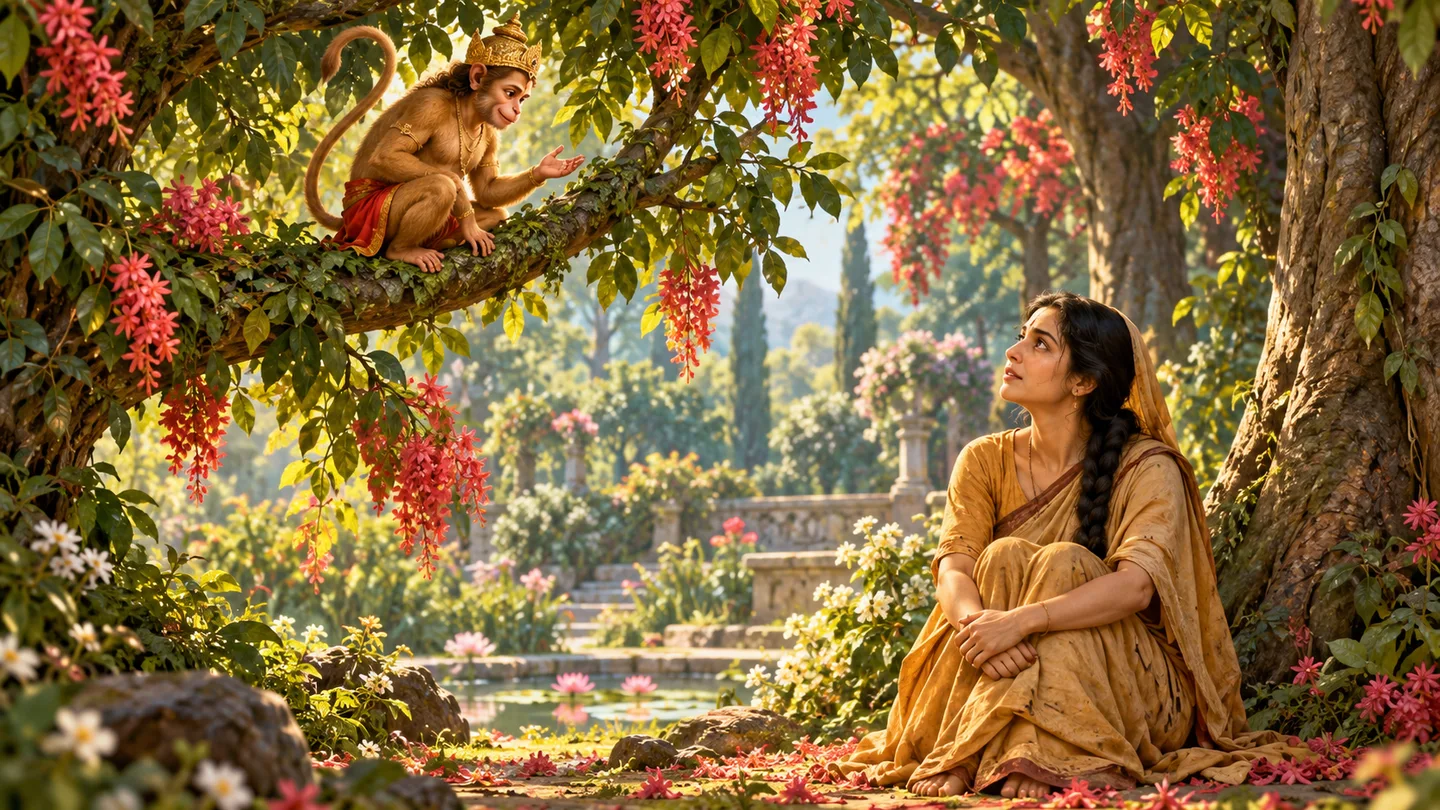
A small Hanuman speaks gently from a leafy branch above Sita.
Original DHIH illustration · artistic interpretation

Verse 1 · 5.31.1

#

एवं बहुविधां चिन्तां चिन्तयित्वा महामतिः ।

Having considered these many matters, the greatly wise one

संश्रवे मधुरं वाक्यं वैदेह्या व्याजहार ह ॥

spoke gentle words within Vaidehi’s hearing.

Verse 2 · 5.31.2

#

राजा दशरथो नाम रथकुञ्जरवाजिमान् ।

“There was a king named Dasharatha, rich in chariots, elephants and horses,

पुण्यशीलो महाकीर्तिरिक्ष्वाकूणां महायशाः ॥

virtuous and greatly renowned among the glorious Ikshvakus.

Verse 3 · 5.31.3

#

राजर्षीणां गुणश्रेष्ठस्तपसा चर्षिभिः समः ।

Foremost in the virtues of royal sages, equal to seers in austerity,

चक्रवर्तिकुले जातः पुरंदरसमो बले ॥

born in a line of universal kings, he equalled Indra in strength.

Verse 4 · 5.31.4

#

अहिंसारतिरक्षुद्रो घृणी सत्यपराक्रमः ।

Delighting in non-injury, generous, compassionate and truly courageous,

मुख्यस्येक्ष्वाकुवंशस्य लक्ष्मीवाँल्लक्ष्मिवर्धनः ॥

he was prosperous and increased the glory of the eminent Ikshvaku line.

Verse 5 · 5.31.5

#

पार्थिवव्यञ्जनैर्युक्तः पृथुश्रीः पार्थिवर्षभः ।

Endowed with royal marks and abundant splendour, foremost of kings,

पृथिव्यां चतुरन्तायां विश्रुतः सुखदः सुखी ॥

he was famous throughout the four-bounded earth, happy and bringing happiness.

Verse 6 · 5.31.6

#

तस्य पुत्रः प्रियो ज्येष्ठस्ताराधिपनिभाननः ।

His beloved eldest son, whose face resembled the moon,

रामो नाम विशेषज्ञः श्रेष्ठः सर्वधनुष्मताम् ॥

was named Rama, discerning and foremost among bowmen.

Verse 7 · 5.31.7

#

रक्षिता स्वस्य वृत्तस्य स्वजनस्यापि रक्षिता ।

A guardian of his own conduct and of his people,

रक्षिता जीवलोकस्य धर्मस्य च परंतपः ॥

that scorcher of foes protected living beings and righteousness.

Verse 8 · 5.31.8

#

तस्य सत्याभिसंधस्य वृद्धस्य वचनात् पितुः ।

At the command of his aged father, true to his promise,

सभार्यः सह च भ्रात्रा वीरः प्रव्रजितो वनम् ॥

the hero went into the forest with his wife and brother.

Verse 9 · 5.31.9

#

तेन तत्र महारण्ये मृगयां परिधावता ।

There, while ranging through the great forest in pursuit of game,

राक्षसा निहताः शूरा बहवः कामरूपिणः ॥

he killed many brave, shape-changing rakshasas.

Verse 10 · 5.31.10

#

जनस्थानवधं श्रुत्वा निहतौ खरदूषणौ ।

Hearing of the slaughter in Janasthana and the deaths of Khara and Dushana,

ततस्त्वमर्षापहृता जानकी रावणेन तु ॥

Ravana, in resentment, abducted Janaki,

Verse 11 · 5.31.11

#

वञ्चयित्वा वने रामं मृगरूपेण मायया ।

after deceiving Rama in the forest through the illusion of a deer.

स मार्गमाणस्तां देवीं रामः सीतामनिन्दिताम् ॥

Searching for that noble, blameless Sita, Rama

Verse 12 · 5.31.12

#

आससाद वने मित्रं सुग्रीवं नाम वानरम् ।

found in the forest a friend, a vanara named Sugriva.

ततः स वालिनं हत्वा रामः परपुरंजयः ॥

Then Rama, conqueror of enemy cities, killed Vali

Verse 13 · 5.31.13

#

आयच्छत् कपिराज्यं तु सुग्रीवाय महात्मने ।

and gave the vanara kingdom to noble Sugriva.

सुग्रीवेणाभिसंदिष्टा हरयः कामरूपिणः ॥

At Sugriva’s command, shape-changing vanaras

Verse 14 · 5.31.14

#

दिक्षु सर्वासु तां देवीं विचिन्वन्तः सहस्रशः ।

went by thousands in every direction to seek that lady.

अहं सम्पातिवचनाच्छतयोजनमायतम् ॥

Following Sampati’s words, I crossed a hundred yojanas

Verse 15 · 5.31.15

#

तस्या हेतोर्विशालाक्ष्याः समुद्रं वेगवान् प्लुतः ।

of ocean with speed for the sake of that wide-eyed lady.

यथारूपां यथावर्णां यथालक्ष्मवतीं च ताम् ॥

Her form, complexion and distinguishing marks,

Verse 16 · 5.31.16

#

अश्रौषं राघवस्याहं सेयमासादिता मया ।

as I heard them from Raghava, match the lady I have now found.”

विररामैवमुक्त्वा स वाचं वानरपुंगवः ॥

Having spoken thus, that foremost vanara fell silent.

Verse 17 · 5.31.17

#

जानकी चापि तच्छ्रुत्वा विस्मयं परमं गता ।

Hearing this, Janaki was filled with great astonishment.

ततः सा वक्रकेशान्ता सुकेशी केशसंवृतम् ।

Then the fearful lady with lovely curling hair lifted her face,

उन्नम्य वदनं भीरुः शिंशपामन्ववैक्षत ॥

which her hair had covered, and looked into the shimshapa tree.

Verse 18 · 5.31.18

#

निशम्य सीता वचनं कपेश्च

Hearing the vanara’s words, Sita

दिशश्च सर्वाः प्रदिशश्च वीक्ष्य ।

looked in every direction and quarter;

स्वयं प्रहर्षं परमं जगाम

she herself felt the deepest joy,

सर्वात्मना राममनुस्मरन्ती ॥

remembering Rama with her whole being.

Verse 19 · 5.31.19

#

सा तिर्यगूर्ध्वं च तथा ह्यधस्ता-

Looking sideways, upwards and down,

न्निरीक्षमाणा तमचिन्त्यबुद्धिम् ।

she saw that being of inconceivable intelligence,

ददर्श पिंगाधिपतेरमात्यं

the vanara king’s minister,

वातात्मजं सूर्यमिवोदयस्थम् ॥

the Wind’s son, bright as the rising sun.

CHAPTER 31 COMPLETE

The journey continues.

Sita listens to the unexpected account and searches for its speaker.

NEXT CHAPTER

Continue Hanuman’s journey in the next chapter.

About this reading

Vālmīki Rāmāyaṇa, Sundara Kanda, chapter 31. This reading follows Sanskrit Wikisource revision 354738, with all 19 numbered verses. Verse divisions and wording vary between editions.

The Sanskrit is preserved with normalized display spacing and line breaks. Some sentences continue across verse boundaries; the English follows that continuity. A yojana is a traditional distance unit, retained without assigning a modern measurement. Shape-changing and celestial beings belong to the epic’s sacred narrative.

English line senses and short meanings are original AI-assisted DHIH renderings checked against this Sanskrit reading; they are not a word-for-word grammatical commentary or a claim of human scholarly certification. Roman transliteration is generated mechanically in IAST. Names may also appear in familiar English spellings.

Sanskrit transcription credit: Wikisource contributors, revision history. The adapted reading text and DHIH English on this chapter page are offered under CC BY-SA 4.0. The ancient Sanskrit work is in the public domain. Illustrations are separately commissioned AI-generated DHIH artwork.

Historical comparison: M. N. Dutt’s Ramayana, volume II, a public-domain translation, was consulted for narrative context. The English displayed here is a fresh rendering of the pinned Sanskrit, not a reproduction of that translation.

This is Hanuman’s brief account of earlier events within the larger Ramayana, rather than a complete retelling of those books. Audio will be added only when suitable recording permissions are available.