Search DHIH library

VĀLMĪKI RĀMĀYAṆA · CHAPTER 40

सर्गः ४०

Farewell in the ashoka grove

Sita gives Hanuman her final reminders and greetings for Rama and his companions. He receives the jewel, bows to her, and considers what remains before returning north.

25 versesSanskrit + English1 illustration
Begin reading ↓

An edition-specific reading with original English meanings. Source & reading notes

SCENE 01 · VERSES 1–25

The message entrusted to Hanuman

Sita gives Hanuman her final reminders and greetings for Rama and his companions. He receives the jewel, bows to her, and considers what remains before returning north.

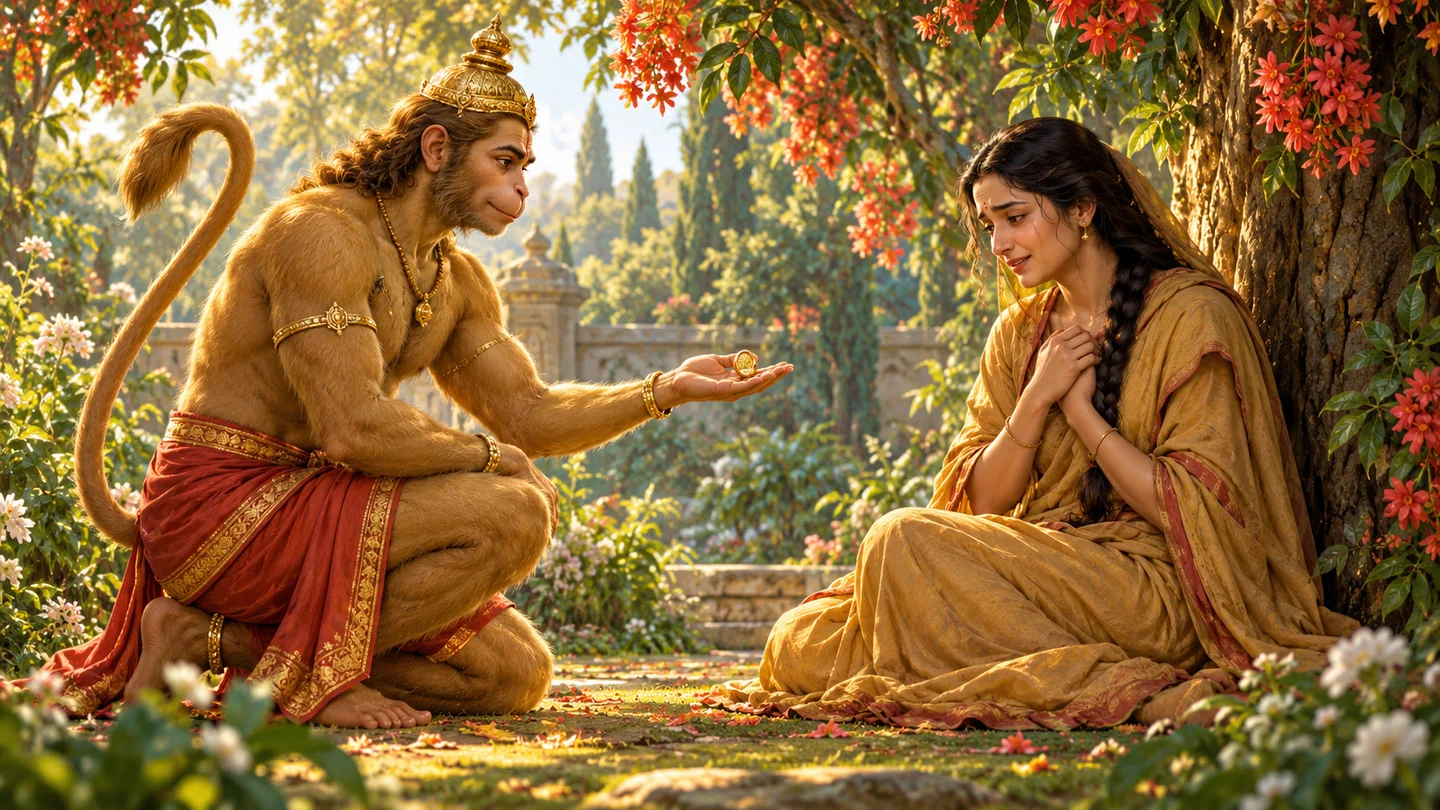
Hanuman respectfully presents Rama’s small ring to Sita in the garden.
Original DHIH illustration · artistic interpretation

Verse 1 · 5.40.1

#

श्रुत्वा तु वचनं तस्य वायुसूनोर्महात्मनः ।

Hearing the words of that noble son of the Wind,

उवाचात्महितं वाक्यं सीता सुरसुतोपमा ॥

Sita, lovely as a daughter of the gods, spoke about what would help her.

Verse 2 · 5.40.2

#

त्वां दृष्ट्वा प्रियवक्तारं सम्प्रहृष्यामि वानर ।

Seeing you, bearer of welcome words, fills me with joy, O vanara,

अर्धसंजातसस्येव वृष्टिं प्राप्य वसुंधरा ॥

like the earth receiving rain when its crop is only half grown.

Verse 3 · 5.40.3

#

यथा तं पुरुषव्याघ्रं गात्रैः शोकाभिकर्शितैः ।

Show me such compassion that, with these limbs worn thin by grief,

संस्पृशेयं सकामाहं तथा कुरु दयां मयि ॥

I may fulfil my longing to embrace that foremost of men.

Verse 4 · 5.40.4

#

अभिज्ञानं च रामस्य दद्या हरिगणोत्तम ।

Give Rama this token of recognition, best among the vanaras:

क्षिप्तामिषीकां काकस्य कोपादेकाक्षिशातनीम् ॥

the blade of grass he angrily cast at the crow, destroying one of its eyes.

Verse 5 · 5.40.5

#

मनःशिलायास्तिलको गण्डपार्श्वे निवेशितः ।

When my forehead mark had been rubbed away, you placed a mark of red mineral pigment

त्वया प्रणष्टे तिलके तं किल स्मर्तुमर्हसि ॥

beside my cheek: surely you should remember that.

Verse 6 · 5.40.6

#

स वीर्यवान् कथं सीतां हृतां समनुमन्यसे ।

You are mighty, like Indra and Varuna: how can you allow Sita,

वसन्तीं रक्षसां मध्ये महेन्द्रवरुणोपम ॥

carried away, to remain among the rakshasas?

Verse 7 · 5.40.7

#

एष चूडामणिर्दिव्यो मया सुपरिरक्षितः ।

I have carefully preserved this divine crest-jewel;

एतं दृष्ट्वा प्रहृष्यामि व्यसने त्वामिवानघ ॥

in my suffering I rejoice on seeing it, as though I were seeing you, blameless one.

Verse 8 · 5.40.8

#

एष निर्यातितः श्रीमान् मया ते वारिसम्भवः ।

I now send you this splendid jewel born from the waters;

अतः परं न शक्ष्यामि जीवितुं शोकलालसा ॥

beyond this I cannot keep living, overwhelmed by sorrow.

Verse 9 · 5.40.9

#

असह्यानि च दुःखानि वाचश्च हृदयच्छिदः ।

For your sake I endure unbearable troubles, words that pierce the heart,

राक्षसैः सह संवासं त्वत्कृते मर्षयाम्यहम् ॥

and this life among the rakshasas.

Verse 10 · 5.40.10

#

धारयिष्यामि मासं तु जीवितं शत्रुसूदन ।

I shall preserve my life for one month, destroyer of enemies;

मासादूर्ध्वं न जीविष्ये त्वया हीना नृपात्मज ॥

beyond a month I cannot live without you, prince.

Verse 11 · 5.40.11

#

घोरो राक्षसराजोऽयं दृष्टिश्च न सुखा मयि ।

This rakshasa king is dreadful, and his look towards me is hostile;

त्वां च श्रुत्वा विषज्जन्तं न जीवेयमपि क्षणम् ॥

if I heard that you were losing heart, I could not live even a moment.

Verse 12 · 5.40.12

#

वैदेह्या वचनं श्रुत्वा करुणं साश्रुभाषितम् ।

Hearing Vaidehi’s sorrowful words, spoken through tears,

अथाब्रवीन्महातेजा हनूमान् मारुतात्मजः ॥

the radiant Hanuman, son of the Wind, replied.

Verse 13 · 5.40.13

#

त्वच्छोकविमुखो रामो देवि सत्येन ते शपे ।

Lady, Rama is turned away from everything by grief for you; I swear this truth to you.

रामे शोकाभिभूते तु लक्ष्मणः परितप्यते ॥

And when Rama is overcome by sorrow, Lakshmana suffers too.

Verse 14 · 5.40.14

#

दृष्टा कथंचिद् भवती न कालः परिदेवितुम् ।

Somehow you have at last been found; this is no time to lament.

इमं मुहूर्तं दुःखानामन्तं द्रक्ष्यसि भामिनि ॥

Very soon, fair lady, you will see the end of your troubles.

Verse 15 · 5.40.15

#

तावुभौ पुरुषव्याघ्रौ राजपुत्रावनिन्दितौ ।

Those two blameless princes, foremost among men,

त्वद्दर्शनकृतोत्साहौ लङ्कां भस्मीकरिष्यतः ॥

eager to see you, will reduce Lanka to ashes.

Verse 16 · 5.40.16

#

हत्वा तु समरे रक्षो रावणं सहबान्धवैः ।

After killing the rakshasa Ravana and his kinsmen in battle,

राघवौ त्वां विशालाक्षि स्वां पुरीं प्रति नेष्यतः ॥

the two descendants of Raghu will take you, wide-eyed lady, back to their own city.

Verse 17 · 5.40.17

#

यत्तु रामो विजानीयादभिज्ञानमनिन्दिते ।

You should give me some further token, blameless lady,

प्रीतिसंजननं भूयस्तस्य त्वं दातुमर्हसि ॥

that Rama will recognise and that will bring him joy.

Verse 18 · 5.40.18

#

साब्रवीद् दत्तमेवाहो मयाभिज्ञानमुत्तमम् ।

She said: I have already given an excellent token.

एतदेव हि रामस्य दृष्ट्वा यत्नेन भूषणम् ॥

For when Rama sees this very ornament and considers it carefully—

Verse 19 · 5.40.19

#

श्रद्धेयं हनुमन् वाक्यं तव वीर भविष्यति ।

Your words, heroic Hanuman, will be believed.

स तं मणिवरं गृह्य श्रीमान् प्लवगसत्तमः ॥

Taking that precious jewel, the illustrious foremost of vanaras—

Verse 20 · 5.40.20

#

प्रणम्य शिरसा देवीं गमनायोपचक्रमे ।

bowed his head to the lady and prepared to depart.

तमुत्पातकृतोत्साहमवेक्ष्य हरियूथपम् ॥

Seeing that leader of the vanaras eager to leap away—

Verse 21 · 5.40.21

#

वर्धमानं महावेगमुवाच जनकात्मजा ।

growing in size and filled with great speed, Janaka’s daughter spoke,

अश्रुपूर्णमुखी दीना बाष्पगद‍्गदया गिरा ॥

her face full of tears, distressed, and her voice choked with sobs.

Verse 22 · 5.40.22

#

हनूमन् सिंहसंकाशौ भ्रातरौ रामलक्ष्मणौ ।

Hanuman, convey my wish for their well-being to the lion-like brothers Rama and Lakshmana,

सुग्रीवं च सहामात्यं सर्वान् ब्रूया अनामयम् ॥

to Sugriva with his ministers, and to them all.

Verse 23 · 5.40.23

#

यथा च स महाबाहुर्मां तारयति राघवः ।

You must arrange matters so that the mighty-armed descendant of Raghu

अस्माद् दुःखाम्बुसंरोधात् त्वं समाधातुमर्हसि ॥

carries me across this enclosing flood of sorrow.

Verse 24 · 5.40.24

#

इदं च तीव्रं मम शोकवेगं

And this fierce surge of my grief,

रक्षोभिरेभिः परिभर्त्सनं च ।

and the threats of these rakshasas—

ब्रूयास्तु रामस्य गतः समीपं

tell Rama of them when you come into his presence;

शिवश्च तेऽध्वास्तु हरिप्रवीर ॥

and may your journey be blessed, heroic vanara.

Verse 25 · 5.40.25

#

स राजपुत्र्या प्रतिवेदितार्थः

Having understood the princess’s message,

कपिः कृतार्थः परिहृष्टचेताः ।

the vanara, successful in his mission and delighted at heart,

तदल्पशेषं प्रसमीक्ष्य कार्यं

considered the little that remained to be done

दिशं ह्युदीचीं मनसा जगाम ॥

and turned his thoughts towards the north.

CHAPTER 40 COMPLETE

The journey continues.

Sita’s message is entrusted to Hanuman, who turns towards the return journey.

NEXT CHAPTER

Continue Hanuman’s journey in the next chapter.

About this reading

Vālmīki Rāmāyaṇa, Sundara Kanda, chapter 40. This reading follows Sanskrit Wikisource revision 354801, with all 25 numbered verses. Verse divisions and wording vary between editions.

The Sanskrit is preserved with normalized display spacing and line breaks. Some sentences continue across verse boundaries; the English follows that continuity. A yojana is a traditional distance unit, retained without assigning a modern measurement. Shape-changing and celestial beings belong to the epic’s sacred narrative.

English line senses and short meanings are original AI-assisted DHIH renderings checked against this Sanskrit reading; they are not a word-for-word grammatical commentary or a claim of human scholarly certification. Roman transliteration is generated mechanically in IAST. Names may also appear in familiar English spellings.

Sanskrit transcription credit: Wikisource contributors, revision history. The adapted reading text and DHIH English on this chapter page are offered under CC BY-SA 4.0. The ancient Sanskrit work is in the public domain. Illustrations are separately commissioned AI-generated DHIH artwork.

Historical comparison: M. N. Dutt’s Ramayana, volume II, a public-domain translation, was consulted for narrative context. The English displayed here is a fresh rendering of the pinned Sanskrit, not a reproduction of that translation.

Sita’s distress includes a stated limit to how long she feels able to endure. The passage expresses the urgency of rescue within the epic, rather than advice about responding to suffering. Audio will be added only when suitable recording permissions are available.