Search DHIH library

VĀLMĪKI RĀMĀYAṆA · CHAPTER 41

सर्गः ४१

Hanuman tests Lanka’s strength

Before returning, Hanuman decides to learn more about Ravana’s forces. He destroys the pleasure grove to provoke a military response and waits at its gateway.

21 versesSanskrit + English1 illustration
Begin reading ↓

An edition-specific reading with original English meanings. Source & reading notes

SCENE 01 · VERSES 1–21

A deliberate challenge

Before returning, Hanuman decides to learn more about Ravana’s forces. He destroys the pleasure grove to provoke a military response and waits at its gateway.

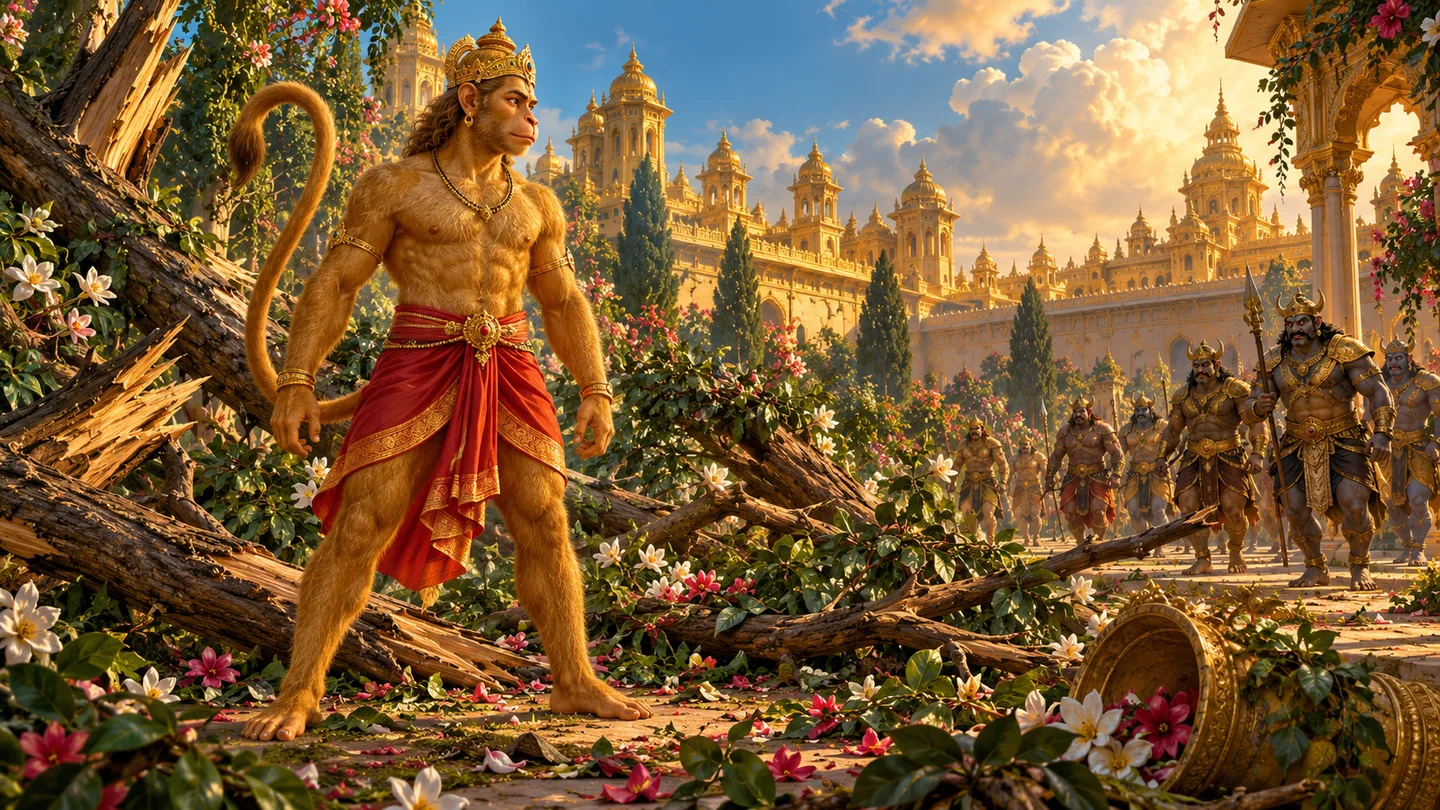
Hanuman stands firm in a disturbed garden while armed guards remain in the distance.
Original DHIH illustration · artistic interpretation

Verse 1 · 5.41.1

#

स च वाग्भिः प्रशस्ताभिर्गमिष्यन् पूजितस्तया ।

Honoured by her gracious words as he was about to leave,

तस्माद् देशादपाक्रम्य चिन्तयामास वानरः ॥

the vanara moved away from that place and began to reflect.

Verse 2 · 5.41.2

#

अल्पशेषमिदं कार्यं दृष्टेयमसितेक्षणा ।

Little remains of this mission: I have seen the dark-eyed lady.

त्रीनुपायानतिक्रम्य चतुर्थ इह दृश्यते ॥

Setting aside the first three methods, the fourth seems suitable here.

Verse 3 · 5.41.3

#

न साम रक्षःसु गुणाय कल्पते

Conciliation will not produce a useful result among these rakshasas;

न दानमर्थोपचितेषु युज्यते ।

gifts have no place with people already rich.

न भेदसाध्या बलदर्पिता जनाः

Those proud of their strength cannot be won by sowing division;

पराक्रमस्त्वेष ममेह रोचते ॥

a display of force is what appeals to me here.

Verse 4 · 5.41.4

#

न चास्य कार्यस्य पराक्रमादृते

Without a display of force,

विनिश्चयः कश्चिदिहोपपद्यते ।

no firm assessment of this task is possible here.

हतप्रवीराश्च रणे तु राक्षसाः

If their leading warriors are killed in battle today,

कथंचिदीयुर्यदिहाद्य मार्दवम् ॥

the rakshasas might perhaps become less arrogant.

Verse 5 · 5.41.5

#

कार्ये कर्मणि निर्वृत्ते यो बहून्यपि साधयेत् ।

One who, after finishing the assigned work, achieves other purposes too

पूर्वकार्याविरोधेन स कार्यं कर्तुमर्हति ॥

without obstructing the first task is fit to undertake a mission.

Verse 6 · 5.41.6

#

न ह्येकः साधको हेतुः स्वल्पस्यापीह कर्मणः ।

Even a small undertaking does not have only one means of success.

यो ह्यर्थं बहुधा वेद स समर्थोऽर्थसाधने ॥

One who understands an objective in several ways is capable of accomplishing it.

Verse 7 · 5.41.7

#

इहैव तावत्कृतनिश्चयो ह्यहं

Only after making a firm assessment here

व्रजेयमद्य प्लवगेश्वरालयम् ।

should I return today to the lord of the vanaras.

परात्मसम्मर्दविशेषतत्त्ववित्

Knowing the true difference between our strength and the enemy’s in conflict,

ततः कृतं स्यान्मम भर्तृशासनम् ॥

I shall then have fully carried out my master’s command.

Verse 8 · 5.41.8

#

कथं नु खल्वद्य भवेत् सुखागतं

How might a battle with the rakshasas

प्रसह्य युद्धं मम राक्षसैः सह ।

come about here today through a direct challenge from me,

तथैव खल्वात्मबलं च सारवत्

so that the ten-headed king brings his substantial forces

समानयेन्मां च रणे दशाननः ॥

and confronts me in combat?

Verse 9 · 5.41.9

#

ततः समासाद्य रणे दशाननं

Then, confronting the ten-headed king in battle

समन्त्रिवर्गं सबलं सयायिनम् ।

with his ministers, forces, and followers,

हृदि स्थितं तस्य मतं बलं च

I could readily learn his intentions and strength

सुखेन मत्वाहमितः पुनर्व्रजे ॥

and return from here.

Verse 10 · 5.41.10

#

इदमस्य नृशंसस्य नन्दनोपममुत्तमम् ।

Here is this cruel king’s splendid grove, like Nandana,

वनं नेत्रमनःकान्तं नानाद्रुमलतायुतम् ॥

pleasing to the eye and mind, full of different trees and vines.

Verse 11 · 5.41.11

#

इदं विध्वंसयिष्यामि शुष्कं वनमिवानलः ।

I shall destroy it as fire consumes a dry forest.

अस्मिन् भग्ने ततः कोपं करिष्यति स रावणः ॥

When it is broken, Ravana will become angry.

Verse 12 · 5.41.12

#

ततो महत्साश्वमहारथद्विपं

Then a great force with horses, mighty chariots, and elephants

बलं समानेष्यति राक्षसाधिपः ।

will be brought out by the rakshasa king,

त्रिशूलकालायसपट्टिशायुधं

armed with tridents and iron-bladed weapons;

ततो महद्युद्धमिदं भविष्यति ॥

and a great battle will follow.

Verse 13 · 5.41.13

#

अहं च तैः संयति चण्डविक्रमैः

Meeting those rakshasas of fierce prowess in combat,

समेत्य रक्षोभिरभङ्गविक्रमः ।

I, whose strength is unbroken,

निहत्य तद् रावणचोदितं बलं

will destroy the force sent by Ravana

सुखं गमिष्यामि हरीश्वरालयम् ॥

and return safely to the lord of the vanaras.

Verse 14 · 5.41.14

#

ततो मारुतवत् क्रुद्धो मारुतिर्भीमविक्रमः ।

Then the Wind’s son, fierce in prowess and angry like a storm,

ऊरुवेगेन महता द्रुमान् क्षेप्तुमथारभत् ॥

began hurling down trees with the tremendous force of his thighs.

Verse 15 · 5.41.15

#

ततस्तद्धनुमान् वीरो बभञ्ज प्रमदावनम् ।

The heroic Hanuman shattered the pleasure grove,

मत्तद्विजसमाघुष्टं नानाद्रुमलतायुतम् ॥

resounding with excited birds and filled with many trees and vines.

Verse 16 · 5.41.16

#

तद्वनं मथितैर्वृक्षैर्भिन्नैश्च सलिलाशयैः ।

With its trees crushed, its pools broken,

चूर्णितैः पर्वताग्रैश्च बभूवाप्रियदर्शनम् ॥

and its rocky heights pulverised, the grove became an unpleasant sight.

Verse 17 · 5.41.17

#

नानाशकुन्तविरुतैः प्रभिन्नसलिलाशयैः ।

With the cries of many birds, shattered pools,

ताम्रैः किसलयैः क्लान्तैः क्लान्तद्रुमलतायुतैः ॥

reddened young leaves drooping, and trees and vines hanging limp—

Verse 18 · 5.41.18

#

न बभौ तद् वनं तत्र दावानलहतं यथा ।

the forest no longer shone, as though struck by a forest fire.

व्याकुलावरणा रेजुर्विह्वला इव ता लताः ॥

Its vines, with their supports thrown into confusion, seemed distressed themselves.

Verse 19 · 5.41.19

#

लतागृहैश्चित्रगृहैश्च सादितै-

With bowers and decorated pavilions brought down,

र्व्यालैर्मृगैरार्तरवैश्च पक्षिभिः ।

beasts, deer, and birds crying in anguish,

शिलागृहैरुन्मथितैस्तथा गृहैः

and stone houses and other dwellings torn apart,

प्रणष्टरूपं तदभून्महद् वनम् ॥

that great grove lost its beauty.

Verse 20 · 5.41.20

#

सा विह्वलाशोकलताप्रताना

The woodland floor, once spread with flourishing ashoka growth,

वनस्थली शोकलताप्रताना ।

became a place spread with grief-stricken vines.

जाता दशास्यप्रमदावनस्य

Such was the change in the ten-headed king’s pleasure grove

कपेर्बलाद्धि प्रमदावनस्य ॥

through the strength of the vanara who ruined that pleasure grove.

Verse 21 · 5.41.21

#

ततः स कृत्वा जगतीपतेर्महान्

Having inflicted this great hurt on the mind

महद् व्यलीकं मनसो महात्मनः ।

of the powerful ruler of the earth,

युयुत्सुरेको बहुभिर्महाबलैः

the vanara, eager to fight alone against many mighty opponents,

श्रिया ज्वलंस्तोरणमाश्रितः कपिः ॥

stood on the gateway, blazing with splendour.

CHAPTER 41 COMPLETE

The journey continues.

The ruined grove becomes the starting point for a new confrontation.

NEXT CHAPTER

Continue Hanuman’s journey in the next chapter.

About this reading

Vālmīki Rāmāyaṇa, Sundara Kanda, chapter 41. This reading follows Sanskrit Wikisource revision 354972, with all 21 numbered verses. Verse divisions and wording vary between editions.

The Sanskrit is preserved with normalized display spacing and line breaks. Some sentences continue across verse boundaries; the English follows that continuity. A yojana is a traditional distance unit, retained without assigning a modern measurement. Shape-changing and celestial beings belong to the epic’s sacred narrative.

English line senses and short meanings are original AI-assisted DHIH renderings checked against this Sanskrit reading; they are not a word-for-word grammatical commentary or a claim of human scholarly certification. Roman transliteration is generated mechanically in IAST. Names may also appear in familiar English spellings.

Sanskrit transcription credit: Wikisource contributors, revision history. The adapted reading text and DHIH English on this chapter page are offered under CC BY-SA 4.0. The ancient Sanskrit work is in the public domain. Illustrations are separately commissioned AI-generated DHIH artwork.

Historical comparison: M. N. Dutt’s Ramayana, volume II, a public-domain translation, was consulted for narrative context. The English displayed here is a fresh rendering of the pinned Sanskrit, not a reproduction of that translation.

This is a violent strategic episode in the full epic. Hanuman’s assessment of force applies to his fictional military mission and is not a general lesson that destruction resolves conflict. Audio will be added only when suitable recording permissions are available.