Search DHIH library

VĀLMĪKI RĀMĀYAṆA · CHAPTER 54

सुन्दरकाण्डम् · सर्गः 54

Lanka in flames

Hanuman carries fire across Lanka’s buildings, sparing Vibhishana’s house. The chapter describes both his overwhelming force and the suffering within the burning city.

51 versesSanskrit + English1 illustration
Begin reading ↓

An edition-specific reading with original English meanings. Source & reading notes

SCENE 01 · VERSES 1–51

The cost of the conflagration

The narrative follows the spreading fire, the inhabitants’ distress and Hanuman’s return of thought to Rama.

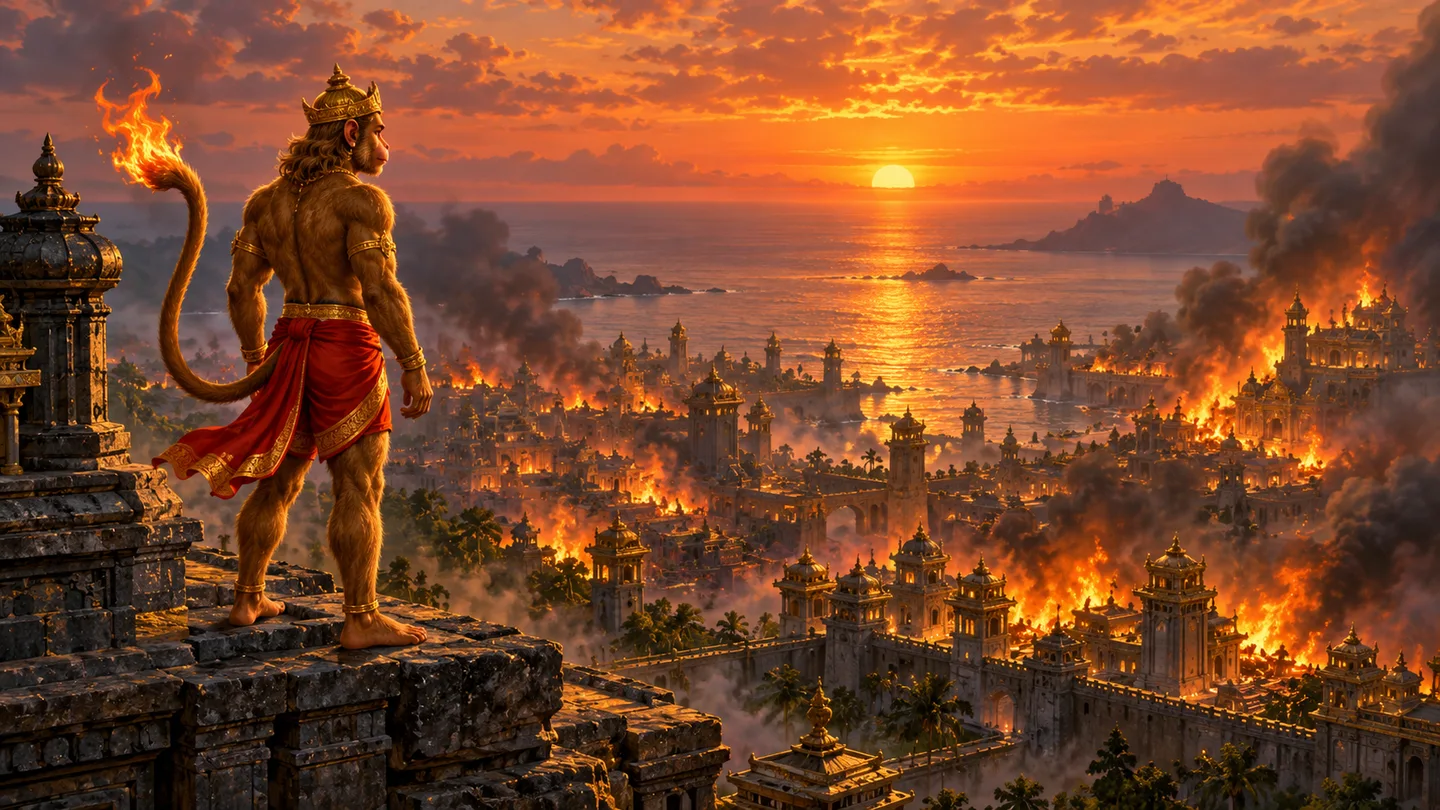
Hanuman looks across Lanka’s glowing rooftops during the epic fire episode.
Original DHIH illustration · artistic interpretation

Verse 1 · 5.54.1

#

वीक्षमाणस्ततो लङ्कां कपिः कृतमनोरथः ।

Looking over Lanka after accomplishing his immediate purpose,

वर्धमानसमुत्साहः कार्यशेषमचिन्तयत् ॥

the vanara's enthusiasm grew as he considered what remained.

Verse 2 · 5.54.2

#

किं नु खल्ववशिष्टं मे कर्तव्यमिह साम्प्रतम् ।

'What remains for me to do here now

यदेषां रक्षसां भूयः संतापजननं भवेत् ॥

that would bring further distress to these rakshasas?

Verse 3 · 5.54.3

#

वनं तावत्प्रमथितं प्रकृष्टा राक्षसा हताः ।

The grove is wrecked, eminent rakshasas killed,

बलैकदेशः क्षपितः शेषं दुर्गविनाशनम् ॥

and part of the army destroyed; the fortress remains to be ruined.

Verse 4 · 5.54.4

#

दुर्गे विनाशिते कर्म भवेत् सुखपरिश्रमम् ।

If the fortress is destroyed, my labour will bear further fruit;

अल्पयत्नेन कार्येऽस्मिन् मम स्यात् सफलः श्रमः ॥

a little additional effort will make this undertaking successful.

Verse 5 · 5.54.5

#

यो ह्ययं मम लाङ्गूले दीप्यते हव्यवाहनः ।

The bearer of offerings burns upon my tail;

अस्य संतर्पणं न्याय्यं कर्तुमेभिर्गृहोत्तमैः ॥

it is fitting to feed this fire with these splendid houses.'

Verse 6 · 5.54.6

#

ततः प्रदीप्तलाङ्गूलः सविद्युदिव तोयदः ।

With his tail aflame, like a cloud carrying lightning,

भवनाग्रेषु लङ्काया विचचार महाकपिः ॥

the great vanara moved across Lanka's rooftops.

Verse 7 · 5.54.7

#

गृहाद् गृहं राक्षसानामुद्यानानि च वानरः ।

Fearlessly he passed from rakshasa house to house,

वीक्षमाणो ह्यसंत्रस्तः प्रासादांश्च चचार सः ॥

surveying gardens and travelling across lofty mansions.

Verse 8 · 5.54.8

#

अवप्लुत्य महावेगः प्रहस्तस्य निवेशनम् ।

Leaping onto Prahasta's residence,

अग्निं तत्र विनिक्षिप्य श्वसनेन समो बली ॥

that mighty one, swift as the wind, set fire to it.

Verse 9 · 5.54.9

#

ततोऽन्यत् पुप्लुवे वेश्म महापार्श्वस्य वीर्यवान् ।

Then the powerful Hanuman leapt to Mahaparshva's house

मुमोच हनुमानग्निं कालानलशिखोपमम् ॥

and released fire like the flame of final destruction.

Verse 10 · 5.54.10

#

वज्रदंष्ट्रस्य च तथा पुप्लुवे स महाकपिः ।

The radiant great vanara also leapt to Vajradamshtra's house,

शुकस्य च महातेजाः सारणस्य च धीमतः ॥

to Shuka's, and to the house of wise Sarana.

Verse 11 · 5.54.11

#

तथा चेन्द्रजितो वेश्म ददाह हरियूथपः ।

The vanara leader likewise burned Indrajit's residence,

जम्बुमालेः सुमालेश्च ददाह भवनं ततः ॥

and then the houses of Jambumali and Sumali.

Verse 12 · 5.54.12

#

रश्मिकेतोश्च भवनं सूर्यशत्रोस्तथैव च ।

He burned the houses of Rashmiketu and Suryashatru,

ह्रस्वकर्णस्य दंष्ट्रस्य रोमशस्य च रक्षसः ॥

Hrasvakarna, Damshtra and the rakshasa Romasha.

Verse 13 · 5.54.13

#

युद्धोन्मत्तस्य मत्तस्य ध्वजग्रीवस्य रक्षसः ।

Those of Yuddhonmatta, Matta and the rakshasa Dhvajagriva,

विद्युज्जिह्वस्य घोरस्य तथा हस्तिमुखस्य च ॥

terrible Vidyujjihva and Hastimukha were also burned.

Verse 14 · 5.54.14

#

करालस्य विशालस्य शोणिताक्षस्य चैव हि ।

The houses of Karala, Vishala and Shonitaksha,

कुम्भकर्णस्य भवनं मकराक्षस्य चैव हि ॥

and those of Kumbhakarna and Makaraksha, were burned.

Verse 15 · 5.54.15

#

नरान्तकस्य कुम्भस्य निकुम्भस्य दुरात्मनः ।

So were those of Narantaka, Kumbha, wicked Nikumbha,

यज्ञशत्रोश्च भवनं ब्रह्मशत्रोस्तथैव च ॥

Yajnashatru and Brahmashatru.

Verse 16 · 5.54.16

#

वर्जयित्वा महातेजा विभीषणगृहं प्रति ।

Passing onward in succession, the radiant foremost vanara

क्रममाणः क्रमेणैव ददाह हरिपुङ्गवः ॥

burned the residences, but spared Vibhishana's house.

Verse 17 · 5.54.17

#

तेषु तेषु महार्हेषु भवनेषु महायशाः ।

In those costly mansions and residences of the wealthy,

गृहेष्वृद्धिमतामृद्धिं ददाह कपिकुञ्जरः ॥

the renowned foremost vanara burned their accumulated riches.

Verse 18 · 5.54.18

#

सर्वेषां समतिक्रम्य राक्षसेन्द्रस्य वीर्यवान् ।

Having passed beyond all these, that mighty and splendid one

आससादाथ लक्ष्मीवान् रावणस्य निवेशनम् ॥

reached the residence of Ravana, the rakshasa king.

Verse 19 · 5.54.19

#

ततस्तस्मिन् गृहे मुख्ये नानारत्नविभूषिते ।

There, in that foremost palace adorned with many jewels,

मेरुमन्दरसंकाशे नानामङ्गलशोभिते ॥

like Meru or Mandara and bright with auspicious ornaments—

Verse 20 · 5.54.20

#

प्रदीप्तमग्निमुत्सृज्य लाङ्गूलाग्रे प्रतिष्ठितम् ।

the hero Hanuman released the blazing fire from his tail

ननाद हनुमान् वीरो युगान्तजलदो यथा ॥

and roared like a cloud at the end of an age.

Verse 21 · 5.54.21

#

श्वसनेन च संयोगादतिवेगो महाबलः ।

Joined with the wind, the immensely powerful fire gathered speed,

कालाग्निरिव जज्वाल प्रावर्धत हुताशनः ॥

growing and blazing like the fire of Time.

Verse 22 · 5.54.22

#

प्रदीप्तमग्निं पवनस्तेषु वेश्मसु चारयन् ।

The wind spread the blazing fire through the mansions,

तानि काञ्चनजालानि मुक्तामणिमयानि च ॥

among their golden lattices and ornaments of pearls and gems—

Verse 23 · 5.54.23

#

भवनानि व्यशीर्यन्त रत्नवन्ति महान्ति च ।

and the great jewel-filled houses broke apart;

तानि भग्नविमानानि निपेतुर्वसुधातले ॥

their lofty structures shattered and fell to the earth.

Verse 24 · 5.54.24

#

भवनानीव सिद्धानामम्बरात् पुण्यसंक्षये ।

Like celestial dwellings falling when their occupants' merit is spent, they fell;

संजज्ञे तुमुलः शब्दो राक्षसानां प्रधावताम् ॥

a tumult arose from rakshasas running everywhere.

Verse 25 · 5.54.25

#

स्वे स्वे गृहपरित्राणे भग्नोत्साहोज्झितश्रियाम् ।

Disheartened as they tried to save their homes and lost their wealth,

नूनमेषोऽग्निरायातः कपिरूपेण हा इति ॥

they cried, 'Alas, surely Fire himself has come in a vanara's form!'

Verse 26 · 5.54.26

#

क्रन्दन्त्यः सहसा पेतुः स्तनंधयधराः स्त्रियः ।

Some women, screaming and holding nursing infants,

काश्चिदग्निपरीताङ्ग्यो हर्म्येभ्यो मुक्तमूर्धजाः ॥

fell from the mansions, their hair loose and their bodies surrounded by flames.

Verse 27 · 5.54.27

#

पतन्त्योरेजिरेऽभ्रेभ्यः सौदामन्य इवाम्बरात् ।

Falling, they appeared like lightning descending from clouds.

वज्रविद्रुमवैदूर्यमुक्तारजतसंहतान् ॥

Diamonds, coral, cat's-eye gems, pearls and masses of silver—

Verse 28 · 5.54.28

#

विचित्रान् भवनाद्धातून् स्यन्दमानान् ददर्श सः ।

and varied molten metals flowed from the houses as he watched.

नाग्निस्तृप्यति काष्ठानां तृणानां च यथा तथा ॥

Just as fire is never satisfied with wood and grass—

Verse 29 · 5.54.29

#

हनूमान् राक्षसेन्द्राणां वधे किंचिन्न तृप्यति ।

Hanuman was not yet satisfied in destroying the rakshasa chiefs,

न हनूमद्विशस्तानां राक्षसानां वसुन्धरा ॥

nor the earth with receiving the rakshasas struck down by him.

Verse 30 · 5.54.30

#

हनूमता वेगवता वानरेण महात्मना ।

Lanka was burned by that swift and great-hearted vanara Hanuman,

लङ्कापुरं प्रदग्धं तद् रुद्रेण त्रिपुरं यथा ॥

as the three cities were burned by Rudra.

Verse 31 · 5.54.31

#

ततः स लङ्कापुरपर्वताग्रे

Then the fire of terrible force rose

समुत्थितो भीमपराक्रमोऽग्निः ।

above the mountain on which Lanka stood.

प्रसार्य चूडावलयं प्रदीप्तो

Spreading its blazing crest in a circle,

हनूमता वेगवतोपसृष्टः ॥

it surged where swift Hanuman had kindled it.

Verse 32 · 5.54.32

#

युगान्तकालानलतुल्यरूपः

Like the fire at the end of an age,

समारुतोऽग्निर्ववृधे दिवस्पृक् ।

driven by wind, it grew until it touched the sky.

विधूमरश्मिर्भवनेषु सक्तो

Its bright rays clung to buildings,

रक्षःशरीराज्यसमर्पितार्चिः ॥

its flames fed, as with clarified butter, by rakshasa bodies.

Verse 33 · 5.54.33

#

आदित्यकोटीसदृशः सुतेजा

Radiant as millions of suns,

लङ्कां समस्तां परिवार्य तिष्ठन् ।

the great fire stood surrounding all Lanka.

शब्दैरनेकैरशनिप्ररूढै-

With countless thunder-like crashes,

र्भिन्दन्निवाण्डं प्रबभौ महाग्निः ॥

it shone as though breaking apart the cosmic shell.

Verse 34 · 5.54.34

#

तत्राम्बरादग्निरतिप्रवृद्धो

The greatly increased fire shone against the sky,

रूक्षप्रभः किंशुकपुष्पचूडः ।

harshly radiant, its crest like red kinshuka flowers.

निर्वाणधूमाकुलराजयश्च

Banks of smoke from dying flames

नीलोत्पलाभाः प्रचकाशिरेऽभ्राः ॥

appeared like clouds dark as blue lotuses.

Verse 35 · 5.54.35

#

वज्री महेन्द्रस्त्रिदशेश्वरो वा

'Is this thunderbolt-wielding Indra, lord of the gods,

साक्षाद् यमो वा वरुणोऽनिलो वा ।

Yama himself, Varuna or the Wind?

रौद्रोऽग्निरर्को धनदश्च सोमो

Is it fierce Fire, the Sun, Kubera or the Moon?

न वानरोऽयं स्वयमेव कालः ॥

This is no vanara: it is Time itself.

Verse 36 · 5.54.36

#

किं ब्रह्मणः सर्वपितामहस्य

Has the anger of four-faced Brahma,

लोकस्य धातुश्चतुराननस्य ।

grandfather and creator of the whole world,

इहागतो वानररूपधारी

come here in a vanara's form

रक्षोपसंहारकरः प्रकोपः ॥

to bring the rakshasas to destruction?

Verse 37 · 5.54.37

#

किं वैष्णवं वा कपिरूपमेत्य

Or has Vishnu's supreme radiance taken a vanara's form

रक्षोविनाशाय परं सुतेजः ।

to destroy the rakshasas?

अचिन्त्यमव्यक्तमनन्तमेकं

Inconceivable, unmanifest, infinite and one,

स्वमायया साम्प्रतमागतं वा ॥

has it now arrived through its own wondrous power?'

Verse 38 · 5.54.38

#

इत्येवमूचुर्बहवो विशिष्टा

Thus many distinguished rakshasas

रक्षोगणास्तत्र समेत्य सर्वे ।

spoke when they gathered together,

सप्राणिसङ्घां सगृहां सवृक्षां

suddenly seeing their city burned

दग्धां पुरीं तां सहसा समीक्ष्य ॥

with its inhabitants, houses and trees.

Verse 39 · 5.54.39

#

ततस्तु लङ्का सहसा प्रदग्धा

Then Lanka, suddenly burned,

सराक्षसा साश्वरथा सनागा ।

with rakshasas, horses, chariots and elephants,

सपक्षिसङ्घा समृगा सवृक्षा

with flocks of birds, animals and trees,

रुरोद दीना तुमुलं सशब्दम् ॥

seemed to cry out miserably in a great tumult.

Verse 40 · 5.54.40

#

हा तात हा पुत्रक कान्त मित्र

'Father! My child! Beloved! Friend!

हा जीवितेशाङ्ग हतं सुपुण्यम् ।

Lord of my life! Alas, our good fortune is destroyed!'

रक्षोभिरेवं बहुधा ब्रुवद्भिः

So the rakshasas cried in many ways,

शब्दः कृतो घोरतरः सुभीमः ॥

raising an exceedingly terrible and fearful sound.

Verse 41 · 5.54.41

#

हुताशनज्वालसमावृता सा

Enveloped in flames,

हतप्रवीरा परिवृत्तयोधा ।

its champions killed and its warriors scattered,

हनूमतः क्रोधबलाभिभूता

overwhelmed by the force of Hanuman's anger,

बभूव शापोपहतेव लङ्का ॥

Lanka seemed struck by a curse.

Verse 42 · 5.54.42

#

ससम्भ्रमं त्रस्तविषण्णराक्षसां

Hanuman saw Lanka in turmoil,

समुज्ज्वलज्ज्वालहुताशनाङ्किताम् ।

its rakshasas frightened and dejected, its buildings marked by blazing fire.

ददर्श लङ्कां हनुमान् महामनाः

That great-minded one beheld it

स्वयंभुरोषोपहतामिवावनिम् ॥

like the earth struck by the Creator's wrath.

Verse 43 · 5.54.43

#

भङ्‍क्त्वा वनं पादपरत्नसंकुलं

Having broken the grove filled with excellent trees,

हत्वा तु रक्षांसि महान्ति संयुगे ।

killed mighty rakshasas in battle,

दग्ध्वा पुरीं तां गृहरत्नमालिनीं

and burned the city garlanded with splendid houses,

तस्थौ हनूमान् पवनात्मजः कपिः ॥

Hanuman, the Wind's son, stood still.

Verse 44 · 5.54.44

#

स राक्षसांस्तान् सुबहूंश्च हत्वा

After killing many rakshasas,

वनं च भङ्‍क्‍त्वा बहुपादपं तत् ।

breaking the grove with its numerous trees,

विसृज्य रक्षोभवनेषु चाग्निं

and setting fire to the rakshasa houses,

जगाम रामं मनसा महात्मा ॥

the great one turned his thoughts to Rama.

Verse 45 · 5.54.45

#

ततस्तु तं वानरवीरमुख्यं

Then all the hosts of gods praised

महाबलं मारुततुल्यवेगम् ।

that foremost vanara hero,

महामतिं वायुसुतं वरिष्ठं

immensely strong, swift as the wind,

प्रतुष्टुवुर्देवगणाश्च सर्वे ॥

wise and excellent son of Vayu.

Verse 46 · 5.54.46

#

देवाश्च सर्वे मुनिपुङ्गवाश्च

All the gods and foremost sages,

गन्धर्वविद्याधरपन्नगाश्च ।

gandharvas, vidyadharas and serpents,

भूतानि सर्वाणि महान्ति तत्र

and the great beings assembled there,

जग्मुः परां प्रीतिमतुल्यरूपाम् ॥

experienced an extraordinary, unequalled joy.

Verse 47 · 5.54.47

#

भङ्‍क्त्वा वनं महातेजा हत्वा रक्षांसि संयुगे ।

Having broken the grove, slain rakshasas in battle,

दग्ध्वा लङ्कापुरीं भीमां रराज स महाकपिः ॥

and burned terrible Lanka, the radiant great vanara shone.

Verse 48 · 5.54.48

#

गृहाग्र्यशृङ्गाग्रतले विचित्रे

Standing upon the decorated summit

प्रतिष्ठितो वानरराजसिंहः ।

of a lofty mansion, that lion among vanaras,

प्रदीप्तलाङ्गूलकृतार्चिमाली

garlanded with flames from his burning tail,

व्यराजतादित्य इवार्चिमाली ॥

shone like the sun surrounded by its rays.

Verse 49 · 5.54.49

#

लङ्कां समस्तां सम्पीड्य लाङ्गूलाग्निं महाकपिः ।

After overwhelming all Lanka, the great vanara

निर्वापयामास तदा समुद्रे हरिपुङ्गवः ॥

extinguished the fire on his tail in the ocean.

Verse 50 · 5.54.50

#

ततो देवाः सगन्धर्वाः सिद्धाश्च परमर्षयः ।

Seeing Lanka burned, the gods, gandharvas,

दृष्ट्वा लङ्कां प्रदग्धां तां विस्मयं परमं गताः ॥

perfected beings and great sages were filled with wonder.

Verse 51 · 5.54.51

#

तं दृष्ट्वा वानरश्रेष्ठं हनूमन्तं महाकपिम् ।

Beholding the foremost great vanara Hanuman,

कालाग्निरिति संचिन्त्य सर्वभूतानि तत्रसुः ॥

all beings trembled, thinking him the fire of final destruction.

CHAPTER 54 COMPLETE

The journey continues.

Hanuman has extinguished his tail in the ocean. Concern for Sita will now interrupt his triumph.

NEXT CHAPTER

Continue Hanuman’s journey in the next chapter.

About this reading

Vālmīki Rāmāyaṇa, Sundara Kanda, chapter 54. This reading follows Sanskrit Wikisource revision 355170, with all 51 numbered verses. Verse divisions and wording vary between editions.

The Sanskrit is preserved with normalized display spacing and line breaks. Some sentences continue across verse boundaries; the English follows that continuity. A yojana is a traditional distance unit, retained without assigning a modern measurement. Shape-changing and celestial beings belong to the epic’s sacred narrative.

English line senses and short meanings are original AI-assisted DHIH renderings checked against this Sanskrit reading; they are not a word-for-word grammatical commentary or a claim of human scholarly certification. Roman transliteration is generated mechanically in IAST. Names may also appear in familiar English spellings.

Sanskrit transcription credit: Wikisource contributors, revision history. The adapted reading text and DHIH English on this chapter page are offered under CC BY-SA 4.0. The ancient Sanskrit work is in the public domain. Illustrations are separately commissioned AI-generated DHIH artwork.

Historical comparison: M. N. Dutt’s Ramayana, volume II, a public-domain translation, was consulted for narrative context. The English displayed here is a fresh rendering of the pinned Sanskrit, not a reproduction of that translation.

This chapter contains explicit descriptions of warfare, death, burning buildings and suffering families. It preserves difficult details of the epic and should not be presented to young children without a separate, carefully framed adaptation. Audio will be added only when suitable recording permissions are available.