The welcome that everyone helped make · 328-word learning story
About this story
The four-page story below is an original family reading inspired by this form’s meaning. Its people, conversations and events are imagined; it is not an ancient scripture, a temple legend, or a claim that the deity performed these events.
The traditional introduction and Sanskrit reading have their own source notes. Read aloud together with younger children.
Swipe left for next · swipe right to go back
Original AI-assisted devotional illustration; a symbolic interpretation, not a photograph or prescribed temple icon.
1 / 6
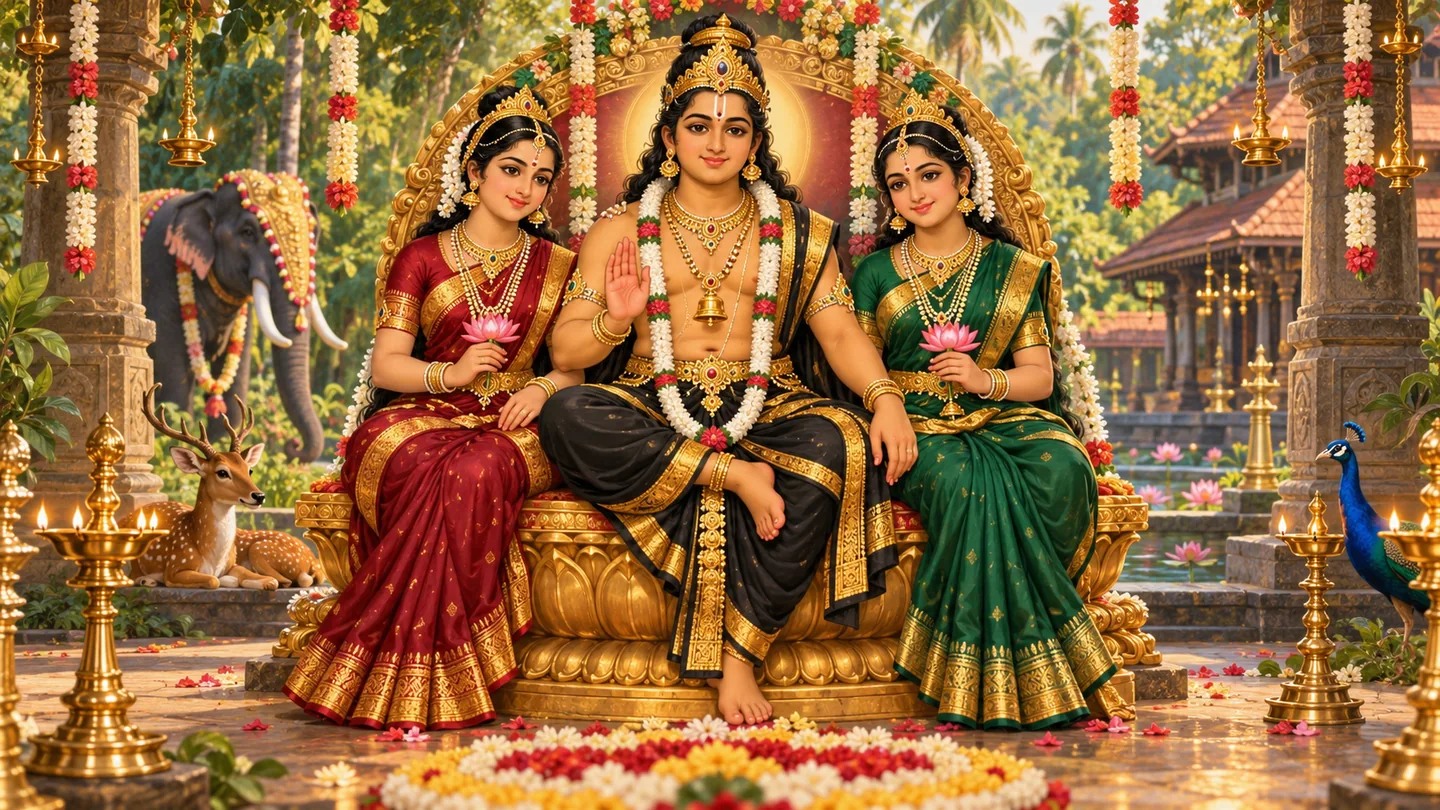
Meet Sri Purna–Pushkala Kalyana Sastha
Traditional background
श्रीपूर्णापुष्कलाकल्याणशास्ता
Śrī-Pūrṇā-Puṣkalā-Kalyāṇaśāstā
Kerala Tourism describes Achankovil’s Sastha as a householder accompanied by Purna and Pushkala. The 108-name hymn names both companions in its invocation and verse 14. These references support the family form; they do not by themselves establish every later marriage narrative circulated online. Kalyana conveys auspiciousness and is used in wedding-related devotion. This page does not combine the two consorts with the separate Prabha–Satyaka tradition. Our three adult figures form an original devotional interpretation. The story reflects on companionship and hospitality rather than inventing the details of a divine wedding.
Sanskrit headwords and IAST are editorially normalized. The source note distinguishes exact hymn wording from later devotional titles.
Next: The welcome that everyone helped make, an original learning story inspired by this form.
Original AI-assisted devotional illustration; a symbolic interpretation, not a photograph or prescribed temple icon.
2 / 6
A beautiful doorway, an empty table
Original learning story · 1 of 4
For a family celebration, Dev and his cousins decorated the doorway with flowers. They argued over which garland should hang in the middle and spent so long comparing colours that they forgot the drinking water and seats. When the first guests arrived, an elderly aunt had nowhere comfortable to sit. Dev felt embarrassed because the entrance looked beautiful. His grandmother helped bring a chair, then asked the children what a welcome needed besides something lovely to look at.
Original AI-assisted devotional illustration; a symbolic interpretation, not a photograph or prescribed temple icon.
3 / 6
Companionship in a sacred image
Original learning story · 2 of 4
Before the gathering, the family had looked at a picture of Sastha with Purna and Pushkala. Grandmother had explained the Achankovil householder tradition, keeping it distinct from other Sastha forms. Dev had mostly noticed the crowns. Now he wondered what companionship could mean in an ordinary home. Grandmother suggested that people preparing a celebration could share responsibility without competing for the most admired task. The children listed water, shade, a clear walkway and someone ready to greet arriving guests.
Original AI-assisted devotional illustration; a symbolic interpretation, not a photograph or prescribed temple icon.
4 / 6
The less visible work
Original learning story · 3 of 4
One cousin filled water jugs with an adult, another arranged chairs, and Dev checked that bags did not block the path. They asked guests what they needed instead of deciding everything for them. When the flower garland slipped, nobody abandoned the water table to argue about it. They repaired it together after the visitors were comfortable. The gathering felt warmer because the work supported the people. Even the cousin who preferred quiet tasks had a useful place without being pushed into entertaining everyone.
Original AI-assisted devotional illustration; a symbolic interpretation, not a photograph or prescribed temple icon.
5 / 6
An auspicious beginning
Original learning story · 4 of 4
At the end, the children cleaned up together and returned borrowed chairs. Dev realised that the celebration’s good beginning had continued through many small decisions. The family image now reminded him of companionship expressed in action. He did not turn their afternoon into a supposed ancient wedding story; it was their own lesson from a devotional form. Flowers and music still mattered, but so did an offered seat, a kept promise and a clear path. A welcome became complete when everyone’s comfort had a place in the plan.
Original AI-assisted devotional illustration; a symbolic interpretation, not a photograph or prescribed temple icon.
6 / 6
Sastha with Purna and Pushkala
Sanskrit & English
Dharmashastuh Ashtottarashatanama Stotram, verse 14, second line (excerpt).
पुष्कलापूर्णासंयुक्तः परमात्मा सताङ्गतिः ॥
United with Pushkala and Purna, he is the supreme Self and the refuge of the good.
Short meaning
This verse names Purna and Pushkala together with Sastha. It belongs to the householder tradition and should not be applied to Sabarimala’s celibate form.
What changed for the child in “The welcome that everyone helped make”?
Which small action from this story could we try together?
Tradition, Sanskrit sources & artwork
The four-page story below is an original family reading inspired by this form’s meaning. Its people, conversations and events are imagined; it is not an ancient scripture, a temple legend, or a claim that the deity performed these events.
Dharmashastuh Ashtottarashatanama Stotram, verse 14, second line (excerpt).
English meanings are original DHIH readings, not borrowed translations. The portrait is a symbolic illustration of the form, reused through its reader; it is not a picture of the imagined children’s events. Last editorial source review: 2026-10-27. No human scholarly certification is claimed.
Documents devotional names and attributes, not a sequence of incarnations. Underlying date and authorship are not established here. This edition is linked for study, not reproduced wholesale.