A FIRST INTRODUCTION
Who is Lord Ayyappa?
Meet the names, stories and living traditions of Ayyappa and Dharma Sastha.
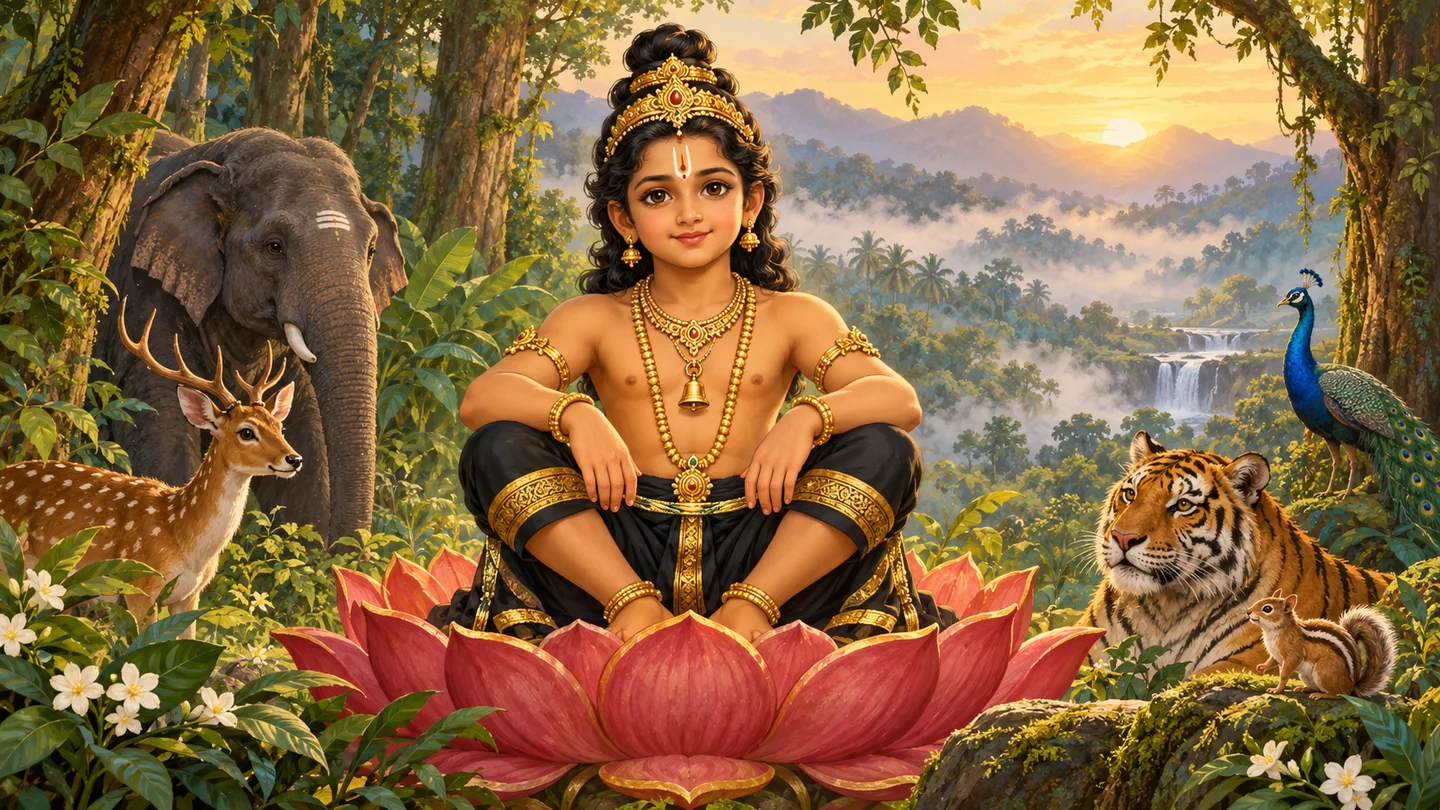
Ayyappa and Dharma Sastha
Ayyappa is the familiar name of the deity at Sabarimala. Dharma Sastha expresses the role of a divine guide in right living. Other Sastha temples may honour a child, a householder, or a guardian form. Their different images deserve their own context.
Hariharaputra: a name about divine parentage
Hari is a name of Vishnu; Hara is a name of Shiva; putra means child or son. In the Sabarimala tradition, Vishnu takes the form of Mohini, and Ayyappa is the child of Shiva and Mohini. Hariharatmaja is a related name with the same parentage theme.
Manikandan: the child of the forest story
Manikandan is the name of the divine child raised by King Rajasekhara of Pandalam. The familiar bell-at-the-neck explanation appears in the Kerala Tourism narrative. Another official telling describes a golden neck ornament. We retain the familiar bell in our artwork and acknowledge the wording difference.
Ayyanar: connected, with a tradition of his own
Tamil Ayyanar worship includes village guardianship and distinctive local customs. A historical museum catalogue connects Aiyanar with Sastha and Hariharaputra and records several seated and mounted images. That connection does not make every Ayyanar custom the same as Sabarimala worship.
Swamiye Saranam Ayyappa
This refuge chant can be understood as “Lord Ayyappa, I seek refuge in you.” Devotees use it in prayer and on pilgrimage. Here, refuge expresses trust and a wish for guidance; it is not a promise that no difficulty will occur.
Why Sabarimala matters
The forest shrine is a place of pilgrimage, prayer and disciplined preparation. The journey and its eighteen sacred steps have spiritual significance in the tradition. Different explanations of the steps exist; they are not evidence for eighteen universal avatars.
Follow the story
Sources behind this introduction
- Kerala Tourism · The mythology of Ayyappa ↗
Sections: Divine Birth; Discovery; Queen’s Feigned Illness; Defeat of Mahishi; Return; Founding of the Temple
An official presentation of religious tradition, not independent historical proof. DHIH retells traditional motifs in original language; source prose and art are not reproduced. - Kerala Tourism · Ayyappa temple ↗
Sabarimala temple and associated shrines overview
Site description and living tradition; not proof of a legendary founding date. - Gravely & Ramachandran · South Indian Hindu Metal Images ↗
1932 catalogue, reprinted 2002: printed pp.127–129, Aiyanar entries 6–14; p.139, Grama Devatas (PDF pp.135–137 and 147)
Museum objects attest varied seated and mounted iconography. The catalogue’s dated terminology is not adopted as a judgment on living traditions. - Sharana Manthra · temple-hosted explanation ↗
“The Sharana-Manthra”, opening paragraphs
Supports the refuge meaning of the chant. Spiritual benefits are devotional beliefs, not guaranteed outcomes.