The quiet voice that spoke up · 326-word learning story
About this story
The four-page story below is an original family reading inspired by this form’s meaning. Its people, conversations and events are imagined; it is not an ancient scripture, a temple legend, or a claim that the deity performed these events.
The traditional introduction and Sanskrit reading have their own source notes. Read aloud together with younger children.
Swipe left for next · swipe right to go back
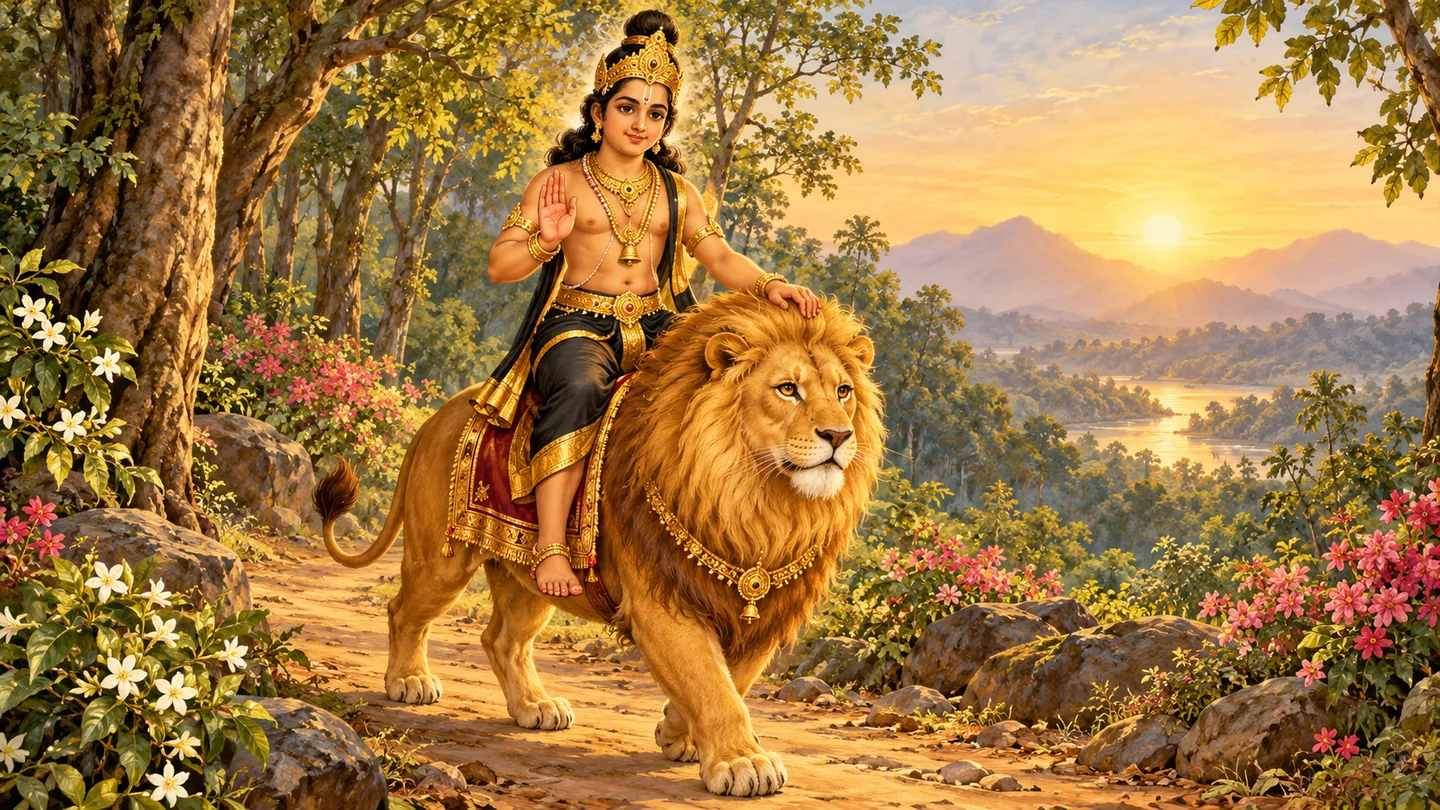
Original AI-assisted devotional illustration; a symbolic interpretation, not a photograph or prescribed temple icon.
1 / 6
Meet Simharudha Sastha
Traditional background
सिंहारूढशास्ता
Siṃhārūḍhaśāstā
Simha means lion. The 108-name hymn names Simharudha together with elephant and horse mounts. A lion is not a tiger: Ayyappa’s tiger-milk episode belongs to a different narrative and cannot establish the meaning of this title. The verse supports the mount, but the checked sources do not provide a separate complete lion-ride biography. Our lion’s visible mane makes the distinction clear. The original story reflects on courage that protects a friend through truthful speech and appropriate adult help.
Sanskrit headwords and IAST are editorially normalized. The source note distinguishes exact hymn wording from later devotional titles.
Next: The quiet voice that spoke up, an original learning story inspired by this form.
Original AI-assisted devotional illustration; a symbolic interpretation, not a photograph or prescribed temple icon.
2 / 6
Laughter near the playground
Original learning story · 1 of 4
At the playground, Rohan heard two children repeatedly mocking a younger boy’s way of speaking. Rohan did not join them, but he also did not move. He worried that they would laugh at him next. The younger boy stood alone beside the gate. Rohan remembered a lion-mounted image of Sastha he had admired at home. He had thought courage must feel loud and fearless. Now his own voice felt small, and he wished someone else would notice what was happening.
Original AI-assisted devotional illustration; a symbolic interpretation, not a photograph or prescribed temple icon.
3 / 6
A safe first step
Original learning story · 2 of 4
He walked to the teacher on duty and explained exactly what he had heard. He did not add a dramatic story or hide the repeated teasing. The teacher went with him and stopped it. Rohan then asked the younger boy whether he wanted company while they waited near the supervised play area. His heart was still beating quickly. Courage had not removed the uncomfortable feeling; it had helped him take a safe, useful step while the feeling was there.
Original AI-assisted devotional illustration; a symbolic interpretation, not a photograph or prescribed temple icon.
4 / 6
Standing beside someone
Original learning story · 3 of 4
The teacher arranged a conversation and followed the school’s rules about bullying. Rohan did not have to solve it alone. During the next game he made sure the younger boy heard the instructions and had a fair turn, without treating him as helpless. They discovered they both liked drawing animals. Rohan drew a lion with a large mane and explained why it was different from a tiger. The other boy drew a bird, and soon they were discussing pictures rather than the teasing.
Original AI-assisted devotional illustration; a symbolic interpretation, not a photograph or prescribed temple icon.
5 / 6
A different sound of bravery
Original learning story · 4 of 4
At home Rohan told his father that speaking up had not felt heroic. Father said that an action need not look grand to protect someone. They looked again at Simharudha Sastha, and Rohan noticed the composed posture of the figure on the lion. He understood the picture as a personal reminder, not an instruction to fight. Next time he saw harm, he could name it truthfully, find a trusted adult and offer company. His quiet voice had already proved that it could be useful.
Original AI-assisted devotional illustration; a symbolic interpretation, not a photograph or prescribed temple icon.
6 / 6
The mounted forms
Sanskrit & English
Dharmashastuh Ashtottarashatanama Stotram, verse 3, second line (excerpt); simha spelling normalized.
सिंहारूढो गजारूढो हयारूढो महेश्वरः ॥
The great Lord is mounted on a lion, mounted on an elephant, and mounted on a horse.
Short meaning
The hymn honours several mounts in one line. It does not narrate three separate incarnations.
What changed for the child in “The quiet voice that spoke up”?
Which small action from this story could we try together?
Tradition, Sanskrit sources & artwork
The four-page story below is an original family reading inspired by this form’s meaning. Its people, conversations and events are imagined; it is not an ancient scripture, a temple legend, or a claim that the deity performed these events.
Dharmashastuh Ashtottarashatanama Stotram, verse 3, second line (excerpt); simha spelling normalized.
English meanings are original DHIH readings, not borrowed translations. The portrait is a symbolic illustration of the form, reused through its reader; it is not a picture of the imagined children’s events. Last editorial source review: 2026-10-27. No human scholarly certification is claimed.
Documents devotional names and attributes, not a sequence of incarnations. Underlying date and authorship are not established here. This edition is linked for study, not reproduced wholesale.