Search DHIH library

VĀLMĪKI RĀMĀYAṆA · CHAPTER 17

सुन्दरकाण्डम् · सर्गः १७

Joy within a sorrowful grove

Hanuman sees Sita surrounded by frightening guards and rejoices that she is alive, though her suffering remains severe.

32 versesSanskrit + English1 illustration
Begin reading ↓

An edition-specific reading with original English meanings. Source & reading notes

SCENE 01 · VERSES 1–32

Found at last

Hanuman sees Sita surrounded by frightening guards and rejoices that she is alive, though her suffering remains severe.

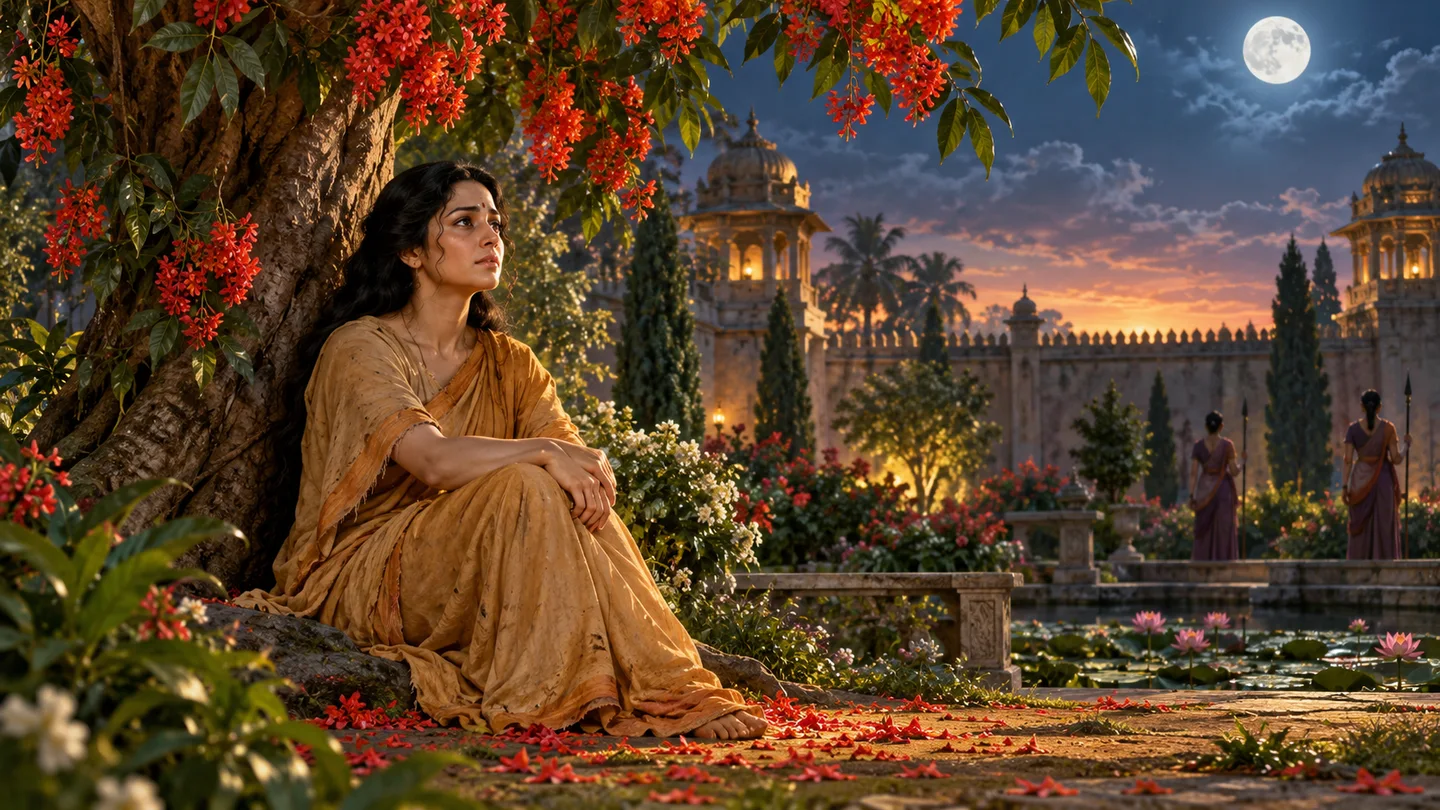
Sita sits beneath a flowering tree in the Ashoka grove, holding to hope.
Original DHIH illustration · artistic interpretation

Verse 1 · 5.17.1

#

ततः कुमुदखण्डाभो निर्मलं निर्मलोदयः ।

Then the moon, white as a cluster of water-lilies, rose clear

प्रजगाम नभश्चन्द्रो हंसो नीलमिवोदकम् ॥

and crossed the spotless sky like a swan through blue water.

Verse 2 · 5.17.2

#

साचिव्यमिव कुर्वन् स प्रभया निर्मलप्रभः ।

As though helping him, the moon with its pure radiance

चन्द्रमा रश्मिभिः शीतैः सिषेवे पवनात्मजम् ॥

attended the son of the Wind with cool rays.

Verse 3 · 5.17.3

#

स ददर्श ततः सीतां पूर्णचन्द्रनिभाननाम् ।

Then he saw Sita, her face like the full moon,

शोकभारैरिव न्यस्तां भारैर्नावमिवाम्भसि ॥

weighed down by sorrow like a heavily laden boat upon the water.

Verse 4 · 5.17.4

#

दिदृक्षमाणो वैदेहीं हनूमान् मारुतात्मजः ।

Wishing to see Sita more clearly, Hanuman, son of the Wind,

स ददर्शाविदूरस्था राक्षसीर्घोरदर्शनाः ॥

saw nearby rakshasis of frightening appearance.

Verse 5 · 5.17.5

#

एकाक्षीमेककर्णां च कर्णप्रावरणां तथा ।

One had a single eye, another one ear, another ears like a covering;

अकर्णां शङ्कुकर्णां च मस्तकोच्छ्वासनासिकाम् ॥

some had no ears, pointed ears, or nostrils set upon the head.

Verse 6 · 5.17.6

#

अतिकायोत्तमांगीं च तनुदीर्घशिरोधराम् ।

Some had huge bodies and heads, others thin, long necks;

ध्वस्तकेशीं तथाकेशीं केशकम्बलधारिणीम् ॥

some had disheveled hair, none at all, or hair like a blanket.

Verse 7 · 5.17.7

#

लम्बकर्णललाटां च लम्बोदरपयोधराम् ।

Some had hanging ears and foreheads, bellies and breasts;

लम्बोष्ठीं चिबुकोष्ठीं च लम्बास्यां लम्बजानुकाम् ॥

others had long lips, lips upon the chin, long faces, or long knees.

Verse 8 · 5.17.8

#

ह्रस्वां दीर्घां च कुब्जां च विकटां वामनां तथा ।

Some were short, tall, bent, huge, or dwarfish;

करालां भुग्नवक्त्रां च पिंगाक्षीं विकृताननाम् ॥

others had fearsome, crooked faces, tawny eyes, and distorted features.

Verse 9 · 5.17.9

#

विकृताः पिंगलाः कालीः क्रोधनाः कलहप्रियाः ।

Strange-shaped, tawny, or dark, angry and fond of quarrels,

कालायसमहाशूलकूटमुद‍्गरधारिणीः ॥

they carried great iron tridents, heavy clubs, and hammers.

Verse 10 · 5.17.10

#

वराहमृगशार्दूलमहिषाजशिवामुखाः ।

Some had faces of boars, deer, tigers, buffaloes, goats, or jackals;

गजोष्ट्रहयपादाश्च निखातशिरसोऽपराः ॥

some had elephant, camel, or horse feet, while others had sunken heads.

Verse 11 · 5.17.11

#

एकहस्तैकपादाश्च खरकर्ण्यश्वकर्णिकाः ।

Some had one hand or one foot, ears of donkeys or horses,

गोकर्णीर्हस्तिकर्णीश्च हरिकर्णीस्तथापराः ॥

and others ears of cows, elephants, or lions.

Verse 12 · 5.17.12

#

अतिनासाश्च काश्चिच्च तिर्यङ्नासा अनासिकाः ।

Some had enormous, sideways, or absent noses;

गजसंनिभनासाश्च ललाटोच्छ्वासनासिकाः ॥

others had elephantlike noses or breathed through the forehead.

Verse 13 · 5.17.13

#

हस्तिपादा महापादा गोपादाः पादचूलिकाः ।

Some had elephant feet, huge feet, cow feet, or tufts upon their feet;

अतिमात्रशिरोग्रीवा अतिमात्रकुचोदरीः ॥

their heads, necks, breasts, or bellies were exceedingly large.

Verse 14 · 5.17.14

#

अतिमात्रास्यनेत्राश्च दीर्घजिह्वाननास्तथा ।

Some had enormous mouths and eyes, long tongues and faces,

अजामुखीर्हस्तिमुखीर्गोमुखीः सूकरीमुखीः ॥

and the faces of goats, elephants, cows, or pigs.

Verse 15 · 5.17.15

#

हयोष्ट्रखरवक्त्राश्च राक्षसीर्घोरदर्शनाः ।

There were terrible rakshasis with horse, camel, and donkey faces,

शूलमुद‍्गरहस्ताश्च क्रोधनाः कलहप्रियाः ॥

holding tridents and hammers, angry and quarrelsome.

Verse 16 · 5.17.16

#

कराला धूम्रकेशिन्यो राक्षसीर्विकृताननाः ।

Fearsome, smoke-haired, and distorted-faced,

पिबन्ति सततं पानं सुरामांससदाप्रियाः ॥

they continually drank liquor and delighted in liquor and meat.

Verse 17 · 5.17.17

#

मांसशोणितदिग्धांगीर्मांसशोणितभोजनाः ।

Their limbs were smeared with flesh and blood, and flesh and blood were their food;

ता ददर्श कपिश्रेष्ठो रोमहर्षणदर्शनाः ॥

the foremost vanara saw them, a sight to make one's hair stand up.

Verse 18 · 5.17.18

#

स्कन्धवन्तमुपासीनाः परिवार्य वनस्पतिम् ।

They sat surrounding a thick-trunked tree;

तस्याधस्ताच्च तां देवीं राजपुत्रीमनिन्दिताम् ॥

beneath it was the noble lady, the faultless princess.

Verse 19 · 5.17.19

#

लक्षयामास लक्ष्मीवान् हनूमाञ्जनकात्मजाम् ।

Illustrious Hanuman recognized Janaka's daughter,

निष्प्रभां शोकसंतप्तां मलसंकुलमूर्धजाम् ॥

her radiance dimmed by sorrow and her hair filled with dirt.

Verse 20 · 5.17.20

#

क्षीणपुण्यां च्युतां भूमौ तारां निपतितामिव ।

Like a star fallen to earth when its merit is exhausted,

चारित्रव्यपदेशाढ्यां भर्तृदर्शनदुर्गताम् ॥

rich in the reputation of good conduct, she suffered for want of her husband's sight.

Verse 21 · 5.17.21

#

भूषणैरुत्तमैर्हीनां भर्तृवात्सल्यभूषिताम् ।

Without fine ornaments, she was adorned by love for her husband,

राक्षसाधिपसंरुद्धां बन्धुभिश्च विनाकृताम् ॥

confined by the rakshasa lord and separated from her relatives.

Verse 22 · 5.17.22

#

वियूथां सिंहसंरुद्धां बद्धां गजवधूमिव ।

She was like a female elephant separated from its herd, trapped and surrounded by lions,

चन्द्ररेखां पयोदान्ते शारदाभ्रैरिवावृताम् ॥

or a crescent moon veiled by autumn clouds after the rains.

Verse 23 · 5.17.23

#

क्लिष्टरूपामसंस्पर्शादयुक्तामिव वल्लकीम् ।

Her neglected form was like an unplayed, untuned vina;

स तां भर्तृहिते युक्तामयुक्तां रक्षसां वशे ॥

devoted to her husband's welfare, she was unfit to remain in rakshasa power.

Verse 24 · 5.17.24

#

अशोकवनिकामध्ये शोकसागरमाप्लुताम् ।

In the ashoka grove she was plunged into an ocean of grief,

ताभिः परिवृतां तत्र सग्रहामिव रोहिणीम् ॥

surrounded by them like Rohini beset by hostile planets.

Verse 25 · 5.17.25

#

ददर्श हनुमांस्तत्र लतामकुसुमामिव ।

Hanuman saw her there like a creeper without flowers;

सा मलेन च दिग्धांगी वपुषा चाप्यलंकृता ।

her body was soiled, yet its natural beauty adorned her,

मृणाली पङ्कदिग्धेव विभाति च न भाति च ॥

like a lotus stem smeared with mud, both shining and not shining.

Verse 26 · 5.17.26

#

मलिनेन तु वस्त्रेण परिक्लिष्टेन भामिनीम् ।

The vanara Hanuman saw that lovely, doe-eyed woman

संवृतां मृगशावाक्षीं ददर्श हनुमान् कपिः ॥

wrapped in a dirty and much-worn garment.

Verse 27 · 5.17.27

#

तां देवीं दीनवदनामदीनां भर्तृतेजसा ।

Her face was distressed, yet her husband's glory kept her spirit from abasement;

रक्षितां स्वेन शीलेन सीतामसितलोचनाम् ॥

dark-eyed Sita was protected by her own upright conduct.

Verse 28 · 5.17.28

#

तां दृष्ट्वा हनुमान् सीतां मृगशावनिभेक्षणाम् ।

Hanuman saw that doe-eyed Sita

मृगकन्यामिव त्रस्तां वीक्षमाणां समन्ततः ॥

looking around like a frightened young deer.

Verse 29 · 5.17.29

#

दहन्तीमिव निःश्वासैर्वृक्षान् पल्लवधारिणः ।

Her sighs seemed to scorch the young-leafed trees;

संघातमिव शोकानां दुःखस्योर्मिमिवोत्थिताम् ॥

she appeared a gathering of sorrows, a rising wave of pain.

Verse 30 · 5.17.30

#

तां क्षमां सुविभक्तांगीं विनाभरणशोभिनीम् ।

Seeing the patient, well-proportioned princess of Mithila,

प्रहर्षमतुलं लेभे मारुतिः प्रेक्ष्य मैथिलीम् ॥

beautiful without ornaments, the son of the Wind felt incomparable joy.

Verse 31 · 5.17.31

#

हर्षजानि च सोऽश्रूणि तां दृष्ट्वा मदिरेक्षणाम् ।

Seeing her lovely eyes, Hanuman shed tears born of joy

मुमोच हनुमांस्तत्र नमश्चक्रे च राघवम् ॥

and bowed to Raghava.

Verse 32 · 5.17.32

#

नमस्कृत्वाथ रामाय लक्ष्मणाय च वीर्यवान् ।

After bowing to Rama and to Lakshmana, mighty Hanuman,

सीतादर्शनसंहृष्टो हनुमान् संवृतोऽभवत् ॥

delighted at the sight of Sita, remained concealed.

CHAPTER 17 COMPLETE

The journey continues.

He offers silent gratitude to Rama and Lakshmana while keeping his presence secret.

NEXT CHAPTER

Continue Hanuman’s journey in the next chapter.

About this reading

Vālmīki Rāmāyaṇa, Sundara Kanda, chapter 17. This reading follows Sanskrit Wikisource revision 354234, with all 32 numbered verses. Verse divisions and wording vary between editions.

The Sanskrit is preserved with normalized display spacing and line breaks. Some sentences continue across verse boundaries; the English follows that continuity. A yojana is a traditional distance unit, retained without assigning a modern measurement. Shape-changing and celestial beings belong to the epic’s sacred narrative.

English line senses and short meanings are original AI-assisted DHIH renderings checked against this Sanskrit reading; they are not a word-for-word grammatical commentary or a claim of human scholarly certification. Roman transliteration is generated mechanically in IAST. Names may also appear in familiar English spellings.

Sanskrit transcription credit: Wikisource contributors, revision history. The adapted reading text and DHIH English on this chapter page are offered under CC BY-SA 4.0. The ancient Sanskrit work is in the public domain. Illustrations are separately commissioned AI-generated DHIH artwork.

Historical comparison: M. N. Dutt’s Ramayana, volume II, a public-domain translation, was consulted for narrative context. The English displayed here is a fresh rendering of the pinned Sanskrit, not a reproduction of that translation.

The full text includes frightening guards and references to blood and flesh. It is not the simplified children’s version; the supernatural forms belong to the epic’s imagery. Audio will be added only when suitable recording permissions are available.