Search DHIH library

VĀLMĪKI RĀMĀYAṆA · CHAPTER 23

सुन्दरकाण्डम् · सर्गः २३

The guards press their demands

The rakshasis try to persuade Sita by praising Ravana’s lineage, victories, and wealth.

19 versesSanskrit + English1 illustration
Begin reading ↓

An edition-specific reading with original English meanings. Source & reading notes

SCENE 01 · VERSES 1–19

Praise used as pressure

The rakshasis try to persuade Sita by praising Ravana’s lineage, victories, and wealth.

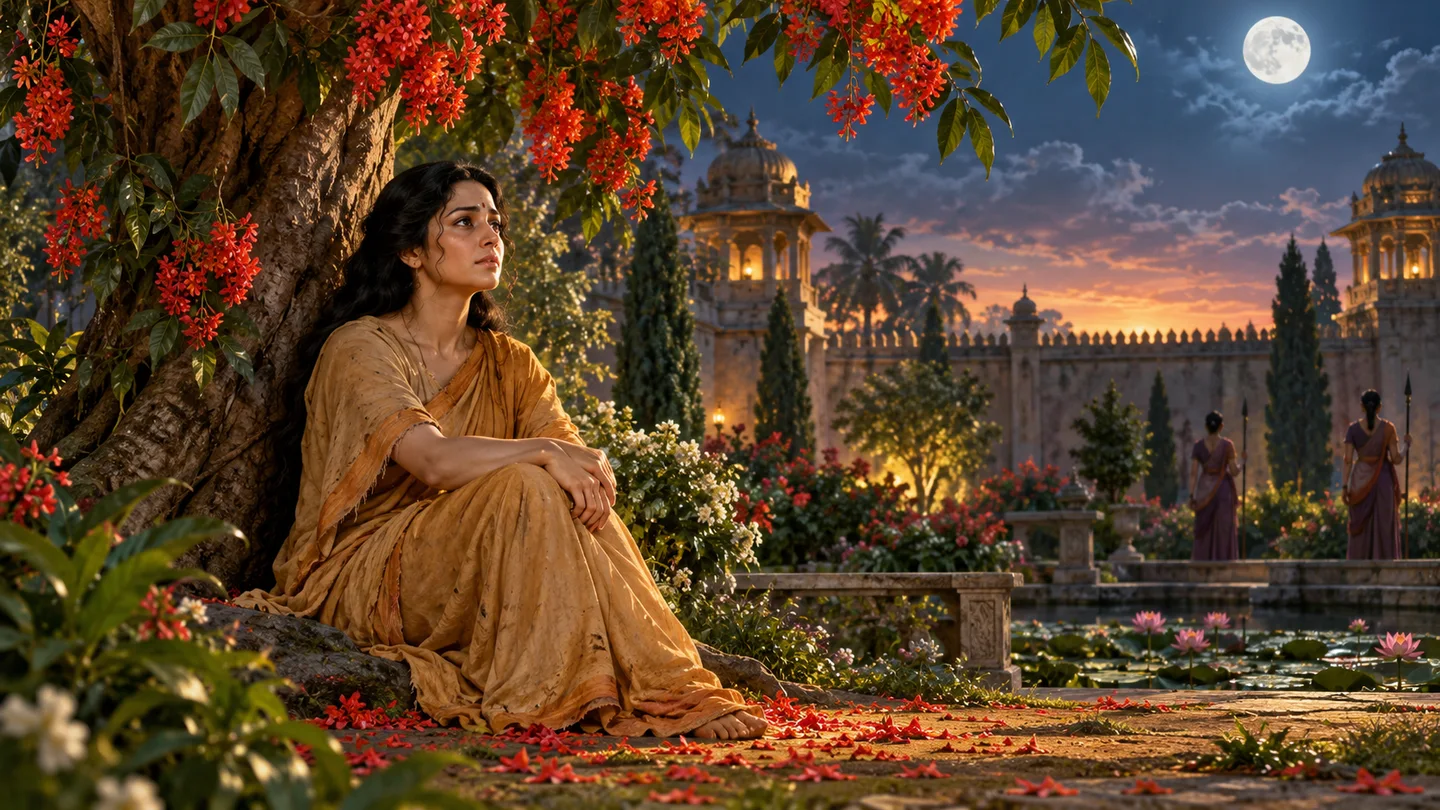
Sita sits beneath a flowering tree in the Ashoka grove, holding to hope.
Original DHIH illustration · artistic interpretation

Verse 1 · 5.23.1

#

इत्युक्त्वा मैथिलीं राजा रावणः शत्रुरावणः ।

After speaking thus to the princess of Mithila, King Ravana, terror of foes,

संदिश्य च ततः सर्वा राक्षसीर्निर्जगाम ह ॥

gave orders to all the rakshasis and departed.

Verse 2 · 5.23.2

#

निष्क्रान्ते राक्षसेन्द्रे तु पुनरन्तःपुरं गते ।

When the rakshasa king had gone back to the inner palace,

राक्षस्यो भीमरूपास्ताः सीतां समभिदुद्रुवुः ॥

the frightening rakshasis rushed toward Sita.

Verse 3 · 5.23.3

#

ततः सीतामुपागम्य राक्षस्यः क्रोधमूर्च्छिताः ।

Approaching Sita, overcome with anger,

परं परुषया वाचा वैदेहीमिदमब्रुवन् ॥

they addressed her in exceedingly harsh words.

Verse 4 · 5.23.4

#

पौलस्त्यस्य वरिष्ठस्य रावणस्य महात्मनः ।

'Sita, you do not value the chance to become the wife

दशग्रीवस्य भार्यात्वं सीते न बहु मन्यसे ॥

of noble, great, ten-headed Ravana, descendant of Pulastya!'

Verse 5 · 5.23.5

#

ततस्त्वेकजटा नाम राक्षसी वाक्यमब्रवीत् ।

Then the rakshasi named Ekajata spoke,

आमन्त्र्य क्रोधताम्राक्षी सीतां करतलोदरीम् ॥

her eyes copper-red with anger as she addressed slender-waisted Sita.

Verse 6 · 5.23.6

#

प्रजापतीनां षण्णां तु चतुर्थोऽयं प्रजापतिः ।

'Of the six progenitors, the fourth is renowned as Pulastya,

मानसो ब्रह्मणः पुत्रः पुलस्त्य इति विश्रुतः ॥

a mind-born son of Brahma.'

Verse 7 · 5.23.7

#

पुलस्त्यस्य तु तेजस्वी महर्षिर्मानसः सुतः ।

'Pulastya's radiant, mind-born son was the great sage

नाम्ना स विश्रवा नाम प्रजापतिसमप्रभः ॥

named Vishravas, equal in splendor to a progenitor.'

Verse 8 · 5.23.8

#

तस्य पुत्रो विशालाक्षि रावणः शत्रुरावणः ।

'His son is Ravana, terror of enemies, wide-eyed one.

तस्य त्वं राक्षसेन्द्रस्य भार्या भवितुमर्हसि ॥

You ought to become that rakshasa king's wife.'

Verse 9 · 5.23.9

#

मयोक्तं चारुसर्वाङ्गि वाक्यं किं नानुमन्यसे ।

'Why do you not accept my words, lovely-limbed woman?'

ततो हरिजटा नाम राक्षसी वाक्यमब्रवीत् ॥

Then a rakshasi named Harijata began to speak.

Verse 10 · 5.23.10

#

विवृत्य नयने कोपान्मार्जारसदृशेक्षणा ।

Opening her catlike eyes wide in anger, she said:

येन देवास्त्रयस्त्रिंशद् देवराजश्च निर्जितः ॥

'He has conquered the thirty-three gods and their king—'

Verse 11 · 5.23.11

#

तस्य त्वं राक्षसेन्द्रस्य भार्या भवितुमर्हसि ।

'you should become the wife of that rakshasa lord.

वीर्योत्सिक्तस्य शूरस्य संग्रामेष्वनिवर्तिनः ।

He is a proud, powerful hero who never retreats from battle;

बलिनो वीर्ययुक्तस्य भार्यात्वं किं न लिप्ससे ॥

why do you not desire marriage to one so strong and valiant?'

Verse 12 · 5.23.12

#

प्रियां बहुमतां भार्यां त्यक्त्वा राजा महाबलः ।

'That mighty king will leave his cherished and honored wife,

सर्वासां च महाभागां त्वामुपैष्यति रावणः ॥

the most fortunate of them all, and come to you.'

Verse 13 · 5.23.13

#

समृद्धं स्त्रीसहस्रेण नानारत्नोपशोभितम् ।

'He will leave his prosperous inner palace, filled with a thousand women

अन्तःपुरं तदुत्सृज्य त्वामुपैष्यति रावणः ॥

and adorned with many jewels, and come to you.'

Verse 14 · 5.23.14

#

अन्या तु विकटा नाम राक्षसी वाक्यमब्रवीत् ।

Another rakshasi named Vikata said:

असकृद् भीमवीर्येण नागा गन्धर्वदानवाः ।

'With terrible strength he has repeatedly conquered nagas, gandharvas, and danavas

निर्जिताः समरे येन स ते पार्श्वमुपागतः ॥

in battle, and now he has come to your side.'

Verse 15 · 5.23.15

#

तस्य सर्वसमृद्धस्य रावणस्य महात्मनः ।

'Why do you not wish to become the wife

किमर्थं राक्षसेन्द्रस्य भार्यात्वं नेच्छसेऽधमे ॥

of that great, wholly prosperous rakshasa lord Ravana, foolish woman?'

Verse 16 · 5.23.16

#

ततस्तां दुर्मुखी नाम राक्षसी वाक्यमब्रवीत् ।

Then a rakshasi named Durmukhi said:

यस्य सूर्यो न तपति भीतो यस्य स मारुतः ।

'The sun does not scorch him, and the Wind fears

न वाति स्मायतापाङ्गि किं त्वं तस्य न तिष्ठसे ॥

to blow before him; why do you not submit, long-eyed woman?'

Verse 17 · 5.23.17

#

पुष्पवृष्टिं च तरवो मुमुचुर्यस्य वै भयात् ।

'Out of fear of him, trees shower flowers,

शैलाः सुस्रुवुः पानीयं जलदाश्च यदेच्छति ॥

mountains pour water, and clouds rain whenever he wishes.'

Verse 18 · 5.23.18

#

तस्य नैर्ऋतराजस्य राजराजस्य भामिनि ।

'Why, lovely woman, do you not set your mind

किं त्वं न कुरुषे बुद्धिं भार्यार्थे रावणस्य हि ॥

on becoming the wife of Ravana, king of kings among rakshasas?'

Verse 19 · 5.23.19

#

साधु ते तत्त्वतो देवि कथितं साधु भामिनि ।

'We have told you what is truly good for you, noble lady.

गृहाण सुस्मिते वाक्यमन्यथा न भविष्यसि ॥

Accept our words, sweet-smiling one, or you will not survive.'

CHAPTER 23 COMPLETE

The journey continues.

Their arguments become threats, but Sita has not consented.

NEXT CHAPTER

Continue Hanuman’s journey in the next chapter.

About this reading

Vālmīki Rāmāyaṇa, Sundara Kanda, chapter 23. This reading follows Sanskrit Wikisource revision 354267, with all 19 numbered verses. Verse divisions and wording vary between editions.

The Sanskrit is preserved with normalized display spacing and line breaks. Some sentences continue across verse boundaries; the English follows that continuity. A yojana is a traditional distance unit, retained without assigning a modern measurement. Shape-changing and celestial beings belong to the epic’s sacred narrative.

English line senses and short meanings are original AI-assisted DHIH renderings checked against this Sanskrit reading; they are not a word-for-word grammatical commentary or a claim of human scholarly certification. Roman transliteration is generated mechanically in IAST. Names may also appear in familiar English spellings.

Sanskrit transcription credit: Wikisource contributors, revision history. The adapted reading text and DHIH English on this chapter page are offered under CC BY-SA 4.0. The ancient Sanskrit work is in the public domain. Illustrations are separately commissioned AI-generated DHIH artwork.

Historical comparison: M. N. Dutt’s Ramayana, volume II, a public-domain translation, was consulted for narrative context. The English displayed here is a fresh rendering of the pinned Sanskrit, not a reproduction of that translation.

The guards’ claims that nature and the gods fear Ravana are part of their coercive boasts. They are not presented as independent historical claims. Audio will be added only when suitable recording permissions are available.