Search DHIH library

VĀLMĪKI RĀMĀYAṆA · CHAPTER 25

सर्गः २५

Sita’s resolve in captivity

The rakshasi guards surround Sita and pressure her to accept Ravana. Sita holds to her love for Rama despite their threats.

20 versesSanskrit + English1 illustration
Begin reading ↓

An edition-specific reading with original English meanings. Source & reading notes

SCENE 01 · VERSES 1–20

Steadfast under threat

The rakshasi guards surround Sita and pressure her to accept Ravana. Sita holds to her love for Rama despite their threats.

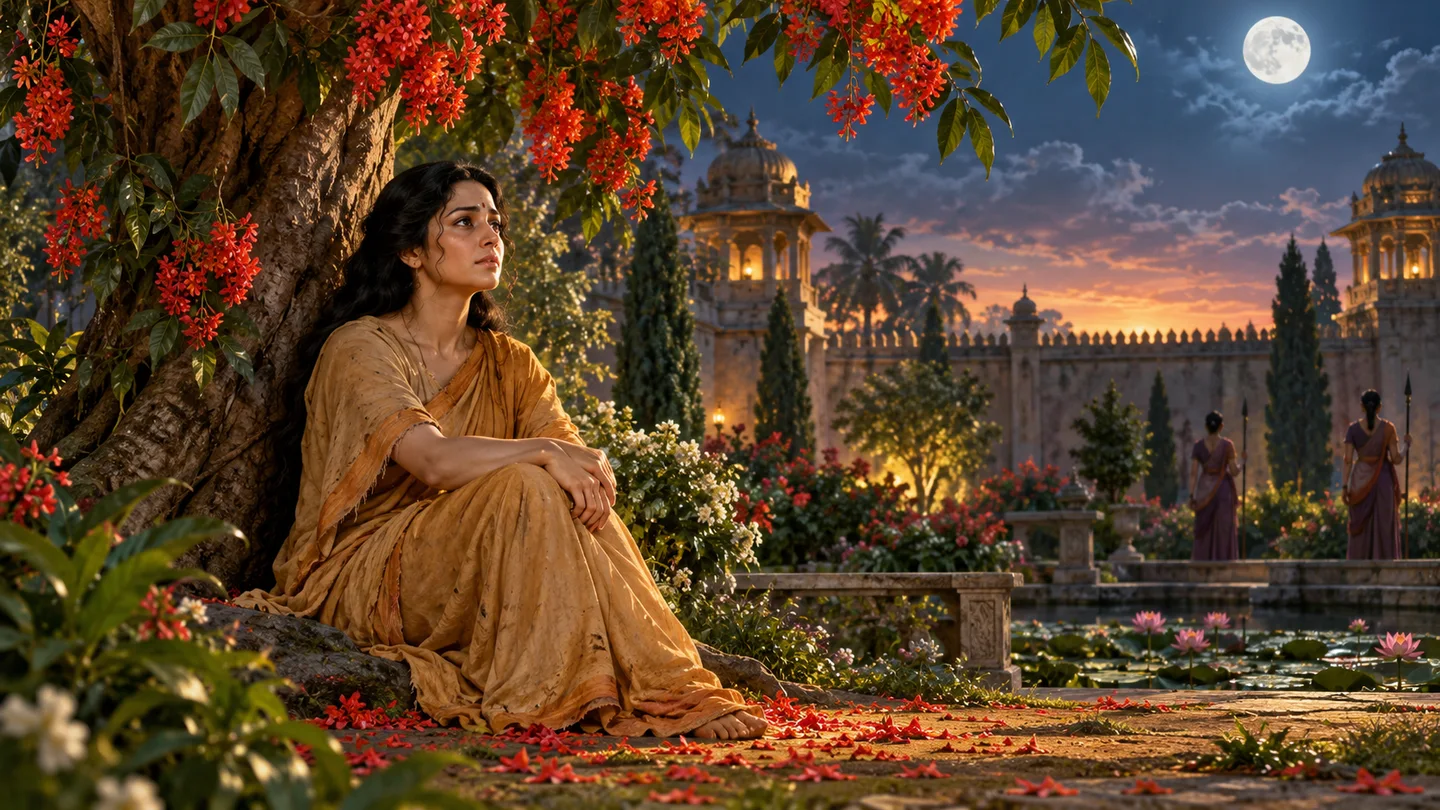
Sita sits beneath a flowering tree in the Ashoka grove, holding to hope.
Original DHIH illustration · artistic interpretation

Verse 1 · 5.25.1

#

अथ तासां वदन्तीनां परुषं दारुणं बहु ।

As the women uttered many harsh and dreadful words,

राक्षसीनामसौम्यानां रुरोद जनकात्मजा ॥

Janaka’s daughter wept among those pitiless rakshasis.

Verse 2 · 5.25.2

#

एवमुक्ता तु वैदेही राक्षसीभिर्मनस्विनी ।

The steadfast Vaidehi, thus addressed by the rakshasis,

उवाच परमत्रस्ता बाष्पगद‍्गदया गिरा ॥

spoke in great fear, her voice choked with tears.

Verse 3 · 5.25.3

#

न मानुषी राक्षसस्य भार्या भवितुमर्हति ।

A human woman cannot become the wife of a rakshasa.

कामं खादत मां सर्वा न करिष्यामि वो वचः ॥

Eat me, all of you, if you wish; I shall not obey you.

Verse 4 · 5.25.4

#

सा राक्षसीमध्यगता सीता सुरसुतोपमा ।

Sita, beautiful as a heavenly maiden, stood among the rakshasis;

न शर्म लेभे शोकार्ता रावणेनेव भर्त्सिता ॥

overcome by sorrow, she found no peace, as though Ravana himself threatened her.

Verse 5 · 5.25.5

#

वेपते स्माधिकं सीता विशन्तीवांगमात्मनः ।

Sita trembled greatly, as if shrinking into herself,

वने यूथपरिभ्रष्टा मृगी कोकैरिवार्दिता ॥

like a doe separated from its herd and harried by wolves.

Verse 6 · 5.25.6

#

सा त्वशोकस्य विपुलां शाखामालम्ब्य पुष्पिताम् ।

Holding a broad, flowering branch of the ashoka tree,

चिन्तयामास शोकेन भर्तारं भग्नमानसा ॥

her heart broken by sorrow, she thought of her husband.

Verse 7 · 5.25.7

#

सा स्नापयन्ती विपुलौ स्तनौ नेत्रजलस्रवैः ।

Her flowing tears drenched her breast;

चिन्तयन्ती न शोकस्य तदान्तमधिगच्छति ॥

as she reflected, she could find no end to her sorrow.

Verse 8 · 5.25.8

#

सा वेपमाना पतिता प्रवाते कदली यथा ।

Trembling, she sank down like a plantain in a strong wind;

राक्षसीनां भयत्रस्ता विवर्णवदनाभवत् ॥

terrified of the rakshasis, her face grew pale.

Verse 9 · 5.25.9

#

तस्याः सा दीर्घबहुला वेपन्त्याः सीतया तदा ।

As Sita trembled, her long, thick braid

ददृशे कम्पिता वेणी व्यालीव परिसर्पती ॥

was seen shaking like a serpent gliding along.

Verse 10 · 5.25.10

#

सा निःश्वसन्ती शोकार्ता कोपोपहतचेतना ।

Sighing in sorrow, her mind wounded by anger,

आर्ता व्यसृजदश्रूणि मैथिली विललाप च ॥

the suffering princess of Mithila shed tears and lamented.

Verse 11 · 5.25.11

#

हा रामेति च दुःखार्ता हा पुनर्लक्ष्मणेति च ।

“Alas, Rama!” she cried in anguish, and again, “Alas, Lakshmana!

हा श्वश्रूर्मम कौसल्ये हा सुमित्रेति भामिनी ॥

Alas, my mother-in-law Kausalya! Alas, Sumitra!”

Verse 12 · 5.25.12

#

लोकप्रवादः सत्योऽयं पण्डितैः समुदाहृतः ।

“This common saying, declared by wise people, is true:

अकाले दुर्लभो मृत्युः स्त्रिया वा पुरुषस्य वा ॥

death is hard to obtain before its appointed time, for woman or man.

Verse 13 · 5.25.13

#

यत्राहमाभिः क्रूराभी राक्षसीभिरिहार्दिता ।

For here I am, tormented by these cruel rakshasis,

जीवामि हीना रामेण मुहूर्तमपि दुःखिता ॥

yet I live even a moment, suffering and separated from Rama.

Verse 14 · 5.25.14

#

एषाल्पपुण्या कृपणा विनशिष्याम्यनाथवत् ।

Unfortunate and helpless, I shall perish without protection,

समुद्रमध्ये नौः पूर्णा वायुवेगैरिवाहता ॥

like a laden boat in mid-ocean battered by violent winds.

Verse 15 · 5.25.15

#

भर्तारं तमपश्यन्ती राक्षसीवशमागता ।

Unable to see my husband, fallen under the rakshasis’ power,

सीदामि खलु शोकेन कूलं तोयहतं यथा ॥

I crumble in grief like a riverbank beaten by water.

Verse 16 · 5.25.16

#

तं पद्मदलपत्राक्षं सिंहविक्रान्तगामिनम् ।

Blessed are those who see my lord, with lotus-petal eyes

धन्याः पश्यन्ति मे नाथं कृतज्ञं प्रियवादिनम् ॥

and a lion’s powerful stride, grateful and gentle in speech.

Verse 17 · 5.25.17

#

सर्वथा तेन हीनाया रामेण विदितात्मना ।

Utterly separated from that self-possessed Rama,

तीक्ष्णं विषमिवास्वाद्य दुर्लभं मम जीवनम् ॥

I find life unbearable, as though I had swallowed bitter poison.

Verse 18 · 5.25.18

#

कीदृशं तु महापापं मया देहान्तरे कृतम् ।

What great wrong did I commit in another lifetime

तेनेदं प्राप्यते घोरं महादुःखं सुदारुणम् ॥

that I now undergo this dreadful and cruel suffering?

Verse 19 · 5.25.19

#

जीवितं त्यक्तुमिच्छामि शोकेन महता वृता ।

Enveloped in great sorrow, I wish to give up my life;

राक्षसीभिश्च रक्षन्त्या रामो नासाद्यते मया ॥

guarded by these rakshasis, I cannot reach Rama.

Verse 20 · 5.25.20

#

धिगस्तु खलु मानुष्यं धिगस्तु परवश्यताम् ।

Alas for human helplessness! Alas for living under another’s power,

न शक्यं यत् परित्यक्तुमात्मच्छन्देन जीवितम् ॥

when even relinquishing life is not within one’s own choice!”

CHAPTER 25 COMPLETE

The journey continues.

The guards’ threats intensify, but Sita remains steadfast.

NEXT CHAPTER

Continue Hanuman’s journey in the next chapter.

About this reading

Vālmīki Rāmāyaṇa, Sundara Kanda, chapter 25. This reading follows Sanskrit Wikisource revision 354275, with all 20 numbered verses. Verse divisions and wording vary between editions.

The Sanskrit is preserved with normalized display spacing and line breaks. Some sentences continue across verse boundaries; the English follows that continuity. A yojana is a traditional distance unit, retained without assigning a modern measurement. Shape-changing and celestial beings belong to the epic’s sacred narrative.

English line senses and short meanings are original AI-assisted DHIH renderings checked against this Sanskrit reading; they are not a word-for-word grammatical commentary or a claim of human scholarly certification. Roman transliteration is generated mechanically in IAST. Names may also appear in familiar English spellings.

Sanskrit transcription credit: Wikisource contributors, revision history. The adapted reading text and DHIH English on this chapter page are offered under CC BY-SA 4.0. The ancient Sanskrit work is in the public domain. Illustrations are separately commissioned AI-generated DHIH artwork.

Historical comparison: M. N. Dutt’s Ramayana, volume II, a public-domain translation, was consulted for narrative context. The English displayed here is a fresh rendering of the pinned Sanskrit, not a reproduction of that translation.

This is the full epic account of captivity and threats, including threats of killing and eating Sita. The guards’ words express their cruelty, not the narrator’s advice. Audio will be added only when suitable recording permissions are available.