Search DHIH library

VĀLMĪKI RĀMĀYAṆA · CHAPTER 29

सर्गः २९

Signs of reassurance

Sita notices bodily signs traditionally understood in the poem as auspicious. Her fear begins to loosen, and her face brightens with renewed hope.

8 versesSanskrit + English1 illustration
Begin reading ↓

An edition-specific reading with original English meanings. Source & reading notes

SCENE 01 · VERSES 1–8

A small return of hope

Sita notices bodily signs traditionally understood in the poem as auspicious. Her fear begins to loosen, and her face brightens with renewed hope.

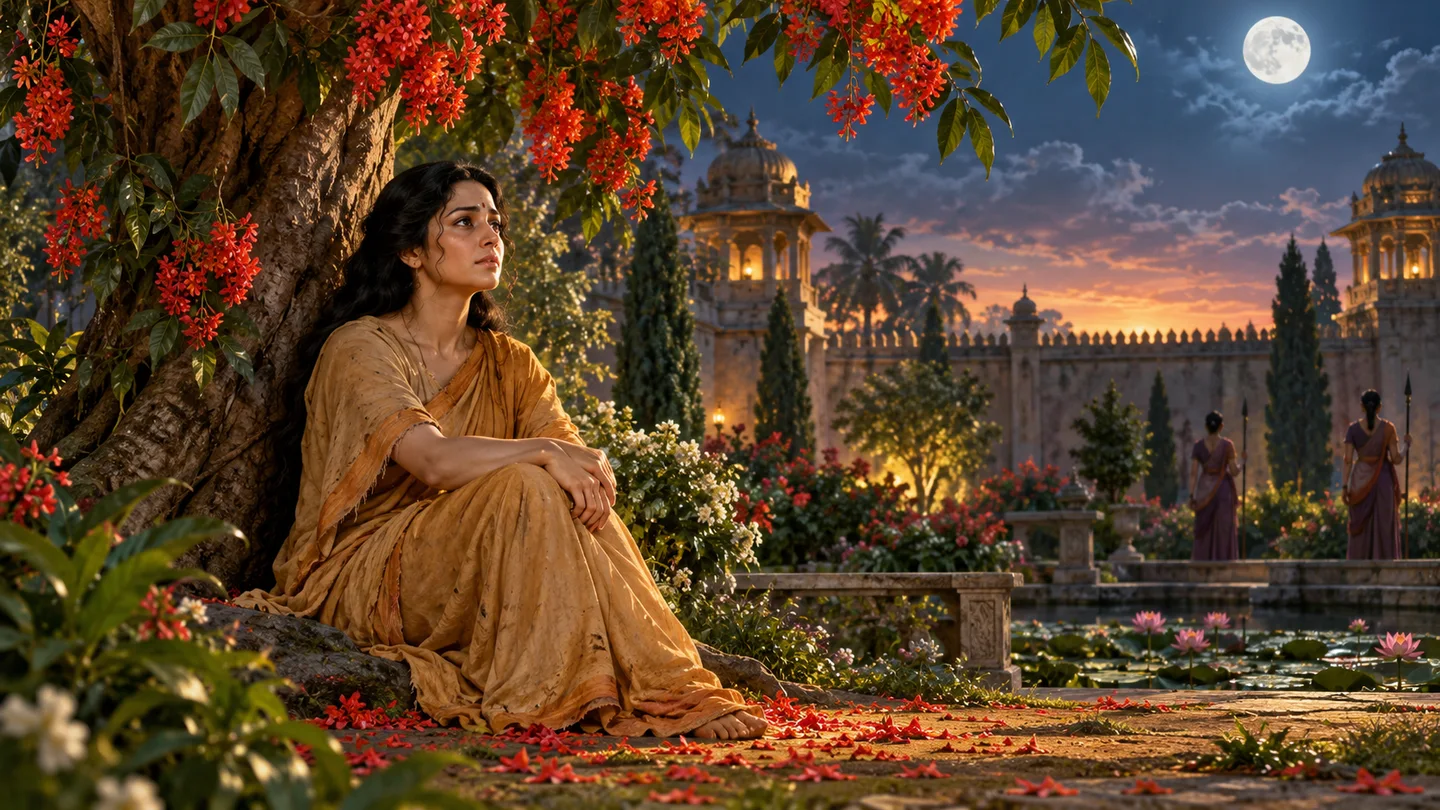
Sita sits beneath a flowering tree in the Ashoka grove, holding to hope.
Original DHIH illustration · artistic interpretation

Verse 1 · 5.29.1

#

तथागतां तां व्यथितामनिन्दितां

To that blameless lady, afflicted in this way,

व्यतीतहर्षां परिदीनमानसाम् ।

joyless and deeply dejected,

शुभां निमित्तानि शुभानि भेजिरे

came auspicious signs, attending her

नरं श्रिया जुष्टमिवोपसेविनः ॥

like servants attending a man favoured by prosperity.

Verse 2 · 5.29.2

#

तस्याः शुभं वाममरालपक्ष्म-

Her auspicious left eye, bordered by curved lashes,

राज्यावृतं कृष्णविशालशुक्लम् ।

with its dark pupil and broad white surface,

प्रास्पन्दतैकं नयनं सुकेश्या

began to tremble, that beautiful-haired lady’s eye,

मीनाहतं पद्ममिवाभिताम्रम् ॥

like a reddish lotus stirred by a fish.

Verse 3 · 5.29.3

#

भुजश्च चार्वञ्चितवृत्तपीनः

Her graceful, rounded, full left arm,

परार्घ्यकालागुरुचन्दनार्हः ।

worthy of precious black aguru and sandal paste,

अनुत्तमेनाघ्युषितः प्रियेण

on which her incomparable beloved had rested,

चिरेण वामः समवेपताशु ॥

suddenly trembled after a long time.

Verse 4 · 5.29.4

#

गजेन्द्रहस्तप्रतिमश्च पीन-

Of her two close-set thighs, a full one

स्तयोर्द्वयोः संहतयोस्तु जातः ।

resembling the trunk of a great elephant

प्रस्पन्दमानः पुनरूरुरस्या

again began to throb,

रामं पुरस्तात् स्थितमाचचक्षे ॥

as though announcing Rama standing before her.

Verse 5 · 5.29.5

#

शुभं पुनर्हेमसमानवर्ण-

Again, the lovely, gold-coloured garment,

मीषद्रजोध्वस्तमिवातुलाक्ष्याः ।

slightly dulled with dust, of that incomparable-eyed lady,

वासः स्थितायाः शिखराग्रदन्त्याः

standing there with fine-pointed teeth

किंचित् परिस्रंसत चारुगात्र्याः ॥

and graceful limbs, slipped a little.

Verse 6 · 5.29.6

#

एतैर्निमित्तैरपरैश्च सुभ्रूः

Encouraged by these and other signs,

संचोदिता प्रागपि साधुसिद्धैः ।

which had proved favourable before, the lovely-browed lady

वातातपक्लान्तमिव प्रणष्टं

revived in joy like a seed almost destroyed

वर्षेण बीजं प्रतिसंजहर्ष ॥

by wind and heat, refreshed by rain.

Verse 7 · 5.29.7

#

तस्याः पुनर्बिम्बफलोपमोष्ठं

Her face, with lips like a bimba fruit,

स्वक्षिभ्रुकेशान्तमरालपक्ष्म ।

lovely eyes, brows and hair, curved eyelashes

वक्त्रं बभासे सितशुक्लदंष्ट्रं

and gleaming white teeth, shone again

राहोर्मुखाच्चन्द्र इव प्रमुक्तः ॥

like the moon released from Rahu’s mouth.

Verse 8 · 5.29.8

#

सा वीतशोका व्यपनीततन्द्रा

Her grief lifted, her weariness departed,

शान्तज्वरा हर्षविबुद्धसत्त्वा ।

her anguish quieted, her spirit awakened by joy;

अशोभतार्या वदनेन शुक्ले

the noble lady shone with her face

शीतांशुना रात्रिरिवोदितेन ॥

like the night brightened by the rising cool-rayed moon.

CHAPTER 29 COMPLETE

The journey continues.

For the first time in this sequence, Sita finds a measure of relief.

NEXT CHAPTER

Continue Hanuman’s journey in the next chapter.

About this reading

Vālmīki Rāmāyaṇa, Sundara Kanda, chapter 29. This reading follows Sanskrit Wikisource revision 354673, with all 8 numbered verses. Verse divisions and wording vary between editions.

The Sanskrit is preserved with normalized display spacing and line breaks. Some sentences continue across verse boundaries; the English follows that continuity. A yojana is a traditional distance unit, retained without assigning a modern measurement. Shape-changing and celestial beings belong to the epic’s sacred narrative.

English line senses and short meanings are original AI-assisted DHIH renderings checked against this Sanskrit reading; they are not a word-for-word grammatical commentary or a claim of human scholarly certification. Roman transliteration is generated mechanically in IAST. Names may also appear in familiar English spellings.

Sanskrit transcription credit: Wikisource contributors, revision history. The adapted reading text and DHIH English on this chapter page are offered under CC BY-SA 4.0. The ancient Sanskrit work is in the public domain. Illustrations are separately commissioned AI-generated DHIH artwork.

Historical comparison: M. N. Dutt’s Ramayana, volume II, a public-domain translation, was consulted for narrative context. The English displayed here is a fresh rendering of the pinned Sanskrit, not a reproduction of that translation.

The signs belong to the epic’s traditional language of omens. They are presented as part of its literary and cultural setting, not as a method for predicting real events. Audio will be added only when suitable recording permissions are available.