Home / Sundara Kanda / Chapter 3VĀLMĪKI RĀMĀYAṆA · CHAPTER 03
सुन्दरकाण्डम् · तृतीयः सर्गः
Hanuman meets Lanka’s guardian At the city’s entrance, Hanuman meets Lanka in her personified form. A challenge gives way to recognition and permission to continue.
51 verses Sanskrit + English 3 illustrated scenes
An edition-specific reading with original English meanings. Source & reading notes
Show Roman text Larger text
SCENE 01 · VERSES 1–19
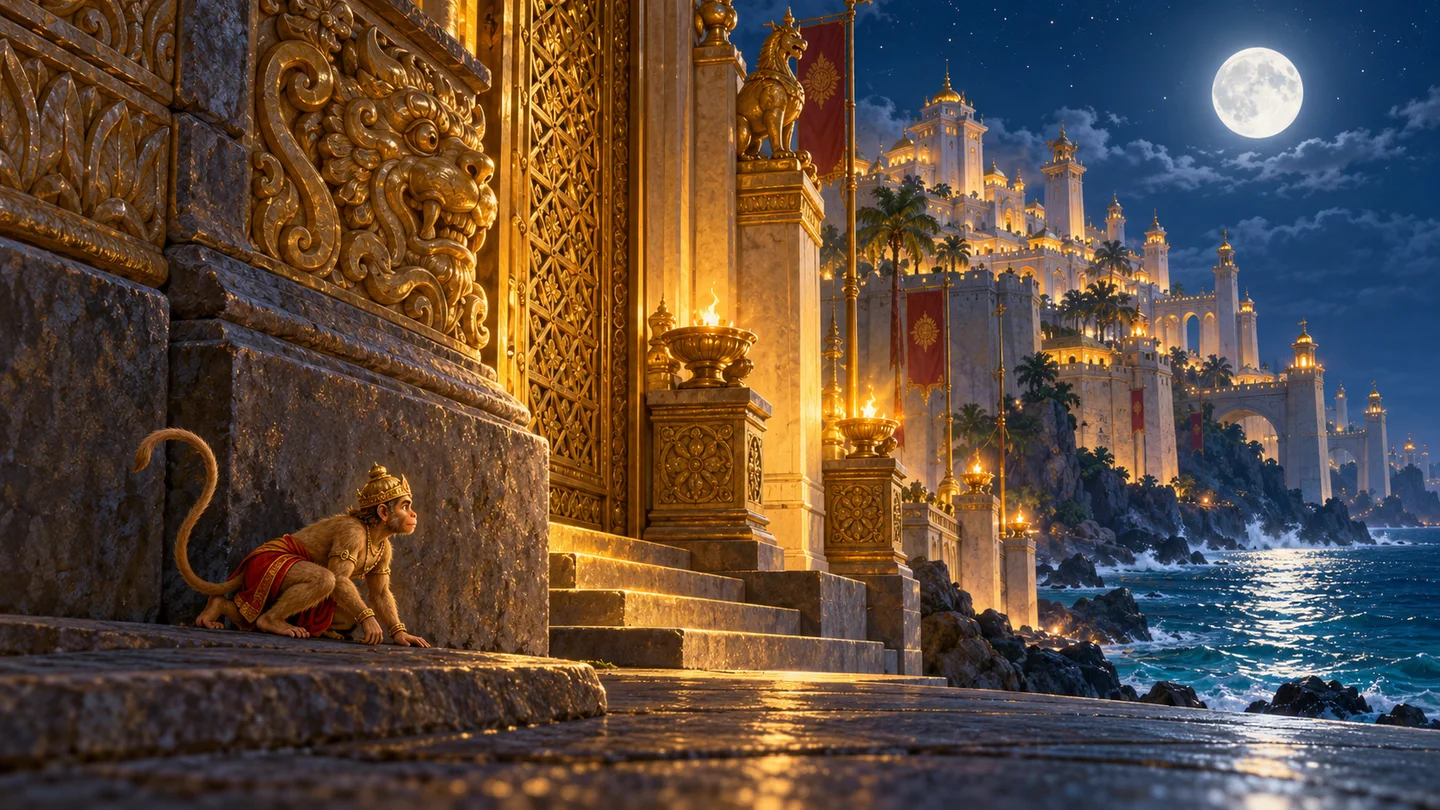
The city at night Lanka shines with lamps, jewels and lofty buildings. Hanuman remembers Rama and Lakshmana and gathers courage.
Original DHIH illustration · artistic interpretation Verse 1 · 5.3.1 # Copy link ↗ स लम्बशिखरे लम्बे लम्बतोयदसंनिभे ।
sa lambaśikhare lambe lambatoyadasaṃnibhe |
On lofty Mount Lamba, which resembled a hanging cloud,
सत्त्वमास्थाय मेधावी हनुमान् मारुतात्मजः ॥
sattvamāsthāya medhāvī hanumān mārutātmajaḥ ||
wise Hanuman, the son of the Wind, gathered his courage.
Verse 2 · 5.3.2 # Copy link ↗ निशि लंकां महासत्त्वो विवेश कपिकुञ्जरः ।
niśi laṃkāṃ mahāsattvo viveśa kapikuñjaraḥ |
At night the courageous hero, foremost among vanaras, entered Lanka,
रम्यकाननतोयाढ्यां पुरीं रावणपालिताम् ॥
ramyakānanatoyāḍhyāṃ purīṃ rāvaṇapālitām ||
Ravana's city, rich in beautiful woods and water.
Verse 3 · 5.3.3 # Copy link ↗ शारदाम्बुधरप्रख्यैर्भवनैरुपशोभिताम् ।
śāradāmbudharaprakhyairbhavanairupaśobhitām |
Its buildings shone like autumn clouds;
सागरोपमनिर्घोषां सागरानिलसेविताम् ॥
sāgaropamanirghoṣāṃ sāgarānilasevitām ||
its roar was like the ocean's, and sea breezes moved through it.
Short meaning Sight, sound and sea air give Lanka a vivid presence.
Verse 4 · 5.3.4 # Copy link ↗ सुपुष्टबलसम्पुष्टां यथैव विटपावतीम् ।
supuṣṭabalasampuṣṭāṃ yathaiva viṭapāvatīm |
Supported by its well-nourished, powerful forces, it resembled Vitapavati;
चारुतोरणनिर्यूहां पाण्डुरद्वारतोरणाम् ॥
cārutoraṇaniryūhāṃ pāṇḍuradvāratoraṇām ||
it had beautiful arches and projecting structures, and pale gateways.
Short meaning The city is both prosperous and well defended, compared here with Kubera's city.
Verse 5 · 5.3.5 # Copy link ↗ भुजगाचरितां गुप्तां शुभां भोगवतीमिव ।
bhujagācaritāṃ guptāṃ śubhāṃ bhogavatīmiva |
It was guarded like lovely Bhogavati, inhabited by serpents,
तां सविद्युद्घनाकीर्णां ज्योतिर्गणनिषेविताम् ॥
tāṃ savidyudghanākīrṇāṃ jyotirgaṇaniṣevitām ||
and seemed surrounded by lightning-bearing clouds and hosts of lights;
Verse 6 · 5.3.6 # Copy link ↗ चण्डमारुतनिर्ह्रादां यथा चाप्यमरावतीम् ।
caṇḍamārutanirhrādāṃ yathā cāpyamarāvatīm |
Like Amaravati, it resounded with the noise of strong winds,
शातकुम्भेन महता प्राकारेणाभिसंवृताम् ॥
śātakumbhena mahatā prākāreṇābhisaṃvṛtām ||
and was enclosed by a great wall of gold.
Verse 7 · 5.3.7 # Copy link ↗ किङ्किणीजालघोषाभिः पताकाभिरलंकृताम् ।
kiṅkiṇījālaghoṣābhiḥ patākābhiralaṃkṛtām |
Banners adorned it amid the sound of networks of little bells.
आसाद्य सहसा हृष्टः प्राकारमभिपेदिवान् ॥
āsādya sahasā hṛṣṭaḥ prākāramabhipedivān ||
Reaching it, Hanuman joyfully approached the rampart.
Verse 8 · 5.3.8 # Copy link ↗ विस्मयाविष्टहृदयः पुरीमालोक्य सर्वतः ।
vismayāviṣṭahṛdayaḥ purīmālokya sarvataḥ |
His heart filled with wonder as he looked around the city,
जाम्बूनदमयैर्द्वारैर्वैदूर्यकृतवेदिकैः ॥
jāmbūnadamayairdvārairvaidūryakṛtavedikaiḥ ||
with its doors of fine gold and terraces made of beryl;
Verse 9 · 5.3.9 # Copy link ↗ वज्रस्फटिकमुक्ताभिर्मणिकुट्टिमभूषितैः ।
vajrasphaṭikamuktābhirmaṇikuṭṭimabhūṣitaiḥ |
its jewelled pavements adorned with diamonds, crystal and pearls,
तप्तहाटकनिर्यूहै राजतामलपाण्डुरैः ॥
taptahāṭakaniryūhai rājatāmalapāṇḍuraiḥ ||
its projections of glowing gold and its pure, pale silver surfaces;
Verse 10 · 5.3.10 # Copy link ↗ वैदूर्यकृतसोपानैः स्फाटिकान्तरपांसुभिः ।
vaidūryakṛtasopānaiḥ sphāṭikāntarapāṃsubhiḥ |
its beryl stairways, crystal-strewn interiors
चारुसंजवनोपेतैः खमिवोत्पतितैः शुभैः ॥
cārusaṃjavanopetaiḥ khamivotpatitaiḥ śubhaiḥ ||
and beautiful courts, with splendid buildings seeming to rise into the sky;
Short meaning Stairs, courtyards and soaring structures add to the city's grandeur.
Verse 11 · 5.3.11 # Copy link ↗ क्रौञ्चबर्हिणसंघुष्टै राजहंसनिषेवितैः ।
krauñcabarhiṇasaṃghuṣṭai rājahaṃsaniṣevitaiḥ |
it echoed with the calls of cranes, peacocks and royal swans,
तूर्याभरणनिर्घोषैः सर्वतः परिनादिताम् ॥
tūryābharaṇanirghoṣaiḥ sarvataḥ parināditām ||
and with the sounds of musical instruments and ornaments on every side.
Short meaning Lanka is filled with birdsong, music and the movement of its inhabitants.
Verse 12 · 5.3.12 # Copy link ↗ वस्वोकसारप्रतिमां समीक्ष्य नगरीं ततः ।
vasvokasārapratimāṃ samīkṣya nagarīṃ tataḥ |
Seeing the city, comparable to Vasvokasara,
खमिवोत्पतितां लंकां जहर्ष हनुमान् कपिः ॥
khamivotpatitāṃ laṃkāṃ jaharṣa hanumān kapiḥ ||
and Lanka seeming to rise into the sky, Hanuman rejoiced.
Verse 13 · 5.3.13 # Copy link ↗ तां समीक्ष्य पुरीं लंकां राक्षसाधिपतेः शुभाम् ।
tāṃ samīkṣya purīṃ laṃkāṃ rākṣasādhipateḥ śubhām |
Having surveyed the rakshasa ruler's splendid city of Lanka,
अनुत्तमामृद्धिमतीं चिन्तयामास वीर्यवान् ॥
anuttamāmṛddhimatīṃ cintayāmāsa vīryavān ||
unequalled and prosperous, the valiant hero began to reflect.
Verse 14 · 5.3.14 # Copy link ↗ नेयमन्येन नगरी शक्या धर्षयितुं बलात् ।
neyamanyena nagarī śakyā dharṣayituṃ balāt |
“This city cannot be overpowered by just anyone,
रक्षिता रावणबलैरुद्यतायुधपाणिभिः ॥
rakṣitā rāvaṇabalairudyatāyudhapāṇibhiḥ ||
guarded by Ravana's forces with weapons raised in their hands.”
Verse 15 · 5.3.15 # Copy link ↗ कुमुदाङ्गदयोर्वापि सुषेणस्य महाकपेः ।
kumudāṅgadayorvāpi suṣeṇasya mahākapeḥ |
“This land might be accessible to Kumuda and Angada, to the great vanara Sushena,
प्रसिद्धेयं भवेद् भूमिर्मैन्दद्विविदयोरपि ॥
prasiddheyaṃ bhaved bhūmirmaindadvividayorapi ||
and also to Mainda and Dvivida;
Verse 16 · 5.3.16 # Copy link ↗ विवस्वतस्तनूजस्य हरेश्च कुशपर्वणः ।
vivasvatastanūjasya hareśca kuśaparvaṇaḥ |
to the Sun's son, the vanara Kushaparvan,
ऋक्षस्य कपिमुख्यस्य मम चैव गतिर्भवेत् ॥
ṛkṣasya kapimukhyasya mama caiva gatirbhavet ||
the foremost bear-chief, and myself.”
Short meaning His list includes Sugriva, Kushaparvan, the bear-chief and himself.
Verse 17 · 5.3.17 # Copy link ↗ समीक्ष्य च महाबाहो राघवस्य पराक्रमम् ।
samīkṣya ca mahābāho rāghavasya parākramam |
Then, considering the prowess of mighty-armed Rama
लक्ष्मणस्य च विक्रान्तमभवत् प्रीतिमान् कपिः ॥
lakṣmaṇasya ca vikrāntamabhavat prītimān kapiḥ ||
and the courage of Lakshmana, the vanara felt glad.
Verse 18 · 5.3.18 # Copy link ↗ तां रत्नवसनोपेतां गोष्ठागारावतंसिकाम् ।
tāṃ ratnavasanopetāṃ goṣṭhāgārāvataṃsikām |
The wealthy city looked like an adorned woman, dressed in jewels, with cattle-yards and storehouses as ornaments,
यन्त्रागारस्तनीमृद्धां प्रमदामिव भूषिताम् ॥
yantrāgārastanīmṛddhāṃ pramadāmiva bhūṣitām ||
and buildings for defensive machinery compared to her breasts.
Short meaning The poet personifies the city's wealth and defensive structures through an elaborate bodily metaphor.
Verse 19 · 5.3.19 # Copy link ↗ तां नष्टतिमिरां दीपैर्भास्वरैश्च महाग्रहैः ।
tāṃ naṣṭatimirāṃ dīpairbhāsvaraiśca mahāgrahaiḥ |
Its darkness was driven away by lamps and shining heavenly bodies.
नगरीं राक्षसेन्द्रस्य स ददर्श महाकपिः ॥
nagarīṃ rākṣasendrasya sa dadarśa mahākapiḥ ||
The great vanara gazed upon that city of the rakshasa king.
SCENE 02 · VERSES 20–37
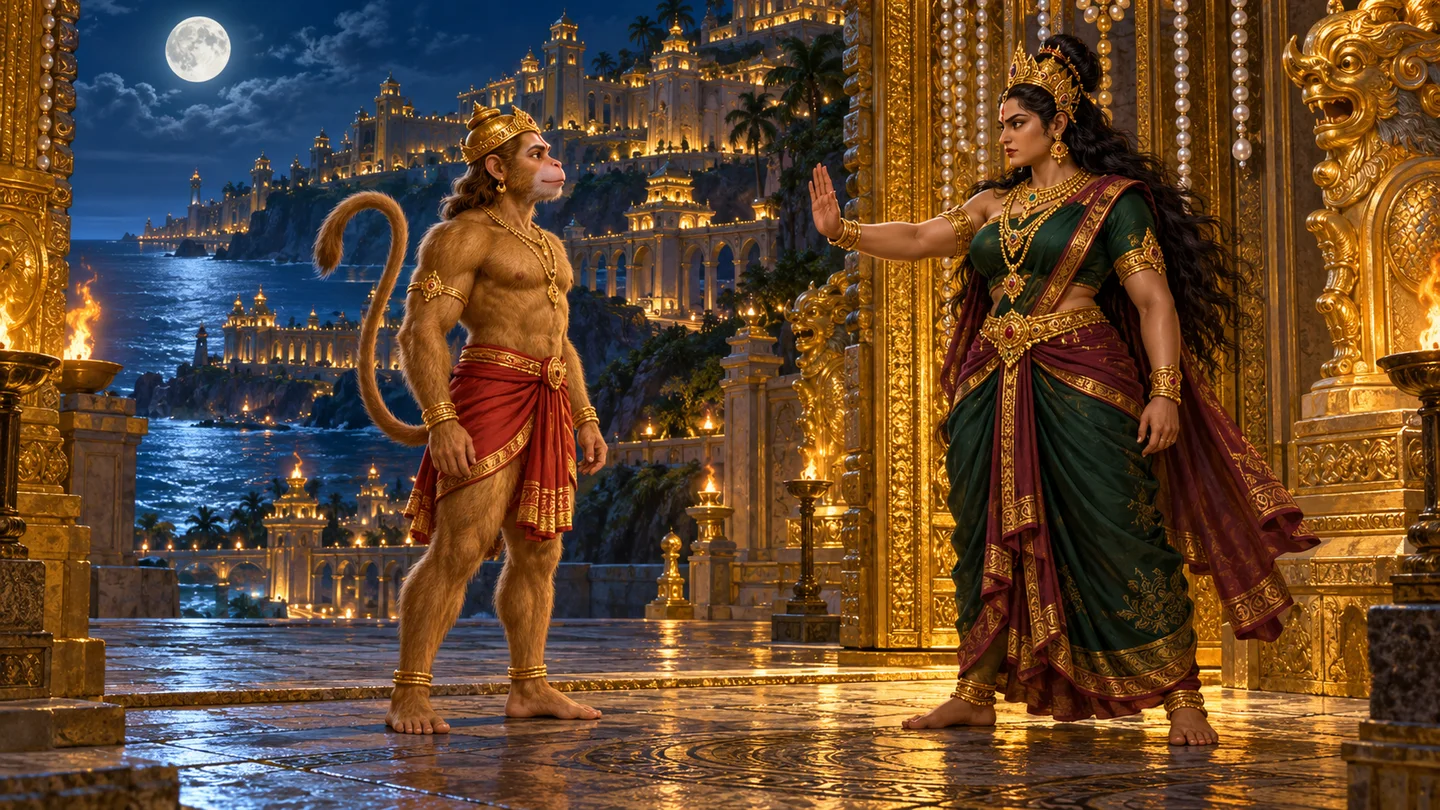
The guardian’s challenge The city takes a fearsome female form and questions the newcomer. Hanuman first responds with words.
Original DHIH illustration · artistic interpretation Verse 20 · 5.3.20 # Copy link ↗ अथ सा हरिशार्दूलं प्रविशन्तं महाकपिम् ।
atha sā hariśārdūlaṃ praviśantaṃ mahākapim |
Then, as the great vanara, foremost of his kind, entered,
नगरी स्वेन रूपेण ददर्श पवनात्मजम् ॥
nagarī svena rūpeṇa dadarśa pavanātmajam ||
the city herself in her embodied form saw the son of the Wind.
Verse 21 · 5.3.21 # Copy link ↗ सा तं हरिवरं दृष्ट्वा लंका रावणपालिता ।
sā taṃ harivaraṃ dṛṣṭvā laṃkā rāvaṇapālitā |
Seeing the foremost vanara, Lanka, protected by Ravana,
स्वयमेवोत्थिता तत्र विकृताननदर्शना ॥
svayamevotthitā tatra vikṛtānanadarśanā ||
rose there herself with a fearsome-looking face.
Verse 22 · 5.3.22 # Copy link ↗ पुरस्तात् तस्य वीरस्य वायुसूनोरतिष्ठत ।
purastāt tasya vīrasya vāyusūnoratiṣṭhata |
She stood before that hero, the son of the Wind,
मुञ्चमाना महानादमब्रवीत् पवनात्मजम् ॥
muñcamānā mahānādamabravīt pavanātmajam ||
and, uttering a mighty cry, addressed him.
Verse 23 · 5.3.23 # Copy link ↗ कस्त्वं केन च कार्येण इह प्राप्तो वनालय ।
kastvaṃ kena ca kāryeṇa iha prāpto vanālaya |
“Who are you, forest-dweller, and for what purpose have you come here?
कथयस्वेह यत् तत्त्वं यावत् प्राणा धरन्ति ते ॥
kathayasveha yat tattvaṃ yāvat prāṇā dharanti te ||
Tell me the truth while life still remains in you.”
Verse 24 · 5.3.24 # Copy link ↗ न शक्यं खल्वियं लंका प्रवेष्टुं वानर त्वया ।
na śakyaṃ khalviyaṃ laṃkā praveṣṭuṃ vānara tvayā |
“You cannot enter this Lanka, vanara,
रक्षिता रावणबलैरभिगुप्ता समन्ततः ॥
rakṣitā rāvaṇabalairabhiguptā samantataḥ ||
protected by Ravana's forces and guarded on every side.”
Verse 25 · 5.3.25 # Copy link ↗ अथ तामब्रवीद् वीरो हनुमानग्रतः स्थिताम् ।
atha tāmabravīd vīro hanumānagrataḥ sthitām |
Then heroic Hanuman spoke to her as she stood before him:
कथयिष्यामि तत् तत्त्वं यन्मां त्वं परिपृच्छसे ॥
kathayiṣyāmi tat tattvaṃ yanmāṃ tvaṃ paripṛcchase ||
“I shall tell you the truth about what you are asking me.”
Verse 26 · 5.3.26 # Copy link ↗ का त्वं विरूपनयना पुरद्वारेऽवतिष्ठसे ।
kā tvaṃ virūpanayanā puradvāre’vatiṣṭhase |
“Who are you, with that fierce appearance, standing at the city gate?
किमर्थं चापि मां क्रोधान्निर्भर्त्सयसि दारुणे ॥
kimarthaṃ cāpi māṃ krodhānnirbhartsayasi dāruṇe ||
And why, fearsome one, do you angrily threaten me?”
Verse 27 · 5.3.27 # Copy link ↗ हनुमद्वचनं श्रुत्वा लंका सा कामरूपिणी ।
hanumadvacanaṃ śrutvā laṃkā sā kāmarūpiṇī |
Hearing Hanuman's words, shape-changing Lanka
उवाच वचनं क्रुद्धा परुषं पवनात्मजम् ॥
uvāca vacanaṃ kruddhā paruṣaṃ pavanātmajam ||
angrily addressed the son of the Wind in harsh terms.
Verse 28 · 5.3.28 # Copy link ↗ अहं राक्षसराजस्य रावणस्य महात्मनः ।
ahaṃ rākṣasarājasya rāvaṇasya mahātmanaḥ |
“I await the command of the mighty rakshasa king Ravana.
आज्ञाप्रतीक्षा दुर्धर्षा रक्षामि नगरीमिमाम् ॥
ājñāpratīkṣā durdharṣā rakṣāmi nagarīmimām ||
Unassailable, I guard this city.”
Verse 29 · 5.3.29 # Copy link ↗ न शक्यं मामवज्ञाय प्रवेष्टुं नगरीमिमाम् ।
na śakyaṃ māmavajñāya praveṣṭuṃ nagarīmimām |
“You cannot disregard me and enter this city.
अद्य प्राणैः परित्यक्तः स्वप्स्यसे निहतो मया ॥
adya prāṇaiḥ parityaktaḥ svapsyase nihato mayā ||
Today you will lie lifeless, slain by me.”
Verse 30 · 5.3.30 # Copy link ↗ अहं हि नगरी लंका स्वयमेव प्लवङ्गम ।
ahaṃ hi nagarī laṃkā svayameva plavaṅgama |
“I am the city of Lanka herself, vanara.
सर्वतः परिरक्षामि अतस्ते कथितं मया ॥
sarvataḥ parirakṣāmi ataste kathitaṃ mayā ||
I protect it on every side; this is what I have told you.”
Verse 31 · 5.3.31 # Copy link ↗ लंकाया वचनं श्रुत्वा हनुमान् मारुतात्मजः ।
laṃkāyā vacanaṃ śrutvā hanumān mārutātmajaḥ |
Hearing Lanka's words, Hanuman, the son of the Wind,
यत्नवान् स हरिश्रेष्ठः स्थितः शैल इवापरः ॥
yatnavān sa hariśreṣṭhaḥ sthitaḥ śaila ivāparaḥ ||
remained alert and stood like another mountain.
Verse 32 · 5.3.32 # Copy link ↗ स तां स्त्रीरूपविकृतां दृष्ट्वा वानरपुङ्गवः ।
sa tāṃ strīrūpavikṛtāṃ dṛṣṭvā vānarapuṅgavaḥ |
Seeing her fearsome female form, the foremost vanara,
आबभाषेऽथ मेधावी सत्त्ववान् प्लवगर्षभः ॥
ābabhāṣe’tha medhāvī sattvavān plavagarṣabhaḥ ||
wise and courageous, spoke to her.
Verse 33 · 5.3.33 # Copy link ↗ द्रक्ष्यामि नगरीं लंकां साट्टप्राकारतोरणाम् ।
drakṣyāmi nagarīṃ laṃkāṃ sāṭṭaprākāratoraṇām |
“I wish to see Lanka, with its towers, ramparts and gateways.
इत्यर्थमिह सम्प्राप्तः परं कौतूहलं हि मे ॥
ityarthamiha samprāptaḥ paraṃ kautūhalaṃ hi me ||
That is why I have come; I am deeply curious.”
Verse 34 · 5.3.34 # Copy link ↗ वनान्युपवनानीह लंकायाः काननानि च ।
vanānyupavanānīha laṃkāyāḥ kānanāni ca |
“I have come to see Lanka's woods, pleasure gardens and groves,
सर्वतो गृहमुख्यानि द्रष्टुमागमनं हि मे ॥
sarvato gṛhamukhyāni draṣṭumāgamanaṃ hi me ||
and the principal houses on every side.”
Verse 35 · 5.3.35 # Copy link ↗ तस्य तद् वचनं श्रुत्वा लंका सा कामरूपिणी ।
tasya tad vacanaṃ śrutvā laṃkā sā kāmarūpiṇī |
Hearing these words, shape-changing Lanka
भूय एव पुनर्वाक्यं बभाषे परुषाक्षरम् ॥
bhūya eva punarvākyaṃ babhāṣe paruṣākṣaram ||
once again answered him with harsh speech.
Verse 36 · 5.3.36 # Copy link ↗ मामनिर्जित्य दुर्बुद्धे राक्षसेश्वरपालिताम् ।
māmanirjitya durbuddhe rākṣaseśvarapālitām |
“Without first defeating me, foolish and contemptible vanara,
न शक्यं ह्यद्य ते द्रष्टुं पुरीयं वानराधम ॥
na śakyaṃ hyadya te draṣṭuṃ purīyaṃ vānarādhama ||
you cannot see this city protected by the lord of the rakshasas.”
Verse 37 · 5.3.37 # Copy link ↗ ततः स हरिशार्दूलस्तामुवाच निशाचरीम् ।
tataḥ sa hariśārdūlastāmuvāca niśācarīm |
Then the foremost vanara said to that night-wanderer:
दृष्ट्वा पुरीमिमां भद्रे पुनर्यास्ये यथागतम् ॥
dṛṣṭvā purīmimāṃ bhadre punaryāsye yathāgatam ||
“Good lady, after seeing this city I shall return by the way I came.”
SCENE 03 · VERSES 38–51
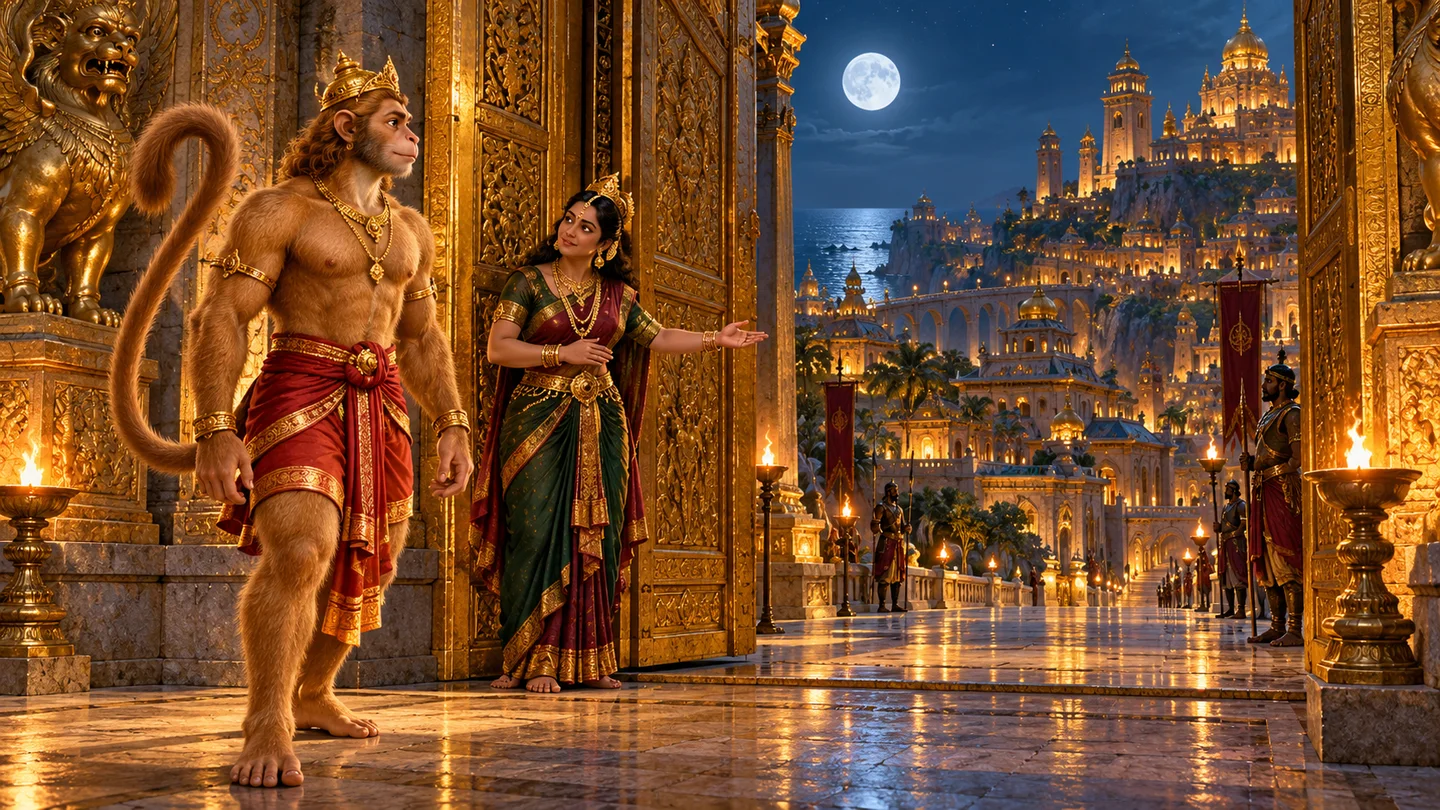
Compassion after the encounter After a brief physical confrontation, Hanuman shows compassion. The guardian recalls a prediction and lets him pass.
Original DHIH illustration · artistic interpretation Verse 38 · 5.3.38 # Copy link ↗ ततः कृत्वा महानादं सा वै लंका भयंकरम् ।
tataḥ kṛtvā mahānādaṃ sā vai laṃkā bhayaṃkaram |
Then Lanka gave a great, terrifying cry
तलेन वानरश्रेष्ठं ताडयामास वेगिता ॥
talena vānaraśreṣṭhaṃ tāḍayāmāsa vegitā ||
and swiftly struck the foremost vanara with her palm.
Verse 39 · 5.3.39 # Copy link ↗ ततः स हरिशार्दूलो लंकया ताडितो भृशम् ।
tataḥ sa hariśārdūlo laṃkayā tāḍito bhṛśam |
Struck hard by Lanka, that foremost vanara,
ननाद सुमहानादं वीर्यवान् मारुतात्मजः ॥
nanāda sumahānādaṃ vīryavān mārutātmajaḥ ||
the valiant son of the Wind, gave a mighty roar.
Verse 40 · 5.3.40 # Copy link ↗ ततः संवर्तयामास वामहस्तस्य सोऽङ्गुलीः ।
tataḥ saṃvartayāmāsa vāmahastasya so’ṅgulīḥ |
Then he closed the fingers of his left hand
मुष्टिनाभिजघानैनां हनुमान् क्रोधर्मूच्छितः ॥
muṣṭinābhijaghānaināṃ hanumān krodharmūcchitaḥ ||
and, seized by anger, struck her with his fist.
Verse 41 · 5.3.41 # Copy link ↗ स्त्री चेति मन्यमानेन नातिक्रोधः स्वयं कृतः ।
strī ceti manyamānena nātikrodhaḥ svayaṃ kṛtaḥ |
Remembering that she was a woman, he did not let his anger reach its full force.
सा तु तेन प्रहारेण विह्वलाङ्गी निशाचरी ।
sā tu tena prahāreṇa vihvalāṅgī niśācarī |
Yet the night-wanderer, her limbs shaken by the blow,
पपात सहसा भूमौ विकृताननदर्शना ॥
papāta sahasā bhūmau vikṛtānanadarśanā ||
suddenly fell to the ground, her face distorted.
Short meaning He limits his force, though the blow still brings the guardian down.
Verse 42 · 5.3.42 # Copy link ↗ ततस्तु हनुमान् वीरस्तां दृष्ट्वा विनिपातिताम् ।
tatastu hanumān vīrastāṃ dṛṣṭvā vinipātitām |
Seeing her fallen, the radiant hero Hanuman
कृपां चकार तेजस्वी मन्यमानः स्त्रियं च ताम् ॥
kṛpāṃ cakāra tejasvī manyamānaḥ striyaṃ ca tām ||
felt compassion, also bearing in mind that she was a woman.
Short meaning After the confrontation, Hanuman responds to her condition with compassion.
Verse 43 · 5.3.43 # Copy link ↗ ततो वै भृशमुद्विग्ना लंका सा गद्गदाक्षरम् ।
tato vai bhṛśamudvignā laṃkā sā gadgadākṣaram |
Then Lanka, deeply shaken, spoke with faltering syllables,
उवाचागर्वितं वाक्यं हनुमन्तं प्लवङ्गमम् ॥
uvācāgarvitaṃ vākyaṃ hanumantaṃ plavaṅgamam ||
addressing Hanuman without her former pride.
Verse 44 · 5.3.44 # Copy link ↗ प्रसीद सुमहाबाहो त्रायस्व हरिसत्तम ।
prasīda sumahābāho trāyasva harisattama |
“Be gracious, mighty-armed one; spare me, foremost vanara.
समये सौम्य तिष्ठन्ति सत्त्ववन्तो महाबलाः ॥
samaye saumya tiṣṭhanti sattvavanto mahābalāḥ ||
Good and powerful beings, gentle one, remain within proper bounds.”
Verse 45 · 5.3.45 # Copy link ↗ अहं तु नगरी लंका स्वयमेव प्लवङ्गम ।
ahaṃ tu nagarī laṃkā svayameva plavaṅgama |
“I am the city of Lanka herself, leaping vanara.
निर्जिताहं त्वया वीर विक्रमेण महाबल ॥
nirjitāhaṃ tvayā vīra vikrameṇa mahābala ||
Hero of great strength, you have overcome me by your prowess.”
Verse 46 · 5.3.46 # Copy link ↗ इदं च तथ्यं शृणु मे ब्रुवन्त्या वै हरीश्वर ।
idaṃ ca tathyaṃ śṛṇu me bruvantyā vai harīśvara |
“Now hear the truth that I tell you, lord of vanaras,
स्वयं स्वयम्भुवा दत्तं वरदानं यथा मम ॥
svayaṃ svayambhuvā dattaṃ varadānaṃ yathā mama ||
about the boon once given to me by the self-born Brahma.”
Verse 47 · 5.3.47 # Copy link ↗ यदा त्वां वानरः कश्चिद् विक्रमाद् वशमानयेत् ।
yadā tvāṃ vānaraḥ kaścid vikramād vaśamānayet |
“When some vanara overcomes you by his valour,
तदा त्वया हि विज्ञेयं रक्षसां भयमागतम् ॥
tadā tvayā hi vijñeyaṃ rakṣasāṃ bhayamāgatam ||
then know that danger has come upon the rakshasas.”
Verse 48 · 5.3.48 # Copy link ↗ स हि मे समयः सौम्य प्राप्तोऽद्य तव दर्शनात् ।
sa hi me samayaḥ saumya prāpto’dya tava darśanāt |
“That appointed time, gentle one, has arrived today through meeting you.
स्वयम्भूविहितः सत्यो न तस्यास्ति व्यतिक्रमः ॥
svayambhūvihitaḥ satyo na tasyāsti vyatikramaḥ ||
What the self-born one ordained is true; it cannot be transgressed.”
Verse 49 · 5.3.49 # Copy link ↗ सीतानिमित्तं राज्ञस्तु रावणस्य दुरात्मनः ।
sītānimittaṃ rājñastu rāvaṇasya durātmanaḥ |
“For wicked King Ravana, because of Sita,
रक्षसां चैव सर्वेषां विनाशः समुपागतः ॥
rakṣasāṃ caiva sarveṣāṃ vināśaḥ samupāgataḥ ||
and for all the rakshasas, destruction has drawn near.”
Verse 50 · 5.3.50 # Copy link ↗ तत् प्रविश्य हरिश्रेष्ठ पुरीं रावणपालिताम् ।
tat praviśya hariśreṣṭha purīṃ rāvaṇapālitām |
“Therefore enter the city ruled by Ravana, foremost vanara,
विधत्स्व सर्वकार्याणि यानि यानीह वाञ्छसि ॥
vidhatsva sarvakāryāṇi yāni yānīha vāñchasi ||
and accomplish all the tasks you wish to carry out here.”
Verse 51 · 5.3.51 # Copy link ↗ प्रविश्य शापोपहतां हरीश्वर
praviśya śāpopahatāṃ harīśvara
“Enter, lord of vanaras, this splendid city touched by a curse,
पुरीं शुभां राक्षसमुख्यपालिताम् ।
purīṃ śubhāṃ rākṣasamukhyapālitām |
guarded by the chief of the rakshasas.
यदृच्छया त्वं जनकात्मजां सतीं
yadṛcchayā tvaṃ janakātmajāṃ satīṃ
Seek the virtuous daughter of Janaka as you wish,
विमार्ग सर्वत्र गतो यथासुखम् ॥
vimārga sarvatra gato yathāsukham ||
going everywhere freely in your search.”
About this reading Vālmīki Rāmāyaṇa, Sundara Kanda, chapter 3. This reading follows Sanskrit Wikisource revision 354129 , with all 51 numbered verses . Verse divisions and wording vary between editions.
The Sanskrit is preserved with normalized display spacing and line breaks. Some sentences continue across verse boundaries; the English follows that continuity. A yojana is a traditional distance unit, retained without assigning a modern measurement. Shape-changing and celestial beings belong to the epic’s sacred narrative.
English line senses and short meanings are original AI-assisted DHIH renderings checked against this Sanskrit reading; they are not a word-for-word grammatical commentary or a claim of human scholarly certification. Roman transliteration is generated mechanically in IAST. Names may also appear in familiar English spellings.
Sanskrit transcription credit: Wikisource contributors, revision history . The adapted reading text and DHIH English on this chapter page are offered under CC BY-SA 4.0 . The ancient Sanskrit work is in the public domain. Illustrations are separately commissioned AI-generated DHIH artwork.
The Sanskrit calls the guardian Lanka, the city embodied; she is commonly known as Lankini in retellings. The original describes her threats, her striking Hanuman, his answering blow and his subsequent compassion. The picture story mentions that the encounter is difficult without depicting the blows. This is an adaptation, not a literal translation. Discuss seeking help and keeping safe rather than imitating a fight. Brahma’s prediction belongs to the epic’s sacred narrative. The picture story is a separately labelled adaptation for reading with a grown-up. Audio will be added only when suitable recording permissions are available.