Search DHIH library

VĀLMĪKI RĀMĀYAṆA · CHAPTER 35

सर्गः ३५

Hanuman earns Sita’s trust

Hanuman describes Rama and Lakshmana, recounts the alliance with Sugriva and the search for Sita, and explains his own journey. Specific memories help Sita recognise a true messenger.

90 versesSanskrit + English1 illustration
Begin reading ↓

An edition-specific reading with original English meanings. Source & reading notes

SCENE 01 · VERSES 1–90

The details that establish trust

Hanuman describes Rama and Lakshmana, recounts the alliance with Sugriva and the search for Sita, and explains his own journey. Specific memories help Sita recognise a true messenger.

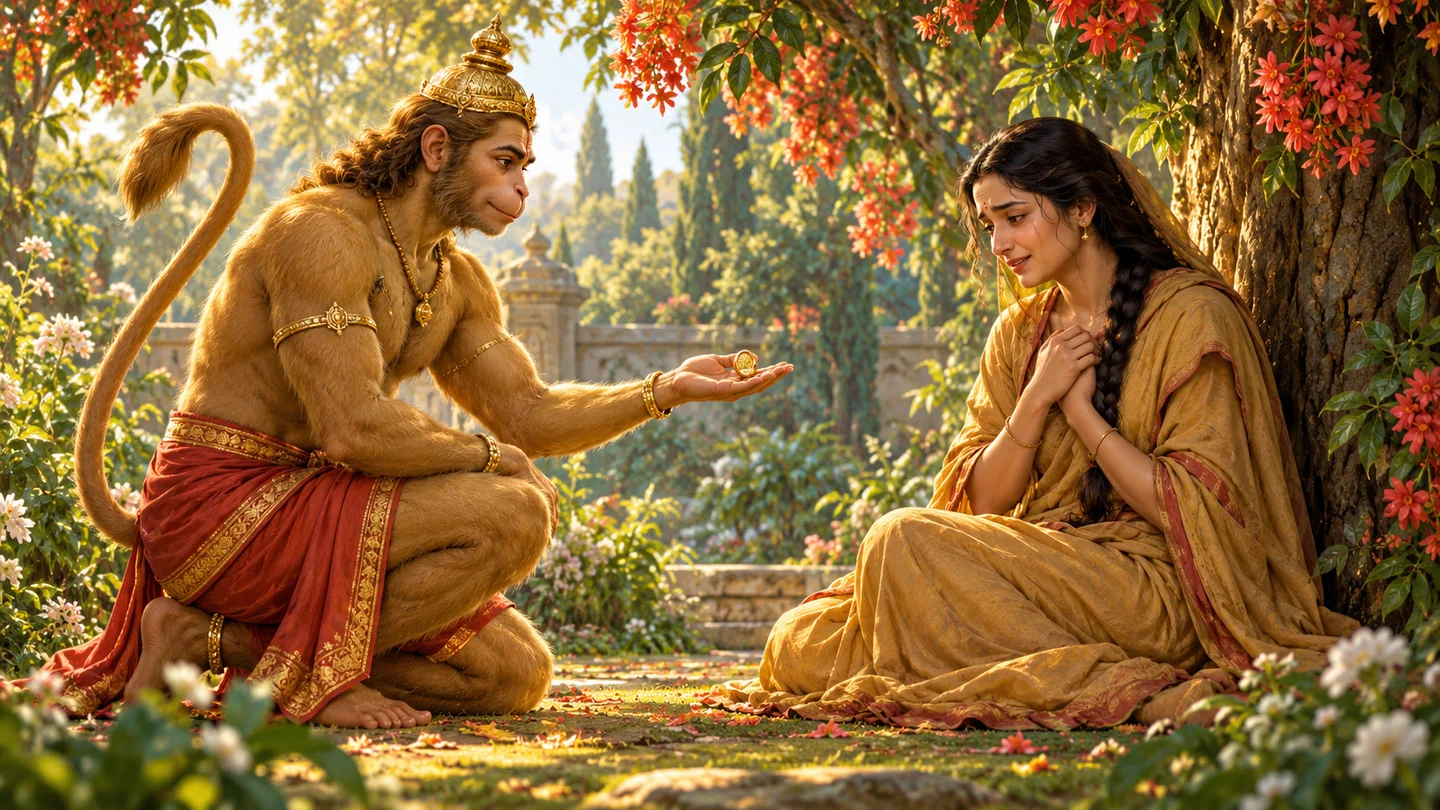
Hanuman respectfully presents Rama’s small ring to Sita in the garden.
Original DHIH illustration · artistic interpretation

Verse 1 · 5.35.1

#

तां तु रामकथां श्रुत्वा वैदेही वानरर्षभात् ।

Hearing Rama’s story from that foremost vanara,

उवाच वचनं सान्त्वमिदं मधुरया गिरा ॥

Vaidehi spoke gently in a sweet voice.

Verse 2 · 5.35.2

#

क्व ते रामेण संसर्गः कथं जानासि लक्ष्मणम् ।

“Where did you meet Rama? How do you know Lakshmana?

वानराणां नराणां च कथमासीत् समागमः ॥

How did vanaras and men come together?

Verse 3 · 5.35.3

#

यानि रामस्य चिह्नानि लक्ष्मणस्य च वानर ।

Tell me again, vanara, the distinguishing marks

तानि भूयः समाचक्ष्व न मां शोकः समाविशेत् ॥

of Rama and Lakshmana, so that grief may not overwhelm me.

Verse 4 · 5.35.4

#

कीदृशं तस्य संस्थानं रूपं तस्य च कीदृशम् ।

What is his build? What is his appearance?

कथमूरू कथं बाहू लक्ष्मणस्य च शंस मे ॥

Describe his thighs and arms, and Lakshmana’s too.”

Verse 5 · 5.35.5

#

एवमुक्तस्तु वैदेह्या हनूमान् मारुतात्मजः ।

Thus addressed by Vaidehi, Hanuman, the Wind’s son,

ततो रामं यथातत्त्वमाख्यातुमुपचक्रमे ॥

began to describe Rama as he truly was.

Verse 6 · 5.35.6

#

जानन्ती बत दिष्ट्या मां वैदेहि परिपृच्छसि ।

“Fortunately, lotus-eyed Vaidehi, though you know them,

भर्तुः कमलपत्राक्षि संस्थानं लक्ष्मणस्य च ॥

you ask me about your husband’s build and Lakshmana’s.

Verse 7 · 5.35.7

#

यानि रामस्य चिह्नानि लक्ष्मणस्य च यानि वै ।

Listen, wide-eyed lady, as I describe the distinguishing marks

लक्षितानि विशालाक्षि वदतः शृणु तानि मे ॥

I have observed in Rama and Lakshmana.

Verse 8 · 5.35.8

#

रामः कमलपत्राक्षः पूर्णचन्द्रनिभाननः ।

Rama has lotus-petal eyes and a face like the full moon;

रूपदाक्षिण्यसम्पन्नः प्रसूतो जनकात्मजे ॥

Janaka’s daughter, he is endowed with beauty and graciousness.

Verse 9 · 5.35.9

#

तेजसाऽऽदित्यसंकाशः क्षमया पृथिवीसमः ।

He resembles the sun in radiance, the earth in patience,

बृहस्पतिसमो बुद्ध्या यशसा वासवोपमः ॥

Brihaspati in wisdom, and Indra in fame.

Verse 10 · 5.35.10

#

रक्षिता जीवलोकस्य स्वजनस्य च रक्षिता ।

He protects living beings and his own people,

रक्षिता स्वस्य वृत्तस्य धर्मस्य च परंतपः ॥

his conduct and righteousness, while subduing foes.

Verse 11 · 5.35.11

#

रामो भामिनि लोकस्य चातुर्वर्ण्यस्य रक्षिता ।

Lady, Rama protects the four social orders of the world;

मर्यादानां च लोकस्य कर्ता कारयिता च सः ॥

he establishes its proper boundaries and ensures their observance.

Verse 12 · 5.35.12

#

अर्चिष्मानर्चितोऽत्यर्थं ब्रह्मचर्यव्रते स्थितः ।

Radiant and greatly honoured, he observes disciplined continence,

साधूनामुपकारज्ञः प्रचारज्ञश्च कर्मणाम् ॥

recognizes kindness from good people, and understands how duties are performed.

Verse 13 · 5.35.13

#

राजनीत्यां विनीतश्च ब्राह्मणानामुपासकः ।

Trained in statecraft and attentive to brahmanas,

ज्ञानवान् शीलसम्पन्नो विनीतश्च परंतपः ॥

that conqueror of foes is wise, well-conducted and humble.

Verse 14 · 5.35.14

#

यजुर्वेदविनीतश्च वेदविद्भिः सुपूजितः ।

Trained in the Yajurveda and honoured by Vedic scholars,

धनुर्वेदे च वेदे च वेदाङ्गेषु च निष्ठितः ॥

he is grounded in archery, the Vedas and their auxiliary disciplines.

Verse 15 · 5.35.15

#

विपुलांसो महाबाहुः कम्बुग्रीवः शुभाननः ।

Broad-shouldered and long-armed, with a conch-like neck and lovely face,

गूढजत्रुः सुताम्राक्षो रामो नाम जनैः श्रुतः ॥

full over the collarbones and reddish-eyed, he is known among people as Rama.

Verse 16 · 5.35.16

#

दुन्दुभिस्वननिर्घोषः स्निग्धवर्णः प्रतापवान् ।

His voice resounds like a kettledrum; his complexion is lustrous and his presence powerful.

समश्च सुविभक्ताङ्गो वर्णं श्यामं समाश्रितः ॥

His limbs are symmetrical and well proportioned, and his colour is dark.

Verse 17 · 5.35.17

#

त्रिस्थिरस्त्रिप्रलम्बश्च त्रिसमस्त्रिषु चोन्नतः ।

Three features are firm, three long, three equal, and three raised;

त्रिताम्रस्त्रिषु च स्निग्धो गम्भीरस्त्रिषु नित्यशः ॥

three are copper-red, three lustrous, and three always deep.

Verse 18 · 5.35.18

#

त्रिवलीमांस्त्र्यवनतश्चतुर्व्यङ्गस्त्रिशीर्षवान् ।

He has three bodily folds, three low-set features, four short features, and three hair-whorls;

चतुष्कलश्चतुर्लेखश्चतुष्किष्कुश्चतुःसमः ॥

four auspicious signs and lines, a height of four cubits, and four equal features.

Verse 19 · 5.35.19

#

चतुर्दशसमद्वन्द्वश्चतुर्दंष्ट्रश्चतुर्गतिः ।

Fourteen paired features are symmetrical; he has four marked canine teeth and four noble gaits;

महोष्ठहनुनासश्च पञ्चस्निग्धोऽष्टवंशवान् ॥

his lips, jaw and nose are prominent, five features lustrous, and eight long.

Verse 20 · 5.35.20

#

दशपद्मो दशबृहत् त्रिभिर्व्याप्तो द्विशुक्लवान् ।

Ten features are lotus-like, ten broad; three qualities pervade him, and two are pure;

षडुन्नतो नवतनुस्त्रिभिर्व्याप्नोति राघवः ॥

six features are raised and nine fine; Raghava attends to the three aims of life.

Verse 21 · 5.35.21

#

सत्यधर्मरतः श्रीमान् संग्रहानुग्रहे रतः ।

Glorious, devoted to truth and dharma, he delights in gathering and giving support;

देशकालविभागज्ञः सर्वलोकप्रियंवदः ॥

he understands place and time and speaks agreeably to everyone.

Verse 22 · 5.35.22

#

भ्राता चास्य च वैमात्रः सौमित्रिरमितप्रभः ।

His brother by another mother, Saumitri of boundless radiance,

अनुरागेण रूपेण गुणैश्चापि तथाविधः ॥

is like him in affection, appearance and virtues.

Verse 23 · 5.35.23

#

स सुवर्णच्छविः श्रीमान् रामः श्यामो महायशाः ।

Glorious Lakshmana is golden-hued; renowned Rama is dark.

तावुभौ नरशार्दूलौ त्वद्दर्शनकृतोत्सवौ ॥

Those two foremost men are eagerly intent on seeing you.

Verse 24 · 5.35.24

#

विचिन्वन्तौ महीं कृत्स्नामस्माभिः सह संगतौ ।

Searching the whole earth, they met us;

त्वामेव मार्गमाणौ तौ विचरन्तौ वसुन्धराम् ॥

they were roaming the world seeking you alone.

Verse 25 · 5.35.25

#

ददर्शतुर्मृगपतिं पूर्वजेनावरोपितम् ।

At the foot of tree-covered Rishyamuka,

ऋष्यमूकस्य मूले तु बहुपादपसंकुले ॥

they saw the vanara ruler, displaced by his elder brother,

Verse 26 · 5.35.26

#

भ्रातुर्भयार्तमासीनं सुग्रीवं प्रियदर्शनम् ।

pleasant-looking Sugriva, sitting in fear of his brother.

वयं च हरिराजं तं सुग्रीवं सत्यसङ्गरम् ॥

We were attending that vanara king, Sugriva, true to his pledge,

Verse 27 · 5.35.27

#

परिचर्यामहे राज्यात् पूर्वजेनावरोपितम् ।

who had been driven from his kingdom by his elder brother.

ततस्तौ चीरवसनौ धनुःप्रवरपाणिनौ ॥

Then those two, dressed in bark and holding fine bows,

Verse 28 · 5.35.28

#

ऋष्यमूकस्य शैलस्य रम्यं देशमुपागतौ ।

came to a lovely place on Mount Rishyamuka.

स तौ दृष्ट्वा नरव्याघ्रौ धन्विनौ वानरर्षभः ॥

Seeing those two tiger-like men carrying bows, the foremost vanara

Verse 29 · 5.35.29

#

अभिप्लुतो गिरेस्तस्य शिखरं भयमोहितः ।

leapt in fear to that mountain’s summit.

ततः स शिखरे तस्मिन् वानरेन्द्रो व्यवस्थितः ॥

Established there upon the peak, the vanara king

Verse 30 · 5.35.30

#

तयोः समीपं मामेव प्रेषयामास सत्वरम् ।

quickly sent me alone to approach them.

तावहं पुरुषव्याघ्रौ सुग्रीववचनात् प्रभू ॥

At Sugriva’s command, I approached those mighty, tiger-like men,

Verse 31 · 5.35.31

#

रूपलक्षणसम्पन्नौ कृताञ्जलिरुपस्थितः ।

endowed with beauty and noble marks, with my palms joined.

तौ परिज्ञाततत्त्वार्थौ मया प्रीतिसमन्वितौ ॥

After I learned their true purpose, the two were pleased;

Verse 32 · 5.35.32

#

पृष्ठमारोप्य तं देशं प्रापितौ पुरुषर्षभौ ।

I carried those foremost men on my back to that place

निवेदितौ च तत्त्वेन सुग्रीवाय महात्मने ॥

and truthfully introduced them to great-souled Sugriva.

Verse 33 · 5.35.33

#

तयोरन्योन्यसम्भाषाद् भृशं प्रीतिरजायत ।

Through conversation, great affection arose between them.

तत्र तौ कीर्तिसम्पन्नौ हरीश्वरनरेश्वरौ ॥

There the renowned vanara lord and lord of men

Verse 34 · 5.35.34

#

परस्परकृताश्वासौ कथया पूर्ववृत्तया ।

reassured one another by recounting their earlier experiences.

तं ततः सान्त्वयामास सुग्रीवं लक्ष्मणाग्रजः ॥

Then Lakshmana’s elder brother comforted Sugriva,

Verse 35 · 5.35.35

#

स्त्रीहेतोर्वालिना भ्रात्रा निरस्तं पुरुतेजसा ।

who had been driven out by mighty Vali over a dispute concerning a wife.

ततस्त्वन्नाशजं शोकं रामस्याक्लिष्टकर्मणः ॥

Then the grief of Rama, unfailing in action, caused by your disappearance,

Verse 36 · 5.35.36

#

लक्ष्मणो वानरेन्द्राय सुग्रीवाय न्यवेदयत् ।

was related by Lakshmana to Sugriva, lord of vanaras.

स श्रुत्वा वानरेन्द्रस्तु लक्ष्मणेनेरितं वचः ॥

Hearing the words spoken by Lakshmana, that vanara king

Verse 37 · 5.35.37

#

तदासीन्निष्प्रभोऽत्यर्थं ग्रहग्रस्त इवांशुमान् ।

became greatly downcast, like the sun seized in eclipse.

ततस्त्वद‍्गात्रशोभीनि रक्षसा ह्रियमाणया ॥

Then the ornaments that had adorned your body,

Verse 38 · 5.35.38

#

यान्याभरणजालानि पातितानि महीतले ।

which you had cast to the ground while being carried away by the rakshasa,

तानि सर्वाणि रामाय आनीय हरियूथपाः ॥

were all brought to Rama by the vanara leaders.

Verse 39 · 5.35.39

#

संहृष्टा दर्शयामासुर्गतिं तु न विदुस्तव ।

They gladly showed them, though they did not know where you had gone.

तानि रामाय दत्तानि मयैवोपहृतानि च ॥

I myself brought and handed those ornaments to Rama.

Verse 40 · 5.35.40

#

स्वनवन्त्यवकीर्णानि तस्मिन् विहतचेतसि ।

They had fallen scattered with a tinkling sound; his mind was shattered.

तान्यङ्के दर्शनीयानि कृत्वा बहुविधं तदा ॥

Placing those lovely ornaments on his lap,

Verse 41 · 5.35.41

#

तेन देवप्रकाशेन देवेन परिदेवितम् ।

that godlike lord lamented in many ways.

पश्यतस्तानि रुदतस्ताम्यतश्च पुनः पुनः ॥

As he looked at them, wept, and repeatedly grew faint,

Verse 42 · 5.35.42

#

प्रादीपयद् दाशरथेस्तदा शोकहुताशनम् ॥

they kindled the fire of sorrow in Dasharatha’s son.

Verse 43 · 5.35.43

#

शायितं च चिरं तेन दुःखार्तेन महात्मना ।

That great soul lay for a long time, overcome by sorrow.

मयापि विविधैर्वाक्यैः कृच्छ्रादुत्थापितः पुनः ॥

With many words I finally persuaded him to rise again.

Verse 44 · 5.35.44

#

तानि दृष्ट्वा महार्हाणि दर्शयित्वा मुहुर्मुहुः ।

After looking at those precious things and showing them repeatedly,

राघवः सहसौमित्रिः सुग्रीवे संन्यवेशयत् ॥

Raghava, together with Saumitri, entrusted them to Sugriva.

Verse 45 · 5.35.45

#

स तवादर्शनादार्ये राघवः परितप्यते ।

Noble lady, Raghava suffers because he cannot see you,

महता ज्वलता नित्यमग्निनेवाग्निपर्वतः ॥

like a fiery mountain continually burning with a great flame.

Verse 46 · 5.35.46

#

त्वत्कृते तमनिद्रा च शोकश्चिन्ता च राघवम् ।

Sleeplessness, sorrow and anxious thought on your account

तापयन्ति महात्मानमग्न्यगारमिवाग्नयः ॥

torment great-souled Raghava like fires blazing in a fire-house.

Verse 47 · 5.35.47

#

तवादर्शनशोकेन राघवः परिचाल्यते ।

Grief at not seeing you shakes Raghava

महता भूमिकम्पेन महानिव शिलोच्चयः ॥

like a great mountain shaken by a mighty earthquake.

Verse 48 · 5.35.48

#

काननानि सुरम्याणि नदीप्रस्रवणानि च ।

Though he wanders lovely woods, rivers and springs,

चरन् न रतिमाप्नोति त्वामपश्यन् नृपात्मजे ॥

he finds no pleasure without seeing you, princess.

Verse 49 · 5.35.49

#

स त्वां मनुजशार्दूलः क्षिप्रं प्राप्स्यति राघवः ।

That foremost man, Raghava, will soon reach you,

समित्रबान्धवं हत्वा रावणं जनकात्मजे ॥

after killing Ravana with his friends and kin, Janaka’s daughter.

Verse 50 · 5.35.50

#

सहितौ रामसुग्रीवावुभावकुरुतां तदा ।

Rama and Sugriva together made an agreement

समयं वालिनं हन्तुं तव चान्वेषणं प्रति ॥

concerning Vali’s defeat and the search for you.

Verse 51 · 5.35.51

#

ततस्ताभ्यां कुमाराभ्यां वीराभ्यां स हरीश्वरः ।

Then, with those two heroic princes, the vanara lord

किष्किन्धां समुपागम्य वाली युद्धे निपातितः ॥

went to Kishkindha, where Vali was struck down in battle.

Verse 52 · 5.35.52

#

ततो निहत्य तरसा रामो वालिनमाहवे ।

Having swiftly killed Vali in battle, Rama

सर्वर्क्षहरिसङ्घानां सुग्रीवमकरोत् पतिम् ॥

made Sugriva lord of all the bands of bears and vanaras.

Verse 53 · 5.35.53

#

रामसुग्रीवयोरैक्यं देव्येवं समजायत ।

Thus, lady, Rama and Sugriva became united.

हनूमन्तं च मां विद्धि तयोर्दूतमुपागतम् ॥

Know me as Hanuman, come as their messenger.

Verse 54 · 5.35.54

#

स्वं राज्यं प्राप्य सुग्रीवः स्वानानीय महाकपीन् ।

Regaining his kingdom, Sugriva assembled his great vanaras

त्वदर्थं प्रेषयामास दिशो दश महाबलान् ॥

and sent those mighty ones through all ten directions for your sake.

Verse 55 · 5.35.55

#

आदिष्टा वानरेन्द्रेण सुग्रीवेण महौजसः ।

At the command of their king Sugriva, those mighty beings,

अद्रिराजप्रतीकाशाः सर्वतः प्रस्थिता महीम् ॥

resembling great mountains, set out across the earth.

Verse 56 · 5.35.56

#

ततस्ते मार्गमाणा वै सुग्रीववचनातुराः ।

Thus, eagerly following Sugriva’s command,

चरन्ति वसुधां कृत्स्नां वयमन्ये च वानराः ॥

we and the other vanaras roamed the whole earth searching.

Verse 57 · 5.35.57

#

अङ्गदो नाम लक्ष्मीवान् वालिसूनुर्महाबलः ।

A glorious, mighty son of Vali, named Angada,

प्रस्थितः कपिशार्दूलस्त्रिभागबलसंवृतः ॥

that foremost vanara, set out with a division of the army.

Verse 58 · 5.35.58

#

तेषां नो विप्रणष्टानां विन्ध्ये पर्वतसत्तमे ।

Many days and nights passed while we lost our way

भृशं शोकपरीतानामहोरात्रगणा गताः ॥

in the great Vindhya mountains, surrounded by sorrow.

Verse 59 · 5.35.59

#

ते वयं कार्यनैराश्यात् कालस्यातिक्रमेण च ।

Hopeless about the task, beyond the allotted time,

भयाच्च कपिराजस्य प्राणांस्त्यक्तुमुपस्थिताः ॥

and afraid of the vanara king, we prepared to give up our lives.

Verse 60 · 5.35.60

#

विचित्य गिरिदुर्गाणि नदीप्रस्रवणानि च ।

Having searched difficult mountains, rivers and springs,

अनासाद्य पदं देव्याः प्राणांस्त्यक्तुं व्यवस्थिताः ॥

we found no trace of you and resolved to abandon life.

Verse 61 · 5.35.61

#

ततस्तस्य गिरेर्मूर्ध्नि वयं प्रायमुपास्महे ।

Then we undertook a fast to death on that mountain’s summit.

दृष्ट्वा प्रायोपविष्टांश्च सर्वान् वानरपुङ्गवान् ॥

Seeing all the foremost vanaras seated in that fast,

Verse 62 · 5.35.62

#

भृशं शोकार्णवे मग्नः पर्यदेवयदङ्गदः ।

Angada, sunk in a deep ocean of grief, lamented

तव नाशं च वैदेहि वालिनश्च तथा वधम् ॥

your disappearance, Vaidehi, and Vali’s death,

Verse 63 · 5.35.63

#

प्रायोपवेशमस्माकं मरणं च जटायुषः ।

our fast to death and the death of Jatayu.

तेषां नः स्वामिसंदेशान्निराशानां मुमूर्षताम् ॥

To us, despairing of our master’s command and wishing to die,

Verse 64 · 5.35.64

#

कार्यहेतोरिहायातः शकुनिर्वीर्यवान् महान् ।

came a mighty great bird, furthering the undertaking:

गृध्रराजस्य सोदर्यः सम्पातिर्नाम गृध्रराट् ॥

a vulture king named Sampati, the vulture king’s own brother.

Verse 65 · 5.35.65

#

श्रुत्वा भ्रातृवधं कोपादिदं वचनमब्रवीत् ।

Hearing of his brother’s death, he angrily said,

यवीयान् केन मे भ्राता हतः क्व च निपातितः ॥

‘Who killed my younger brother, and where was he struck down?

Verse 66 · 5.35.66

#

एतदाख्यातुमिच्छामि भवद्भिर्वानरोत्तमाः ।

Foremost vanaras, I wish you to tell me this.’

अङ्गदोऽकथयत् तस्य जनस्थाने महद्वधम् ॥

Angada related to him the terrible killing in Janasthana,

Verse 67 · 5.35.67

#

रक्षसा भीमरूपेण त्वामुद्दिश्य यथार्थतः ।

truthfully explaining how the fearsome rakshasa killed him for your sake.

जटायोस्तु वधं श्रुत्वा दुःखितः सोऽरुणात्मजः ॥

Hearing of Jatayu’s death, that son of Aruna grieved.

Verse 68 · 5.35.68

#

त्वामाह स वरारोहे वसन्तीं रावणालये ।

Then, graceful lady, he said you lived in Ravana’s abode.

तस्य तद् वचनं श्रुत्वा सम्पातेः प्रीतिवर्धनम् ॥

Hearing Sampati’s words, which increased our joy,

Verse 69 · 5.35.69

#

अङ्गदप्रमुखाः सर्वे ततः प्रस्थापिता वयम् ।

we all, led by Angada, were set on our way.

विन्ध्यादुत्थाय सम्प्राप्ताः सागरस्यान्तमुत्तमम् ॥

Rising from the Vindhyas, we reached the great ocean’s shore.

Verse 70 · 5.35.70

#

त्वद्दर्शने कृतोत्साहा हृष्टाः पुष्टाः प्लवङ्गमाः ।

Glad, strengthened and eager to see you,

अङ्गदप्रमुखाः सर्वे वेलोपान्तमुपागताः ॥

all the vanaras led by Angada approached the water’s edge.

Verse 71 · 5.35.71

#

चिन्तां जग्मुः पुनर्भीमां त्वद्दर्शनसमुत्सुकाः ।

Eager to find you, they again fell into grave anxiety.

अथाहं हरिसैन्यस्य सागरं दृश्य सीदतः ॥

Then, seeing the vanara army discouraged before the ocean,

Verse 72 · 5.35.72

#

व्यवधूय भयं तीव्रं योजनानां शतं प्लुतः ।

I cast aside intense fear and leapt a hundred yojanas.

लङ्का चापि मया रात्रौ प्रविष्टा राक्षसाकुला ॥

At night I entered Lanka, crowded with rakshasas.

Verse 73 · 5.35.73

#

रावणश्च मया दृष्टस्त्वं च शोकनिपीडिता ।

I saw Ravana and you, oppressed by sorrow.

एतत् ते सर्वमाख्यातं यथावृत्तमनिन्दिते ॥

Blameless lady, I have told you everything as it happened.

Verse 74 · 5.35.74

#

अभिभाषस्व मां देवि दूतो दाशरथेरहम् ।

Speak to me, lady; I am Dasharatha’s son’s messenger.

तन्मां रामकृतोद्योगं त्वन्निमित्तमिहागतम् ॥

I have undertaken Rama’s task and come here for your sake;

Verse 75 · 5.35.75

#

सुग्रीवसचिवं देवि बुद्ध्यस्व पवनात्मजम् ।

recognize me, lady, as Sugriva’s minister and the Wind’s son.

कुशली तव काकुत्स्थः सर्वशस्त्रभृतां वरः ॥

Your Kakutstha, foremost bearer of weapons, is well.

Verse 76 · 5.35.76

#

गुरोराराधने युक्तो लक्ष्मणः शुभलक्षणः ।

Auspicious Lakshmana attends devotedly upon his elder,

तस्य वीर्यवतो देवि भर्तुस्तव हिते रतः ॥

concerned, lady, for the welfare of your valiant husband.

Verse 77 · 5.35.77

#

अहमेकस्तु सम्प्राप्तः सुग्रीववचनादिह ।

At Sugriva’s command I alone have reached this place.

मयेयमसहायेन चरता कामरूपिणा ॥

Alone and able to change form, I have travelled

Verse 78 · 5.35.78

#

दक्षिणा दिगनुक्रान्ता त्वन्मार्गविचयैषिणा ।

through the southern direction seeking your trail.

दिष्ट्याहं हरिसैन्यानां त्वन्नाशमनुशोचताम् ॥

Fortunately I shall relieve the vanara army, grieving over your loss,

Verse 79 · 5.35.79

#

अपनेष्यामि संतापं तवाधिगमशासनात् ।

of its anguish by announcing that you have been found.

दिष्ट्या हि न मम व्यर्थं सागरस्येह लङ्घनम् ॥

Fortunately my crossing of the ocean was not in vain.

Verse 80 · 5.35.80

#

प्राप्स्याम्यहमिदं देवि त्वद्दर्शनकृतं यशः ।

Lady, I shall gain the honour of having seen you;

राघवश्च महावीर्यः क्षिप्रं त्वामभिपत्स्यते ॥

and mighty Raghava will soon come to you,

Verse 81 · 5.35.81

#

सपुत्रबान्धवं हत्वा रावणं राक्षसाधिपम् ।

after killing Ravana, the rakshasa king, with his sons and kin.

माल्यवान् नाम वैदेहि गिरीणामुत्तमो गिरिः ॥

Vaidehi, there is an excellent mountain called Malyavan;

Verse 82 · 5.35.82

#

ततो गच्छति गोकर्णं पर्वतं केसरी हरिः ।

from there the vanara Kesari went to Mount Gokarna.

स च देवर्षिभिर्दिष्टः पिता मम महाकपिः ।

At the divine sages’ command, that great vanara, my father,

तीर्थे नदीपतेः पुण्ये शम्बसादनमुद्धरन् ॥

destroyed Shambasadana at the ocean’s sacred pilgrimage place.

Verse 83 · 5.35.83

#

यस्याहं हरिणः क्षेत्रे जातो वातेन मैथिलि ।

In that vanara’s household I was born through the Wind, princess of Mithila.

हनूमानिति विख्यातो लोके स्वेनैव कर्मणा ॥

Through my own deeds I am known in the world as Hanuman.

Verse 84 · 5.35.84

#

विश्वासार्थं तु वैदेहि भर्तुरुक्ता मया गुणाः ।

Vaidehi, I have described your husband’s virtues to establish trust.

अचिरात् त्वामितो देवि राघवो नयिता ध्रुवम् ॥

Surely, lady, Raghava will soon take you away from here.”

Verse 85 · 5.35.85

#

एवं विश्वासिता सीता हेतुभिः शोककर्शिता ।

Reassured by these reasons and fitting identifying details,

उपपन्नैरभिज्ञानैर्दूतं तमधिगच्छति ॥

Sita, wasted by sorrow, recognized him as the messenger.

Verse 86 · 5.35.86

#

अतुलं च गता हर्षं प्रहर्षेण तु जानकी ।

Filled with incomparable happiness, Janaki

नेत्राभ्यां वक्रपक्ष्माभ्यां मुमोचानन्दजं जलम् ॥

shed tears of joy from her curved-lashed eyes.

Verse 87 · 5.35.87

#

चारु तद् वदनं तस्यास्ताम्रशुक्लायतेक्षणम् ।

Her lovely face, with long eyes white and reddish at the edges,

अशोभत विशालाक्ष्या राहुमुक्त इवोडुराट् ॥

shone like the moon released from Rahu.

Verse 88 · 5.35.88

#

हनूमन्तं कपिं व्यक्तं मन्यते नान्यथेति सा ।

She clearly regarded him as Hanuman the vanara, and nothing else.

अथोवाच हनूमांस्तामुत्तरं प्रियदर्शनाम् ॥

Then Hanuman again addressed the lovely lady:

Verse 89 · 5.35.89

#

एतत् ते सर्वमाख्यातं समाश्वसिहि मैथिलि ।

“I have told you everything; take comfort, princess of Mithila.

किं करोमि कथं वा ते रोचते प्रतियाम्यहम् ॥

What shall I do? How would you wish me to return?

Verse 90 · 5.35.90

#

हतेऽसुरे संयति शम्बसादने

After the asura Shambasadana was killed in battle

कपिप्रवीरेण महर्षिचोदनात् ।

by that foremost vanara at the great sages’ urging,

ततोऽस्मि वायुप्रभवो हि मैथिलि

I was born through the Wind, princess of Mithila,

प्रभावतस्तत्प्रतिमश्च वानरः ॥

a vanara equal to him in power.”

CHAPTER 35 COMPLETE

The journey continues.

Sita’s doubts ease as Hanuman’s detailed account gives her reason to trust him.

NEXT CHAPTER

Continue Hanuman’s journey in the next chapter.

About this reading

Vālmīki Rāmāyaṇa, Sundara Kanda, chapter 35. This reading follows Sanskrit Wikisource revision 354790, with all 90 numbered verses. Verse divisions and wording vary between editions.

The Sanskrit is preserved with normalized display spacing and line breaks. Some sentences continue across verse boundaries; the English follows that continuity. A yojana is a traditional distance unit, retained without assigning a modern measurement. Shape-changing and celestial beings belong to the epic’s sacred narrative.

English line senses and short meanings are original AI-assisted DHIH renderings checked against this Sanskrit reading; they are not a word-for-word grammatical commentary or a claim of human scholarly certification. Roman transliteration is generated mechanically in IAST. Names may also appear in familiar English spellings.

Sanskrit transcription credit: Wikisource contributors, revision history. The adapted reading text and DHIH English on this chapter page are offered under CC BY-SA 4.0. The ancient Sanskrit work is in the public domain. Illustrations are separately commissioned AI-generated DHIH artwork.

Historical comparison: M. N. Dutt’s Ramayana, volume II, a public-domain translation, was consulted for narrative context. The English displayed here is a fresh rendering of the pinned Sanskrit, not a reproduction of that translation.

The descriptions include traditional auspicious bodily marks and numerical lists. Where an anatomical identification is uncertain, the English preserves the enumeration rather than adding unsupported explanations. Audio will be added only when suitable recording permissions are available.