Search DHIH library

VĀLMĪKI RĀMĀYAṆA · CHAPTER 36

सर्गः ३६

Rama’s ring

Hanuman gives Sita Rama’s ring. Reassured by this token, she asks about her husband, his allies, and the plans for bringing her home.

47 versesSanskrit + English1 illustration
Begin reading ↓

An edition-specific reading with original English meanings. Source & reading notes

SCENE 01 · VERSES 1–47

A token and questions of home

Hanuman gives Sita Rama’s ring. Reassured by this token, she asks about her husband, his allies, and the plans for bringing her home.

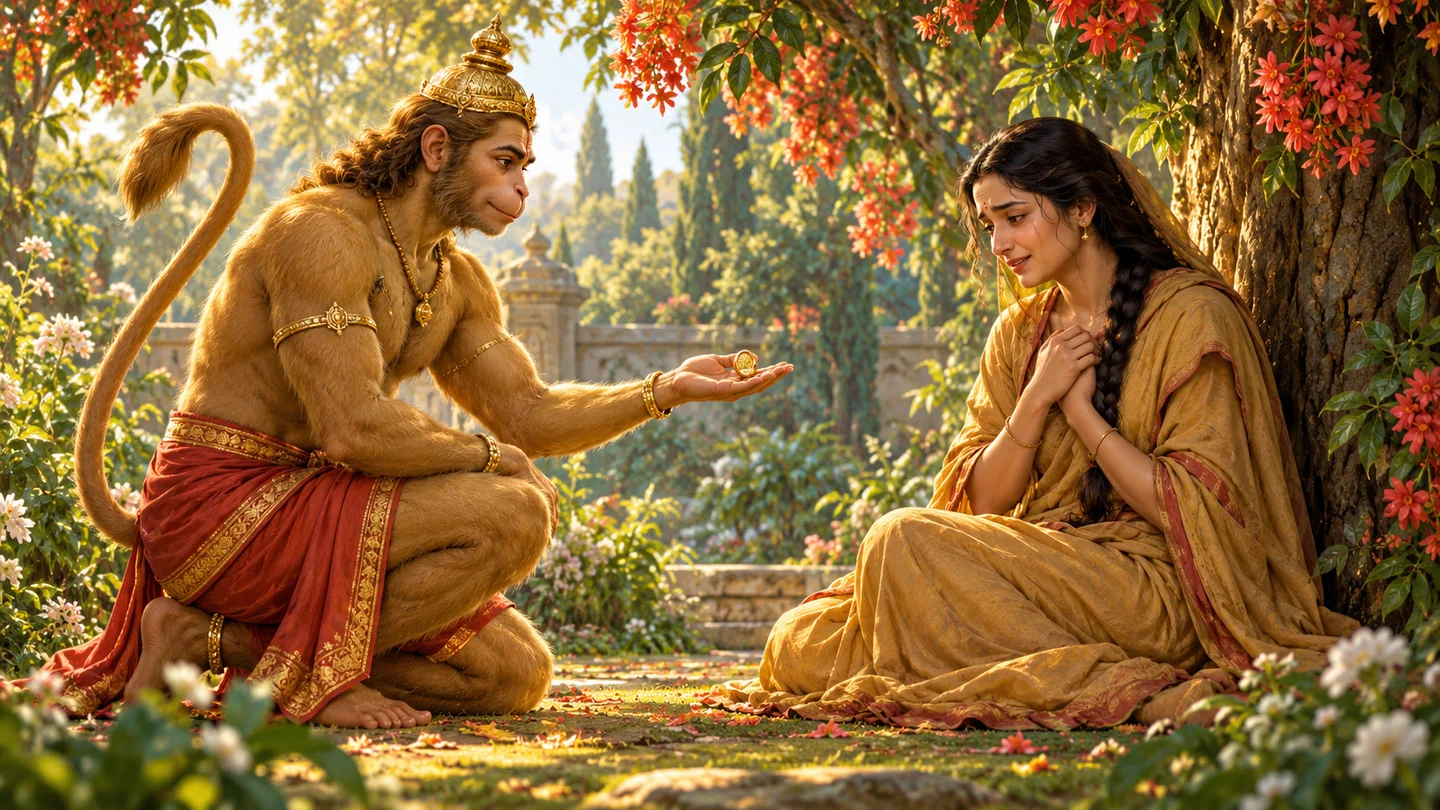
Hanuman respectfully presents Rama’s small ring to Sita in the garden.
Original DHIH illustration · artistic interpretation

Verse 1 · 5.36.1

#

भूय एव महातेजा हनूमान् पवनात्मजः ।

Again glorious Hanuman, the Wind’s son,

अब्रवीत् प्रश्रितं वाक्यं सीताप्रत्ययकारणात् ॥

spoke humbly to strengthen Sita’s trust.

Verse 2 · 5.36.2

#

वानरोऽहं महाभागे दूतो रामस्य धीमतः ।

“Blessed lady, I am a vanara, wise Rama’s messenger.

रामनामाङ्कितं चेदं पश्य देव्यङ्गुलीयकम् ॥

Look, lady, at this ring engraved with Rama’s name.

Verse 3 · 5.36.3

#

प्रत्ययार्थं तवानीतं तेन दत्तं महात्मना ।

That great soul gave it to me to bring you assurance.

समाश्वसिहि भद्रं ते क्षीणदुःखफला ह्यसि ॥

Take comfort; good awaits you, for your suffering is nearing its end.”

Verse 4 · 5.36.4

#

गृहीत्वा प्रेक्षमाणा सा भर्तुः करविभूषितम् ।

Taking and examining the ornament of her husband’s hand,

भर्तारमिव सम्प्राप्तं जानकी मुदिताभवत् ॥

Janaki rejoiced as though her husband himself had arrived.

Verse 5 · 5.36.5

#

चारु तद् वदनं तस्यास्ताम्रशुक्लायतेक्षणम् ।

Her lovely face, with long eyes white and reddish at the edges,

बभूव हर्षोदग्रं च राहुमुक्त इवोडुराट् ॥

rose in joy like the moon released from Rahu.

Verse 6 · 5.36.6

#

ततः सा ह्रीमती बाला भर्तुः संदेशहर्षिता ।

Then the modest lady, delighted by her husband’s message,

परितुष्टा प्रियं कृत्वा प्रशशंस महाकपिम् ॥

pleased and affectionate, praised the great vanara.

Verse 7 · 5.36.7

#

विक्रान्तस्त्वं समर्थस्त्वं प्राज्ञस्त्वं वानरोत्तम ।

“You are brave, capable and wise, foremost vanara,

येनेदं राक्षसपदं त्वयैकेन प्रधर्षितम् ॥

for you alone have penetrated this stronghold of rakshasas.

Verse 8 · 5.36.8

#

शतयोजनविस्तीर्णः सागरो मकरालयः ।

In crossing the hundred-yojana ocean, home of sea creatures,

विक्रमश्लाघनीयेन क्रमता गोष्पदीकृतः ॥

your praiseworthy courage made it seem a cow’s hoofprint.

Verse 9 · 5.36.9

#

नहि त्वां प्राकृतं मन्ये वानरं वानरर्षभ ।

I do not regard you as an ordinary vanara, foremost of vanaras,

यस्य ते नास्ति संत्रासो रावणादपि सम्भ्रमः ॥

for you feel neither terror nor confusion even before Ravana.

Verse 10 · 5.36.10

#

अर्हसे च कपिश्रेष्ठ मया समभिभाषितुम् ।

Foremost vanara, you deserve to be spoken with by me,

यद्यसि प्रेषितस्तेन रामेण विदितात्मना ॥

since self-possessed Rama has sent you.

Verse 11 · 5.36.11

#

प्रेषयिष्यति दुर्धर्षो रामो नह्यपरीक्षितम् ।

Invincible Rama would never send an untested person,

पराक्रममविज्ञाय मत्सकाशं विशेषतः ॥

without knowing his courage, especially to me.

Verse 12 · 5.36.12

#

दिष्ट्या च कुशली रामो धर्मात्मा सत्यसंगरः ।

Fortunately righteous Rama, true to his pledge, is well,

लक्ष्मणश्च महातेजाः सुमित्रानन्दवर्धनः ॥

as is glorious Lakshmana, who brings Sumitra joy.

Verse 13 · 5.36.13

#

कुशली यदि काकुत्स्थः किं न सागरमेखलाम् ।

If Kakutstha is well, why does he not burn

महीं दहति कोपेन युगान्ताग्निरिवोत्थितः ॥

the ocean-girdled earth in anger, like the fire at the world’s end?

Verse 14 · 5.36.14

#

अथवा शक्तिमन्तौ तौ सुराणामपि निग्रहे ।

Yet those two can subdue even the gods;

ममैव तु न दुःखानामस्ति मन्ये विपर्ययः ॥

I think it is only my suffering that finds no reversal.

Verse 15 · 5.36.15

#

कच्चिन्न व्यथते रामः कच्चिन्न परितप्यते ।

Is Rama not distressed or consumed by grief?

उत्तराणि च कार्याणि कुरुते पुरुषोत्तमः ॥

Does that foremost man take the steps still needed?

Verse 16 · 5.36.16

#

कच्चिन्न दीनः सम्भ्रान्तः कार्येषु च न मुह्यति ।

Is he neither despondent nor confused in his work?

कच्चित् पुरुषकार्याणि कुरुते नृपतेः सुतः ॥

Does the king’s son undertake the actions a man must perform?

Verse 17 · 5.36.17

#

द्विविधं त्रिविधोपायमुपायमपि सेवते ।

Seeking victory, does that friendly conqueror of foes employ

विजिगीषुः सुहृत् कच्चिन्मित्रेषु च परंतपः ॥

the appropriate twofold and threefold policies towards allies?

Verse 18 · 5.36.18

#

कच्चिन्मित्राणि लभतेऽमित्रैश्चाप्यभिगम्यते ।

Does he gain friends and receive approaches even from opponents?

कच्चित् कल्याणमित्रश्च मित्रैश्चापि पुरस्कृतः ॥

Has he good allies, and do his friends honour him?

Verse 19 · 5.36.19

#

कच्चिदाशास्ति देवानां प्रसादं पार्थिवात्मजः ।

Does the prince seek the gods’ favour?

कच्चित् पुरुषकारं च दैवं च प्रतिपद्यते ॥

Does he attend both to human effort and to providence?

Verse 20 · 5.36.20

#

कच्चिन्न विगतस्नेहो विवासान्मयि राघवः ।

Has exile not diminished Raghava’s affection for me?

कच्चिन्मां व्यसनादस्मान्मोक्षयिष्यति राघवः ॥

Will Raghava free me from this calamity?

Verse 21 · 5.36.21

#

सुखानामुचितो नित्यमसुखानामनूचितः ।

Accustomed to happiness and unaccustomed to hardship,

दुःखमुत्तरमासाद्य कच्चिद् रामो न सीदति ॥

does Rama remain unbroken by this greater suffering?

Verse 22 · 5.36.22

#

कौसल्यायास्तथा कच्चित् सुमित्रायास्तथैव च ।

Is news of Kausalya’s and Sumitra’s welfare,

अभीक्ष्णं श्रूयते कच्चित् कुशलं भरतस्य च ॥

and of Bharata’s, heard frequently?

Verse 23 · 5.36.23

#

मन्निमित्तेन मानार्हः कच्चिच्छोकेन राघवः ।

Is honourable Raghava troubled by sorrow on my account?

कच्चिन्नान्यमना रामः कच्चिन्मां तारयिष्यति ॥

Is Rama’s mind still on me, and will he bring me through?

Verse 24 · 5.36.24

#

कच्चिदक्षौहिणीं भीमां भरतो भ्रातृवत्सलः ।

Will Bharata, devoted to his brother, send for my sake

ध्वजिनीं मन्त्रिभिर्गुप्तां प्रेषयिष्यति मत्कृते ॥

a formidable akshauhini army, with banners and protected by ministers?

Verse 25 · 5.36.25

#

वानराधिपतिः श्रीमान् सुग्रीवः कच्चिदेष्यति ।

Will glorious Sugriva, lord of vanaras, come for my sake,

मत्कृते हरिभिर्वीरैर्वृतो दन्तनखायुधैः ॥

surrounded by brave vanaras armed with teeth and nails?

Verse 26 · 5.36.26

#

कच्चिच्च लक्ष्मणः शूरः सुमित्रानन्दवर्धनः ।

Will brave Lakshmana, who brings Sumitra joy,

अस्त्रविच्छरजालेन राक्षसान् विधमिष्यति ॥

skilled in weapons, scatter the rakshasas with showers of arrows?

Verse 27 · 5.36.27

#

रौद्रेण कच्चिदस्त्रेण रामेण निहतं रणे ।

Will I soon see Ravana and his companions

द्रक्ष्याम्यल्पेन कालेन रावणं ससुहृज्जनम् ॥

struck down in battle by Rama’s terrible weapon?

Verse 28 · 5.36.28

#

कच्चिन्न तद्धेमसमानवर्णं

Is his golden-hued face,

तस्याननं पद्मसमानगन्धि ।

fragrant like a lotus,

मया विना शुष्यति शोकदीनं

not withering in grief without me,

जलक्षये पद्ममिवातपेन ॥

like a lotus scorched when water fails?

Verse 29 · 5.36.29

#

धर्मापदेशात् त्यजतः स्वराज्यं

When he gave up his kingdom for dharma

मां चाप्यरण्यं नयतः पदातेः ।

and led me on foot into the forest,

नासीद् यथा यस्य न भीर्न शोकः

he showed neither fear nor sorrow;

कच्चित् स धैर्यं हृदये करोति ॥

does he hold that courage in his heart now?

Verse 30 · 5.36.30

#

न चास्य माता न पिता न चान्यः

Neither his mother, father, nor anyone else

स्नेहाद् विशिष्टोऽस्ति मया समो वा ।

equals or surpasses me in his affection.

तावद्ध्यहं दूत जिजीविषेयं

Messenger, I would wish to remain alive

यावत् प्रवृत्तिं शृणुयां प्रियस्य ॥

until I hear news of my beloved.”

Verse 31 · 5.36.31

#

इतीव देवी वचनं महार्थं

Having spoken these weighty words,

तं वानरेन्द्रं मधुरार्थमुक्त्वा ।

sweet in meaning, to the foremost vanara,

श्रोतुं पुनस्तस्य वचोऽभिरामं

the lovely lady fell silent, eager to hear again

रामार्थयुक्तं विरराम रामा ॥

his pleasing words concerning Rama.

Verse 32 · 5.36.32

#

सीताया वचनं श्रुत्वा मारुतिर्भीमविक्रमः ।

Hearing Sita’s words, Maruti of formidable prowess

शिरस्यञ्जलिमाधाय वाक्यमुत्तरमब्रवीत् ॥

raised joined palms to his head and replied:

Verse 33 · 5.36.33

#

न त्वामिहस्थां जानीते रामः कमललोचनः ।

“Lotus-eyed Rama does not know you are here.

तेन त्वां नानयत्याशु शचीमिव पुरंदरः ॥

That is why he has not quickly taken you back, as Indra recovered Shachi.

Verse 34 · 5.36.34

#

श्रुत्वैव च वचो मह्यं क्षिप्रमेष्यति राघवः ।

As soon as he hears my report, Raghava will come quickly,

चमूं प्रकर्षन् महतीं हर्यृक्षगणसंयुताम् ॥

bringing a great army of vanaras and bears.

Verse 35 · 5.36.35

#

विष्टम्भयित्वा बाणौघैरक्षोभ्यं वरुणालयम् ।

Holding the unshakable ocean with showers of arrows,

करिष्यति पुरीं लङ्कां काकुत्स्थः शान्तराक्षसाम् ॥

Kakutstha will render Lanka’s rakshasas powerless.

Verse 36 · 5.36.36

#

तत्र यद्यन्तरा मृत्युर्यदि देवा महासुराः ।

Even if Death, gods, or mighty asuras

स्थास्यन्ति पथि रामस्य स तानपि वधिष्यति ॥

stand in Rama’s path, he will overcome them.

Verse 37 · 5.36.37

#

तवादर्शनजेनार्ये शोकेन परिपूरितः ।

Noble lady, filled with grief at not seeing you,

न शर्म लभते रामः सिंहार्दित इव द्विपः ॥

Rama finds no peace, like an elephant harried by a lion.

Verse 38 · 5.36.38

#

मन्दरेण च ते देवि शपे मूलफलेन च ।

Lady, I swear by Mandara, by roots and fruits,

मलयेन च विन्ध्येन मेरुणा दर्दुरेण च ॥

by Malaya, Vindhya, Meru and Dardura,

Verse 39 · 5.36.39

#

यथा सुनयनं वल्गु बिम्बोष्ठं चारुकुण्डलम् ।

that you shall see Rama’s face, lovely-eyed, charming,

मुखं द्रक्ष्यसि रामस्य पूर्णचन्द्रमिवोदितम् ॥

with bimba-red lips and beautiful earrings, like the risen full moon.

Verse 40 · 5.36.40

#

क्षिप्रं द्रक्ष्यसि वैदेहि रामं प्रस्रवणे गिरौ ।

Soon, Vaidehi, you shall see Rama upon Mount Prasravana,

शतक्रतुमिवासीनं नागपृष्ठस्य मूर्धनि ॥

seated like Indra on the summit of a great elephant’s back.

Verse 41 · 5.36.41

#

न मांसं राघवो भुङ्‍क्ते न चैव मधु सेवते ।

Raghava eats no meat and drinks no intoxicating mead;

वन्यं सुविहितं नित्यं भक्तमश्नाति पञ्चमम् ॥

he regularly takes a properly prepared forest meal at the fifth portion of the day.

Verse 42 · 5.36.42

#

नैव दंशान् न मशकान् न कीटान् न सरीसृपान् ।

Raghava does not remove biting flies, mosquitoes, insects or crawling creatures

राघवोऽपनयेद् गात्रात् त्वद‍्गतेनान्तरात्मना ॥

from his body, for his inner thoughts are fixed on you.

Verse 43 · 5.36.43

#

नित्यं ध्यानपरो रामो नित्यं शोकपरायणः ।

Rama is always absorbed in thought, always devoted to grief;

नान्यच्चिन्तयते किंचित् स तु कामवशं गतः ॥

overcome by longing, he thinks of nothing else.

Verse 44 · 5.36.44

#

अनिद्रः सततं रामः सुप्तोऽपि च नरोत्तमः ।

Rama is continually sleepless; even when that foremost man sleeps,

सीतेति मधुरां वाणीं व्याहरन् प्रतिबुध्यते ॥

he awakens uttering the sweet word ‘Sita.’

Verse 45 · 5.36.45

#

दृष्ट्वा फलं वा पुष्पं वा यच्चान्यत् स्त्रीमनोहरम् ।

Seeing a fruit, flower, or anything pleasing to women,

बहुशो हा प्रियेत्येवं श्वसंस्त्वामभिभाषते ॥

he repeatedly sighs, ‘Alas, beloved!’ and addresses you.

Verse 46 · 5.36.46

#

स देवि नित्यं परितप्यमान-

Lady, always suffering,

स्त्वामेव सीतेत्यभिभाषमाणः ।

calling only to you, ‘Sita,’

धृतव्रतो राजसुतो महात्मा

that great-souled prince, steadfast in his vow,

तवैव लाभाय कृतप्रयत्नः ॥

has devoted his effort solely to recovering you.”

Verse 47 · 5.36.47

#

सा रामसंकीर्तनवीतशोका

Freed from sorrow by the account of Rama,

रामस्य शोकेन समानशोका ।

yet sharing Rama’s sorrow,

शरन्मुखेनाम्बुदशेषचन्द्रा

she resembled an early-autumn night with its moon among lingering clouds—

निशेव वैदेहसुता बभूव ॥

such was the daughter of the king of Videha.

CHAPTER 36 COMPLETE

The journey continues.

Hanuman’s account of Rama’s longing and resolve gives Sita comfort mixed with sorrow.

NEXT CHAPTER

Continue Hanuman’s journey in the next chapter.

About this reading

Vālmīki Rāmāyaṇa, Sundara Kanda, chapter 36. This reading follows Sanskrit Wikisource revision 354792, with all 47 numbered verses. Verse divisions and wording vary between editions.

The Sanskrit is preserved with normalized display spacing and line breaks. Some sentences continue across verse boundaries; the English follows that continuity. A yojana is a traditional distance unit, retained without assigning a modern measurement. Shape-changing and celestial beings belong to the epic’s sacred narrative.

English line senses and short meanings are original AI-assisted DHIH renderings checked against this Sanskrit reading; they are not a word-for-word grammatical commentary or a claim of human scholarly certification. Roman transliteration is generated mechanically in IAST. Names may also appear in familiar English spellings.

Sanskrit transcription credit: Wikisource contributors, revision history. The adapted reading text and DHIH English on this chapter page are offered under CC BY-SA 4.0. The ancient Sanskrit work is in the public domain. Illustrations are separately commissioned AI-generated DHIH artwork.

Historical comparison: M. N. Dutt’s Ramayana, volume II, a public-domain translation, was consulted for narrative context. The English displayed here is a fresh rendering of the pinned Sanskrit, not a reproduction of that translation.

The ring is a recognisable token within the story. Rama’s grief, diet, and discipline are described as features of his situation, not as instructions for a reader to imitate. Audio will be added only when suitable recording permissions are available.