Search DHIH library

VĀLMĪKI RĀMĀYAṆA · CHAPTER 43

सर्गः ४३

At the shrine in the grove

Hanuman climbs the shrine building, confronts its guards, and brings it down in flames. He warns that Sugriva commands many warriors capable of coming to Lanka.

25 versesSanskrit + English1 illustration
Begin reading ↓

An edition-specific reading with original English meanings. Source & reading notes

SCENE 01 · VERSES 1–25

A warning from the gateway of war

Hanuman climbs the shrine building, confronts its guards, and brings it down in flames. He warns that Sugriva commands many warriors capable of coming to Lanka.

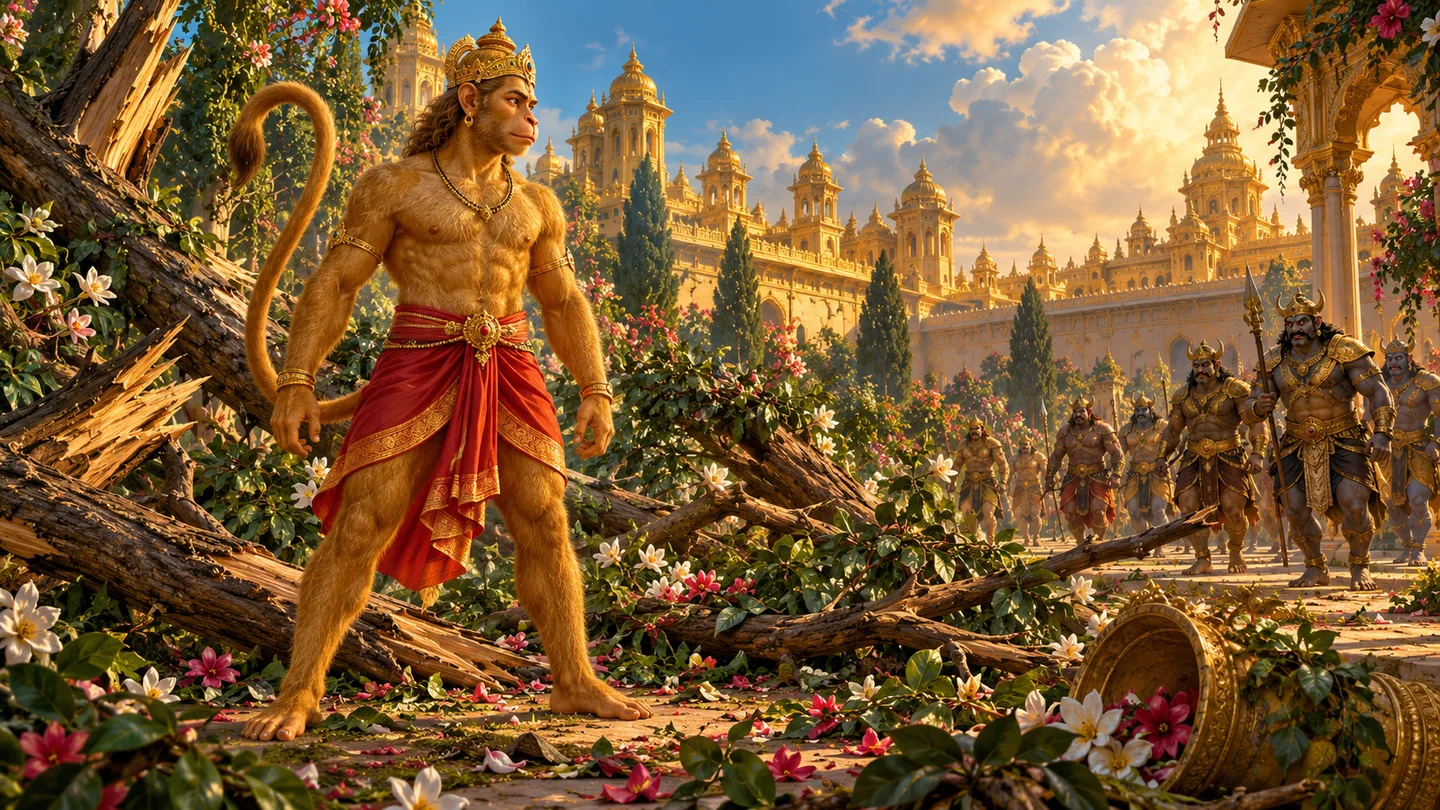
Hanuman stands firm in a disturbed garden while armed guards remain in the distance.
Original DHIH illustration · artistic interpretation

Verse 1 · 5.43.1

#

ततः स किंकरान् हत्वा हनूमान् ध्यानमास्थितः ।

After killing the Kinkaras, Hanuman reflected:

वनं भग्नं मया चैत्यप्रासादो न विनाशितः ॥

I have broken the grove, but have not destroyed its shrine building.

Verse 2 · 5.43.2

#

तस्मात् प्रासादमद्यैवमिमं विध्वंसयाम्यहम् ।

Therefore I shall destroy this building today as well.

इति संचिन्त्य हनुमान् मनसादर्शयन् बलम् ॥

Thinking this in his mind, Hanuman displayed his strength.

Verse 3 · 5.43.3

#

चैत्यप्रासादमुत्प्लुत्य मेरुशृङ्गमिवोन्नतम् ।

Leaping up towards the shrine, lofty as a peak of Meru,

आरुरोह हरिश्रेष्ठो हनूमान् मारुतात्मजः ॥

Hanuman, foremost of vanaras and son of the Wind, climbed upon it.

Verse 4 · 5.43.4

#

आरुह्य गिरिसंकाशं प्रासादं हरियूथपः ।

After climbing the mountain-like building, the leader of the vanaras,

बभौ स सुमहातेजाः प्रतिसूर्य इवोदितः ॥

radiant with immense energy, shone like a second sun risen in the sky.

Verse 5 · 5.43.5

#

सम्प्रधृष्य तु दुर्धर्षश्चैत्यप्रासादमुन्नतम् ।

Overpowering the lofty shrine, the unassailable Hanuman,

हनूमान् प्रज्वलँल्लक्ष्म्या पारियात्रोपमोऽभवत् ॥

blazing with splendour, resembled Mount Pariyatra.

Verse 6 · 5.43.6

#

स भूत्वा सुमहाकायः प्रभावान् मारुतात्मजः ।

The powerful son of the Wind made his body enormous

धृष्टमास्फोटयामास लङ्कां शब्देन पूरयन् ॥

and boldly struck his arms, filling Lanka with the sound.

Verse 7 · 5.43.7

#

तस्यास्फोटितशब्देन महता श्रोत्रघातिना ।

At that tremendous, ear-shattering sound of striking his arms,

पेतुर्विहंगमास्तत्र चैत्यपालाश्च मोहिताः ॥

birds fell down there and the shrine guards were stunned.

Verse 8 · 5.43.8

#

अस्त्रविज्जयतां रामो लक्ष्मणश्च महाबलः ।

May Rama, skilled in weapons, and mighty Lakshmana be victorious!

राजा जयति सुग्रीवो राघवेणाभिपालितः ॥

Victory to King Sugriva, protected by the descendant of Raghu!

Verse 9 · 5.43.9

#

दासोऽहं कोसलेन्द्रस्य रामस्याक्लिष्टकर्मणः ।

I am the servant of Rama, lord of Kosala, whose deeds are accomplished without weariness.

हनूमान् शत्रुसैन्यानां निहन्ता मारुतात्मजः ॥

I am Hanuman, son of the Wind, destroyer of enemy armies.

Verse 10 · 5.43.10

#

न रावणसहस्रं मे युद्धे प्रतिबलं भवेत् ।

Not even a thousand Ravanas could match me in battle

शिलाभिश्च प्रहरतः पादपैश्च सहस्रशः ॥

as I strike with rocks and trees by the thousand.

Verse 11 · 5.43.11

#

धर्षयित्वा पुरीं लङ्कामभिवाद्य च मैथिलीम् ।

After overpowering Lanka and bowing to Maithili,

समृद्धार्थो गमिष्यामि मिषतां सर्वरक्षसाम् ॥

I shall depart with my purpose achieved, while all the rakshasas look on.

Verse 12 · 5.43.12

#

एवमुक्त्वा महाकायश्चैत्यस्थो हरियूथपः ।

Having said this, the gigantic vanara leader standing on the shrine

ननाद भीमनिर्ह्रादो रक्षसां जनयन् भयम् ॥

gave a terrible resounding roar, spreading fear among the rakshasas.

Verse 13 · 5.43.13

#

तेन नादेन महता चैत्यपालाः शतं ययुः ।

At that great roar, a hundred shrine guards came forward,

गृहीत्वा विविधानस्त्रान् प्रासान् खड्गान् परश्वधान् ॥

taking various weapons: javelins, swords, and battle-axes.

Verse 14 · 5.43.14

#

विसृजन्तो महाकाया मारुतिं पर्यवारयन् ।

The huge-bodied guards surrounded the son of the Wind, hurling their weapons.

ते गदाभिर्विचित्राभिः परिघैः काञ्चनाङ्गदैः ॥

With decorated maces and iron bars banded with gold—

Verse 15 · 5.43.15

#

आजग्मुर्वानरश्रेष्ठं बाणैश्चादित्यसंनिभैः ।

they attacked the foremost vanara, also shooting arrows bright as the sun.

आवर्त इव गङ्गायास्तोयस्य विपुलो महान् ॥

Like a great, wide whirlpool in the waters of the Ganga—

Verse 16 · 5.43.16

#

परिक्षिप्य हरिश्रेष्ठं स बभौ रक्षसां गणः ।

the rakshasa host appeared as it encircled the foremost vanara.

ततो वातात्मजः क्रुद्धो भीमरूपं समास्थितः ॥

Then the Wind’s son grew angry and assumed a terrifying form.

Verse 17 · 5.43.17

#

प्रासादस्य महांस्तस्य स्तम्भं हेमपरिष्कृतम् ।

A great pillar of that building, adorned with gold,

उत्पाटयित्वा वेगेन हनूमान् मारुतात्मजः ॥

Hanuman, son of the Wind, swiftly tore out.

Verse 18 · 5.43.18

#

ततस्तं भ्रामयामास शतधारं महाबलः ।

Then the mighty hero whirled that many-edged pillar around.

तत्र चाग्निः समभवत् प्रासादश्चाप्यदह्यत ॥

Fire arose there, and the shrine building began to burn.

Verse 19 · 5.43.19

#

दह्यमानं ततो दृष्ट्वा प्रासादं हरियूथपः ।

Seeing the building burning, the vanara leader,

स राक्षसशतं हत्वा वज्रेणेन्द्र इवासुरान् ॥

having killed the hundred rakshasas as Indra kills asuras with his thunderbolt—

Verse 20 · 5.43.20

#

अन्तरिक्षस्थितः श्रीमानिदं वचनमब्रवीत् ।

stood in the air in splendour and spoke these words:

मादृशानां सहस्राणि विसृष्टानि महात्मनाम् ॥

Thousands of great-hearted warriors like me have been sent out—

Verse 21 · 5.43.21

#

बलिनां वानरेन्द्राणां सुग्रीववशवर्तिनाम् ।

mighty leaders of the vanaras who obey Sugriva.

अटन्ति वसुधां कृत्स्नां वयमन्ये च वानराः ॥

We and other vanaras are ranging across the whole earth.

Verse 22 · 5.43.22

#

दशनागबलाः केचित् केचिद् दशगुणोत्तराः ।

Some possess the strength of ten elephants, some ten times that strength,

केचिन्नागसहस्रस्य बभूवुस्तुल्यविक्रमाः ॥

and some have prowess equal to a thousand elephants.

Verse 23 · 5.43.23

#

सन्ति चौघबलाः केचित् सन्ति वायुबलोपमाः ।

Some have the strength of vast hosts, and some are as strong as the wind.

अप्रमेयबलाः केचित् तत्रासन् हरियूथपाः ॥

Among them are vanara leaders whose strength cannot be measured.

Verse 24 · 5.43.24

#

ईदृग्विधैस्तु हरिभिर्वृतो दन्तनखायुधैः ।

Surrounded by vanaras such as these, armed with teeth and nails,

शतैः शतसहस्रैश्च कोटिभिश्चायुतैरपि ॥

in hundreds, hundreds of thousands, tens of thousands, and millions—

Verse 25 · 5.43.25

#

आगमिष्यति सुग्रीवः सर्वेषां वो निषूदनः ।

Sugriva will come as the destroyer of you all.

नेयमस्ति पुरी लङ्का न यूयं न च रावणः ।

Neither this city of Lanka, nor you, nor Ravana will remain,

यस्य त्विक्ष्वाकुवीरेण बद्धं वैरं महात्मना ॥

for he has bound himself in enmity with the great-hearted hero of Ikshvaku’s line.

CHAPTER 43 COMPLETE

The journey continues.

Hanuman’s warning points beyond this single fight to the army that may follow.

NEXT CHAPTER

Continue Hanuman’s journey in the next chapter.

About this reading

Vālmīki Rāmāyaṇa, Sundara Kanda, chapter 43. This reading follows Sanskrit Wikisource revision 355134, with all 25 numbered verses. Verse divisions and wording vary between editions.

The Sanskrit is preserved with normalized display spacing and line breaks. Some sentences continue across verse boundaries; the English follows that continuity. A yojana is a traditional distance unit, retained without assigning a modern measurement. Shape-changing and celestial beings belong to the epic’s sacred narrative.

English line senses and short meanings are original AI-assisted DHIH renderings checked against this Sanskrit reading; they are not a word-for-word grammatical commentary or a claim of human scholarly certification. Roman transliteration is generated mechanically in IAST. Names may also appear in familiar English spellings.

Sanskrit transcription credit: Wikisource contributors, revision history. The adapted reading text and DHIH English on this chapter page are offered under CC BY-SA 4.0. The ancient Sanskrit work is in the public domain. Illustrations are separately commissioned AI-generated DHIH artwork.

Historical comparison: M. N. Dutt’s Ramayana, volume II, a public-domain translation, was consulted for narrative context. The English displayed here is a fresh rendering of the pinned Sanskrit, not a reproduction of that translation.

This full chapter depicts the destruction of a shrine and the death of its guards in an ancient war narrative. It is not an instruction to damage religious places or attack others. Audio will be added only when suitable recording permissions are available.