Search DHIH library

VĀLMĪKI RĀMĀYAṆA · CHAPTER 44

सर्गः ४४

Jambumali confronts Hanuman

Prahasta’s son Jambumali arrives with his bow and wounds Hanuman with repeated volleys. Hanuman answers with a rock, a tree, and finally the iron bar.

20 versesSanskrit + English1 illustration
Begin reading ↓

An edition-specific reading with original English meanings. Source & reading notes

SCENE 01 · VERSES 1–20

Arrows and an iron bar

Prahasta’s son Jambumali arrives with his bow and wounds Hanuman with repeated volleys. Hanuman answers with a rock, a tree, and finally the iron bar.

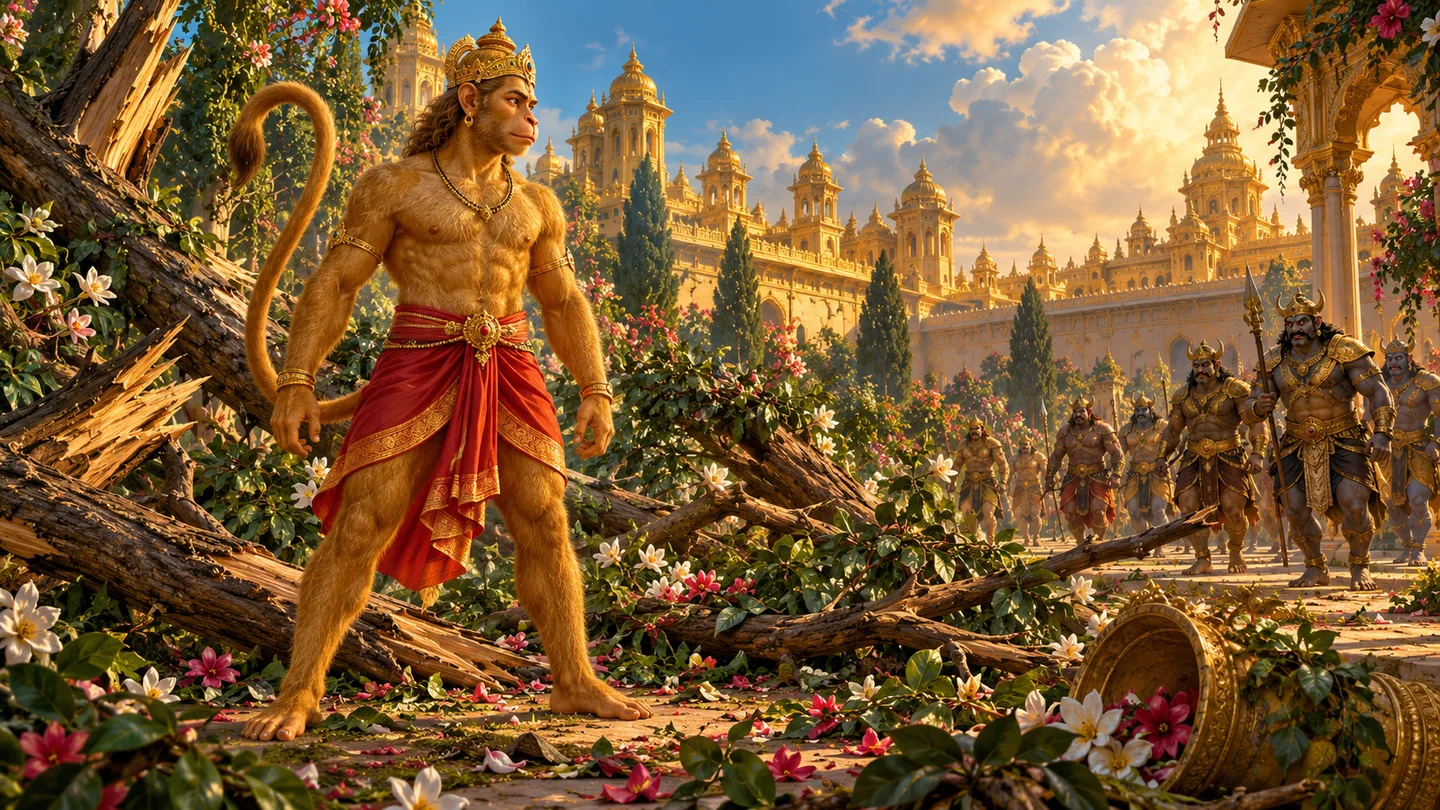
Hanuman stands firm in a disturbed garden while armed guards remain in the distance.
Original DHIH illustration · artistic interpretation

Verse 1 · 5.44.1

#

संदिष्टो राक्षसेन्द्रेण प्रहस्तस्य सुतो बली ।

Commanded by the rakshasa king, Prahasta’s powerful son

जम्बुमाली महादंष्ट्रो निर्जगाम धनुर्धरः ॥

Jambumali, great-fanged and carrying a bow, set out.

Verse 2 · 5.44.2

#

रक्तमाल्याम्बरधरः स्रग्वी रुचिरकुण्डलः ।

Wearing red garlands and garments, wreathed with flowers and lovely earrings,

महान् विवृत्तनयनश्चण्डः समरदुर्जयः ॥

he was huge, fierce, wide-eyed, and difficult to overcome in battle.

Verse 3 · 5.44.3

#

धनुः शक्रधनुःप्रख्यं महद्रुचिरसायकम् ।

His great bow resembled Indra’s rainbow and bore splendid arrows;

विस्फारयानो वेगेन वज्राशनिसमस्वनम् ॥

he drew it forcefully, making a sound like crashing thunderbolts.

Verse 4 · 5.44.4

#

तस्य विस्फारघोषेण धनुषो महता दिशः ।

The tremendous twang of his bow

प्रदिशश्च नभश्चॆव सहसा समपूर्यत ॥

suddenly filled the main directions, the intermediate directions, and the sky.

Verse 5 · 5.44.5

#

रथेन खरयुक्तेन तमागतमुदीक्ष्य सः ।

Seeing him arrive in a chariot drawn by donkeys,

हनुमान् वेगसंपन्नो जहर्ष च ननाद च ॥

swift Hanuman rejoiced and roared.

Verse 6 · 5.44.6

#

तं तोरणविटङ्कस्थं हनुमन्तं महाकपिम् ।

Mighty-armed Jambumali pierced with sharp arrows

जम्बुमाली महाबाहुर्विव्याध निशितैः शरैः ॥

the great vanara Hanuman, who stood upon the gateway’s projecting ledge.

Verse 7 · 5.44.7

#

अर्धचन्द्रेण वदने शिरस्येकेन कर्णिना ।

He struck his face with a crescent-headed arrow, his head with one barbed arrow,

बाह्वोर्विव्याध नाराचैर्दशभिस्तं कपीश्वरम् ॥

and the vanara leader’s arms with ten iron arrows.

Verse 8 · 5.44.8

#

तस्य तच्छुशुभे ताम्रं शरेणाभिहतं मुखम् ।

His copper-coloured face, struck by an arrow, shone

शरदीवाम्बुजम्फुल्लं विद्धं भास्कररश्मिना ॥

like an open autumn lotus pierced by the sun’s rays.

Verse 9 · 5.44.9

#

तत्तस्य रक्तं रक्तेन रञ्जितं शुशुभे मुखम् ।

His red face, further coloured by blood, shone

यथाकाशे महापद्मं सिक्तं चन्दनबिन्दुभिः ॥

like a great lotus in the sky sprinkled with drops of sandalwood paste.

Verse 10 · 5.44.10

#

चुकोप बाणाभिहतो राक्षसस्य महाकपिः ।

Struck by the arrows, the great vanara grew angry with the rakshasa.

ततः पार्श्वेतिविपुलां ददर्श महतीं शिलाम् ॥

Then he saw an enormous rock close beside him.

Verse 11 · 5.44.11

#

तरसा तां समुत्पाट्य चिक्षेप बलवद्बली ।

Quickly tearing it loose, the powerful hero hurled it with great force.

तां शरैर्दशभिः क्रुद्धस्ताडयामास राक्षसः ॥

The angry rakshasa struck that rock with ten arrows.

Verse 12 · 5.44.12

#

विपन्नं कर्म तद्दृष्ट्वा हनुमांश्चण्डविक्रमः ।

Seeing that his attack had failed, Hanuman of fierce prowess

सालं विपुलमुत्पाट्य भ्रामयामास वीर्यवान् ॥

uprooted a great sala tree and began to whirl it.

Verse 13 · 5.44.13

#

भ्रामयन्तं कपिं दृष्ट्वा सालवृक्षं महाबलम् ।

Seeing the immensely strong vanara whirling the sala tree,

चिक्षेप सुबहून् बाणान् जम्बुमाली महाबलः ॥

powerful Jambumali discharged a great many arrows.

Verse 14 · 5.44.14

#

सालं चतुर्भिश्चिच्छेद वानरं पञ्चभिर्भुजे ।

With four arrows he cut the sala tree, with five he struck the vanara’s arm,

शिरस्येकेन बाणेन दशभिस्तु स्तनान्तरे ॥

with one he struck his head, and with ten the middle of his chest.

Verse 15 · 5.44.15

#

स शरैः पूरिततनुः क्रोधेन महता वृतः ।

His body covered with arrows and filled with great anger,

तमेव परिघं गृह्य भ्रामयामास वेगतः ॥

Hanuman took that same iron bar and whirled it rapidly.

Verse 16 · 5.44.16

#

अतिवेगोतिवेगेन भ्रामयित्वा बलोत्कटः ।

The fiercely powerful, swift hero whirled it at tremendous speed

परिघं पातयामास जम्बुमालेर्महोरसि ॥

and brought the iron bar down upon Jambumali’s broad chest.

Verse 17 · 5.44.17

#

तस्य चैव शिरो नास्ति न बाहू न च जानुनी ।

Neither his head, arms, nor knees could be distinguished,

न धनुर्नरथो नाश्वास्तत्रादृश्यन्त नेषवः ॥

nor could his bow, chariot, draught animals, or arrows be seen there.

Verse 18 · 5.44.18

#

स हतस्तरसा तेन जम्बुमाली महाबलः ।

Powerful Jambumali was killed by that forceful blow

पपात निहतो भूवौ चूर्णिताङ्गविभूषणः ॥

and fell dead upon the earth, his limbs and ornaments shattered.

Verse 19 · 5.44.19

#

जम्बुमालिं च निहतं किङ्करांश्च महाबलान् ।

Hearing that Jambumali and the mighty Kinkaras had been slain,

चुक्रोध रावणः श्रुत्वा कोपसंरक्त लोचनः ॥

Ravana grew furious, his eyes reddening with anger.

Verse 20 · 5.44.20

#

स रोषसंवर्तितताम्रलोचनः

With his copper-red eyes rolling in fury,

प्रहस्त पुत्रे निहते महाबले ।

after mighty Prahasta’s son had been killed,

अमात्यपुत्रानतिवीर्यविक्रमान्

the ministers’ sons, warriors of immense strength and courage,

समादिदेशाशु निशाचरेश्वरः ॥

were immediately commanded to go by the lord of the night-roaming rakshasas.

CHAPTER 44 COMPLETE

The journey continues.

Jambumali falls, and Ravana orders the ministers’ sons into battle.

NEXT CHAPTER

Continue Hanuman’s journey in the next chapter.

About this reading

Vālmīki Rāmāyaṇa, Sundara Kanda, chapter 44. This reading follows Sanskrit Wikisource revision 355140, with all 20 numbered verses. Verse divisions and wording vary between editions.

The Sanskrit is preserved with normalized display spacing and line breaks. Some sentences continue across verse boundaries; the English follows that continuity. A yojana is a traditional distance unit, retained without assigning a modern measurement. Shape-changing and celestial beings belong to the epic’s sacred narrative.

English line senses and short meanings are original AI-assisted DHIH renderings checked against this Sanskrit reading; they are not a word-for-word grammatical commentary or a claim of human scholarly certification. Roman transliteration is generated mechanically in IAST. Names may also appear in familiar English spellings.

Sanskrit transcription credit: Wikisource contributors, revision history. The adapted reading text and DHIH English on this chapter page are offered under CC BY-SA 4.0. The ancient Sanskrit work is in the public domain. Illustrations are separately commissioned AI-generated DHIH artwork.

Historical comparison: M. N. Dutt’s Ramayana, volume II, a public-domain translation, was consulted for narrative context. The English displayed here is a fresh rendering of the pinned Sanskrit, not a reproduction of that translation.

The combat includes explicit wounds and a fatal crushing blow. The full epic reading differs from an age-adapted illustrated story. Audio will be added only when suitable recording permissions are available.