Search DHIH library

VĀLMĪKI RĀMĀYAṆA · CHAPTER 45

सर्गः ४५

The ministers’ sons

Seven ministers’ sons ride out with their forces, while their families fear for them. Hanuman evades their arrows and overwhelms the attackers.

17 versesSanskrit + English1 illustration
Begin reading ↓

An edition-specific reading with original English meanings. Source & reading notes

SCENE 01 · VERSES 1–17

Seven warriors enter the battle

Seven ministers’ sons ride out with their forces, while their families fear for them. Hanuman evades their arrows and overwhelms the attackers.

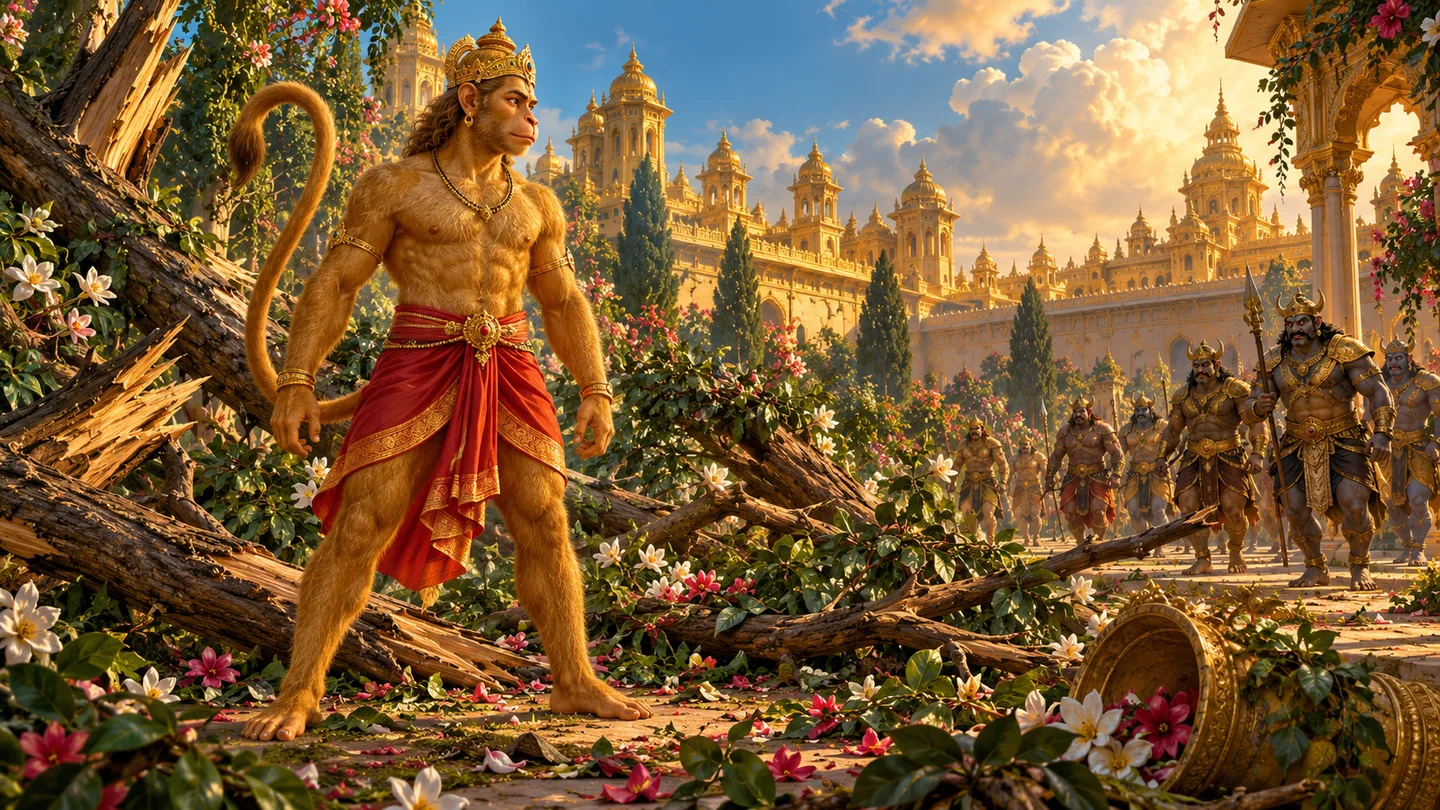
Hanuman stands firm in a disturbed garden while armed guards remain in the distance.
Original DHIH illustration · artistic interpretation

Verse 1 · 5.45.1

#

ततस्ते राक्षसेन्द्रेण चोदिता मन्त्रिणः सुताः ।

Then, commanded by the rakshasa king, the seven ministers’ sons

निर्ययुर्भवनात् तस्मात् सप्त सप्तार्चिवर्चसः ॥

came out of the palace, shining like the seven-flamed fire.

Verse 2 · 5.45.2

#

महद‍्बलपरीवारा धनुष्मन्तो महाबलाः ।

Mighty archers surrounded by great forces,

कृतास्त्रास्त्रविदां श्रेष्ठाः परस्परजयैषिणः ॥

trained in weapons and foremost among those skilled in them, each sought to surpass the others.

Verse 3 · 5.45.3

#

हेमजालपरिक्षिप्तैर्ध्वजवद्भिः पताकिभिः ।

They rode great horse-drawn chariots covered in golden latticework,

तोयदस्वननिर्घोषैर्वाजियुक्तैर्महारथैः ॥

bearing flags and banners and rumbling like storm clouds.

Verse 4 · 5.45.4

#

तप्तकाञ्चनचित्राणि चापान्यमितविक्रमाः ।

These warriors of boundless prowess joyfully drew their bows,

विस्फारयन्तः संहृष्टास्तडिद्वन्त इवाम्बुदाः ॥

decorated with refined gold, like clouds carrying lightning.

Verse 5 · 5.45.5

#

जनन्यस्तास्ततस्तेषां विदित्वा किंकरान् हतान् ।

Their mothers, knowing that the Kinkaras had been slain,

बभूवुः शोकसम्भ्रान्ताः सबान्धवसुहृज्जनाः ॥

were overwhelmed with grief and anxiety, together with relatives and friends.

Verse 6 · 5.45.6

#

ते परस्परसंघर्षात् तप्तकाञ्चनभूषणाः ।

Competing eagerly with one another, wearing ornaments of refined gold,

अभिपेतुर्हनूमन्तं तोरणस्थमवस्थितम् ॥

they rushed at Hanuman, who stood upon the gateway.

Verse 7 · 5.45.7

#

सृजन्तो बाणवृष्टिं ते रथगर्जितनिःस्वनाः ।

Pouring showers of arrows while their chariots thundered,

प्रावृट्काल इवाम्भोदा विचेरुर्नैर्ऋताम्बुदाः ॥

those cloud-like rakshasas moved about like clouds in the rainy season.

Verse 8 · 5.45.8

#

अवकीर्णस्ततस्ताभिर्हनूमान् शरवृष्टिभिः ।

Covered by those showers of arrows, Hanuman

अभवत् संवृताकारः शैलराडिव वृष्टिभिः ॥

had his form hidden, like the king of mountains veiled by rain.

Verse 9 · 5.45.9

#

स शरान् वञ्चयामास तेषामाशुचरः कपिः ।

Moving swiftly through the clear sky, the vanara evaded their arrows

रथवेगांश्च वीराणां विचरन् विमलेऽम्बरे ॥

and the rushes of those warriors’ chariots.

Verse 10 · 5.45.10

#

स तैः क्रीडन् धनुष्मद्भिर्व्योम्नि वीरः प्रकाशते ।

The hero shone as he played with those bow-bearing warriors in the sky,

धनुष्मद्भिर्यथा मेघैर्मारुतः प्रभुरम्बरे ॥

like the mighty wind playing among rainbow-bearing clouds.

Verse 11 · 5.45.11

#

स कृत्वा निनदं घोरं त्रासयंस्तां महाचमूम् ।

Giving a dreadful roar that terrified that great army,

चकार हनुमान् वेगं तेषु रक्षःसु वीर्यवान् ॥

valiant Hanuman rushed upon the rakshasas.

Verse 12 · 5.45.12

#

तलेनाभिहनत् कांश्चित् पादैः कांश्चित् परंतपः ।

The tormentor of enemies struck some with his palms and others with his feet;

मुष्टिभिश्चाहनत् कांश्चिन्नखैः कांश्चिद् व्यदारयत् ॥

some he struck with his fists, and others he tore with his nails.

Verse 13 · 5.45.13

#

प्रममाथोरसा कांश्चिदूरुभ्यामपरानपि ।

He crushed some with his chest and others with his thighs;

केचित् तस्यैव नादेन तत्रैव पतिता भुवि ॥

some fell to the ground there at the sound of his roar alone.

Verse 14 · 5.45.14

#

ततस्तेष्ववसन् नेषु भूमौ निपतितेषु च ।

When those warriors were overcome and had fallen to the ground,

तत्सैन्यमगमत् सर्वं दिशो दश भयार्दितम् ॥

their whole army fled in terror in all ten directions.

Verse 15 · 5.45.15

#

विनेदुर्विस्वरं नागा निपेतुर्भुवि वाजिनः ।

Elephants cried out harshly, and horses fell to the earth;

भग्ननीडध्वजच्छत्रैर्भूश्च कीर्णाभवद् रथैः ॥

the ground was strewn with chariots whose platforms, standards, and canopies were broken.

Verse 16 · 5.45.16

#

स्रवता रुधिरेणाथ स्रवन्त्यो दर्शिताः पथि ।

Streams of flowing blood appeared along the roads,

विविधैश्च स्वनैर्लङ्का ननाद विकृतं तदा ॥

and Lanka resounded strangely with many kinds of cries.

Verse 17 · 5.45.17

#

स तान् प्रवृद्धान् विनिहत्य राक्षसान्

Having slain those formidable rakshasas,

महाबलश्चण्डपराक्रमः कपिः ।

the immensely strong vanara of fierce prowess,

युयुत्सुरन्यैः पुनरेव राक्षसै-

eager to fight still other rakshasas,

स्तदेव वीरोऽभिजगाम तोरणम् ॥

returned once again to that same gateway.

CHAPTER 45 COMPLETE

The journey continues.

The defeated force scatters, and Hanuman returns to the gateway.

NEXT CHAPTER

Continue Hanuman’s journey in the next chapter.

About this reading

Vālmīki Rāmāyaṇa, Sundara Kanda, chapter 45. This reading follows Sanskrit Wikisource revision 355141, with all 17 numbered verses. Verse divisions and wording vary between editions.

The Sanskrit is preserved with normalized display spacing and line breaks. Some sentences continue across verse boundaries; the English follows that continuity. A yojana is a traditional distance unit, retained without assigning a modern measurement. Shape-changing and celestial beings belong to the epic’s sacred narrative.

English line senses and short meanings are original AI-assisted DHIH renderings checked against this Sanskrit reading; they are not a word-for-word grammatical commentary or a claim of human scholarly certification. Roman transliteration is generated mechanically in IAST. Names may also appear in familiar English spellings.

Sanskrit transcription credit: Wikisource contributors, revision history. The adapted reading text and DHIH English on this chapter page are offered under CC BY-SA 4.0. The ancient Sanskrit work is in the public domain. Illustrations are separately commissioned AI-generated DHIH artwork.

Historical comparison: M. N. Dutt’s Ramayana, volume II, a public-domain translation, was consulted for narrative context. The English displayed here is a fresh rendering of the pinned Sanskrit, not a reproduction of that translation.

This chapter includes graphic battle imagery and the grief of warriors’ families. Its descriptions are retained as part of the full text. Audio will be added only when suitable recording permissions are available.