Search DHIH library

VĀLMĪKI RĀMĀYAṆA · CHAPTER 46

सर्गः ४६

Five commanders and a warning

Ravana now sends five senior commanders, warning them that Hanuman must not be underestimated. Their combined attacks bring a fierce battle around the gateway.

41 versesSanskrit + English1 illustration
Begin reading ↓

An edition-specific reading with original English meanings. Source & reading notes

SCENE 01 · VERSES 1–41

Even a confident army must be careful

Ravana now sends five senior commanders, warning them that Hanuman must not be underestimated. Their combined attacks bring a fierce battle around the gateway.

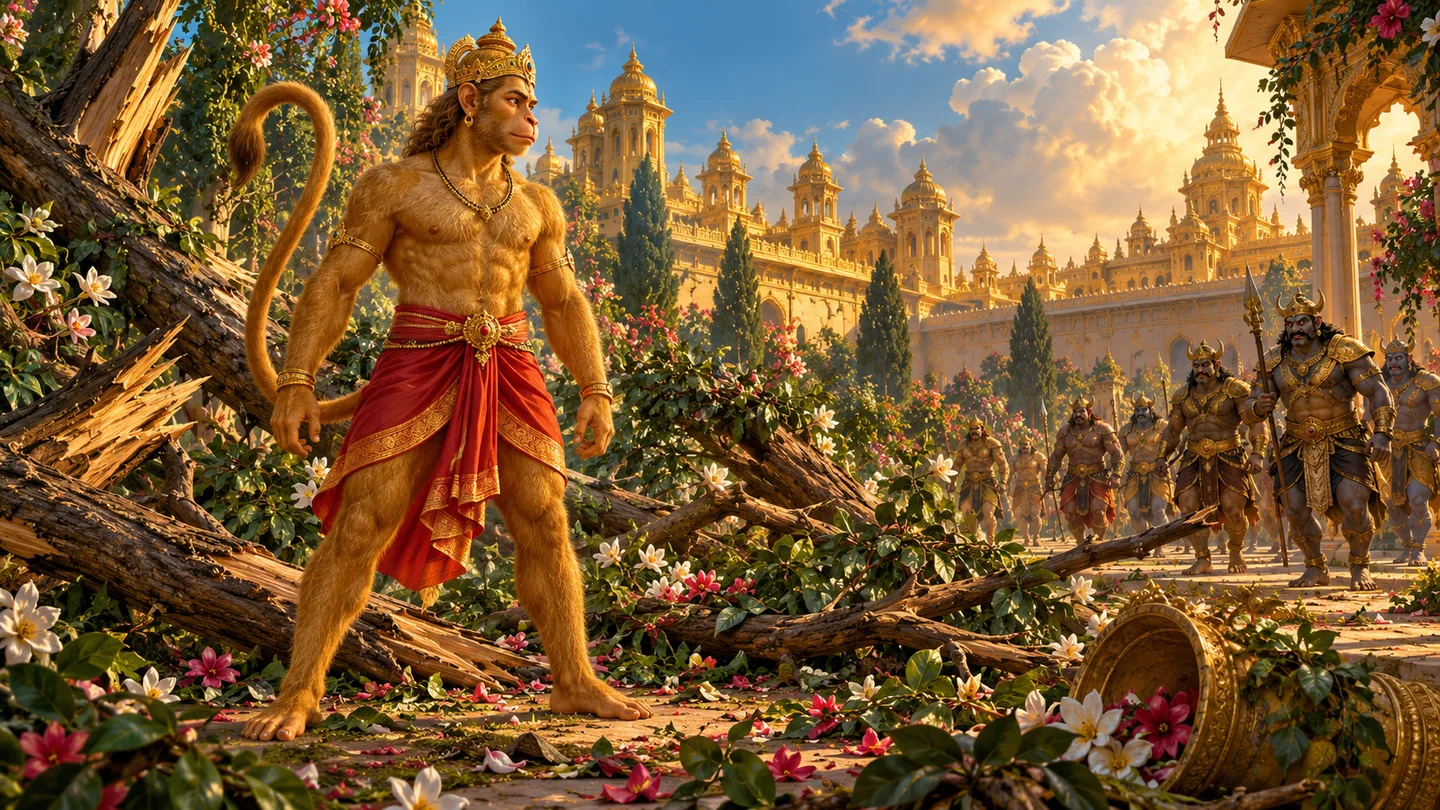
Hanuman stands firm in a disturbed garden while armed guards remain in the distance.
Original DHIH illustration · artistic interpretation

Verse 1 · 5.46.1

#

हतान् मन्त्रिसुतान् बुद्‍ध्वा वानरेण महात्मना ।

Learning that the ministers’ sons had been slain by the great-hearted vanara,

रावणः संवृताकारश्चकार मतिमुत्तमाम् ॥

Ravana concealed his reaction and carefully considered his next decision.

Verse 2 · 5.46.2

#

स विरूपाक्षयूपाक्षौ दुर्धरं चैव राक्षसम् ।

He selected Virupaksha and Yupaksha, the rakshasa Durdhara,

प्रघसं भासकर्णं च पञ्च सेनाग्रनायकान् ॥

Praghasa and Bhasakarna: five leading commanders of his army.

Verse 3 · 5.46.3

#

संदिदेश दशग्रीवो वीरान् नयविशारदान् ।

The ten-headed king commanded those heroes, skilled in strategy,

हनूमद्‍ग्रहणेऽव्यग्रान् वायुवेगसमान् युधि ॥

to capture Hanuman with steady attention, swift as the wind in battle.

Verse 4 · 5.46.4

#

यात सेनाग्रगाः सर्वे महाबलपरिग्रहाः ।

Go, all you commanders, accompanied by a mighty force

सवाजिरथमातङ्गाः स कपिः शास्यतामिति ॥

with horses, chariots, and elephants; subdue that vanara.

Verse 5 · 5.46.5

#

यत्तैश्च खलु भाव्यं स्यात् तमासाद्य वनालयम् ।

When you encounter that forest-dweller, you must be watchful;

कर्म चापि समाधेयं देशकालाविरोधितम् ॥

carry out the task in a way suited to the place and time.

Verse 6 · 5.46.6

#

न ह्यहं तं कपिं मन्ये कर्मणा प्रति तर्कयन् ।

Judging by his deeds, I do not consider him an ordinary vanara.

सर्वथा तन्महद् भूतं महाबलपरिग्रहम् ॥

In every way he is a great being endowed with tremendous strength.

Verse 7 · 5.46.7

#

वानरोऽयमिति ज्ञात्वा नहि शुद्ध्यति मे मनः ।

My mind is not satisfied by the explanation that he is a vanara.

नैवाहं तं कपिं मन्ये यथेयं प्रस्तुता कथा ॥

From the account that has been given, I cannot take him for merely a vanara.

Verse 8 · 5.46.8

#

भवेदिन्द्रेण वा सृष्टमस्मदर्थं तपोबलात् ।

Perhaps Indra has created him through ascetic power to act against us.

सनागयक्षगन्धर्वदेवासुरमहर्षयः ॥

The nagas, yakshas, gandharvas, gods, asuras, and great sages—

Verse 9 · 5.46.9

#

युष्माभिः प्रहितैः सर्वैर्मया सह विनिर्जिताः ।

have all been defeated by me together with you, whom I sent against them.

तैरवश्यं विधातव्यं व्यलीकं किंचिदेव नः ॥

They must surely be arranging some harm against us.

Verse 10 · 5.46.10

#

तदेव नात्र संदेहः प्रसह्य परिगृह्यताम् ।

This must be it; there is no doubt here. Seize him by force.

यात सेनाग्रगाः सर्वे महाबलपरिग्रहाः ॥

Go, all you commanders, accompanied by a mighty force—

Verse 11 · 5.46.11

#

सवाजिरथमातङ्गाः स कपिः शास्यतामिति ।

with horses, chariots, and elephants; that vanara must be subdued.

नावमन्यो भवद्भिश्च कपिर्धीरपराक्रमः ॥

Yet you must not underestimate this vanara of steady courage.

Verse 12 · 5.46.12

#

दृष्टा हि हरयः पूर्वे मया विपुलविक्रमाः ।

I have previously seen vanaras of immense prowess:

वाली च सह सुग्रीवो जाम्बवांश्च महाबलः ॥

Vali with Sugriva, and mighty Jambavan—

Verse 13 · 5.46.13

#

नीलः सेनापतिश्चैव ये चान्ये द्विविदादयः ।

also Nila the commander, and others such as Dvivida.

नैव तेषां गतिर्भीमा न तेजो न पराक्रमः ॥

Yet theirs is not such dreadful speed, radiance, or prowess—

Verse 14 · 5.46.14

#

न मतिर्न बलोत्साहो न रूपपरिकल्पनम् ।

nor such intelligence, strength, spirit, or ability to assume forms.

महत्सत्त्वमिदं ज्ञेयं कपिरूपं व्यवस्थितम् ॥

Know this to be a great being present in the form of a vanara.

Verse 15 · 5.46.15

#

प्रयत्नं महदास्थाय क्रियतामस्य निग्रहः ।

Make the greatest effort to capture him.

कामं लोकास्त्रयः सेन्द्राः ससुरासुरमानवाः ॥

Certainly, even the three worlds with Indra, gods, asuras, and humans—

Verse 16 · 5.46.16

#

भवतामग्रतः स्थातुं न पर्याप्ता रणाजिरे ।

would not be able to stand before you on the battlefield.

तथापि तु नयज्ञेन जयमाकाङ्क्षता रणे ॥

Even so, someone who understands strategy and seeks victory in battle—

Verse 17 · 5.46.17

#

आत्मा रक्ष्यः प्रयत्नेन युद्धसिद्धिर्हि चञ्चला ।

must carefully protect himself, for success in war is uncertain.

ते स्वामिवचनं सर्वे प्रतिगृह्य महौजसः ॥

All those immensely powerful warriors accepted their master’s words—

Verse 18 · 5.46.18

#

समुत्पेतुर्महावेगा हुताशसमतेजसः ।

and rushed out at great speed, shining like fire,

रथैश्च मत्तैर्नागैश्च वाजिभिश्च महाजवैः ॥

with chariots, fierce elephants, and very swift horses—

Verse 19 · 5.46.19

#

शस्त्रैश्च विविधैस्तीक्ष्णैः सर्वैश्चोपहिता बलैः ।

equipped with many sharp weapons and every kind of troop.

ततस्तु ददृशुर्वीरा दीप्यमानं महाकपिम् ॥

Then those warriors saw the great vanara blazing with radiance—

Verse 20 · 5.46.20

#

रश्मिमन्तमिवोद्यन्तं स्वतेजोरश्मिमालिनम् ।

like the rising sun, wreathed in rays of his own splendour,

तोरणस्थं महावेगं महासत्त्वं महाबलम् ॥

standing on the gateway, immense in speed, courage, and strength—

Verse 21 · 5.46.21

#

महामतिं महोत्साहं महाकायं महाभुजम् ।

great in intelligence and spirit, huge in body and mighty-armed.

तं समीक्ष्यैव ते सर्वे दिक्षु सर्वास्ववस्थिताः ॥

The moment they saw him, they took positions in every direction—

Verse 22 · 5.46.22

#

तैस्तैः प्रहरणैर्भीमैरभिपेतुस्ततस्ततः ।

and rushed at him from all sides with their dreadful weapons.

तस्य पञ्चायसास्तीक्ष्णाः सिताः पीतमुखाः शराः ।

Five sharp iron arrows, pale with yellow tips,

शिरस्युत्पलपत्राभा दुर्धरेण निपातिताः ॥

shaped like lotus petals, were driven into his head by Durdhara.

Verse 23 · 5.46.23

#

स तैः पञ्चभिराविद्धः शरैः शिरसि वानरः ।

Struck in the head by those five arrows, the vanara

उत्पपात नदन् व्योम्नि दिशो दश विनादयन् ॥

leapt into the sky with a roar that resounded in all ten directions.

Verse 24 · 5.46.24

#

ततस्तु दुर्धरो वीरः सरथः सज्जकार्मुकः ।

Then mighty Durdhara, the warrior, with his chariot and ready bow,

किरन् शरशतैर्नैकैरभिपेदे महाबलः ॥

rushed forward, scattering many hundreds of arrows.

Verse 25 · 5.46.25

#

स कपिर्वारयामास तं व्योम्नि शरवर्षिणम् ।

The vanara checked him as he rained arrows through the sky,

वृष्टिमन्तं पयोदान्ते पयोदमिव मारुतः ॥

as the wind checks a rain-bearing cloud at the end of the rainy season.

Verse 26 · 5.46.26

#

अर्द्यमानस्ततस्तेन दुर्धरेणानिलात्मजः ।

Harassed by Durdhara, the son of the Wind

चकार निनदं भूयो व्यवर्धत च वीर्यवान् ॥

roared again and, filled with power, enlarged his body.

Verse 27 · 5.46.27

#

स दूरं सहसोत्पत्य दुर्धरस्य रथे हरिः ।

Leaping far up, the vanara suddenly fell upon Durdhara’s chariot

निपपात महावेगो विद्युद्राशिर्गिराविव ॥

with tremendous speed, like a mass of lightning striking a mountain.

Verse 28 · 5.46.28

#

ततः स मथिताष्टाश्वं रथं भग्नाक्षकूबरम् ।

Its eight horses were crushed, and its axle and pole were broken.

विहाय न्यपतद् भूमौ दुर्धरस्त्यक्तजीवितः ॥

Durdhara fell from the ruined chariot to the ground, deprived of life.

Verse 29 · 5.46.29

#

तं विरूपाक्षयूपाक्षौ दृष्ट्वा निपतितं भुवि ।

Seeing him fallen upon the ground, Virupaksha and Yupaksha,

तौ जातरोषौ दुर्धर्षावुत्पेततुररिंदमौ ॥

those formidable subduers of enemies, sprang up in anger.

Verse 30 · 5.46.30

#

स ताभ्यां सहसोत्प्लुत्य विष्ठितो विमलेऽम्बरे ।

The two suddenly leapt up and struck the mighty-armed vanara,

मुद‍्गराभ्यां महाबाहुर्वक्षस्यभिहतः कपिः ॥

who stood in the clear sky, upon the chest with their mallets.

Verse 31 · 5.46.31

#

तयोर्वेगवतोर्वेगं निहत्य स महाबलः ।

Checking the rush of those two swift warriors, the immensely strong hero

निपपात पुनर्भूमौ सुपर्ण इव वेगितः ॥

descended again to the earth, swift as Garuda.

Verse 32 · 5.46.32

#

स सालवृक्षमासाद्य समुत्पाट्य च वानरः ।

Finding a sala tree, the vanara uprooted it,

तावुभौ राक्षसौ वीरौ जघान पवनात्मजः ॥

and the son of the Wind killed both those heroic rakshasas with it.

Verse 33 · 5.46.33

#

ततस्तांस्त्रीन् हतान् ज्ञात्वा वानरेण तरस्विना ।

Knowing that the swift vanara had killed those three,

अभिपेदे महावेगः प्रहस्य प्रघसो बली ॥

mighty Praghasa laughed and rushed forward at great speed.

Verse 34 · 5.46.34

#

भासकर्णश्च संक्रुद्धः शूलमादाय वीर्यवान् ।

The powerful Bhasakarna, enraged, also took up his spear.

एकतः कपिशार्दूलं यशस्विनमवस्थितौ ॥

Together they stood to one side of the renowned, foremost vanara.

Verse 35 · 5.46.35

#

पट्टिशेन शिताग्रेण प्रघसः प्रत्यपोथयत् ।

Praghasa struck with his sharp-pointed bladed weapon,

भासकर्णश्च शूलेन राक्षसः कपिकुञ्जरम् ॥

and the rakshasa Bhasakarna struck the mighty vanara with his spear.

Verse 36 · 5.46.36

#

स ताभ्यां विक्षतैर्गात्रैरसृग्दिग्धतनूरुहः ।

With his limbs wounded by them and his hair smeared with blood,

अभवद् वानरः क्रुद्धो बालसूर्यसमप्रभः ॥

the angry vanara shone like the young rising sun.

Verse 37 · 5.46.37

#

समुत्पाट्य गिरेः शृङ्गं समृगव्यालपादपम् ।

Uprooting a mountain peak with its beasts, serpents, and trees,

जघान हनुमान् वीरो राक्षसौ कपिकुञ्जरः ।

the heroic Hanuman, foremost of vanaras, struck the two rakshasas.

गिरिशृङ्गसुनिष्पिष्टौ तिलशस्तौ बभूवतुः ॥

Crushed by the mountain peak, the two were broken into tiny pieces.

Verse 38 · 5.46.38

#

ततस्तेष्ववसन्नेषु सेनापतिषु पञ्चसु ।

After those five commanders had fallen,

बलं तदवशेषं तु नाशयामास वानरः ॥

the vanara destroyed the remaining force.

Verse 39 · 5.46.39

#

अश्वैरश्वान् गजैर्नागान् योधैर्योधान् रथै रथान् ।

Horses with horses, elephants with elephants, warriors with warriors, and chariots with chariots—

स कपिर्नाशयामास सहस्राक्ष इवासुरान् ॥

the vanara destroyed them, like thousand-eyed Indra destroying the asuras.

Verse 40 · 5.46.40

#

हयैर्नागैस्तुरंगैश्च भग्नाक्षैश्च महारथैः ।

With horses, elephants, steeds, great chariots with broken axles,

हतैश्च राक्षसैर्भूमी रुद्धमार्गा समन्ततः ॥

and slain rakshasas, the ground was blocked on every side.

Verse 41 · 5.46.41

#

ततः कपिस्तान् ध्वजिनीपतीन् रणे

Having slain those heroic army commanders in battle,

निहत्य वीरान् सबलान् सवाहनान् ।

together with their forces and vehicles,

तथैव वीरः परिगृह्य तोरणं

the vanara hero once again occupied the gateway,

कृतक्षणः काल इव प्रजाक्षये ॥

waiting his moment like Time at the destruction of living beings.

CHAPTER 46 COMPLETE

The journey continues.

All five commanders fall, and Hanuman once again waits at the gateway.

NEXT CHAPTER

Continue Hanuman’s journey in the next chapter.

About this reading

Vālmīki Rāmāyaṇa, Sundara Kanda, chapter 46. This reading follows Sanskrit Wikisource revision 355146, with all 41 numbered verses. Verse divisions and wording vary between editions.

The Sanskrit is preserved with normalized display spacing and line breaks. Some sentences continue across verse boundaries; the English follows that continuity. A yojana is a traditional distance unit, retained without assigning a modern measurement. Shape-changing and celestial beings belong to the epic’s sacred narrative.

English line senses and short meanings are original AI-assisted DHIH renderings checked against this Sanskrit reading; they are not a word-for-word grammatical commentary or a claim of human scholarly certification. Roman transliteration is generated mechanically in IAST. Names may also appear in familiar English spellings.

Sanskrit transcription credit: Wikisource contributors, revision history. The adapted reading text and DHIH English on this chapter page are offered under CC BY-SA 4.0. The ancient Sanskrit work is in the public domain. Illustrations are separately commissioned AI-generated DHIH artwork.

Historical comparison: M. N. Dutt’s Ramayana, volume II, a public-domain translation, was consulted for narrative context. The English displayed here is a fresh rendering of the pinned Sanskrit, not a reproduction of that translation.

The chapter contains graphic violence and fantastical feats. Ravana’s observation that victory is uncertain is his tactical advice within the narrative, not a separate teaching attributed to the author. Audio will be added only when suitable recording permissions are available.