Search DHIH library

VĀLMĪKI RĀMĀYAṆA · CHAPTER 47

सुन्दरकाण्डम् · सर्गः 47

Hanuman and Prince Aksha

Ravana sends the young Prince Aksha against Hanuman. Their aerial battle brings admiration, a grave decision and a tragic death.

38 versesSanskrit + English1 illustration
Begin reading ↓

An edition-specific reading with original English meanings. Source & reading notes

SCENE 01 · VERSES 1–38

The battle with Aksha

Hanuman recognizes Aksha’s courage even as their conflict intensifies.

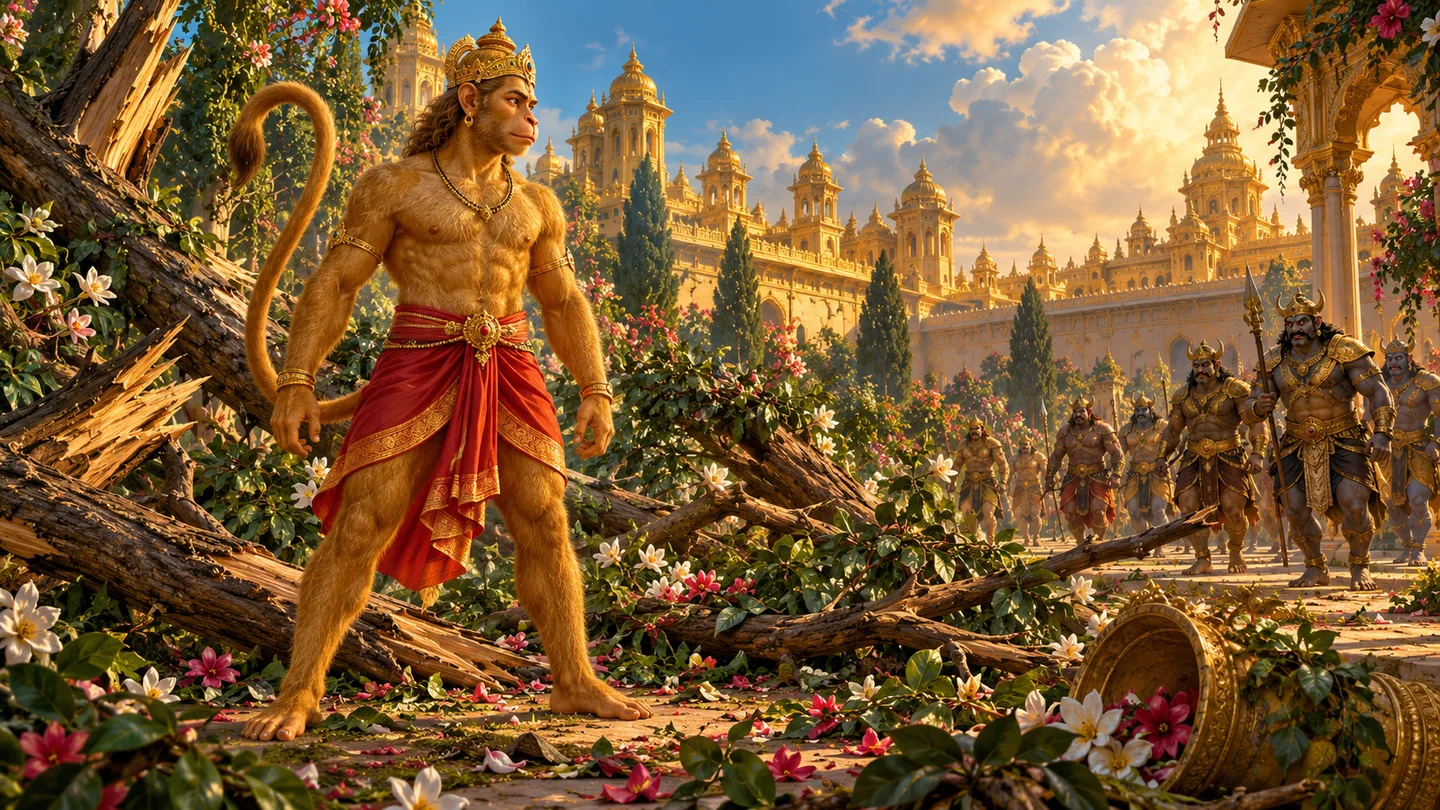
Hanuman stands firm in a disturbed garden while armed guards remain in the distance.
Original DHIH illustration · artistic interpretation

Verse 1 · 5.47.1

#

सेनापतीन् पञ्च स तु प्रमापितान्

Hearing that his five commanders had been killed,

हनूमता सानुचरान् सवाहनान् ।

together with their followers and vehicles, by Hanuman,

निशम्य राजा समरोद्धतोन्मुखं

the king turned his eyes towards Prince Aksha,

कुमारमक्षं प्रसमैक्षताक्षम् ॥

whose spirit was eager for battle.

Verse 2 · 5.47.2

#

स तस्य दृष्ट्यर्पणसम्प्रचोदितः

Prompted by that look from his father,

प्रतापवान् काञ्चनचित्रकार्मुकः ।

the splendid prince, bearing a gold-decorated bow,

समुत्पपाताथ सदस्युदीरितो

sprang up in the assembly when called upon,

द्विजातिमुख्यैर्हविषेव पावकः ॥

like fire rising at an offering made by leading priests.

Verse 3 · 5.47.3

#

ततो महान् बालदिवाकरप्रभं

Then that mighty foremost rakshasa

प्रतप्तजाम्बूनदजालसंततम् ।

mounted a chariot bright as the young sun,

रथं समास्थाय ययौ स वीर्यवान्

covered with a network of refined gold,

महाहरिं तं प्रति नैर्ऋतर्षभः ॥

and went out against the great vanara.

Verse 4 · 5.47.4

#

ततस्तपःसंग्रहसंचयार्जितं

It had been gained through accumulated austerities,

प्रतप्तजाम्बूनदजालचित्रितम् ।

and was decorated with a lattice of burnished gold,

पताकिनं रत्नविभूषितध्वजं

with pennants and a jewel-adorned standard,

मनोजवाष्टाश्ववरैः सुयोजितम् ॥

drawn by eight excellent horses swift as thought.

Verse 5 · 5.47.5

#

सुरासुराधृष्यमसङ्गचारिणं

Gods and asuras could not assail it; it moved unhindered,

तडित्प्रभं व्योमचरं समाहितम् ।

flashed like lightning, and travelled through the sky.

सतूणमष्टासिनिबद्धबन्धुरं

It bore quivers and eight swords fastened in place,

यथाक्रमावेशितशक्तितोमरम् ॥

with spears and javelins arranged in proper order.

Verse 6 · 5.47.6

#

विराजमानं प्रतिपूर्णवस्तुना

Fully equipped and magnificently adorned

सहेमदाम्ना शशिसूर्यवर्चसा ।

with golden garlands, it shone like sun and moon.

दिवाकराभं रथमास्थितस्ततः

Having mounted this sunlike chariot,

स निर्जगामामरतुल्यविक्रमः ॥

the prince of godlike prowess set out.

Verse 7 · 5.47.7

#

स पूरयन् खं च महीं च साचलां

Filling sky, earth and mountains

तुरङ्गमातङ्गमहारथस्वनैः ।

with the sounds of horses, elephants and great chariots,

बलैः समेतैः सहतोरणस्थितं

he approached with assembled forces

समर्थमासीनमुपागमत् कपिम् ॥

the capable vanara seated at the gateway.

Verse 8 · 5.47.8

#

स तं समासाद्य हरिं हरीक्षणो

The golden-eyed Aksha came upon that vanara,

युगान्तकालाग्निमिव प्रजाक्षये ।

who stood like the fire ending an age,

अवस्थितं विस्मितजातसम्भ्रमं

and, surprised into awe and agitation,

समैक्षताक्षो बहुमानचक्षुषा ॥

looked at him with respect.

Verse 9 · 5.47.9

#

स तस्य वेगं च कपेर्महात्मनः

Considering the great vanara's speed

पराक्रमं चारिषु रावणात्मजः ।

and prowess against enemies, Ravana's mighty son

विचारयन् स्वं च बलं महाबलो

also measured his own strength

युगक्षये सूर्य इवाभिवर्धत ॥

and grew in splendour like the sun at an age's end.

Verse 10 · 5.47.10

#

स जातमन्युः प्रसमीक्ष्य विक्रमं

Angered as he observed that irresistible prowess,

स्थितः स्थिरः संयति दुर्निवारणम् ।

the prince stood firm in battle.

समाहितात्मा हनुमन्तमाहवे

With his attention collected,

प्रचोदयामास शितैः शरैस्त्रिभिः ॥

he challenged Hanuman with three sharp arrows.

Verse 11 · 5.47.11

#

ततः कपिं तं प्रसमीक्ष्य गर्वितं

Observing the proud vanara,

जितश्रमं शत्रुपराजयोचितम् ।

unwearied and accustomed to defeating foes,

अवैक्षताक्षः समुदीर्णमानसं

Aksha looked at his greatly excited opponent

सबाणपाणिः प्रगृहीतकार्मुकः ॥

while gripping his bow and arrows.

Verse 12 · 5.47.12

#

स हेमनिष्काङ्गदचारुकुण्डलः

Wearing golden necklaces, armlets and lovely earrings,

समाससादाशुपराक्रमः कपिम् ।

the swiftly acting prince closed upon the vanara.

तयोर्बभूवाप्रतिमः समागमः

Their encounter became extraordinary,

सुरासुराणामपि सम्भ्रमप्रदः ॥

striking even gods and asuras with alarm.

Verse 13 · 5.47.13

#

ररास भूमिर्न तताप भानुमान्

Earth roared, the sun withheld its heat,

ववौ न वायुः प्रचचाल चाचलः ।

wind ceased, and mountains shook.

कपेः कुमारस्य च वीर्यसंयुगं

At the meeting of the vanara's and prince's strength,

ननाद च द्यौरुदधिश्च चुक्षुभे ॥

the sky thundered and the ocean grew troubled.

Verse 14 · 5.47.14

#

स तस्य वीरः सुमुखान् पतत्रिणः

That warrior sent fine-feathered arrows,

सुवर्णपुङ्खान् सविषानिवोरगान् ।

gold-fletched and like venomous serpents.

समाधिसंयोगविमोक्षतत्त्ववि-

Skilled in aiming, drawing and release,

च्छरानथ त्रीन् कपिमूर्ध्न्यताडयत् ॥

he struck Hanuman's head with three shafts.

Verse 15 · 5.47.15

#

स तैः शरैर्मूर्ध्नि समं निपातितैः

With those arrows planted together in his head,

क्षरन्नसृग्दिग्धविवृत्तनेत्रः ।

his widened eyes and streaming blood glowing,

नवोदितादित्यनिभः शरांशुमान्

Hanuman resembled the newly risen sun,

व्यराजतादित्य इवांशुमालिकः ॥

the arrows appearing like rays around him.

Verse 16 · 5.47.16

#

ततः प्लवङ्गाधिपमन्त्रिसत्तमः

The foremost counsellor of the vanara king

समीक्ष्य तं राजवरात्मजं रणे ।

looked at that noble king's son in battle,

उदग्रचित्रायुधचित्रकार्मुकं

with his splendid weapons and decorated bow,

जहर्ष चापूर्यत चाहवोन्मुखः ॥

and felt joy and renewed eagerness for combat.

Verse 17 · 5.47.17

#

स मन्दराग्रस्थ इवांशुमाली

Like the sun resting upon Mandara's summit,

विवृद्धकोपो बलवीर्यसंवृतः ।

growing angry and filled with strength,

कुमारमक्षं सबलं सवाहनं

he seemed to burn Aksha, his troops and chariot

ददाह नेत्राग्निमरीचिभिस्तदा ॥

with the fiery rays of his eyes.

Verse 18 · 5.47.18

#

ततः स बाणासनशक्रकार्मुकः

Then that rakshasa cloud, his bow a rainbow,

शरप्रवर्षो युधि राक्षसाम्बुदः ।

poured a shower of arrows in battle.

शरान् मुमोचाशु हरीश्वराचले

He rapidly loosed shafts upon the mountainlike vanara,

बलाहको वृष्टिमिवाचलोत्तमे ॥

as a rain cloud showers a mighty mountain.

Verse 19 · 5.47.19

#

कपिस्ततस्तं रणचण्डविक्रमं

Seeing Aksha's fierce prowess in battle

प्रवृद्धतेजोबलवीर्यसायकम् ।

and his growing brilliance, strength and arrows,

कुमारमक्षं प्रसमीक्ष्य संयुगे

Hanuman faced the prince in combat

ननाद हर्षाद् घनतुल्यनिःस्वनः ॥

and roared joyfully like a thundercloud.

Verse 20 · 5.47.20

#

स बालभावाद् युधि वीर्यदर्पितः

Young and proud of his prowess,

प्रवृद्धमन्युः क्षतजोपमेक्षणः ।

his anger rising and his eyes blood-red,

समाससादाप्रतिमं रणे कपिं

Aksha approached the unequalled vanara

गजो महाकूपमिवावृतं तृणैः ॥

like an elephant approaching a deep pit concealed by grass.

Verse 21 · 5.47.21

#

स तेन बाणैः प्रसभं निपातितै-

Struck forcefully by Aksha's arrows,

श्चकार नादं घननादनिःस्वनः ।

Hanuman roared with the sound of thunder.

समुत्सहेनाशु नभः समारुजन्

With sudden energy he sprang into the sky,

भुजोरुविक्षेपणघोरदर्शनः ॥

terrible to behold as he flung out arms and thighs.

Verse 22 · 5.47.22

#

तमुत्पतन्तं समभिद्रवद् बली

The mighty and splendid rakshasa prince

स राक्षसानां प्रवरः प्रतापवान् ।

pursued him as he rose.

रथी रथश्रेष्ठतरः किरन् शरैः

From his excellent chariot he showered arrows,

पयोधरः शैलमिवाश्मवृष्टिभिः ॥

like a cloud pelting a mountain with hail.

Verse 23 · 5.47.23

#

स ताञ्छरांस्तस्य हरिर्विमोक्षयं-

Evading those arrows, the brave vanara

श्चचार वीरः पथि वायुसेविते ।

moved along the path travelled by the wind.

शरान्तरे मारुतवद् विनिष्पतन्

He darted between shafts like a breeze,

मनोजवः संयति भीमविक्रमः ॥

swift as thought and formidable in battle.

Verse 24 · 5.47.24

#

तमात्तबाणासनमाहवोन्मुखं

Aksha held his bow ready for battle

खमास्तृणन्तं विविधैः शरोत्तमैः ।

and covered the sky with excellent arrows.

अवैक्षताक्षं बहुमानचक्षुषा

The Wind's son regarded him respectfully

जगाम चिन्तां स च मारुतात्मजः ॥

and began to consider what to do.

Verse 25 · 5.47.25

#

ततः शरैर्भिन्नभुजान्तरः कपिः

Arrows from that noble prince pierced his chest;

कुमारवर्येण महात्मना नदन् ।

the vanara roared.

महाभुजः कर्मविशेषतत्त्वविद्

Strong-armed and skilled in judging action,

विचिन्तयामास रणे पराक्रमम् ॥

he considered the prince's prowess in battle.

Verse 26 · 5.47.26

#

अबालवद् बालदिवाकरप्रभः

'Though young and bright as the rising sun,

करोत्ययं कर्म महन्महाबलः ।

this powerful one performs deeds beyond his years.

न चास्य सर्वाहवकर्मशालिनः

Yet, skilled as he is in every work of war,

प्रमापणे मे मतिरत्र जायते ॥

I have not felt inclined to kill him.

Verse 27 · 5.47.27

#

अयं महात्मा च महांश्च वीर्यतः

He is noble and very powerful,

समाहितश्चातिसहश्च संयुगे ।

collected and exceptionally enduring in battle.

असंशयं कर्मगुणोदयादयं

Surely, for the excellence of his deeds,

सनागयक्षैर्मुनिभिश्च पूजितः ॥

nagas, yakshas and sages honour him.

Verse 28 · 5.47.28

#

पराक्रमोत्साहविवृद्धमानसः-

His spirit enlarged by courage and enthusiasm,

समीक्षते मां प्रमुखोऽग्रतः स्थितः ।

he stands foremost and looks directly at me.

पराक्रमो ह्यस्य मनांसि कम्पयेत्

This swift warrior's prowess could shake

सुरासुराणामपि शीघ्रकारिणः ॥

the hearts even of gods and asuras.

Verse 29 · 5.47.29

#

न खल्वयं नाभिभवेदुपेक्षितः

If neglected, he could certainly overcome me;

पराक्रमो ह्यस्य रणे विवर्धते ।

his strength in battle continues to grow.

प्रमापणं ह्यस्य ममाद्य रोचते

Now I judge that he must be killed:

न वर्धमानोऽग्निरुपेक्षितुं क्षमः ॥

a spreading fire cannot safely be ignored.'

Verse 30 · 5.47.30

#

इति प्रवेगं तु परस्य तर्कयन्

Having assessed his enemy's force

स्वकर्मयोगं च विधाय वीर्यवान् ।

and settled the course of his own action,

चकार वेगं तु महाबलस्तदा

that mighty hero gathered speed,

मतिं च चक्रेऽस्य वधे तदानीम् ॥

resolved at that moment to kill him.

Verse 31 · 5.47.31

#

स तस्य तानष्ट वरान् महाहयान्

The Wind's son struck Aksha's eight excellent horses,

समाहितान् भारसहान् विवर्तने ।

well trained to bear their burden and turn in battle,

जघान वीरः पथि वायुसेविते

with blows of his hands

तलप्रहारैः पवनात्मजः कपिः ॥

upon the wind-travelled path of the sky.

Verse 32 · 5.47.32

#

ततस्तलेनाभिहतो महारथः

Struck by his palm, that great chariot

स तस्य पिङ्गाधिपमन्त्रिनिर्जितः ।

was overcome by the vanara king's counsellor.

स भग्ननीडः परिवृत्तकूबरः

Its platform shattered and pole overturned,

पपात भूमौ हतवाजिरम्बरात् ॥

it fell from the sky with its horses slain.

Verse 33 · 5.47.33

#

स तं परित्यज्य महारथो रथं

Abandoning his chariot, that great warrior

सकार्मुकः खड्गधरः खमुत्पतन् ।

sprang into the air with bow and sword,

ततोऽभियोगादृषिरुग्रवीर्यवान्

like a powerful sage, through spiritual effort,

विहाय देहं मरुतामिवालयम् ॥

leaving the body to reach the realm of the winds.

Verse 34 · 5.47.34

#

कपिस्ततस्तं विचरन्तमम्बरे

As Aksha moved through the sky

पतत्त्रिराजानिलसिद्धसेविते ।

frequented by Garuda, wind and perfected beings,

समेत्य तं मारुतवेगविक्रमः

the vanara, swift and strong as the wind,

क्रमेण जग्राह च पादयोर्दृढम् ॥

approached and firmly seized both his feet.

Verse 35 · 5.47.35

#

स तं समाविध्य सहस्रशः कपि-

The vanara whirled him round a thousand times,

र्महोरगं गृह्य इवाण्डजेश्वरः ।

like the king of birds grasping a great serpent.

मुमोच वेगात् पितृतुल्यविक्रमो

Matching his father the Wind in force,

महीतले संयति वानरोत्तमः ॥

that foremost vanara hurled him violently to the ground.

Verse 36 · 5.47.36

#

स भग्नबाहूरुकटीपयोधरः

His arms, thighs, waist and chest broken,

क्षरन्नसृङ्‍‍‍‍निर्मथितास्थिलोचनः ।

bleeding, with bones and eyes crushed,

सम्भिन्नसंधिः प्रविकीर्णबन्धनो

his joints shattered and limbs torn apart,

हतः क्षितौ वायुसुतेन राक्षसः ॥

the rakshasa lay dead, killed by the Wind's son.

Verse 37 · 5.47.37

#

महाकपिर्भूमितले निपीड्य तं

Crushing him upon the earth, the great vanara

चकार रक्षोऽधिपतेर्महद्भयम् ।

brought terrible fear to the rakshasa king.

महर्षिभिश्चक्रचरैः समागतैः

Great sages and beings who roamed the celestial circles,

समेत्य भूतैश्च सयक्षपन्नगैः ।

together with spirits, yakshas and serpents,

सुरैश्च सेन्द्रैर्भृशजातविस्मयै-

and the gods with Indra, looked on in profound amazement

र्हते कुमारे स कपिर्निरीक्षितः ॥

at the vanara after the prince's death.

Verse 38 · 5.47.38

#

निहत्य तं वज्रिसुतोपमं रणे

Having killed the red-eyed Prince Aksha,

कुमारमक्षं क्षतजोपमेक्षणम् ।

who was like Indra's son in battle,

तदेव वीरोऽभिजगाम तोरणं

the hero returned to the same gateway,

कृतक्षणः काल इव प्रजाक्षये ॥

awaiting the next moment like Time at the world's destruction.

CHAPTER 47 COMPLETE

The journey continues.

Aksha has fallen. Ravana must decide how to respond to Hanuman’s formidable strength.

NEXT CHAPTER

Continue Hanuman’s journey in the next chapter.

About this reading

Vālmīki Rāmāyaṇa, Sundara Kanda, chapter 47. This reading follows Sanskrit Wikisource revision 355156, with all 38 numbered verses. Verse divisions and wording vary between editions.

The Sanskrit is preserved with normalized display spacing and line breaks. Some sentences continue across verse boundaries; the English follows that continuity. A yojana is a traditional distance unit, retained without assigning a modern measurement. Shape-changing and celestial beings belong to the epic’s sacred narrative.

English line senses and short meanings are original AI-assisted DHIH renderings checked against this Sanskrit reading; they are not a word-for-word grammatical commentary or a claim of human scholarly certification. Roman transliteration is generated mechanically in IAST. Names may also appear in familiar English spellings.

Sanskrit transcription credit: Wikisource contributors, revision history. The adapted reading text and DHIH English on this chapter page are offered under CC BY-SA 4.0. The ancient Sanskrit work is in the public domain. Illustrations are separately commissioned AI-generated DHIH artwork.

Historical comparison: M. N. Dutt’s Ramayana, volume II, a public-domain translation, was consulted for narrative context. The English displayed here is a fresh rendering of the pinned Sanskrit, not a reproduction of that translation.

The full Sanskrit chapter describes fatal combat and explicit injuries. It preserves the epic’s account and is not an adaptation for young children. Audio will be added only when suitable recording permissions are available.