Search DHIH library

VĀLMĪKI RĀMĀYAṆA · CHAPTER 49

सुन्दरकाण्डम् · सर्गः 49

Hanuman beholds Ravana

Inside the royal court, Hanuman observes Ravana’s extraordinary splendour and reflects upon power misused through unrighteous conduct.

20 versesSanskrit + English1 illustration
Begin reading ↓

An edition-specific reading with original English meanings. Source & reading notes

SCENE 01 · VERSES 1–20

Power and its purpose

Ravana’s impressive appearance prompts Hanuman to reflect on the responsibility that comes with strength.

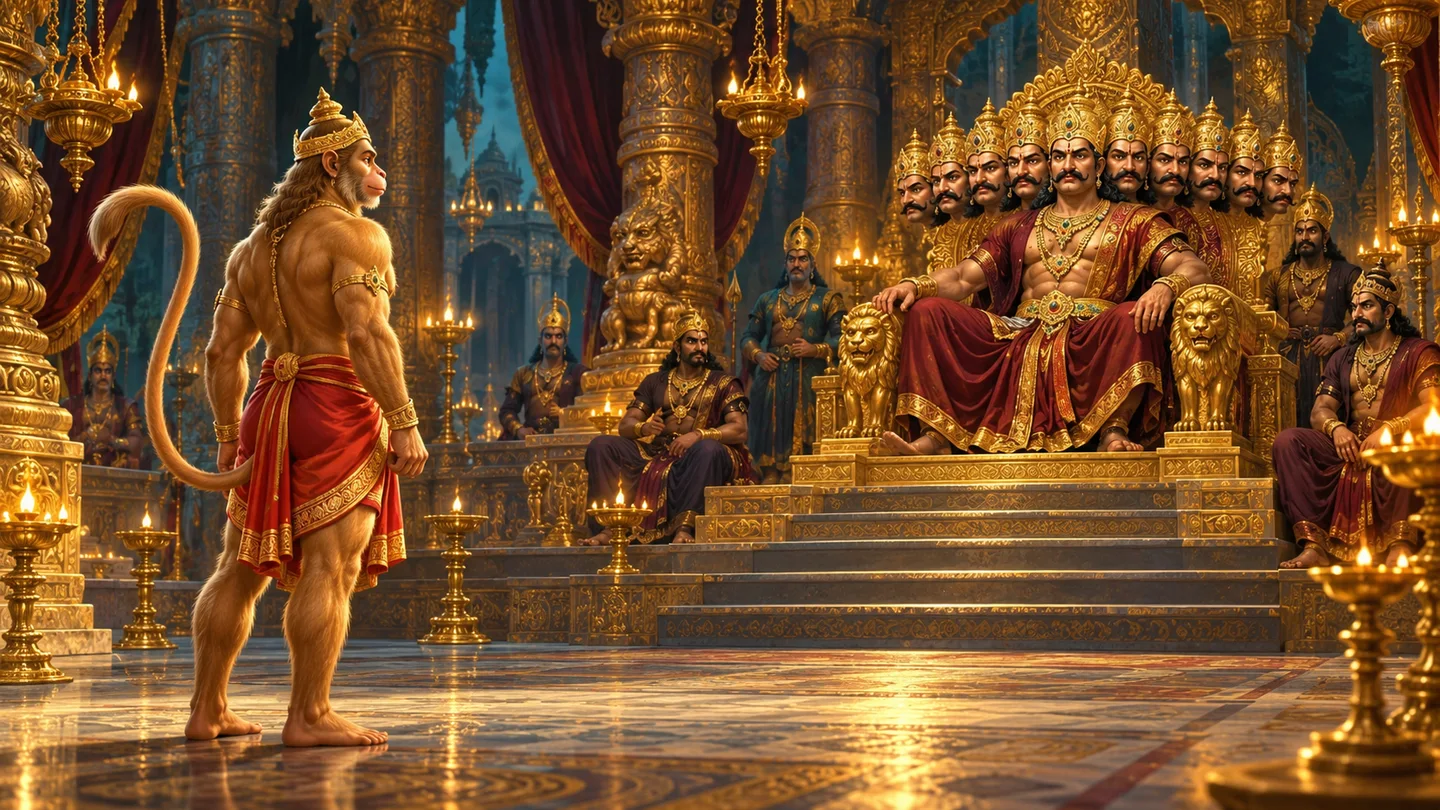
Hanuman stands as Rama’s messenger before Ravana in a grand royal hall.
Original DHIH illustration · artistic interpretation

Verse 1 · 5.49.1

#

ततः स कर्मणा तस्य विस्मितो भीमविक्रमः ।

Astonished by Ravana's appearance, the fiercely powerful Hanuman,

हनूमान् क्रोधताम्राक्षो रक्षोऽधिपमवैक्षत ॥

his eyes copper-red with anger, looked upon the rakshasa lord.

Verse 2 · 5.49.2

#

भ्राजमानं महार्हेण काञ्चनेन विराजता ।

He shone with a costly, radiant golden crown,

मुक्ताजालवृतेनाथ मुकुटेन महाद्युतिम् ॥

encircled with strings of pearls, and blazed with splendour.

Verse 3 · 5.49.3

#

वज्रसंयोगसंयुक्तैर्महार्हमणिविग्रहैः ।

His marvellous golden ornaments, set with diamonds

हैमैराभरणैश्चित्रैर्मनसेव प्रकल्पितैः ॥

and precious gems, seemed fashioned by thought itself.

Verse 4 · 5.49.4

#

महार्हक्षौमसंवीतं रक्तचन्दनरूषितम् ।

He wore costly fine linen and red sandal paste,

स्वनुलिप्तं विचित्राभिर्विविधाभिश्च भक्तिभिः ॥

his body beautifully marked with varied decorative designs.

Verse 5 · 5.49.5

#

विचित्रं दर्शनीयैश्च रक्ताक्षैर्भीमदर्शनैः ।

His appearance was striking, with red eyes terrible to behold,

दीप्ततीक्ष्णमहादंष्ट्रं प्रलम्बं दशनच्छदैः ॥

gleaming sharp tusks and long hanging lips.

Verse 6 · 5.49.6

#

शिरोभिर्दशभिर्वीरो भ्राजमानं महौजसम् ।

The mighty hero shone with his ten heads,

नानाव्यालसमाकीर्णैः शिखरैरिव मन्दरम् ॥

like Mount Mandara with peaks crowded by many wild creatures.

Verse 7 · 5.49.7

#

नीलाञ्जनचयप्रख्यं हारेणोरसि राजता ।

Dark as a mass of collyrium, a shining necklace upon his chest,

पूर्णचन्द्राभवक्त्रेण सबालार्कमिवाम्बुदम् ॥

his moonlike face made him resemble a cloud bearing the young sun.

Verse 8 · 5.49.8

#

बाहुभिर्बद्धकेयूरैश्चन्दनोत्तमरूषितैः ।

His fearsome arms bore armlets and excellent sandal paste,

भ्राजमानाङ्गदैर्भीमैः पञ्चशीर्षैरिवोरगैः ॥

their glittering ornaments making them seem like five-headed serpents.

Verse 9 · 5.49.9

#

महति स्फाटिके चित्रे रत्नसंयोगचित्रिते ।

He sat upon a magnificent crystal throne inlaid with jewels,

उत्तमास्तरणास्तीर्णे सूपविष्टं वरासने ॥

covered with the finest furnishings.

Verse 10 · 5.49.10

#

अलंकृताभिरत्यर्थं प्रमदाभिः समन्ततः ।

Beautifully adorned women stood around him,

वालव्यजनहस्ताभिरारात्समुपसेवितम् ॥

attending nearby with yak-tail fans in their hands.

Verse 11 · 5.49.11

#

दुर्धरेण प्रहस्तेन महापार्श्वेन रक्षसा ।

Durdhara, Prahasta, the rakshasa Mahaparshva,

मन्त्रिभिर्मन्त्रतत्त्वज्ञैर्निकुम्भेन च मन्त्रिणा ॥

and Nikumbha, all ministers skilled in counsel, were near him.

Verse 12 · 5.49.12

#

उपोपविष्टं रक्षोभिश्चतुर्भिर्बलदर्पितम् ।

With those four powerful rakshasas seated around him,

कृत्स्नं परिवृतं लोकं चतुर्भिरिव सागरैः ॥

he resembled the whole earth surrounded by its four oceans.

Verse 13 · 5.49.13

#

मन्त्रिभिर्मन्त्रतत्त्वज्ञैरन्यैश्च शुभदर्शिभिः ।

Other wise and impressive counsellors also supported him,

आश्वास्यमानं सचिवैः सुरैरिव सुरेश्वरम् ॥

as the gods attend their sovereign.

Verse 14 · 5.49.14

#

अपश्यद् राक्षसपतिं हनूमानतितेजसम् ।

Hanuman saw the immensely radiant rakshasa king

वेष्टितं मेरुशिखरे सतोयमिव तोयदम् ॥

encircled like a rain-filled cloud upon Mount Meru's summit.

Verse 15 · 5.49.15

#

स तैः सम्पीड्यमानोऽपि रक्षोभिर्भीमविक्रमैः ।

Though pressed by those rakshasas of terrible prowess,

विस्मयं परमं गत्वा रक्षोऽधिपमवैक्षत ॥

Hanuman gazed at their lord in the greatest wonder.

Verse 16 · 5.49.16

#

भ्राजमानं ततो दृष्ट्वा हनुमान् राक्षसेश्वरम् ।

Seeing the radiant rakshasa king, Hanuman,

मनसा चिन्तयामास तेजसा तस्य मोहितः ॥

struck by his splendour, reflected within himself.

Verse 17 · 5.49.17

#

अहो रूपमहो धैर्यमहो सत्त्वमहो द्युतिः ।

'What a form! What courage, strength and brilliance!

अहो राक्षसराजस्य सर्वलक्षणयुक्तता ॥

How fully this rakshasa king possesses the marks of greatness!

Verse 18 · 5.49.18

#

यद्यधर्मो न बलवान् स्यादयं राक्षसेश्वरः ।

Were unrighteousness not so strong in this rakshasa lord,

स्यादयं सुरलोकस्य सशक्रस्यापि रक्षिता ॥

he could protect even the heavenly world and Indra himself.

Verse 19 · 5.49.19

#

अस्य क्रूरैर्नृशंसैश्च कर्मभिर्लोककुत्सितैः ।

Because of his cruel, merciless deeds condemned by the world,

सर्वे बिभ्यति खल्वस्माल्लोकाः सामरदानवाः ॥

all realms, including gods and danavas, are afraid of him.

Verse 20 · 5.49.20

#

अयं ह्युत्सहते क्रुद्धः कर्तुमेकार्णवं जगत् ।

In anger he could reduce the world to a single ocean.'

इति चिन्तां बहुविधामकरोन्मतिमान् कपिः ।

Thus the intelligent vanara considered many things,

दृष्ट्वा राक्षसराजस्य प्रभावममितौजसः ॥

seeing the boundless power of the rakshasa king.

CHAPTER 49 COMPLETE

The journey continues.

Hanuman has assessed Ravana’s greatness and its dangerous misuse. The questioning is about to begin.

NEXT CHAPTER

Continue Hanuman’s journey in the next chapter.

About this reading

Vālmīki Rāmāyaṇa, Sundara Kanda, chapter 49. This reading follows Sanskrit Wikisource revision 355158, with all 20 numbered verses. Verse divisions and wording vary between editions.

The Sanskrit is preserved with normalized display spacing and line breaks. Some sentences continue across verse boundaries; the English follows that continuity. A yojana is a traditional distance unit, retained without assigning a modern measurement. Shape-changing and celestial beings belong to the epic’s sacred narrative.

English line senses and short meanings are original AI-assisted DHIH renderings checked against this Sanskrit reading; they are not a word-for-word grammatical commentary or a claim of human scholarly certification. Roman transliteration is generated mechanically in IAST. Names may also appear in familiar English spellings.

Sanskrit transcription credit: Wikisource contributors, revision history. The adapted reading text and DHIH English on this chapter page are offered under CC BY-SA 4.0. The ancient Sanskrit work is in the public domain. Illustrations are separately commissioned AI-generated DHIH artwork.

Historical comparison: M. N. Dutt’s Ramayana, volume II, a public-domain translation, was consulted for narrative context. The English displayed here is a fresh rendering of the pinned Sanskrit, not a reproduction of that translation.

The chapter describes Ravana’s ten-headed form and royal magnificence as part of the epic’s poetic world. Admiration for his gifts is distinguished from approval of his actions. Audio will be added only when suitable recording permissions are available.