Search DHIH library

VĀLMĪKI RĀMĀYAṆA · CHAPTER 50

सुन्दरकाण्डम् · सर्गः 50

Rama’s messenger speaks

Ravana suspects a divine disguise and orders Prahasta to question the captive. Hanuman explains who he is and why he has come.

19 versesSanskrit + English1 illustration
Begin reading ↓

An edition-specific reading with original English meanings. Source & reading notes

SCENE 01 · VERSES 1–19

Identity and intention

The questions in Ravana’s court lead to Hanuman’s clear declaration of purpose.

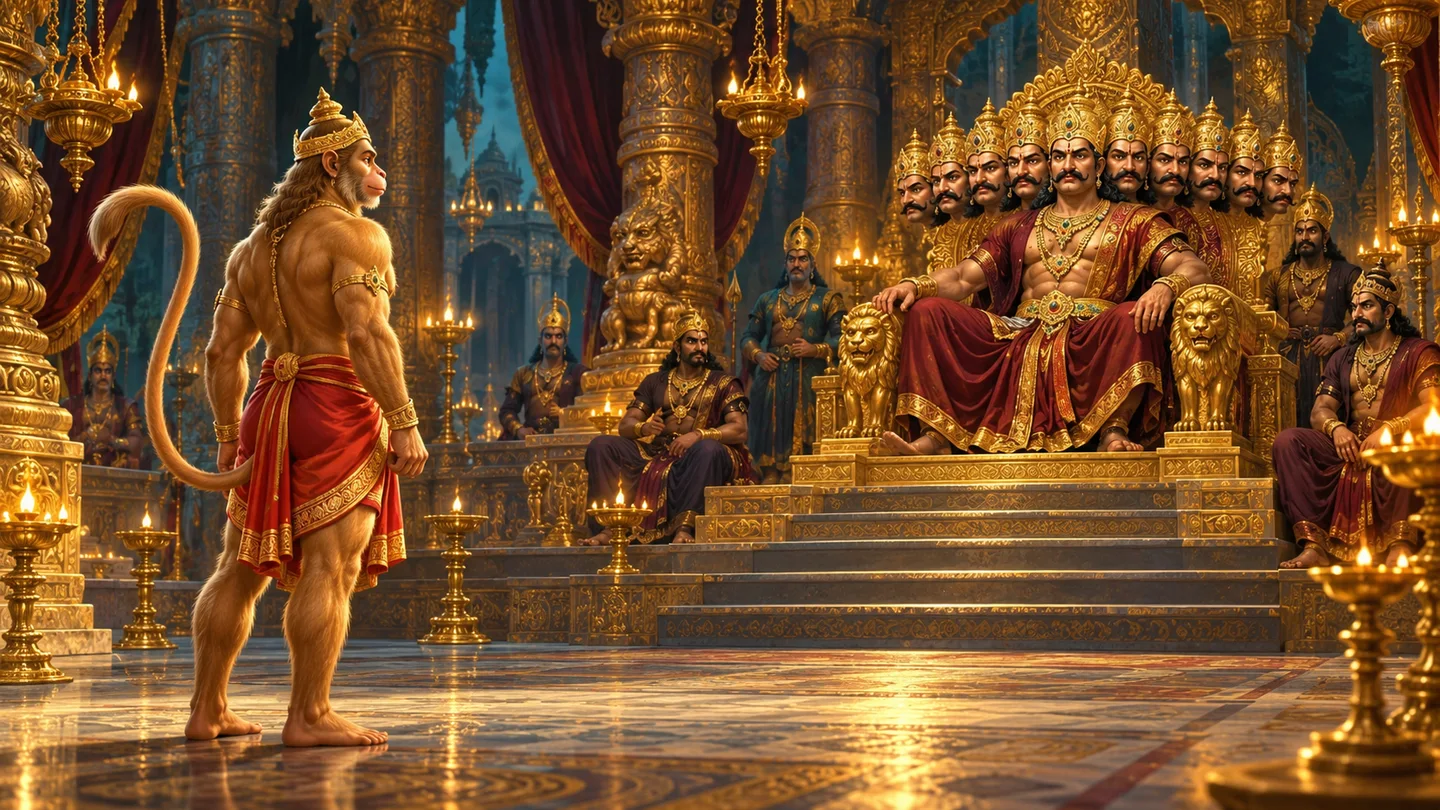
Hanuman stands as Rama’s messenger before Ravana in a grand royal hall.
Original DHIH illustration · artistic interpretation

Verse 1 · 5.50.1

#

तमुद्वीक्ष्य महाबाहुः पिङ्गाक्षं पुरतः स्थितम् ।

Seeing the tawny-eyed vanara standing before him,

रोषेण महताऽऽविष्टो रावणो लोकरावणः ॥

strong-armed Ravana, who made the worlds cry out, was seized by great anger.

Verse 2 · 5.50.2

#

शङ्काहतात्मा दध्यौ स कपीन्द्रं तेजसा वृतम् ।

Troubled by suspicion, he considered the radiant vanara:

किमेष भगवान् नन्दी भवेत् साक्षादिहागतः ॥

'Could this be the blessed Nandi himself, come here in person?

Verse 3 · 5.50.3

#

येन शप्तोऽस्मि कैलासे मया प्रहसिते पुरा ।

He cursed me on Kailasa long ago when I mocked him.

सोऽयं वानरमूर्तिः स्यात्किंस्विद् बाणोऽपि वासुरः ॥

Has he assumed a vanara's form, or could this be the asura Bana?'

Verse 4 · 5.50.4

#

स राजा रोषताम्राक्षः प्रहस्तं मन्त्रिसत्तमम् ।

His eyes copper-red with anger, the king spoke

कालयुक्तमुवाचेदं वचो विपुलमर्थवत् ॥

to his foremost minister Prahasta in substantial, timely words.

Verse 5 · 5.50.5

#

दुरात्मा पृच्छ्यतामेष कुतः किं वास्य कारणम् ।

'Ask this wicked one where he comes from and for what reason;

वनभङ्गे च कोऽस्यार्थो राक्षसानां च तर्जने ॥

what did he intend by destroying the grove and threatening the rakshasas?

Verse 6 · 5.50.6

#

मत्पुरीमप्रधृष्यां वै गमने किं प्रयोजनम् ।

What purpose brought him into my unassailable city,

आयोधने वा कं कार्यं पृच्छ्यतामेष दुर्मतिः ॥

and what did he seek by fighting? Question this ill-minded one.'

Verse 7 · 5.50.7

#

रावणस्य वचः श्रुत्वा प्रहस्तो वाक्यमब्रवीत् ।

Hearing Ravana's words, Prahasta said,

समाश्वसिहि भद्रं ते न भीः कार्या त्वया कपे ॥

'Take courage, vanara; may you fare well. You need not fear.

Verse 8 · 5.50.8

#

यदि तावत् त्वमिन्द्रेण प्रेषितो रावणालयम् ।

If Indra sent you to Ravana's dwelling,

तत्त्वमाख्याहि मा ते भूद् भयं वानर मोक्ष्यसे ॥

tell the truth; have no fear, vanara, and you will be released.

Verse 9 · 5.50.9

#

यदि वैश्रवणस्य त्वं यमस्य वरुणस्य च ।

Or do you belong to Kubera, Yama or Varuna,

चारुरूपमिदं कृत्वा प्रविष्टो नः पुरीमिमाम् ॥

entering our city after assuming this pleasing form?

Verse 10 · 5.50.10

#

विष्णुना प्रेषितो वापि दूतो विजयकाङ्क्षिणा ।

Or are you a messenger sent by Vishnu, who desires victory?

नहि ते वानरं तेजो रूपमात्रं तु वानरम् ॥

Your power is not that of a vanara; only your appearance is.

Verse 11 · 5.50.11

#

तत्त्वतः कथयस्वाद्य ततो वानर मोक्ष्यसे ।

Tell the truth now, vanara, and you will be released;

अनृतं वदतश्चापि दुर्लभं तव जीवितम् ॥

if you speak falsely, it will be difficult for you to live.

Verse 12 · 5.50.12

#

अथवा यन्निमित्तस्ते प्रवेशो रावणालये ।

Otherwise, explain what brought you into Ravana's dwelling.'

एवमुक्तो हरिवरस्तदा रक्षोगणेश्वरम् ॥

Addressed thus, the foremost vanara spoke to the rakshasa leader.

Verse 13 · 5.50.13

#

अब्रवीन्नास्मि शक्रस्य यमस्य वरुणस्य च ।

'I do not belong to Indra, Yama or Varuna.

धनदेन न मे सख्यं विष्णुना नास्मि चोदितः ॥

I have no alliance with Kubera, and Vishnu has not sent me.

Verse 14 · 5.50.14

#

जातिरेव मम त्वेषा वानरोऽहमिहागतः ।

This truly is my own kind: I am a vanara who has come here.

दर्शने राक्षसेन्द्रस्य तदिदं दुर्लभं मया ॥

I wished to see the rakshasa king, but that audience was difficult to obtain.

Verse 15 · 5.50.15

#

वनं राक्षसराजस्य दर्शनार्थं विनाशितम् ।

I destroyed the rakshasa king's grove in order to see him.

ततस्ते राक्षसाः प्राप्ता बलिनो युद्धकाङ्क्षिणः ॥

Then your powerful rakshasas arrived, wishing to fight.

Verse 16 · 5.50.16

#

रक्षणार्थं च देहस्य प्रतियुद्धा मया रणे ।

I fought back in battle to protect my body.

अस्त्रपाशैर्न शक्योऽहं बद्धुं देवासुरैरपि ॥

Even gods and asuras cannot bind me with weapon-bonds.

Verse 17 · 5.50.17

#

पितामहादेष वरो ममापि हि समागतः ।

This boon has also been granted me by Brahma.

राजानं द्रष्टुकामेन मयास्त्रमनुवर्तितम् ॥

Wishing to see the king, I respected the weapon's restraint.

Verse 18 · 5.50.18

#

विमुक्तोऽप्यहमस्त्रेण राक्षसैस्त्वभिवेदितः ।

Though the weapon had released me, the rakshasas brought me before you.

केनचिद् रामकार्येण आगतोऽस्मि तवान्तिकम् ॥

I have come into your presence on a particular mission for Rama.

Verse 19 · 5.50.19

#

दूतोऽहमिति विज्ञाय राघवस्यामितौजसः ।

Know me as the messenger of Raghava, whose might is immeasurable.

श्रूयतामेव वचनं मम पथ्यमिदं प्रभो ॥

Lord, listen to these words of mine, spoken for your good.'

CHAPTER 50 COMPLETE

The journey continues.

Hanuman has declared his mission for Rama and asks Ravana to hear advice for his own good.

NEXT CHAPTER

Continue Hanuman’s journey in the next chapter.

About this reading

Vālmīki Rāmāyaṇa, Sundara Kanda, chapter 50. This reading follows Sanskrit Wikisource revision 355159, with all 19 numbered verses. Verse divisions and wording vary between editions.

The Sanskrit is preserved with normalized display spacing and line breaks. Some sentences continue across verse boundaries; the English follows that continuity. A yojana is a traditional distance unit, retained without assigning a modern measurement. Shape-changing and celestial beings belong to the epic’s sacred narrative.

English line senses and short meanings are original AI-assisted DHIH renderings checked against this Sanskrit reading; they are not a word-for-word grammatical commentary or a claim of human scholarly certification. Roman transliteration is generated mechanically in IAST. Names may also appear in familiar English spellings.

Sanskrit transcription credit: Wikisource contributors, revision history. The adapted reading text and DHIH English on this chapter page are offered under CC BY-SA 4.0. The ancient Sanskrit work is in the public domain. Illustrations are separately commissioned AI-generated DHIH artwork.

Historical comparison: M. N. Dutt’s Ramayana, volume II, a public-domain translation, was consulted for narrative context. The English displayed here is a fresh rendering of the pinned Sanskrit, not a reproduction of that translation.

The chapter includes interrogation and threats. Hanuman’s account explains his own choices within the narrative; it is not advice to provoke confrontation. Audio will be added only when suitable recording permissions are available.