Search DHIH library

VĀLMĪKI RĀMĀYAṆA · CHAPTER 60

सुन्दरकाण्डम् · सर्गः 60

Jambavan recalls the mission

Angada proposes rescuing Sita immediately. Jambavan reminds the group of their instructions and of Rama’s promise to lead the rescue himself.

20 versesSanskrit + English1 illustration
Begin reading ↓

An edition-specific reading with original English meanings. Source & reading notes

SCENE 01 · VERSES 1–20

Capability and responsibility

Enthusiasm for a bold rescue meets Jambavan’s reminder to respect the mission they were given.

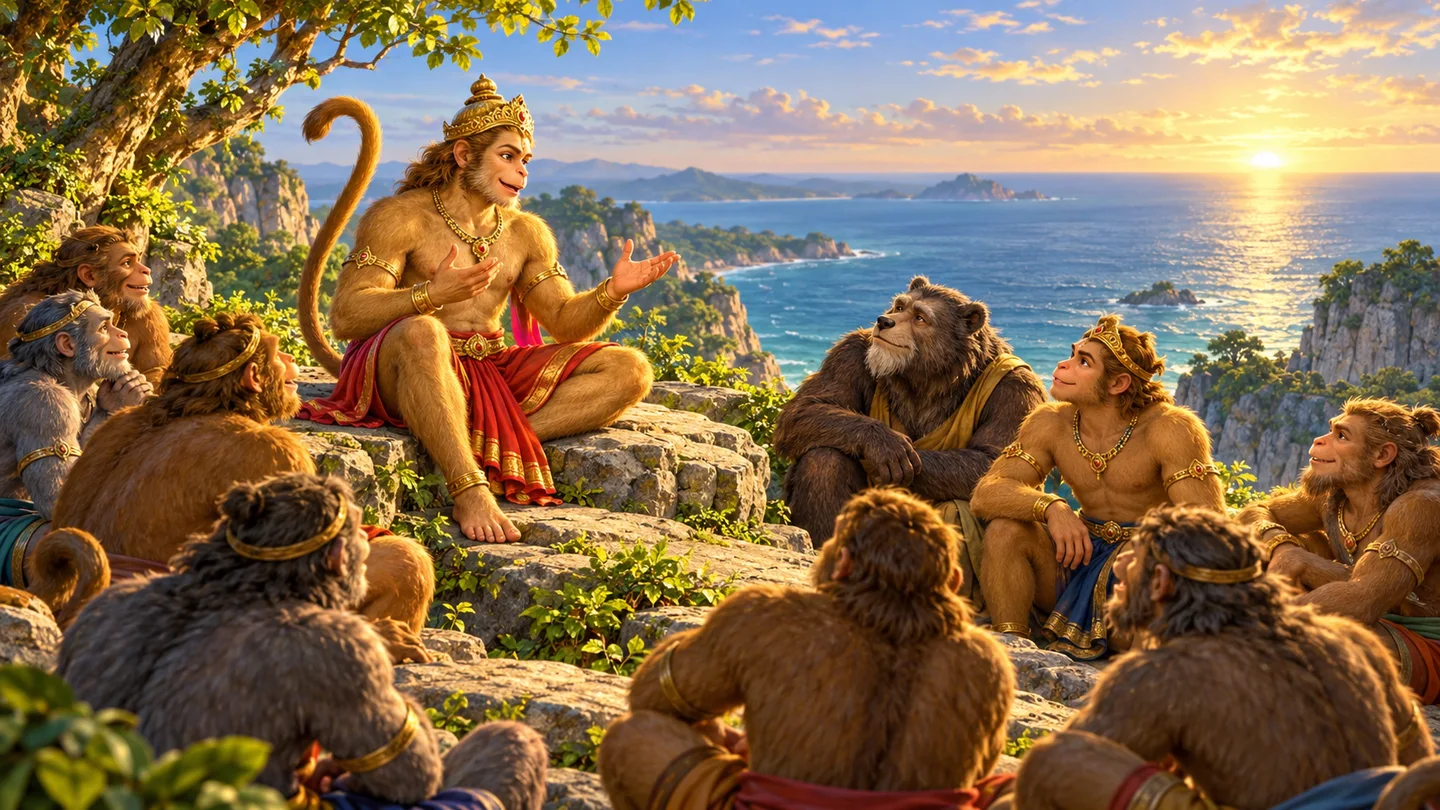
Hanuman recounts his journey to Jambavan, Angada and the vanaras on Mount Mahendra.
Original DHIH illustration · artistic interpretation

Verse 1 · 5.60.1

#

तस्य तद् वचनं श्रुत्वा वालिसूनुरभाषत ।

Hearing Hanuman's words, Vali's son spoke:

अश्विपुत्रौ महावेगौ बलवन्तौ प्लवंगमौ ॥

'The two swift, powerful vanaras born of the Ashvins—

Verse 2 · 5.60.2

#

पितामहवरोत्सेकात् परमं दर्पमास्थितौ ।

are filled with great confidence through Brahma's boon.

अश्विनोर्माननार्थं हि सर्वलोकपितामहः ॥

To honour the Ashvins, the grandfather of all worlds—

Verse 3 · 5.60.3

#

सर्वावध्यत्वमतुलमनयोर्दत्तवान् पुरा ।

long ago granted them unequalled protection from death at anyone's hands.

वरोत्सेकेन मत्तौ च प्रमथ्य महतीं चमूम् ॥

Proud of that boon, they overwhelmed a mighty host—

Verse 4 · 5.60.4

#

सुराणाममृतं वीरौ पीतवन्तौ महाबलौ ।

and those powerful heroes drank the gods' nectar.

एतावेव हि संक्रुद्धौ सवाजिरथकुञ्जराम् ॥

These two alone, if angered, could destroy—

Verse 5 · 5.60.5

#

लङ्कां नाशयितुं शक्तौ सर्वे तिष्ठन्तु वानराः ।

Lanka with its horses, chariots and elephants; all other vanaras could stand aside.

अहमेकोऽपि पर्याप्तः सराक्षसगणां पुरीम् ॥

I alone too am sufficient to destroy the city with its rakshasa hosts—

Verse 6 · 5.60.6

#

तां लङ्कां तरसा हन्तुं रावणं च महाबलम् ।

and mighty Ravana by force.

किं पुनः सहितो वीरैर्बलवद्भिः कृतात्मभिः ॥

How much more with brave, powerful and disciplined companions—

Verse 7 · 5.60.7

#

कृतास्त्रैः प्लवगैः शक्तैर्भवद्भिर्विजयैषिभिः ।

such capable, weapon-trained vanaras as you, who seek victory!

वायुसूनोर्बलेनैव दग्धा लङ्केति नः श्रुतम् ॥

We have heard that Lanka was burned by the Wind's son's strength alone.

Verse 8 · 5.60.8

#

दृष्टा देवी न चानीता इति तत्र निवेदितुम् ।

I do not think it fitting for men of your famed courage

न युक्तमिव पश्यामि भवद्भिः ख्यातपौरुषैः ॥

to report, "We saw the lady, but did not bring her back."

Verse 9 · 5.60.9

#

नहि वः प्लवने कश्चिन्नापि कश्चित् पराक्रमे ।

Foremost vanaras, among the worlds with their gods and daityas,

तुल्यः सामरदैत्येषु लोकेषु हरिसत्तमाः ॥

no one equals you in leaping or in prowess.

Verse 10 · 5.60.10

#

जित्वा लङ्कां सरक्षौघां हत्वा तं रावणं रणे ।

Let us conquer Lanka and its rakshasa host, kill Ravana in battle,

सीतामादाय गच्छामः सिद्धार्था हृष्टमानसाः ॥

and return joyfully with Sita, our task accomplished.

Verse 11 · 5.60.11

#

तेष्वेवं हतवीरेषु राक्षसेषु हनूमता ।

Since Hanuman has already killed their foremost warriors,

किमन्यदत्र कर्तव्यं गृहीत्वा याम जानकीम् ॥

what more is needed? Let us take Janaki and go.

Verse 12 · 5.60.12

#

रामलक्ष्मणयोर्मध्ये न्यस्याम जनकात्मजाम् ।

Let us place Janaka's daughter between Rama and Lakshmana.

किं व्यलीकैस्तु तान् सर्वान् वानरान् वानरर्षभान् ॥

Why trouble all the other foremost vanaras with these difficulties?

Verse 13 · 5.60.13

#

वयमेव हि गत्वा तान् हत्वा राक्षसपुङ्गवान् ।

We ourselves should go, kill those rakshasa chiefs,

राघवं द्रष्टुमर्हामः सुग्रीवं सहलक्ष्मणम् ॥

and then meet Raghava, Lakshmana and Sugriva.'

Verse 14 · 5.60.14

#

तमेवं कृतसंकल्पं जाम्बवान् हरिसत्तमः ।

Seeing him resolved in this way, Jambavan, that excellent and wise leader,

उवाच परमप्रीतो वाक्यमर्थवदर्थवित् ॥

spoke meaningful words with great goodwill.

Verse 15 · 5.60.15

#

नैषा बुद्धिर्महाबुद्धे यद् ब्रवीषि महाकपे ।

'Wise great vanara, the course you propose is not our instruction.

विचेतुं वयमाज्ञप्ता दक्षिणां दिशमुत्तमाम् ॥

We were ordered to search the southern direction thoroughly—

Verse 16 · 5.60.16

#

नानेतुं कपिराजेन नैव रामेण धीमता ।

not to bring her back, either by the vanara king or by wise Rama.

कथंचिन्निर्जितां सीतामस्माभिर्नाभिरोचयेत् ॥

Rama would not welcome Sita being won back by us in some other manner—

Verse 17 · 5.60.17

#

राघवो नृपशार्दूलः कुलं व्यपदिशन् स्वकम् ।

for that lion among kings has invoked his lineage

प्रतिज्ञाय स्वयं राजा सीताविजयमग्रतः ॥

and personally pledged to recover Sita before—

Verse 18 · 5.60.18

#

सर्वेषां कपिमुख्यानां कथं मिथ्या करिष्यति ।

all the foremost vanaras. How could he make that promise false?

विफलं कर्म च कृतं भवेत् तुष्टिर्न तस्य च ॥

Our action would be fruitless and would not bring him satisfaction.

Verse 19 · 5.60.19

#

वृथा च दर्शितं वीर्यं भवेद् वानरपुङ्गवाः ।

Our display of prowess would then be wasted, foremost vanaras.

तस्माद् गच्छाम वै सर्वे यत्र रामः सलक्ष्मणः ।

Therefore let us all go to Rama with Lakshmana

सुग्रीवश्च महातेजाः कार्यस्यास्य निवेदने ॥

and radiant Sugriva, to report this undertaking.

Verse 20 · 5.60.20

#

न तावदेषा मतिरक्षमा नो

Prince, this plan is not beyond our abilities,

यथा भवान् पश्यति राजपुत्र ।

as you rightly perceive.

यथा तु रामस्य मतिर्निविष्टा

Yet consider success in the way

तथा भवान् पश्यतु कार्यसिद्धिम् ॥

that accords with Rama's own intention.'

CHAPTER 60 COMPLETE

The journey continues.

The searchers are urged to return with their information and let the rescue follow Rama’s intended course.

NEXT CHAPTER

Continue Hanuman’s journey in the next chapter.

About this reading

Vālmīki Rāmāyaṇa, Sundara Kanda, chapter 60. This reading follows Sanskrit Wikisource revision 355590, with all 20 numbered verses. Verse divisions and wording vary between editions.

The Sanskrit is preserved with normalized display spacing and line breaks. Some sentences continue across verse boundaries; the English follows that continuity. A yojana is a traditional distance unit, retained without assigning a modern measurement. Shape-changing and celestial beings belong to the epic’s sacred narrative.

English line senses and short meanings are original AI-assisted DHIH renderings checked against this Sanskrit reading; they are not a word-for-word grammatical commentary or a claim of human scholarly certification. Roman transliteration is generated mechanically in IAST. Names may also appear in familiar English spellings.

Sanskrit transcription credit: Wikisource contributors, revision history. The adapted reading text and DHIH English on this chapter page are offered under CC BY-SA 4.0. The ancient Sanskrit work is in the public domain. Illustrations are separately commissioned AI-generated DHIH artwork.

Historical comparison: M. N. Dutt’s Ramayana, volume II, a public-domain translation, was consulted for narrative context. The English displayed here is a fresh rendering of the pinned Sanskrit, not a reproduction of that translation.

The dialogue distinguishes the ability to act from the authority and purpose of the assignment. It discusses military action within the epic’s setting. Audio will be added only when suitable recording permissions are available.