Search DHIH library

VĀLMĪKI RĀMĀYAṆA · CHAPTER 61

सुन्दरकाण्डम् · सर्गः 61

Celebration in Madhuvana

The successful search party travels home and enters Sugriva’s treasured honey-grove. Celebration turns unruly, and the guardian Dadhimukha tries to intervene.

24 versesSanskrit + English1 illustration
Begin reading ↓

An edition-specific reading with original English meanings. Source & reading notes

SCENE 01 · VERSES 1–24

When joy loses restraint

The vanaras’ relief becomes a celebration that disregards the grove and those responsible for it.

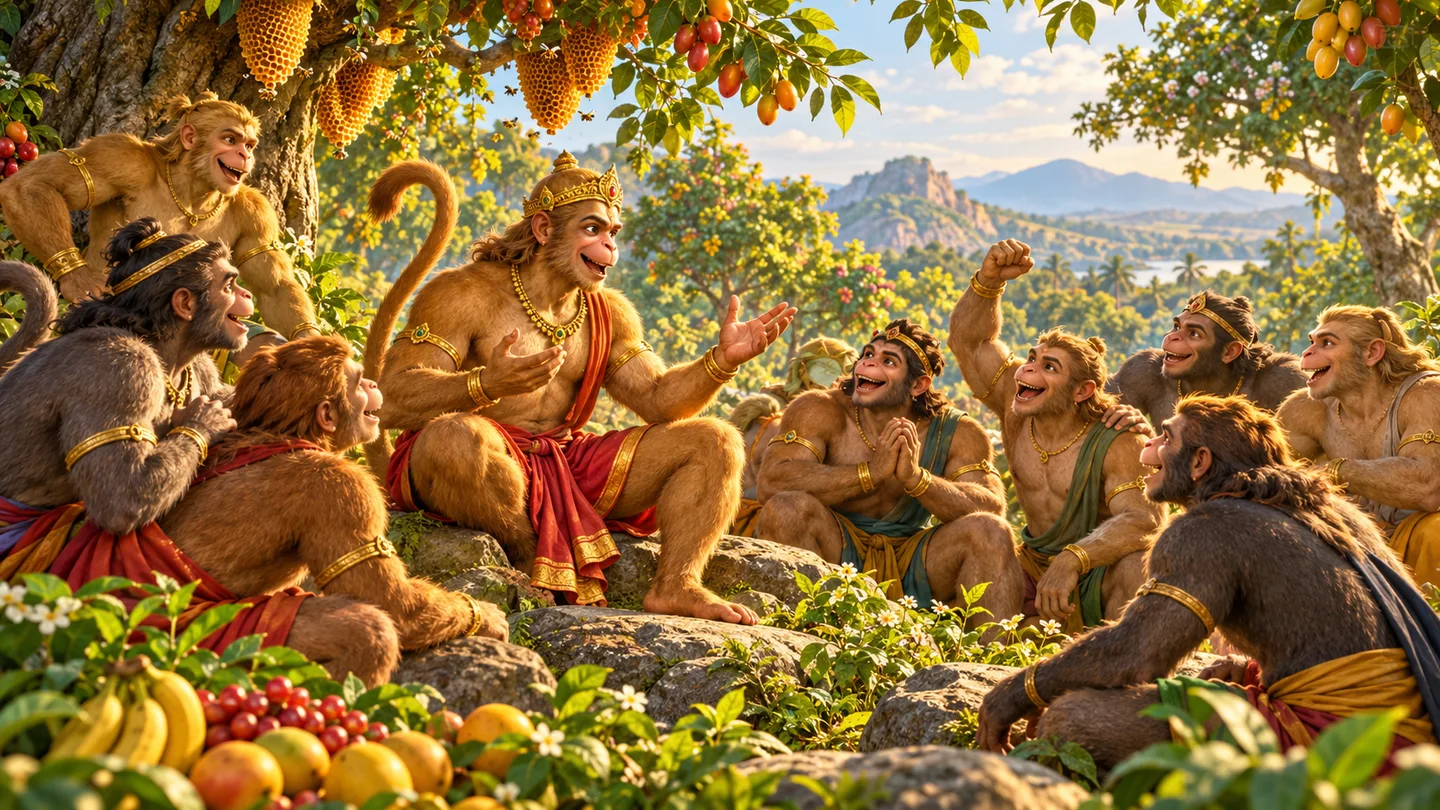
Vanara companions gather in a sunny woodland with flowering trees and honeycombs.
Original DHIH illustration · artistic interpretation

Verse 1 · 5.61.1

#

ततो जाम्बवतो वाक्यमगृह्णन्त वनौकसः ।

The forest-dwellers accepted Jambavan's words—

अङ्गदप्रमुखा वीरा हनूमांश्च महाकपिः ॥

the heroes led by Angada, and the great Hanuman.

Verse 2 · 5.61.2

#

प्रीतिमन्तस्ततः सर्वे वायुपुत्रपुरःसराः ।

Delighted, with the Wind's son at their head,

महेन्द्राग्रात् समुत्पत्य पुप्लुवुः प्लवगर्षभाः ॥

the foremost vanaras leapt from Mahendra's summit and travelled onward.

Verse 3 · 5.61.3

#

मेरुमन्दरसंकाशा मत्ता इव महागजाः ।

Huge and powerful, like Meru and Mandara,

छादयन्त इवाकाशं महाकाया महाबलाः ॥

like excited great elephants, they seemed to cover the sky.

Verse 4 · 5.61.4

#

सभाज्यमानं भूतैस्तमात्मवन्तं महाबलम् ।

Their eyes rested upon swift, mighty and self-controlled Hanuman,

हनूमन्तं महावेगं वहन्त इव दृष्टिभिः ॥

honoured by other beings, as though bearing him along with their gaze.

Verse 5 · 5.61.5

#

राघवे चार्थनिर्वृत्तिं कर्तुं च परमं यशः ।

Their task fulfilled and spirits lifted by success,

समाधाय समृद्धार्थाः कर्मसिद्धिभिरुन्नताः ॥

they resolved to accomplish Raghava's purpose and win great honour.

Verse 6 · 5.61.6

#

प्रियाख्यानोन्मुखाः सर्वे सर्वे युद्धाभिनन्दिनः ।

All wished to tell the welcome news and all welcomed battle;

सर्वे रामप्रतीकारे निश्चितार्था मनस्विनः ॥

resolute and high-minded, they were determined to serve Rama.

Verse 7 · 5.61.7

#

प्लवमानाः खमाप्लुत्य ततस्ते काननौकसः ।

Leaping through the sky, the forest-dwellers

नन्दनोपममासेदुर्वनं द्रुमशतायुतम् ॥

reached a grove with thousands of trees, resembling Nandana.

Verse 8 · 5.61.8

#

यत् तन्मधुवनं नाम सुग्रीवस्याभिरक्षितम् ।

It was named Madhuvana, carefully protected by Sugriva,

अधृष्यं सर्वभूतानां सर्वभूतमनोहरम् ॥

forbidden to other beings and delightful to all who saw it.

Verse 9 · 5.61.9

#

यद् रक्षति महावीरः सदा दधिमुखः कपिः ।

The mighty vanara Dadhimukha always guarded it;

मातुलः कपिमुख्यस्य सुग्रीवस्य महात्मनः ॥

he was the maternal uncle of noble Sugriva, chief of the vanaras.

Verse 10 · 5.61.10

#

ते तद् वनमुपागम्य बभूवुः परमोत्कटाः ।

Reaching that great grove, so dear to their king,

वानरा वानरेन्द्रस्य मनःकान्तं महावनम् ॥

the vanaras became exceedingly excited.

Verse 11 · 5.61.11

#

ततस्ते वानरा हृष्टा दृष्ट्वा मधुवनं महत् ।

Delighted to see the great honey-grove,

कुमारमभ्ययाचन्त मधूनि मधुपिङ्गलाः ॥

the tawny vanaras asked the prince for permission to take its honey.

Verse 12 · 5.61.12

#

ततः कुमारस्तान् वृद्धाञ्जाम्बवत्प्रमुखान् कपीन् ।

After obtaining the approval of the elders led by Jambavan,

अनुमान्य ददौ तेषां निसर्गं मधुभक्षणे ॥

the prince gave them leave to consume the honey.

Verse 13 · 5.61.13

#

ते निसृष्टाः कुमारेण धीमता वालिसूनुना ।

Permitted by Vali's wise son,

हरयः समपद्यन्त द्रुमान् मधुकराकुलान् ॥

the vanaras rushed towards trees crowded with honeybees.

Verse 14 · 5.61.14

#

भक्षयन्तः सुगन्धीनि मूलानि च फलानि च ।

Eating fragrant roots and fruits,

जग्मुः प्रहर्षं ते सर्वे बभूवुश्च मदोत्कटाः ॥

all became delighted and increasingly intoxicated.

Verse 15 · 5.61.15

#

ततश्चानुमताः सर्वे सुसंहृष्टा वनौकसः ।

With permission granted, all the forest-dwellers were overjoyed;

मुदिताश्च ततस्ते च प्रनृत्यन्ति ततस्ततः ॥

in delight they began dancing here and there.

Verse 16 · 5.61.16

#

गायन्ति केचित् प्रहसन्ति केचि-

Some sang, some laughed,

न्नृत्यन्ति केचित् प्रणमन्ति केचित् ।

some danced and some bowed.

पतन्ति केचित् प्रचरन्ति केचित्

Some fell, some wandered,

प्लवन्ति केचित् प्रलपन्ति केचित् ॥

some leapt and some babbled.

Verse 17 · 5.61.17

#

परस्परं केचिदुपाश्रयन्ति

Some leaned upon one another,

परस्परं केचिदतिब्रुवन्ति ।

some shouted over one another.

द्रुमाद् द्रुमं केचिदभिद्रवन्ति

Some rushed from tree to tree,

क्षितौ नगाग्रान्निपतन्ति केचित् ॥

and some fell from tree-tops to the ground.

Verse 18 · 5.61.18

#

महीतलात् केचिदुदीर्णवेगा

Some sprang vigorously from the ground

महाद्रुमाग्राण्यभिसम्पतन्ति ।

to the tops of great trees.

गायन्तमन्यः प्रहसन्नुपैति

One approached a singer laughing;

हसन्तमन्यः प्ररुदन्नुपैति ॥

another approached someone laughing while himself weeping.

Verse 19 · 5.61.19

#

तुदन्तमन्यः प्रणदन्नुपैति

Another approached someone striking out while roaring;

समाकुलं तत् कपिसैन्यमासीत् ।

the vanara army was in complete confusion.

न चात्र कश्चिन्न बभूव मत्तो

Not one there was free of intoxication,

न चात्र कश्चिन्न बभूव दृप्तः ॥

and not one was free of exuberant pride.

Verse 20 · 5.61.20

#

ततो वनं तत् परिभक्ष्यमाणं

Seeing the grove being consumed

द्रुमांश्च विध्वंसितपत्रपुष्पान् ।

and the trees stripped of leaves and flowers,

समीक्ष्य कोपाद् दधिवक्त्रनामा

the vanara called Dadhivaktra grew angry

निवारयामास कपिः कपींस्तान् ॥

and tried to restrain the vanaras.

Verse 21 · 5.61.21

#

स तैः प्रवृद्धैः परिभर्त्स्यमानो

Threatened by the increasingly unruly vanaras,

वनस्य गोप्ता हरिवृद्धवीरः ।

the grove's guardian, a senior vanara hero,

चकार भूयो मतिमुग्रतेजा

once more formed a stern resolve

वनस्य रक्षां प्रति वानरेभ्यः ॥

to protect the grove from them.

Verse 22 · 5.61.22

#

उवाच कांश्चित् परुषाण्यभीत-

Fearlessly he spoke harshly to some,

मसक्तमन्यांश्च तलैर्जघान ।

struck others repeatedly with his palms,

समेत्य कैश्चित् कलहं चकार

quarrelled directly with a few,

तथैव साम्नोपजगाम कांश्चित् ॥

and approached others with conciliatory words.

Verse 23 · 5.61.23

#

स तैर्मदादप्रतिवार्यवेगै-

Those whose intoxication made their rush irresistible,

र्बलाच्च तेन प्रतिवार्यमाणैः ।

although forcibly checked by him,

प्रधर्षणे त्यक्तभयैः समेत्य

lost their fear of assaulting him, gathered around,

प्रकृष्यते चाप्यनवेक्ष्य दोषम् ॥

and dragged him without considering their wrongdoing.

Verse 24 · 5.61.24

#

नखैस्तुदन्तो दशनैर्दशन्त-

Scratching with nails and biting with teeth,

स्तलैश्च पादैश्च समापयन्तः ।

striking him with hands and feet,

मदात् कपिं ते कपयः समन्ता-

the vanaras crowded around him in their intoxication

न्महावनं निर्विषयं च चक्रुः ॥

and left the great grove without effective protection.

CHAPTER 61 COMPLETE

The journey continues.

Dadhimukha has been overpowered as the revelry damages the protected grove.

NEXT CHAPTER

Continue Hanuman’s journey in the next chapter.

About this reading

Vālmīki Rāmāyaṇa, Sundara Kanda, chapter 61. This reading follows Sanskrit Wikisource revision 355599, with all 24 numbered verses. Verse divisions and wording vary between editions.

The Sanskrit is preserved with normalized display spacing and line breaks. Some sentences continue across verse boundaries; the English follows that continuity. A yojana is a traditional distance unit, retained without assigning a modern measurement. Shape-changing and celestial beings belong to the epic’s sacred narrative.

English line senses and short meanings are original AI-assisted DHIH renderings checked against this Sanskrit reading; they are not a word-for-word grammatical commentary or a claim of human scholarly certification. Roman transliteration is generated mechanically in IAST. Names may also appear in familiar English spellings.

Sanskrit transcription credit: Wikisource contributors, revision history. The adapted reading text and DHIH English on this chapter page are offered under CC BY-SA 4.0. The ancient Sanskrit work is in the public domain. Illustrations are separately commissioned AI-generated DHIH artwork.

Historical comparison: M. N. Dutt’s Ramayana, volume II, a public-domain translation, was consulted for narrative context. The English displayed here is a fresh rendering of the pinned Sanskrit, not a reproduction of that translation.

The chapter includes intoxication, waste and violence against the grove’s guardian. These events are narrated as disorderly behaviour, not as conduct for children to imitate. Audio will be added only when suitable recording permissions are available.