Search DHIH library

VĀLMĪKI RĀMĀYAṆA · CHAPTER 66

सुन्दरकाण्डम् · सर्गः 66

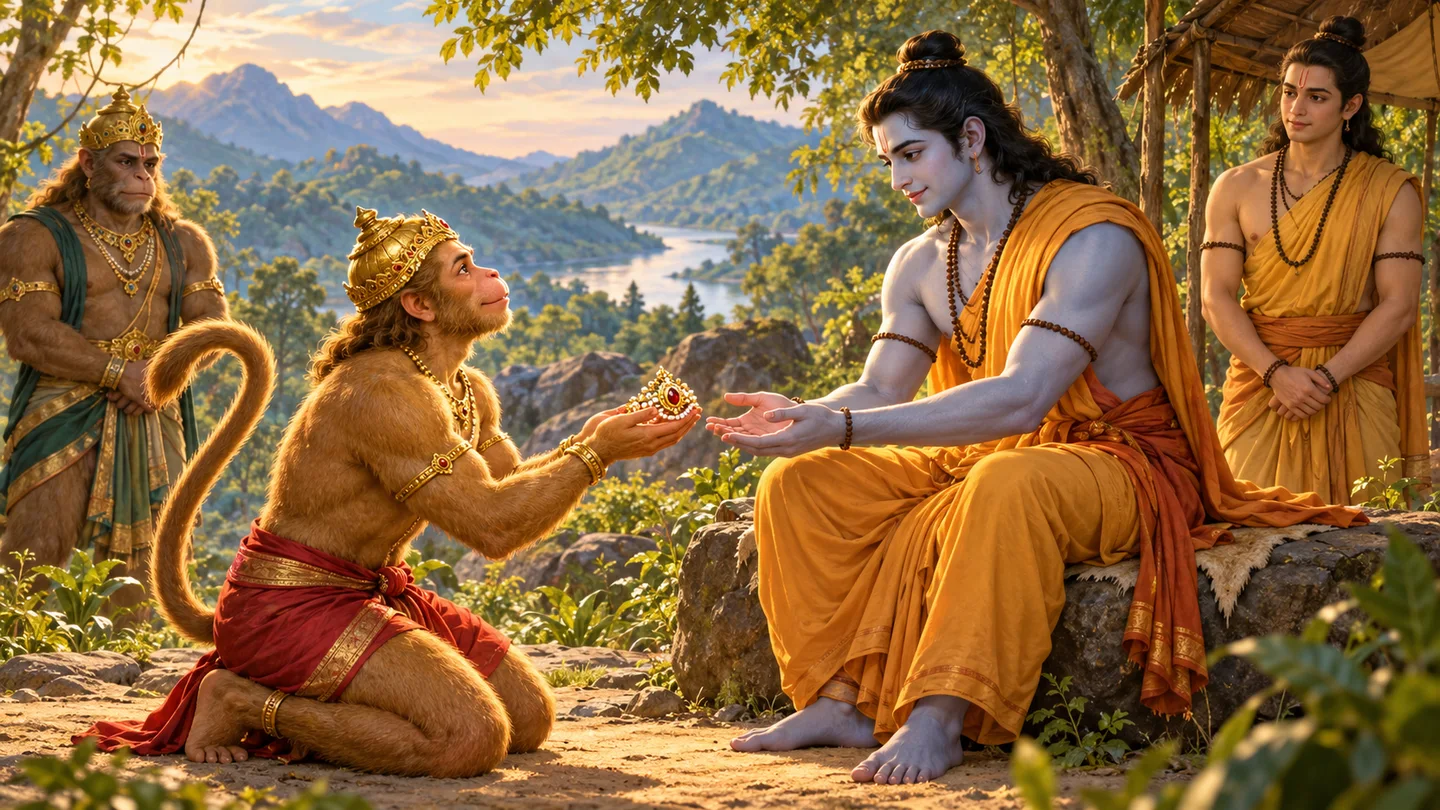
Rama holds the jewel

Sita’s jewel awakens memories of her wedding and family. Rama presses it to his heart and asks Hanuman to repeat her words.

15 versesSanskrit + English1 illustration
Begin reading ↓

An edition-specific reading with original English meanings. Source & reading notes

SCENE 01 · VERSES 1–15

Memory and longing

The treasured jewel brings Sita close in memory while making her absence painfully clear.

Hanuman respectfully brings Sita’s jewel and message to Rama, with Lakshmana nearby.
Original DHIH illustration · artistic interpretation

Verse 1 · 5.66.1

#

एवमुक्तो हनुमता रामो दशरथात्मजः ।

Hearing Hanuman's words, Rama, son of Dasharatha,

तं मणिं हृदये कृत्वा रुरोद सहलक्ष्मणः ॥

pressed the jewel to his heart and wept together with Lakshmana.

Verse 2 · 5.66.2

#

तं तु दृष्ट्वा मणिश्रेष्ठं राघवः शोककर्शितः ।

Seeing that excellent jewel, grief-worn Raghava

नेत्राभ्यामश्रुपूर्णाभ्यां सुग्रीवमिदमब्रवीत् ॥

spoke to Sugriva with eyes full of tears.

Verse 3 · 5.66.3

#

यथैव धेनुः स्रवति स्नेहाद् वत्सस्य वत्सला ।

'As a loving cow lets her milk flow at the sight of her calf,

तथा ममापि हृदयं मणिश्रेष्ठस्य दर्शनात् ॥

so my heart melts at seeing this excellent jewel.

Verse 4 · 5.66.4

#

मणिरत्नमिदं दत्तं वैदेह्याः श्वशुरेण मे ।

My father-in-law gave this precious jewel to Vaidehi

वधूकाले यथा बद्धमधिकं मूर्ध्नि शोभते ॥

at her wedding; bound upon her head, it shone with special beauty.

Verse 5 · 5.66.5

#

अयं हि जलसम्भूतो मणिः प्रवरपूजितः ।

This water-born jewel, honoured among the finest,

यज्ञे परमतुष्टेन दत्तः शक्रेण धीमता ॥

was given by wise Indra when greatly pleased at a sacrifice.

Verse 6 · 5.66.6

#

इमं दृष्ट्वा मणिश्रेष्ठं तथा तातस्य दर्शनम् ।

Seeing this excellent jewel today, gentle one,

अद्यास्म्यवगतः सौम्य वैदेहस्य तथा विभोः ॥

I feel I have seen my father and the lord of Videha.

Verse 7 · 5.66.7

#

अयं हि शोभते तस्याः प्रियाया मूर्ध्नि मे मणिः ।

It shone upon the head of my beloved;

अद्यास्य दर्शनेनाहं प्राप्तां तामिव चिन्तये ॥

seeing it today, I feel as though she herself has come to me.

Verse 8 · 5.66.8

#

किमाह सीता वैदेही ब्रूहि सौम्य पुनः पुनः ।

Tell me again and again what Sita Vaidehi said, gentle one;

परासुमिव तोयेन सिञ्चन्ती वाक्यवारिणा ॥

let her words bathe me like reviving water poured over one nearly lifeless.

Verse 9 · 5.66.9

#

इतस्तु किं दुःखतरं यदिमं वारिसम्भवम् ।

Son of Sumitra, what could be more painful

मणिं पश्यामि सौमित्रे वैदेहीमागतां विना ॥

than seeing this water-born jewel without Vaidehi herself returning?

Verse 10 · 5.66.10

#

चिरं जीवति वैदेही यदि मासं धरिष्यति ।

Vaidehi can endure long if she can hold on for a month;

क्षणं वीर न जीवेयं विना तामसितेक्षणाम् ॥

hero, I could not live a moment without that dark-eyed lady.

Verse 11 · 5.66.11

#

नय मामपि तं देशं यत्र दृष्टा मम प्रिया ।

Take me too to the place where you saw my beloved;

न तिष्ठेयं क्षणमपि प्रवृत्तिमुपलभ्य च ॥

having heard this news, I cannot remain here even a moment.

Verse 12 · 5.66.12

#

कथं सा मम सुश्रोणी भीरुभीरुः सती तदा ।

How can my graceful, gentle and fearful beloved

भयावहानां घोराणां मध्ये तिष्ठति रक्षसाम् ॥

remain among those terrible, frightening rakshasas?

Verse 13 · 5.66.13

#

शारदस्तिमिरोन्मुक्तो नूनं चन्द्र इवाम्बुदैः ।

Surely her face does not shine now,

आवृतो वदनं तस्या न विराजति साम्प्रतम् ॥

like an autumn Moon, normally free of darkness, covered by clouds.

Verse 14 · 5.66.14

#

किमाह सीता हनुमंस्तत्त्वतः कथयस्व मे ।

Hanuman, tell me truthfully what Sita said.

एतेन खलु जीविष्ये भेषजेनातुरो यथा ॥

By this I shall live, as a sick person lives through medicine.

Verse 15 · 5.66.15

#

मधुरा मधुरालापा किमाह मम भामिनी ।

What did my beautiful, sweet-speaking beloved say, Hanuman?

मद्विहीना वरारोहा हनुमन् कथयस्व मे ।

Tell me of that graceful lady separated from me.

दुःखाद् दुःखतरं प्राप्य कथं जीवति जानकी ॥

How does Janaki live, passing from sorrow into greater sorrow?'

CHAPTER 66 COMPLETE

The journey continues.

Rama longs to hear Sita’s exact message again, drawing comfort from every remembered word.

NEXT CHAPTER

Continue Hanuman’s journey in the next chapter.

About this reading

Vālmīki Rāmāyaṇa, Sundara Kanda, chapter 66. This reading follows Sanskrit Wikisource revision 355621, with all 15 numbered verses. Verse divisions and wording vary between editions.

The Sanskrit is preserved with normalized display spacing and line breaks. Some sentences continue across verse boundaries; the English follows that continuity. A yojana is a traditional distance unit, retained without assigning a modern measurement. Shape-changing and celestial beings belong to the epic’s sacred narrative.

English line senses and short meanings are original AI-assisted DHIH renderings checked against this Sanskrit reading; they are not a word-for-word grammatical commentary or a claim of human scholarly certification. Roman transliteration is generated mechanically in IAST. Names may also appear in familiar English spellings.

Sanskrit transcription credit: Wikisource contributors, revision history. The adapted reading text and DHIH English on this chapter page are offered under CC BY-SA 4.0. The ancient Sanskrit work is in the public domain. Illustrations are separately commissioned AI-generated DHIH artwork.

Historical comparison: M. N. Dutt’s Ramayana, volume II, a public-domain translation, was consulted for narrative context. The English displayed here is a fresh rendering of the pinned Sanskrit, not a reproduction of that translation.

The chapter portrays intense grief and expressions of feeling unable to live through separation. These are poetic expressions of distress within the epic, not advice about responding to loss. Audio will be added only when suitable recording permissions are available.