The message before the rain · 325-word learning story
About this story
The four-page story below is an original family reading inspired by this form’s meaning. Its people, conversations and events are imagined; it is not an ancient scripture, a temple legend, or a claim that the deity performed these events.
The traditional introduction and Sanskrit reading have their own source notes. Read aloud together with younger children.
Swipe left for next · swipe right to go back
Original AI-assisted devotional illustration; a symbolic interpretation, not a photograph or prescribed temple icon.
1 / 6
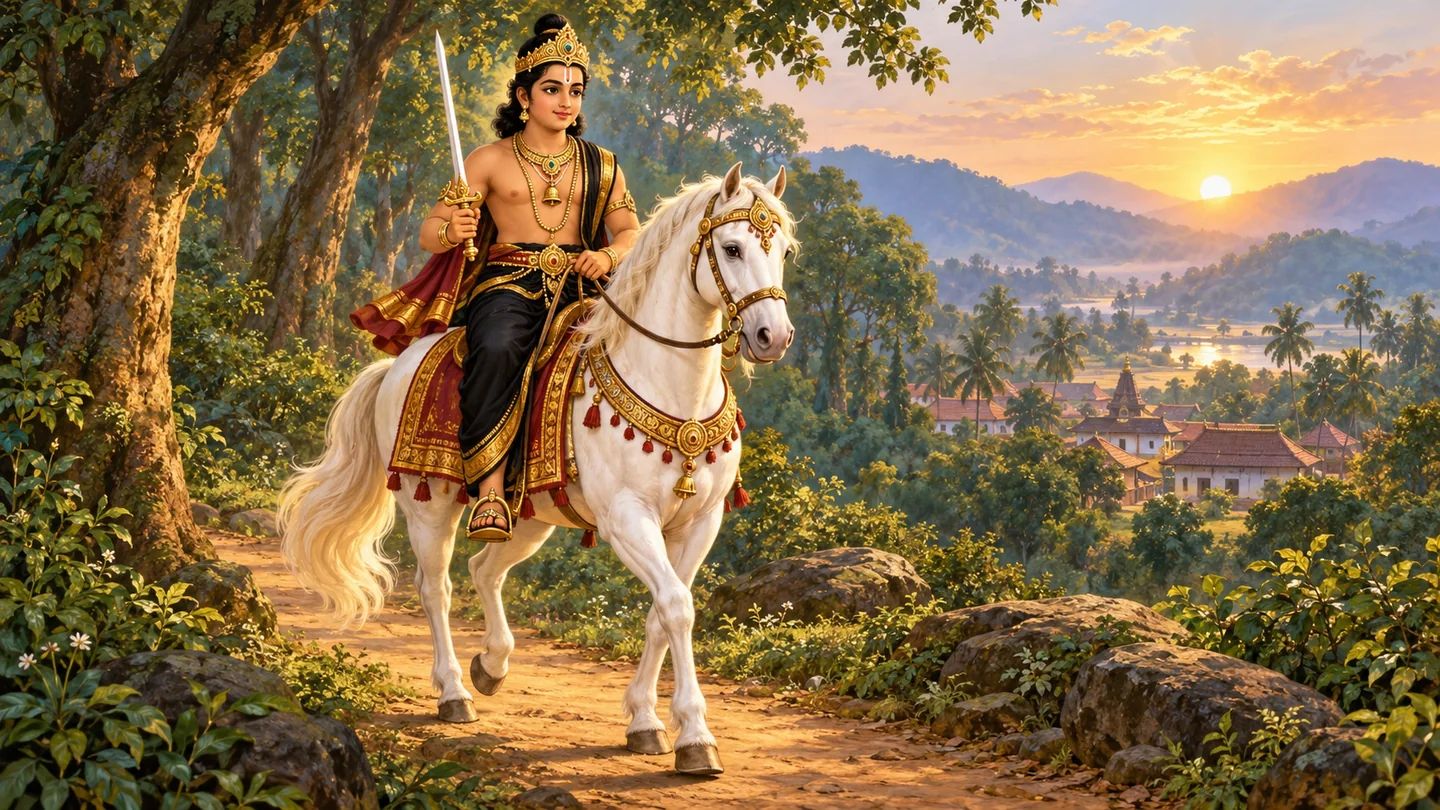
Meet Ashwarudha Sastha
Traditional background
अश्वारूढशास्ता
Aśvārūḍhaśāstā
Ashva and haya both mean horse. The 108-name hymn uses Hayarudha, while the Ashta Sastha Temple describes Veera Sastha as Aswaroodar and connects horse-mounted worship with Kudhiran. These are related witnesses, not evidence of a single separate incarnation with a fixed biography. The mount evokes movement and readiness in our reading. The ceremonial sword is shown at rest: the artwork emphasizes protection without a battle. The original story below translates readiness into a child’s decision to act promptly and ask capable adults for help.
Sanskrit headwords and IAST are editorially normalized. The source note distinguishes exact hymn wording from later devotional titles.
Next: The message before the rain, an original learning story inspired by this form.
Original AI-assisted devotional illustration; a symbolic interpretation, not a photograph or prescribed temple icon.
2 / 6
Clouds above the road
Original learning story · 1 of 4
Kavin and his aunt were returning from the library when dark clouds gathered over the hill. Near a small bridge they saw a branch resting across the path. A few children would soon come that way after music class. Kavin wanted to run ahead and drag it aside by himself. His aunt stopped him before he stepped onto the slippery edge. The branch was larger than it looked. Being quick, she explained, would be useful only if they also stayed safe.
Original AI-assisted devotional illustration; a symbolic interpretation, not a photograph or prescribed temple icon.
3 / 6
Finding the right help
Original learning story · 2 of 4
They moved back to firm ground. Aunt called the village caretaker while Kavin went with her to tell the music teacher. He remembered a picture of Sastha on a white horse that his grandfather had shown him. They had spoken about a guardian being ready to respond. Kavin had imagined readiness meant doing everything alone. Now he carried a clear message: the bridge path was blocked, adults were arranging help, and the children should wait inside until another safe route was ready.
Original AI-assisted devotional illustration; a symbolic interpretation, not a photograph or prescribed temple icon.
4 / 6
Several useful tasks
Original learning story · 3 of 4
The teacher thanked him and checked that every child remained in the hall. Two adults guided families along a different path. The caretaker brought tools and another worker to clear the branch. Kavin stayed under the veranda and helped his aunt check the names of children being collected. Rain began before the work was finished, but nobody had to stand on the bridge. Each person had a manageable task. Kavin’s message had helped those tasks begin before the weather grew worse.
Original AI-assisted devotional illustration; a symbolic interpretation, not a photograph or prescribed temple icon.
5 / 6
Speed with a purpose
Original learning story · 4 of 4
At home he drew the horse-mounted form again. Beside the horse he drew the library, the music hall and a safe path between them. The picture did not turn the day into a miracle. It helped him remember how a devotional image could inspire an ordinary choice. He had noticed a problem, told the truth about it and sought the right help. He could be brave without taking a needless risk. A guardian’s readiness, he thought, should help others reach safety.
Original AI-assisted devotional illustration; a symbolic interpretation, not a photograph or prescribed temple icon.
6 / 6
The mounted forms
Sanskrit & English
Dharmashastuh Ashtottarashatanama Stotram, verse 3, second line (excerpt); simha spelling normalized.
सिंहारूढो गजारूढो हयारूढो महेश्वरः ॥
The great Lord is mounted on a lion, mounted on an elephant, and mounted on a horse.
Short meaning
The hymn honours several mounts in one line. It does not narrate three separate incarnations.
What changed for the child in “The message before the rain”?
Which small action from this story could we try together?
Tradition, Sanskrit sources & artwork
The four-page story below is an original family reading inspired by this form’s meaning. Its people, conversations and events are imagined; it is not an ancient scripture, a temple legend, or a claim that the deity performed these events.
Dharmashastuh Ashtottarashatanama Stotram, verse 3, second line (excerpt); simha spelling normalized.
English meanings are original DHIH readings, not borrowed translations. The portrait is a symbolic illustration of the form, reused through its reader; it is not a picture of the imagined children’s events. Last editorial source review: 2026-10-27. No human scholarly certification is claimed.
Documents devotional names and attributes, not a sequence of incarnations. Underlying date and authorship are not established here. This edition is linked for study, not reproduced wholesale.