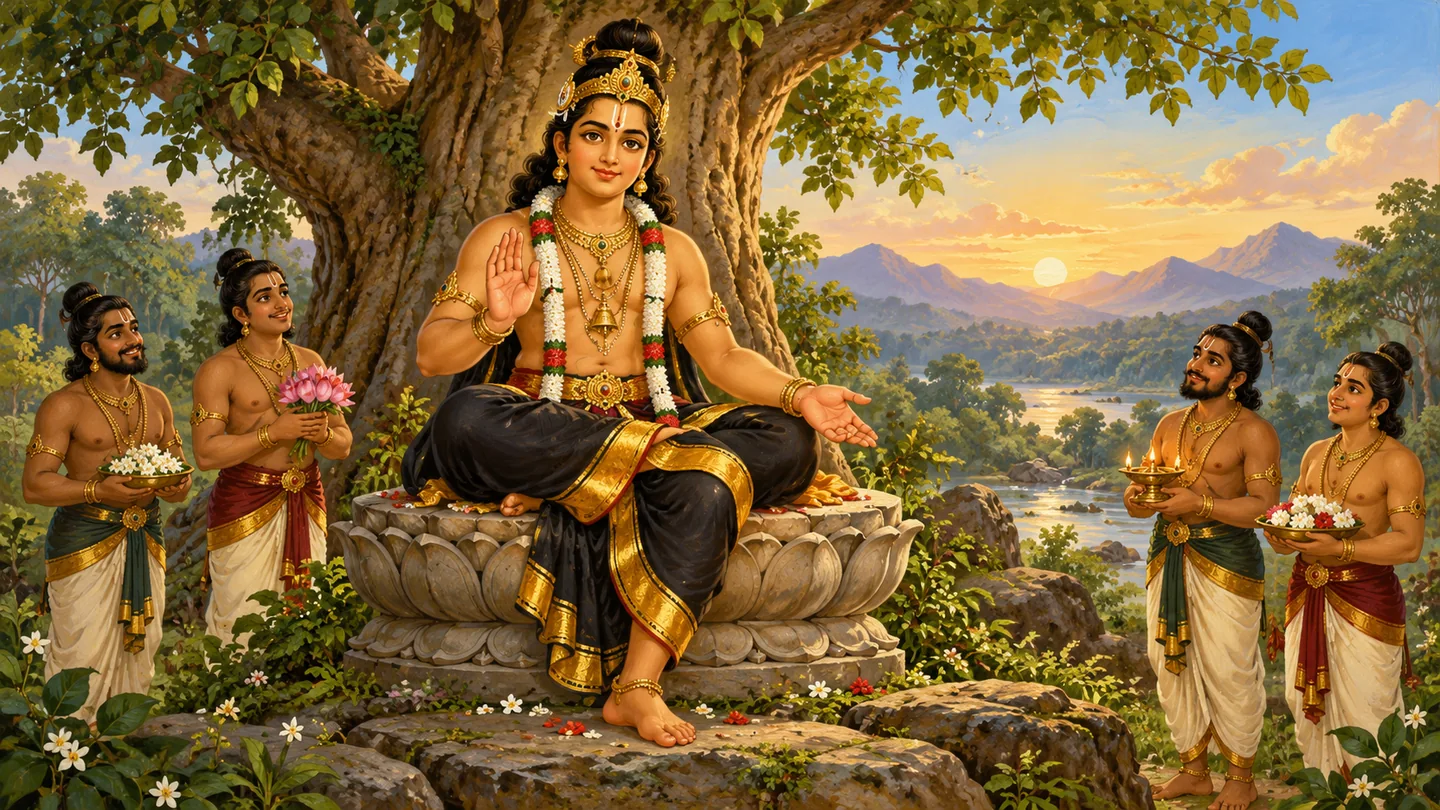
The four-page story below is an original family reading inspired by this form’s meaning. Its people, conversations and events are imagined; it is not an ancient scripture, a temple legend, or a claim that the deity performed these events.
The traditional introduction and Sanskrit reading have their own source notes. Read aloud together with younger children.
Swipe left for next · swipe right to go back
Original AI-assisted devotional illustration; a symbolic interpretation, not a photograph or prescribed temple icon.
1 / 6
Meet Bhutadhipa Sastha
Traditional background
भूताधिपशास्ता
Bhūtādhipaśāstā
Bhutadhipa means lord of the bhutas; the submitted spelling Bhootadi-pa is retained as a search alias. In devotional contexts bhutas can be beings or supernatural attendants, not simply frightening ghosts. The 108-name hymn calls Sastha Bhutesha and Bhutasainika, supporting the lordship and host imagery. This does not establish an independent adventure for each attendant. Our benign figures are a symbolic artistic interpretation. The family story uses the image of an organised host to explore cooperation among different people; it does not identify actual communities with spirits.
Sanskrit headwords and IAST are editorially normalized. The source note distinguishes exact hymn wording from later devotional titles.
Next: Many hands, one garden, an original learning story inspired by this form.
Original AI-assisted devotional illustration; a symbolic interpretation, not a photograph or prescribed temple icon.
2 / 6
Everybody wanted the watering can
Original learning story · 1 of 4
The school garden had six helpers and only one watering can. Arun reached it first, then three others argued that they should use it. By the time their teacher arrived, nobody had watered the plants and a tray of seedlings was drying in the sun. Arun thought the problem was that the other children would not follow him. The teacher asked what the garden actually needed. There were weeds to remove, labels to repair, empty pots to stack and tender plants to move into shade.
Original AI-assisted devotional illustration; a symbolic interpretation, not a photograph or prescribed temple icon.
3 / 6
Seeing more than one job
Original learning story · 2 of 4
That evening Arun asked his mother about a picture of Sastha with attendants. She explained the devotional title Bhutadhipa and said that the picture showed a leader with a host, not a collection of identical figures. Arun noticed different postures and expressions. His mother did not claim the picture was a lesson from scripture about school gardens. Instead, she asked what he might learn from looking. He wondered whether a good leader should discover useful tasks before telling everyone what to do.
Original AI-assisted devotional illustration; a symbolic interpretation, not a photograph or prescribed temple icon.
4 / 6
A plan everyone could join
Original learning story · 3 of 4
The next morning Arun asked his friends which tasks they preferred. Leela liked writing labels. Imran was good at spotting tiny weeds, and Dev could carry the empty pots safely. They agreed to take turns watering. One child who could not kneel comfortably sorted seed packets at a table. When the youngest helper poured too much water into one pot, they helped him measure a smaller cup. The garden gradually changed because the plan made room for different abilities.
Original AI-assisted devotional illustration; a symbolic interpretation, not a photograph or prescribed temple icon.
5 / 6
The garden belonged to everyone
Original learning story · 4 of 4
At the end of the week the teacher asked who had saved the seedlings. Arun began to raise his hand, then looked at the new labels and tidy pots. He named every helper instead. Some tasks were easy to notice; others were quiet. All had mattered. Remembering the devotional host, he understood that leading need not mean being the loudest or doing the most visible job. It could mean helping people cooperate and ensuring that nobody’s useful work was forgotten.
Original AI-assisted devotional illustration; a symbolic interpretation, not a photograph or prescribed temple icon.
6 / 6
The guardian and his hosts
Sanskrit & English
Dharmashastuh Ashtottarashatanama Stotram, verse 2, first line (excerpt).
त्रिलोकरक्षको धन्वी तपस्वी भूतसैनिकः ।
He protects the three worlds, bears a bow, practises austerity, and has the bhutas as his host.
Short meaning
Sastha is praised as a disciplined protector accompanied by supernatural attendants.
What changed for the child in “Many hands, one garden”?
Which small action from this story could we try together?
Tradition, Sanskrit sources & artwork
The four-page story below is an original family reading inspired by this form’s meaning. Its people, conversations and events are imagined; it is not an ancient scripture, a temple legend, or a claim that the deity performed these events.
Dharmashastuh Ashtottarashatanama Stotram, verse 2, first line (excerpt).
English meanings are original DHIH readings, not borrowed translations. The portrait is a symbolic illustration of the form, reused through its reader; it is not a picture of the imagined children’s events. Last editorial source review: 2026-10-27. No human scholarly certification is claimed.
Documents devotional names and attributes, not a sequence of incarnations. Underlying date and authorship are not established here. This edition is linked for study, not reproduced wholesale.