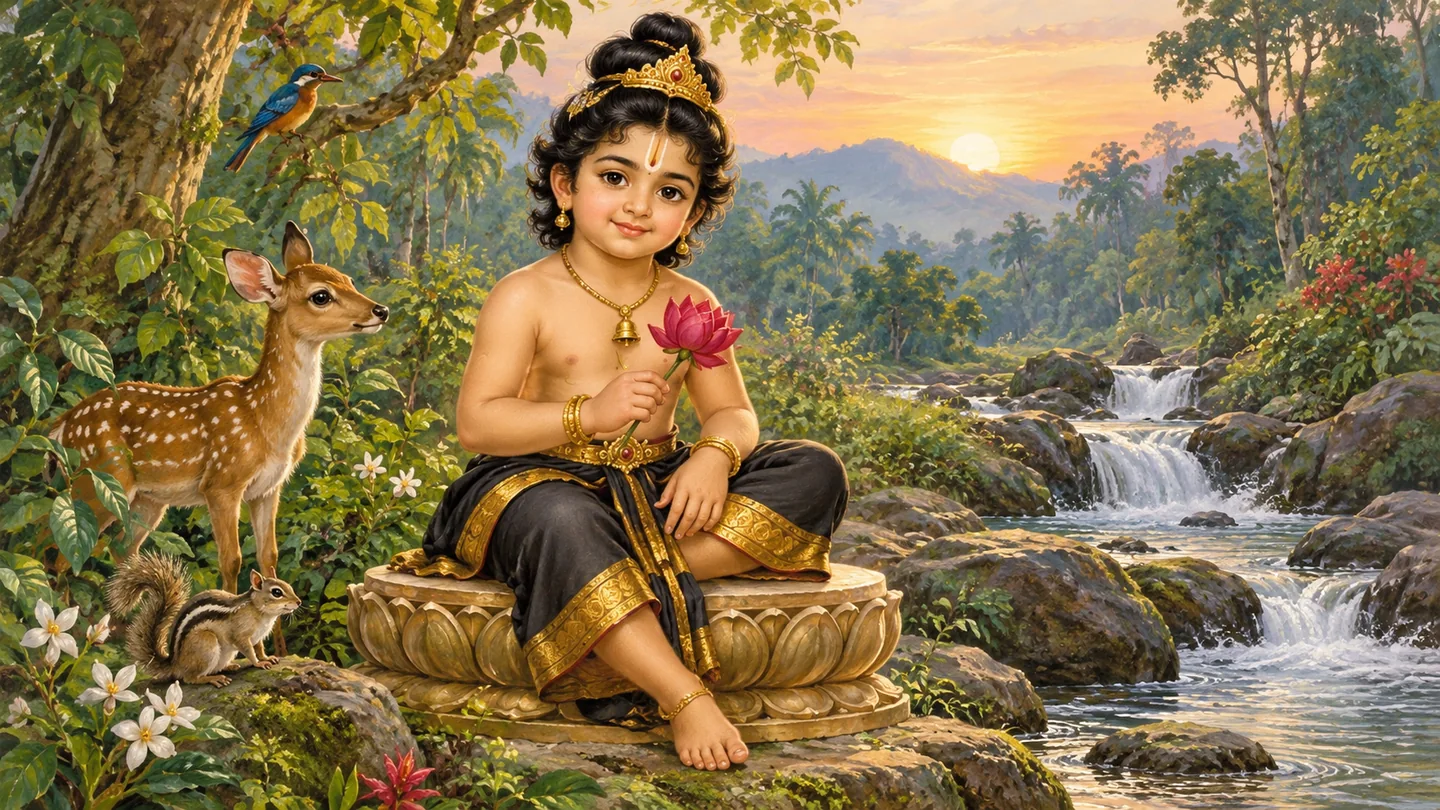
The divine child and the wonder of a new beginning.
The smallest pair of hands · 319-word learning story
About this story
The four-page story below is an original family reading inspired by this form’s meaning. Its people, conversations and events are imagined; it is not an ancient scripture, a temple legend, or a claim that the deity performed these events.
The traditional introduction and Sanskrit reading have their own source notes. Read aloud together with younger children.
Swipe left for next · swipe right to go back
Original AI-assisted devotional illustration; a symbolic interpretation, not a photograph or prescribed temple icon.
1 / 6
Meet Bala Sastha
Traditional background
बालशास्ता
Bālaśāstā
Bala means child. Kerala Tourism identifies Kulathupuzha with the child form of Sastha. In the related Sabarimala life tradition, King Rajasekhara discovers and raises Manikandan, the child distinguished by a bell at his neck. These two traditions help readers approach the deity through childhood, but they are not interchangeable temple foundation accounts. A child form invites tenderness and care; it need not be made to look like an adult warrior. Our lotus and stream are artistic choices, not a claim about the exact Kulathupuzha icon.
Sanskrit headwords and IAST are editorially normalized. The source note distinguishes exact hymn wording from later devotional titles.
Next: The smallest pair of hands, an original learning story inspired by this form.
Original AI-assisted devotional illustration; a symbolic interpretation, not a photograph or prescribed temple icon.
2 / 6
A basket too large
Original learning story · 1 of 4
On the morning of a flower festival, little Nila watched her cousins lift baskets of jasmine. She wanted a basket of her own. The smallest one still covered her knees. When she tried to carry it, the flowers tipped onto the mat. Nobody was hurt, but Nila felt her face grow warm. She sat beside her grandmother and said that being small meant she could never help. Her grandmother did not hurry to disagree. She made room beside her and listened.
Original AI-assisted devotional illustration; a symbolic interpretation, not a photograph or prescribed temple icon.
3 / 6
Something only she noticed
Original learning story · 2 of 4
Together they looked at a picture of Bala Sastha. Grandmother explained that devotees also honour the divine in a child’s form. Then she asked Nila to look carefully around the courtyard. A toddler was trying to find his sandal under a bench. The adults were carrying heavy things and had not noticed. Nila could see it easily. She knelt, brought it out, and waited while he put it on. His grateful smile felt warmer than carrying the biggest basket.
Original AI-assisted devotional illustration; a symbolic interpretation, not a photograph or prescribed temple icon.
4 / 6
Work that fitted
Original learning story · 3 of 4
Nila returned to the flowers. This time she asked for a shallow plate. Her cousin placed a few blossoms on it, and Nila carried them slowly to the doorway. She made several trips. On the last one, another child dropped a flower and began to cry. Nila remembered how she had felt beside the fallen basket. She helped collect the flower instead of laughing. When the arrangements were ready, her little plate was empty and the courtyard was bright.
Original AI-assisted devotional illustration; a symbolic interpretation, not a photograph or prescribed temple icon.
5 / 6
A place at the beginning
Original learning story · 4 of 4
At evening, Grandmother asked which job had mattered most. Nila named the sandal, the flowers and comforting the child. She could not choose just one. Grandmother said that the day had needed all those acts of attention. Nila looked at Bala Sastha again. The child form now reminded her that a beginning is worth caring for. Tomorrow she might learn a larger task. Today she had learned to notice, to ask for help, and to give the help she could.
Original AI-assisted devotional illustration; a symbolic interpretation, not a photograph or prescribed temple icon.
6 / 6
Compassion for devotees
Sanskrit & English
Dharmashastuh Ashtottarashatanama Stotram, concluding name stanza after verse 14, second line (excerpt). This praise addresses Sastha generally, rather than one exclusive child-form hymn.
भक्तानुकम्पी देवेशो भगवान् भक्तवत्सलः ॥
The blessed Lord of the devas feels compassion for devotees and cherishes them.
Short meaning
Compassion is a quality of Sastha praised in the hymn. Devotional trust can inspire care for others.
What changed for the child in “The smallest pair of hands”?
Which small action from this story could we try together?
Tradition, Sanskrit sources & artwork
The four-page story below is an original family reading inspired by this form’s meaning. Its people, conversations and events are imagined; it is not an ancient scripture, a temple legend, or a claim that the deity performed these events.
Dharmashastuh Ashtottarashatanama Stotram, concluding name stanza after verse 14, second line (excerpt). This praise addresses Sastha generally, rather than one exclusive child-form hymn.
English meanings are original DHIH readings, not borrowed translations. The portrait is a symbolic illustration of the form, reused through its reader; it is not a picture of the imagined children’s events. Last editorial source review: 2026-10-27. No human scholarly certification is claimed.
Paragraphs beginning “As a child, Manikandan” and “Upon completing his studies”; subsequent palace, forest and temple narrative
The narrative was available through the indexed official page; direct retrieval was intermittent. Childhood miracle is a traditional religious account, not a medical promise.
Documents devotional names and attributes, not a sequence of incarnations. Underlying date and authorship are not established here. This edition is linked for study, not reproduced wholesale.