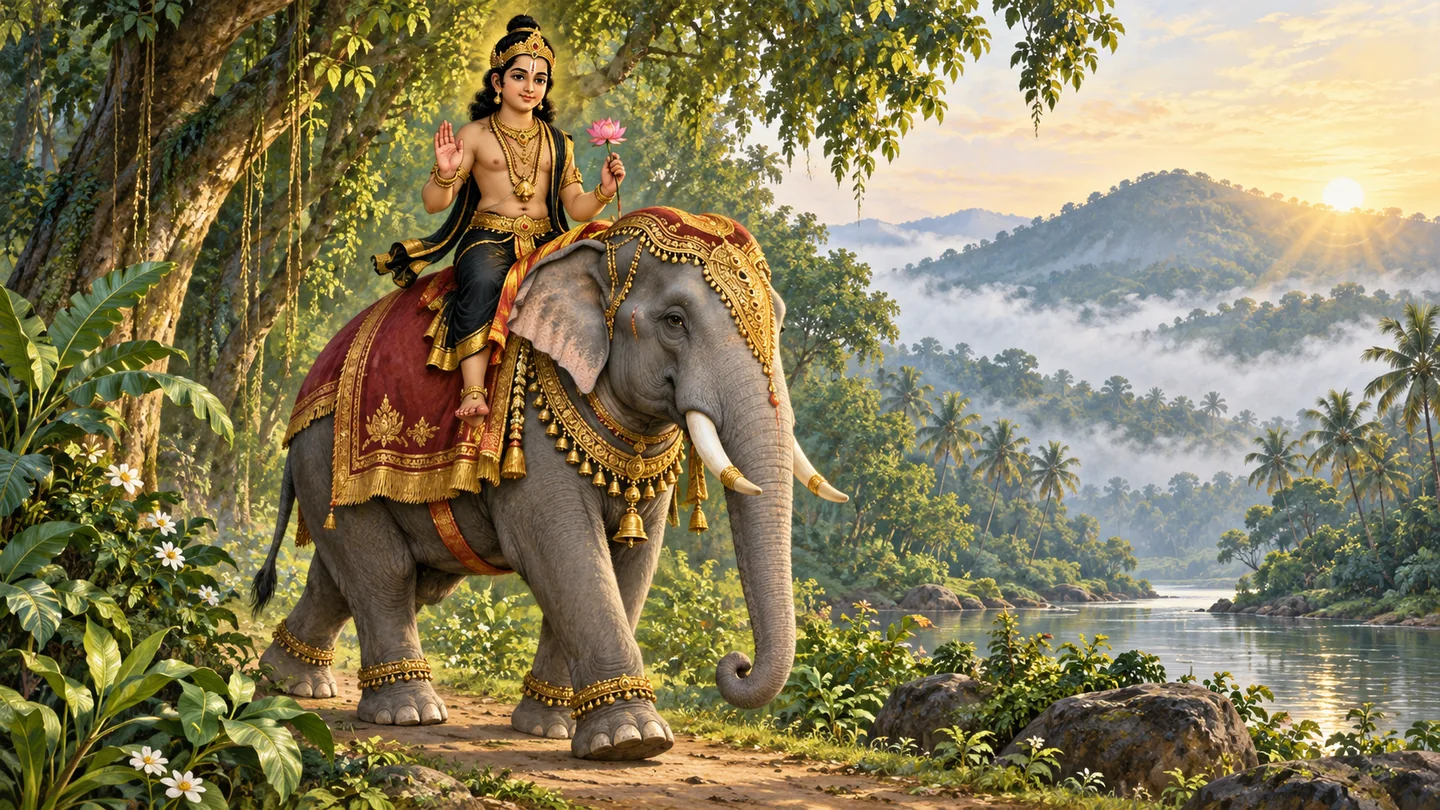
The four-page story below is an original family reading inspired by this form’s meaning. Its people, conversations and events are imagined; it is not an ancient scripture, a temple legend, or a claim that the deity performed these events.
The traditional introduction and Sanskrit reading have their own source notes. Read aloud together with younger children.
Swipe left for next · swipe right to go back
Original AI-assisted devotional illustration; a symbolic interpretation, not a photograph or prescribed temple icon.
1 / 6
Meet Gajarudha Sastha
Traditional background
गजारूढशास्ता
Gajārūḍhaśāstā
Gaja means elephant, and arudha means mounted. The 108-name hymn explicitly names Gajarudha; its opening meditation also describes an elephant-mounted Maha Sastha. Chennai Government Museum’s South Indian bronze catalogue records elephant-mounted Aiyanar images, providing an art-historical comparison. These witnesses establish imagery, not an otherwise unknown elephant adventure. Our calm elephant evokes steadiness and strength. The original story below considers how strength can be used without humiliating someone who needs assistance.
Sanskrit headwords and IAST are editorially normalized. The source note distinguishes exact hymn wording from later devotional titles.
Next: The heavy school box, an original learning story inspired by this form.
Original AI-assisted devotional illustration; a symbolic interpretation, not a photograph or prescribed temple icon.
2 / 6
A job for the strongest
Original learning story · 1 of 4
The school was moving books to a new reading room. Surya was taller than most classmates and offered to carry the largest box. He lifted one corner and announced that it was easy. Then he noticed a smaller child struggling with a pile of notebooks and laughed. His teacher asked him to set the box down before moving. The books were heavier than he expected, and the doorway had a raised edge. A proud promise could not make the load safe.
Original AI-assisted devotional illustration; a symbolic interpretation, not a photograph or prescribed temple icon.
3 / 6
Looking at quiet strength
Original learning story · 2 of 4
During a break, Surya opened a picture book showing Sastha on an elephant. The animal looked powerful without charging or frightening anyone. His teacher explained the meaning of Gajarudha and separated the traditional image from their own reflection on it. What did Surya notice? He pointed to the elephant’s steady feet. The teacher asked whether being strong might include knowing when to slow down. Surya remembered the child he had laughed at and began to wish he had offered a smaller, useful kindness.
Original AI-assisted devotional illustration; a symbolic interpretation, not a photograph or prescribed temple icon.
4 / 6
Sharing the weight
Original learning story · 3 of 4
The class repacked the books into lighter boxes. Two children carried each box where an adult could supervise. Surya helped clear the path and warned everyone about the doorway. He apologised to the smaller child, then asked which books he would like to move. Together they carried a manageable stack of picture books. Nobody had to prove who was strongest. By lunchtime the shelves were filling, and there had been no need to drag an oversized box across the threshold.
Original AI-assisted devotional illustration; a symbolic interpretation, not a photograph or prescribed temple icon.
5 / 6
A shelf within reach
Original learning story · 4 of 4
Surya noticed that the lowest shelf was still empty. He suggested putting the younger children’s books there so they could reach them. His partner arranged the colourful covers. Later, Surya told his family that he had not carried the heaviest box after all. He had learned to make the work easier for everyone. The elephant-mounted picture became a reminder of steady, considerate strength. He could still enjoy being capable, but he did not need another person to feel weak for that to be true.
Original AI-assisted devotional illustration; a symbolic interpretation, not a photograph or prescribed temple icon.
6 / 6
The mounted forms
Sanskrit & English
Dharmashastuh Ashtottarashatanama Stotram, verse 3, second line (excerpt); simha spelling normalized.
सिंहारूढो गजारूढो हयारूढो महेश्वरः ॥
The great Lord is mounted on a lion, mounted on an elephant, and mounted on a horse.
Short meaning
The hymn honours several mounts in one line. It does not narrate three separate incarnations.
What changed for the child in “The heavy school box”?
Which small action from this story could we try together?
Tradition, Sanskrit sources & artwork
The four-page story below is an original family reading inspired by this form’s meaning. Its people, conversations and events are imagined; it is not an ancient scripture, a temple legend, or a claim that the deity performed these events.
Dharmashastuh Ashtottarashatanama Stotram, verse 3, second line (excerpt); simha spelling normalized.
English meanings are original DHIH readings, not borrowed translations. The portrait is a symbolic illustration of the form, reused through its reader; it is not a picture of the imagined children’s events. Last editorial source review: 2026-10-27. No human scholarly certification is claimed.
Documents devotional names and attributes, not a sequence of incarnations. Underlying date and authorship are not established here. This edition is linked for study, not reproduced wholesale.