The visitor who stayed by the door · 322-word learning story
About this story
The four-page story below is an original family reading inspired by this form’s meaning. Its people, conversations and events are imagined; it is not an ancient scripture, a temple legend, or a claim that the deity performed these events.
The traditional introduction and Sanskrit reading have their own source notes. Read aloud together with younger children.
Swipe left for next · swipe right to go back
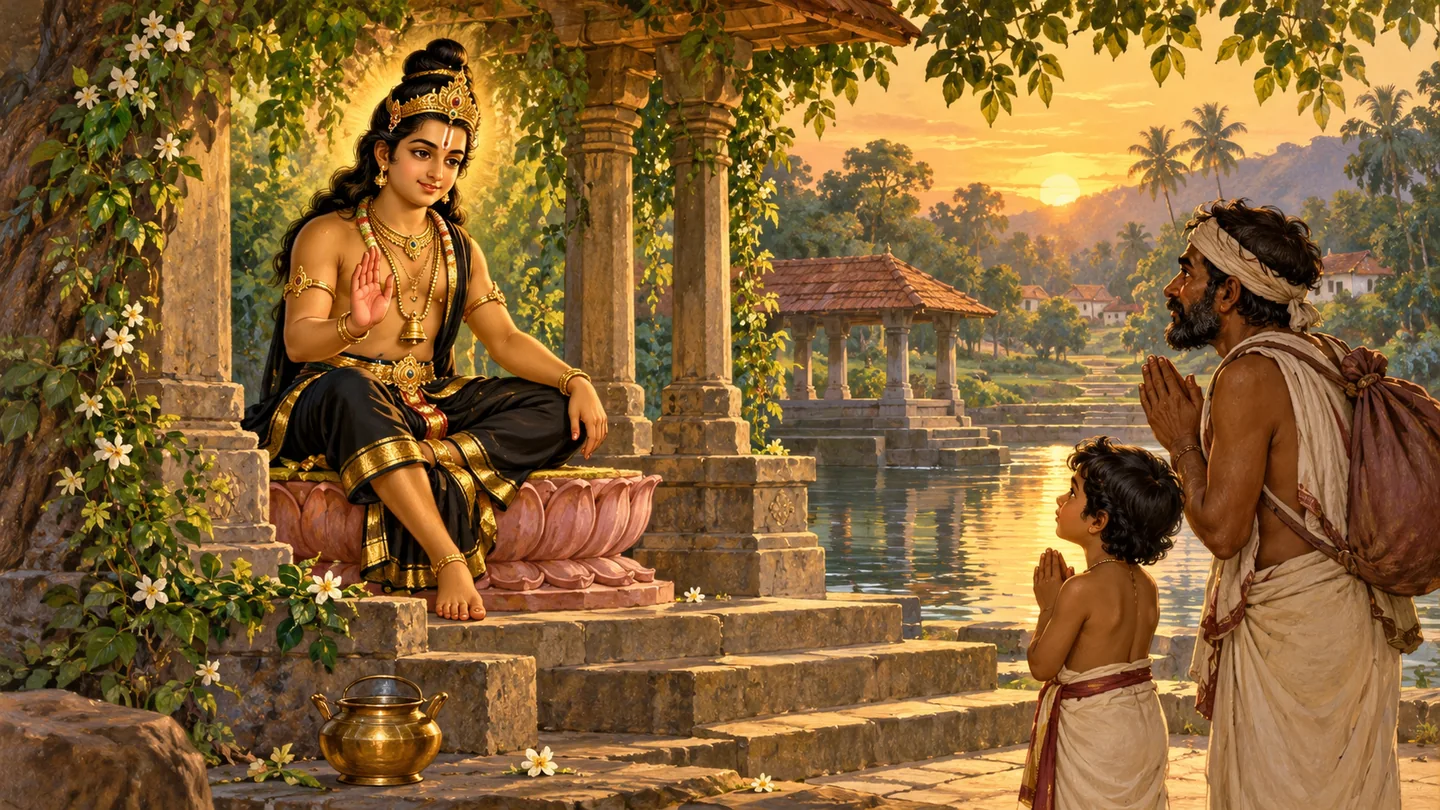
Original AI-assisted devotional illustration; a symbolic interpretation, not a photograph or prescribed temple icon.
1 / 6
Meet Karunakara Sastha
Traditional background
करुणाकरशास्ता
Karuṇākaraśāstā
Karunakara is a devotional description of one who is compassionate. The checked 108-name hymn praises Sastha as Bhaktanukampi and Bhaktavatsala, compassionate toward and affectionate to devotees. This supports the theme; it does not establish a separate canonical biography or a fixed Karunakara icon. Our water pavilion is an artistic expression of hospitality. The original story asks children to notice another person’s discomfort and help respectfully. It makes no claim that a fictional meeting happened at a temple.
Sanskrit headwords and IAST are editorially normalized. The source note distinguishes exact hymn wording from later devotional titles.
Next: The visitor who stayed by the door, an original learning story inspired by this form.
Original AI-assisted devotional illustration; a symbolic interpretation, not a photograph or prescribed temple icon.
2 / 6
A celebration from outside
Original learning story · 1 of 4
Asha was excited about the afternoon storytelling circle. Cushions lay under the veranda and a bowl of fruit stood beside the books. A new child arrived with her father but stayed near the door. Asha called loudly for her to come in. When the child did not move, Asha assumed she did not want to join. She hurried back to her friends. From the cushion, though, she could still see the visitor holding her father’s hand and watching the circle.
Original AI-assisted devotional illustration; a symbolic interpretation, not a photograph or prescribed temple icon.
3 / 6
An invitation with room to choose
Original learning story · 2 of 4
Asha’s mother asked her to walk over quietly with her. The child said she was nervous because she knew nobody and could not hear the storyteller clearly from the doorway. Mother asked where she would feel comfortable sitting. Asha offered the edge of her own cushion, but did not pull the child by the hand. At home she had heard Sastha praised as compassionate. Now that word seemed less like a compliment to say and more like something careful to practise.
Original AI-assisted devotional illustration; a symbolic interpretation, not a photograph or prescribed temple icon.
4 / 6
A quieter place
Original learning story · 3 of 4
The visitor chose a seat beside her father near the front. Asha brought another cushion and moved the fruit bowl where it would not block the path. During the story, she resisted the urge to ask the child questions every minute. At the end she offered two picture books and let her choose one. They discovered that both liked animals, although they did not like all the same animals. Their conversation began slowly, with enough space for a quiet answer.
Original AI-assisted devotional illustration; a symbolic interpretation, not a photograph or prescribed temple icon.
5 / 6
Remembering the doorway
Original learning story · 4 of 4
Later Asha asked her mother why the child had not simply told everybody what she needed. Mother reminded her that entering a new place can be difficult. The next week Asha helped set out a welcoming seat by the front, with a clear path from the door. Remembering Karunakara Sastha, she thought of kindness as attention rather than noise. She could not know every person’s needs by looking. She could greet them gently, ask, listen, and make room for the answer.
Original AI-assisted devotional illustration; a symbolic interpretation, not a photograph or prescribed temple icon.
6 / 6
Compassion for devotees
Sanskrit & English
Dharmashastuh Ashtottarashatanama Stotram, concluding name stanza after verse 14, second line (excerpt).
भक्तानुकम्पी देवेशो भगवान् भक्तवत्सलः ॥
The blessed Lord of the devas feels compassion for devotees and cherishes them.
Short meaning
Compassion is a quality of Sastha praised in the hymn. Devotional trust can inspire care for others.
What changed for the child in “The visitor who stayed by the door”?
Which small action from this story could we try together?
Tradition, Sanskrit sources & artwork
The four-page story below is an original family reading inspired by this form’s meaning. Its people, conversations and events are imagined; it is not an ancient scripture, a temple legend, or a claim that the deity performed these events.
Dharmashastuh Ashtottarashatanama Stotram, concluding name stanza after verse 14, second line (excerpt).
English meanings are original DHIH readings, not borrowed translations. The portrait is a symbolic illustration of the form, reused through its reader; it is not a picture of the imagined children’s events. Last editorial source review: 2026-10-27. No human scholarly certification is claimed.
Documents devotional names and attributes, not a sequence of incarnations. Underlying date and authorship are not established here. This edition is linked for study, not reproduced wholesale.