The song nobody had to join · 323-word learning story
About this story
The four-page story below is an original family reading inspired by this form’s meaning. Its people, conversations and events are imagined; it is not an ancient scripture, a temple legend, or a claim that the deity performed these events.
The traditional introduction and Sanskrit reading have their own source notes. Read aloud together with younger children.
Swipe left for next · swipe right to go back
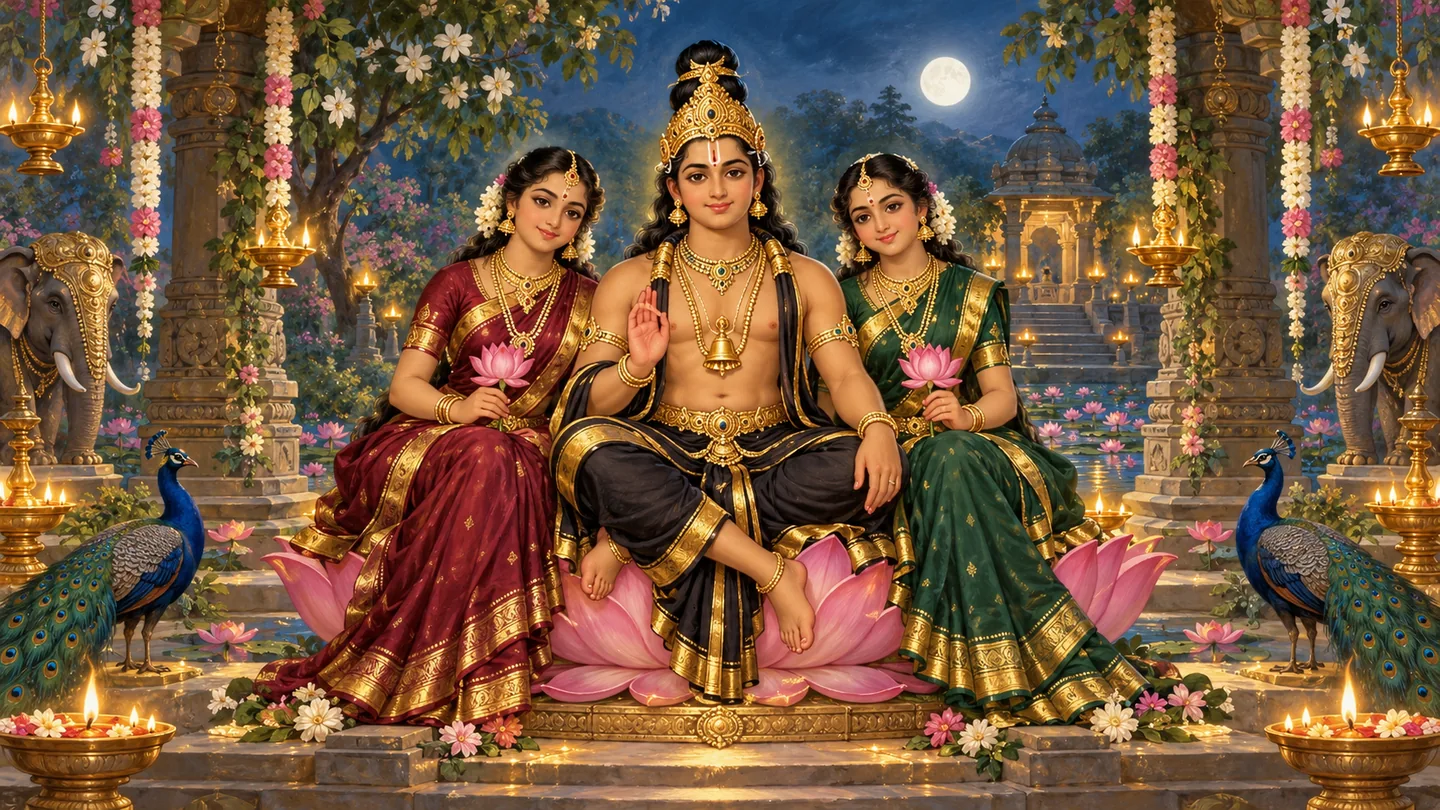
Original AI-assisted devotional illustration; a symbolic interpretation, not a photograph or prescribed temple icon.
1 / 6
Meet Sammohana Sastha
Traditional background
सम्मोहनशास्ता
Sammohanaśāstā
The Sastha dhyana collection calls the deity trailokya-sammohana, enchanting the three worlds. Its second verse describes a particular meditation image with an elephant, flower arrows and a sugarcane bow. The Ashta Sastha Temple also presents a Sammohana tradition with Purna and Pushkala and a protective association with Indrani. These are attributed traditions, not proof of a single universal image. Our garden portrait is symbolic rather than a full reconstruction of that meditation. The story treats attraction as a voluntary movement toward goodness, never as manipulation of another person.
Sanskrit headwords and IAST are editorially normalized. The source note distinguishes exact hymn wording from later devotional titles.
Next: The song nobody had to join, an original learning story inspired by this form.
Original AI-assisted devotional illustration; a symbolic interpretation, not a photograph or prescribed temple icon.
2 / 6
A chorus that sounded unhappy
Original learning story · 1 of 4
Sana was leading a little song at a family event. She loved it and wanted every child to sing. When one child stayed quiet, she moved him into the front row. When another forgot the words, she told her to sing louder. Soon the children looked uncomfortable. Sana could hear the correct tune but not the cheerful feeling she had imagined. Her aunt asked for a break and invited everyone to sit in the shade with water and fruit.
Original AI-assisted devotional illustration; a symbolic interpretation, not a photograph or prescribed temple icon.
3 / 6
A gentler kind of invitation
Original learning story · 2 of 4
Aunt asked the children what would help. One preferred listening. Another wanted a sheet with large letters. A third would enjoy keeping a simple beat instead of singing. Sana remembered hearing the name Sammohana Sastha explained as a divine presence that draws the heart. Her aunt helped distinguish devotion from trying to control people: an invitation should leave them free to respond. Sana began to see that insisting on the same response from everyone had made her song harder to enjoy.
Original AI-assisted devotional illustration; a symbolic interpretation, not a photograph or prescribed temple icon.
4 / 6
Different ways to belong
Original learning story · 3 of 4
They began again with new choices. Some sang, one child tapped a soft beat, and two listened beside their parents. Sana showed the words slowly and smiled when someone asked to repeat a line. Nobody was pulled into the front row. After a while the quiet child chose to join the refrain, but Sana did not treat that as a victory over him. He could still stop. The music became a shared space because participation was offered kindly and freely.
Original AI-assisted devotional illustration; a symbolic interpretation, not a photograph or prescribed temple icon.
5 / 6
What made the song beautiful
Original learning story · 4 of 4
Later Sana asked why the second attempt had felt so different. She already knew part of the answer: the children had felt comfortable being there. Looking at the peaceful devotional portrait, she thought of beauty that invites attention rather than demands it. She would still practise her songs and help others learn. She would also listen when they chose differently. Her lesson from Sammohana Sastha was her own reflection: goodness becomes more inviting when it is joined to respect for another person’s freedom.
Original AI-assisted devotional illustration; a symbolic interpretation, not a photograph or prescribed temple icon.
6 / 6
The presence that draws the heart
Sanskrit & English
Shastridhyana Shlokani, verse 2, final line (excerpt).
शास्तारं शरणं नमामि सततं त्रैलोक्यसम्मोहनम् ॥
I continually bow to Sastha as my refuge, whose presence enchants the three worlds.
Short meaning
The meditation turns the devotee’s attention toward Sastha. Here enchantment is divine attraction; it is not advice to control another person.
What changed for the child in “The song nobody had to join”?
Which small action from this story could we try together?
Tradition, Sanskrit sources & artwork
The four-page story below is an original family reading inspired by this form’s meaning. Its people, conversations and events are imagined; it is not an ancient scripture, a temple legend, or a claim that the deity performed these events.
Shastridhyana Shlokani, verse 2, final line (excerpt).
English meanings are original DHIH readings, not borrowed translations. The portrait is a symbolic illustration of the form, reused through its reader; it is not a picture of the imagined children’s events. Last editorial source review: 2026-10-27. No human scholarly certification is claimed.