A small light under a wide sky · 325-word learning story
About this story
The four-page story below is an original family reading inspired by this form’s meaning. Its people, conversations and events are imagined; it is not an ancient scripture, a temple legend, or a claim that the deity performed these events.
The traditional introduction and Sanskrit reading have their own source notes. Read aloud together with younger children.
Swipe left for next · swipe right to go back
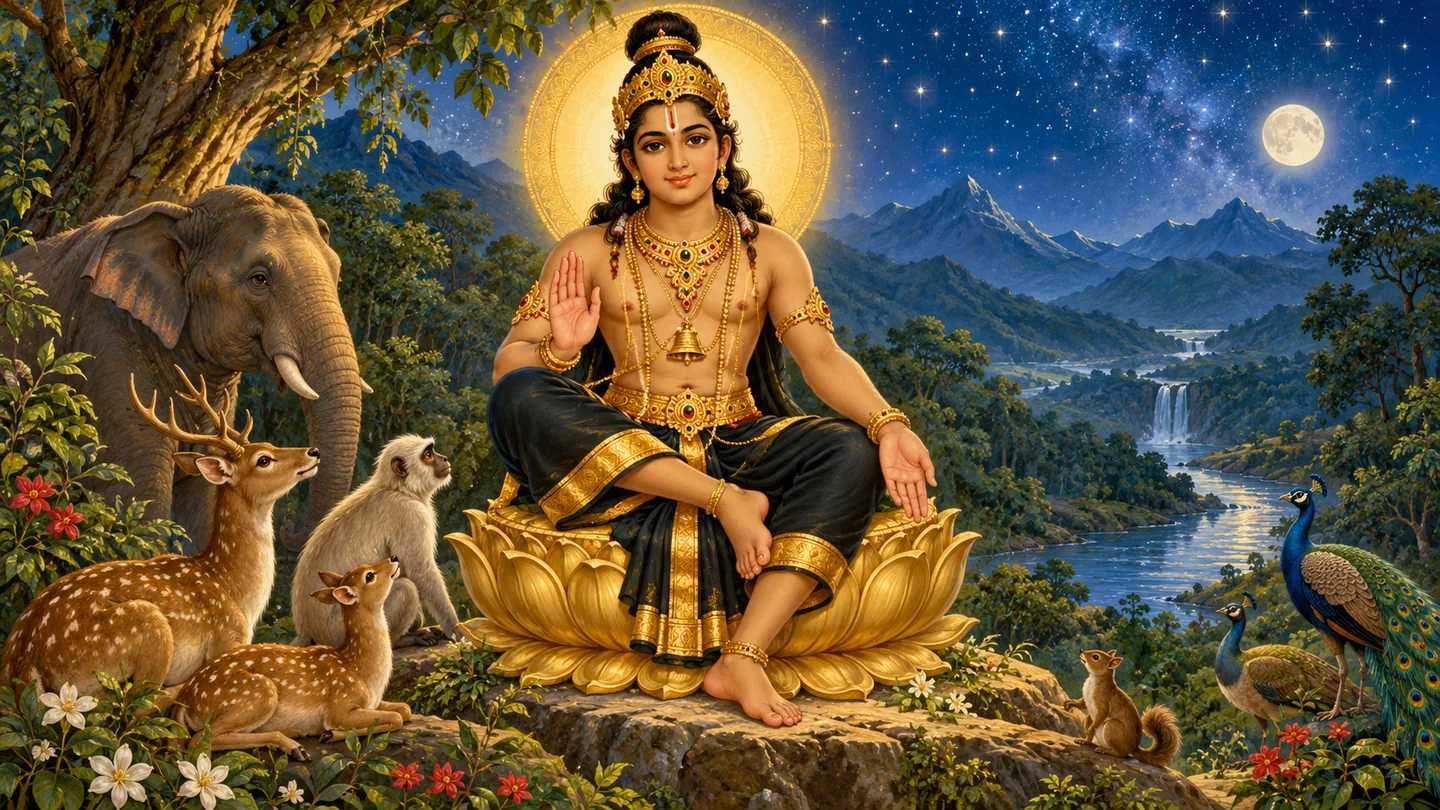
Original AI-assisted devotional illustration; a symbolic interpretation, not a photograph or prescribed temple icon.
1 / 6
Meet Maha Sastha
Traditional background
महाशास्ता
Mahāśāstā
Maha means great. The 108-name hymn begins with Maha Sastha and praises the deity in cosmic roles of creation, sustaining and dissolution. This is theological praise, not a separate dated life or a scientific account of the universe. In some temple descriptions Maha Sastha overlaps with Kala and elephant-mounted forms. Our star-filled landscape expresses vastness artistically. The original family story asks how a person can care about a wide world while still taking responsibility for one small part of it.
Sanskrit headwords and IAST are editorially normalized. The source note distinguishes exact hymn wording from later devotional titles.
Next: A small light under a wide sky, an original learning story inspired by this form.
Original AI-assisted devotional illustration; a symbolic interpretation, not a photograph or prescribed temple icon.
2 / 6
Too many stars to count
Original learning story · 1 of 4
At a family gathering, Ishan tried to count the stars. Each time he reached a number he was proud of, he noticed more. His grandmother sat beside him and listened to his questions about the wide world. Ishan had also heard about a stream polluted with rubbish near their town. Thinking of so many places and so many problems made him feel very small. If the world was that large, he wondered, could anything he did make a difference?
Original AI-assisted devotional illustration; a symbolic interpretation, not a photograph or prescribed temple icon.
3 / 6
Vastness and a beginning
Original learning story · 2 of 4
Grandmother explained the name Maha Sastha and the hymn’s praise of a divine presence embracing the worlds. She kept the devotional teaching separate from Ishan’s science questions, which they could explore in books. Then she asked him to look at the courtyard lamp. Its little circle of light did not reach every hill, but it helped them see the steps at their feet. Ishan did not have to solve every problem tonight. He could learn about one task and take part responsibly.
Original AI-assisted devotional illustration; a symbolic interpretation, not a photograph or prescribed temple icon.
4 / 6
One stretch of the stream
Original learning story · 3 of 4
His parents found a supervised neighbourhood clean-up where children could work safely away from deep water. Ishan helped sort clean, dry recyclables in a designated area while adults handled dangerous waste. He learned why throwing less rubbish mattered more than waiting for another clean-up. At home he labelled the family bins and checked that the labels made sense to everyone. The task was smaller than saving the entire world, but it was real, and other people could join it.
Original AI-assisted devotional illustration; a symbolic interpretation, not a photograph or prescribed temple icon.
5 / 6
The sky was still wide
Original learning story · 4 of 4
A month later, Ishan watched the stars again. They had not become easier to count. The world had not become free of problems. Yet his smallness no longer felt like a reason to do nothing. He could keep learning, avoid claiming more than he knew, and help with work he could safely do. The image of Maha Sastha under the sky reminded him of both wonder and responsibility. A generous view of the world could begin with careful attention to the place where he stood.
Original AI-assisted devotional illustration; a symbolic interpretation, not a photograph or prescribed temple icon.
6 / 6
The great Sastha
Sanskrit & English
Dharmashastuh Ashtottarashatanama Stotram, verse 1. Display lines divided for reading.
ॐ महाशास्ता महादेवो महादेवसुतोऽव्ययः ।
Om. The great Sastha, the great deity, the son of Mahadeva, is imperishable.
लोककर्ता लोकभर्ता लोकहर्तापरात्परः ॥
He creates, sustains and dissolves the worlds, and is beyond even the highest.
Short meaning
These names praise the deity in a cosmic sense, embracing creation, preservation and dissolution.
What changed for the child in “A small light under a wide sky”?
Which small action from this story could we try together?
Tradition, Sanskrit sources & artwork
The four-page story below is an original family reading inspired by this form’s meaning. Its people, conversations and events are imagined; it is not an ancient scripture, a temple legend, or a claim that the deity performed these events.
Dharmashastuh Ashtottarashatanama Stotram, verse 1. Display lines divided for reading.
English meanings are original DHIH readings, not borrowed translations. The portrait is a symbolic illustration of the form, reused through its reader; it is not a picture of the imagined children’s events. Last editorial source review: 2026-10-27. No human scholarly certification is claimed.
Documents devotional names and attributes, not a sequence of incarnations. Underlying date and authorship are not established here. This edition is linked for study, not reproduced wholesale.