An original retelling of the Sabarimala tradition · 486 words
The story in 100 words
Ayyappa’s story begins with a world troubled by Mahishi. The devas ask Vishnu for help. In the Sabarimala tradition, Vishnu takes the form of Mohini, and Ayyappa is born as the child of Shiva and Mohini. He is called Hariharaputra, the child of Hari and Hara. His divine purpose is to end Mahishi’s harmful power. The story then moves from the heavenly world to a forest in Kerala. There, a king will find a little child. We can remember this beginning as a story about hope, protection, and asking for help when a problem feels too big to face alone.
Swipe left for the next page · swipe right to go back
Original illustration · artistic interpretation
01 / 04
A story of protection
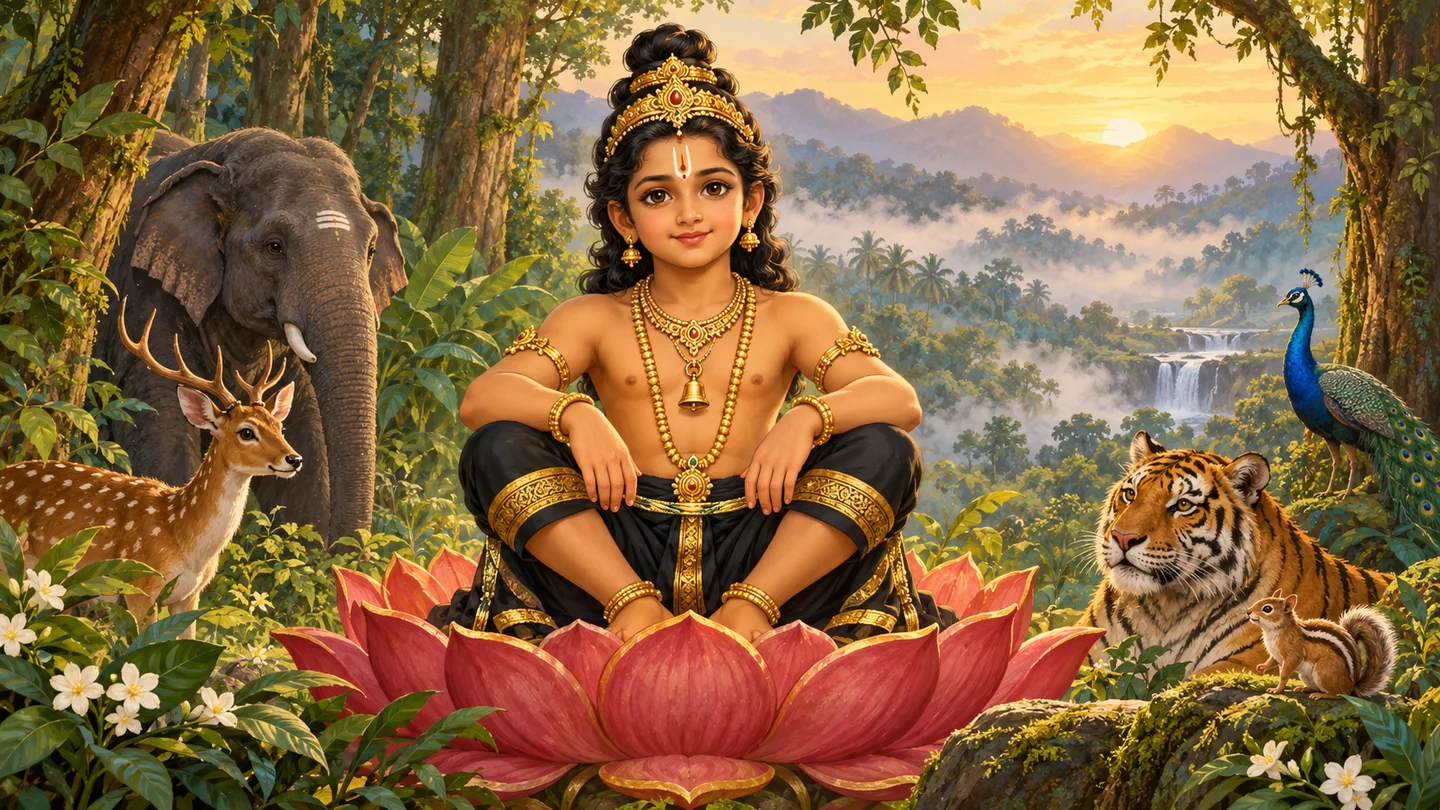
Before we meet the prince in the forest, we begin with the sacred tradition that explains his name. Ayyappa is loved as a protector and a guide. Devotees call him Hariharaputra. Hari is a name of Vishnu. Hara is a name of Shiva. Putra means son or child. Together, the name remembers his divine parentage.
Long before anyone at Pandalam knew his name, the world needed a protector. Trouble had spread, and even the devas were looking for help. Yet the answer would come in the surprising form of a child. He would not begin his earthly journey with a grand procession. He would be found among trees, small enough to be carried in someone’s arms. A great purpose was waiting inside a very small beginning.
Original illustration · artistic interpretation
02 / 04
The devas seek help
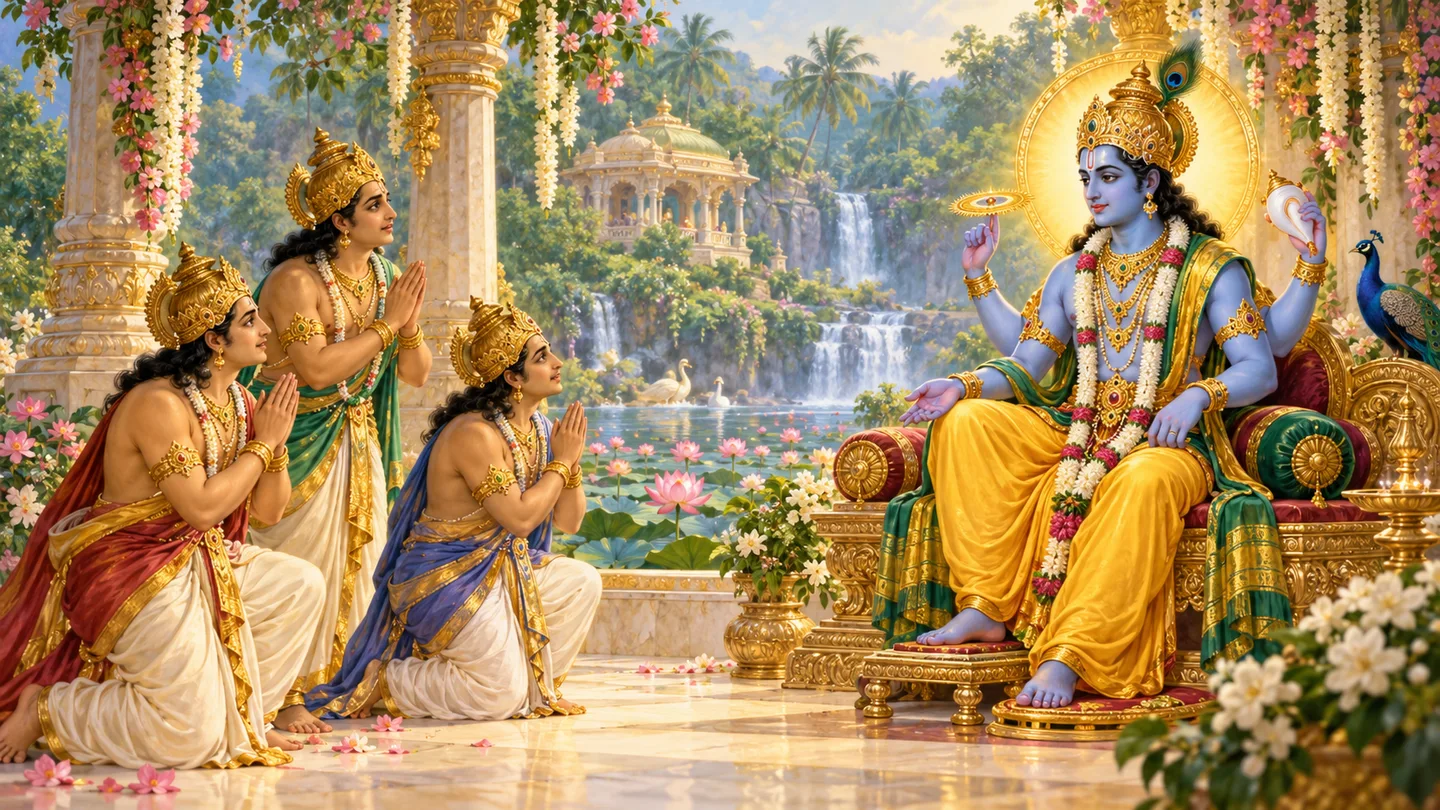
In the Sabarimala telling, Mahishi had received a powerful boon. Only a child of Shiva and Vishnu could bring about her defeat. She believed that this made her impossible to overcome. She used her strength to cause suffering, and the devas became deeply concerned.
The devas turned to Vishnu for help. Their part in the story matters too. They recognised that something was wrong and sought a way to protect others. Asking for help was not a failure of courage. It was the beginning of a response. For a child reading today, this is a gentle reminder that a trusted grown-up can help when a situation feels frightening or unfair.
Original illustration · artistic interpretation
03 / 04
Hari and Hara
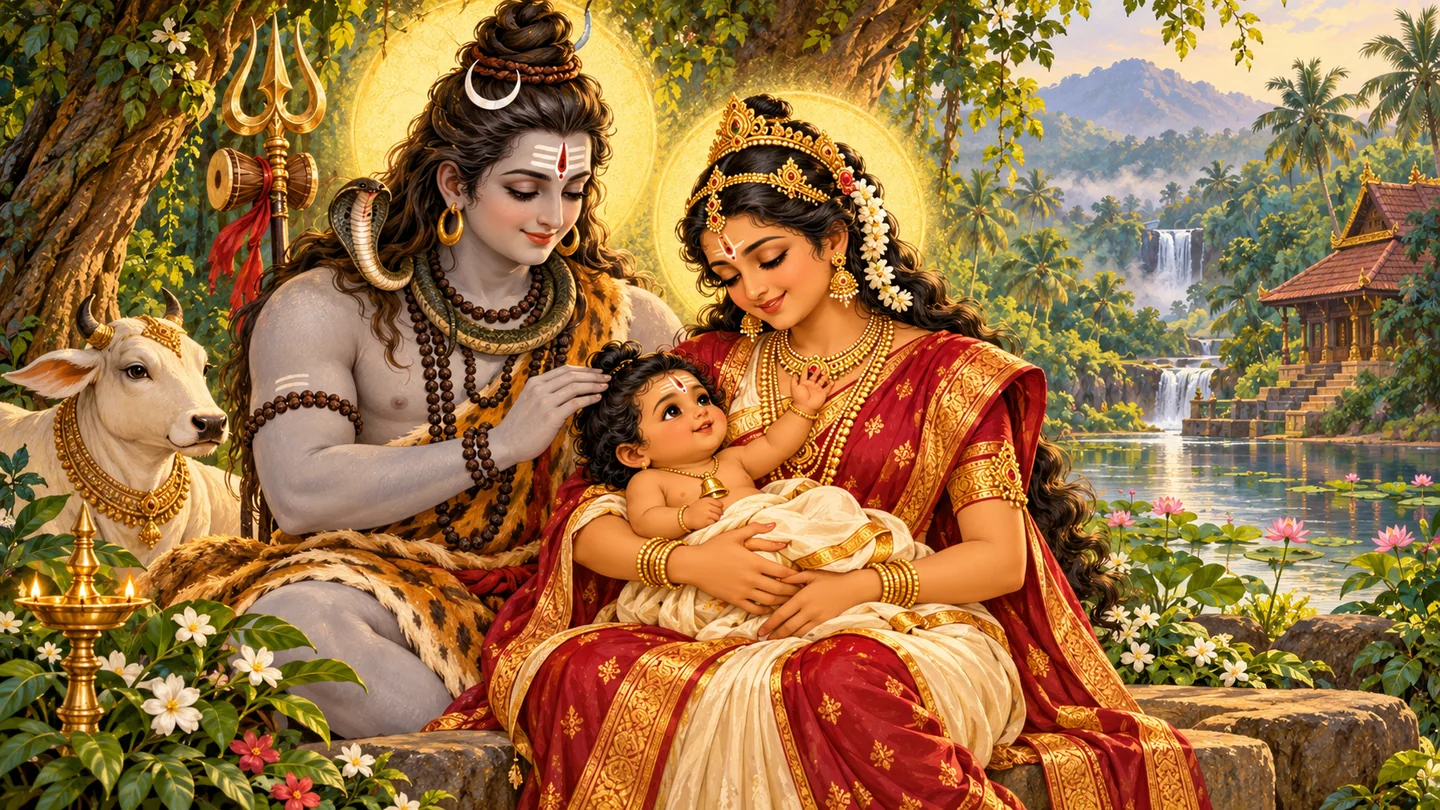
The tradition tells that Vishnu took the female form of Mohini. Ayyappa was born as the child of Shiva and Mohini. This is why his name joins Hari and Hara. Another hymn calls him Hariharatmaja, a related name that also remembers this parentage.
Hari and Hara are remembered together in this child. The name Hariharaputra carries that connection wherever it is spoken. For devotees, Ayyappa’s birth brings hope: Mahishi’s power will not last forever. The child will grow, learn, travel into the forest and face the task ahead of him. But none of that happens all at once. Like a path that slowly appears as we walk, his purpose will become clear one part at a time.
Original illustration · artistic interpretation
04 / 04
A beginning in the forest
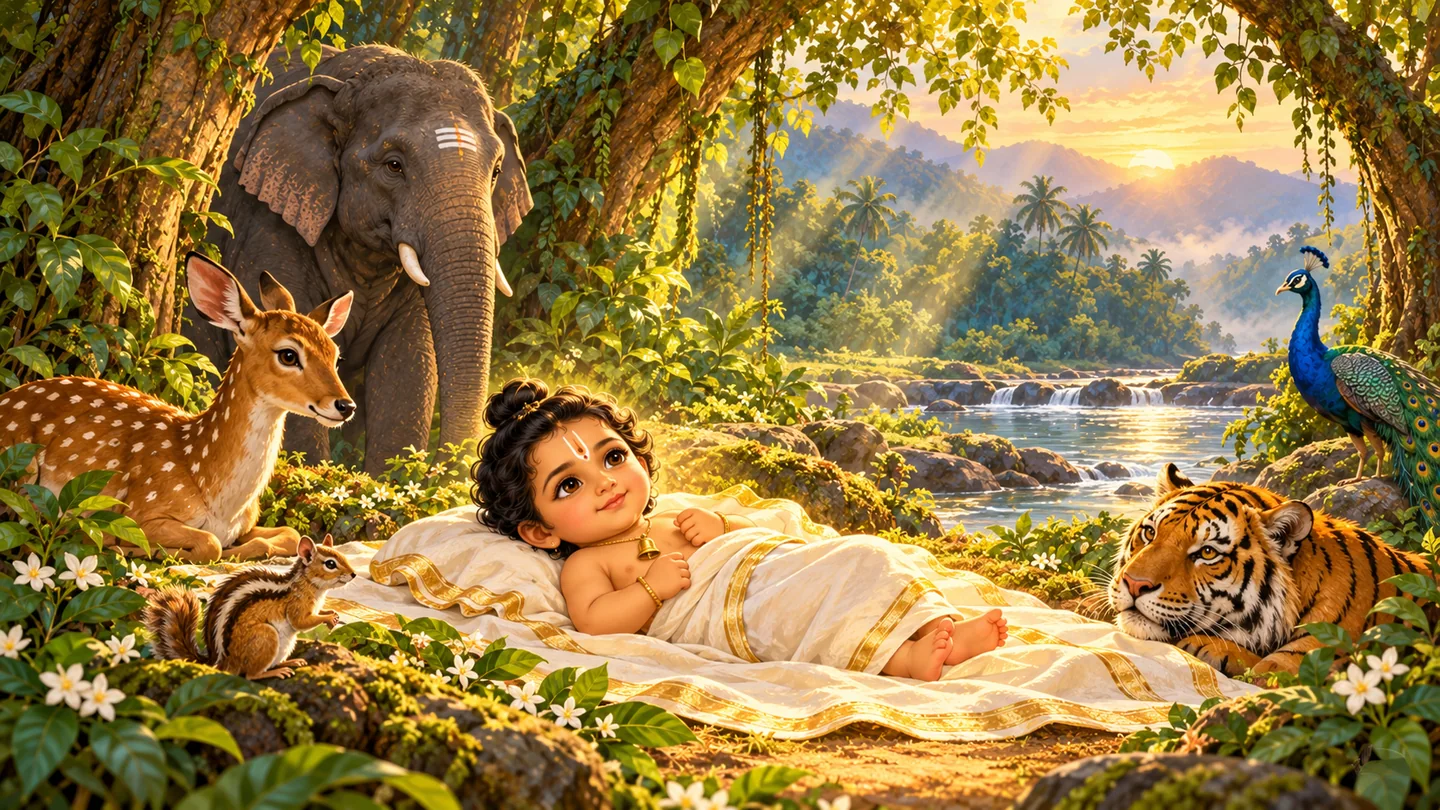
The next part of the tradition brings the divine child into the forest of Kerala. Imagine leaves holding the morning light and a river moving quietly beyond the trees. Beneath the wide branches is a little child. The forest seems enormous beside him. Soon, footsteps will approach along its paths. Someone who longs for a child will find one in the most unexpected place.
A king will soon come this way. He will see a child, feel love, and choose to care for him. At first, he will not understand the full divine story. He will simply know that the baby needs a home. Our chapter ends at this hopeful moment. Before crowns, great journeys, or a mountain shrine, there is a child waiting to be welcomed. The great adventure begins with care.
Meet the characters
Shiva
Vishnu as Mohini
The devas
Ayyappa
Little words, big meanings
Hari
A name of Vishnu.
Hara
A name of Shiva.
Putra
Son or child.
Deva
A divine being in Hindu tradition.
Boon
A special blessing or gift in a traditional story.
READ WITH A GROWN-UP
Let’s talk together
What do Hari and Hara name?
Why did the devas seek help?
Who is a trusted person you can ask for help?
Tradition, sources and a note for grown-ups
An original educational retelling of the cited tradition. Scenery, transitions and reflections are imaginative reading aids. No invented dialogue is presented as scripture. Illustrations are artistic interpretations.
Traditional narrative motifs checked against the cited witnesses. Original AI-assisted prose; not a literal translation or a scholar-certified critical edition. Last reviewed: 2026-10-27.
An official presentation of religious tradition, not independent historical proof. DHIH retells traditional motifs in original language; source prose and art are not reproduced.