An original retelling of the Sabarimala tradition · 498 words
The story in 100 words
The king understands that Manikandan is Lord Ayyappa. When Ayyappa offers him a wish, Rajasekhara asks for a place where people can worship him. In the familiar tradition, Ayyappa sends an arrow towards the hill of Sabari. The place becomes associated with the shrine at Sabarimala. This is a sacred foundation story, not a dated building record. The temple is a real place of living worship in Kerala today. Our pictures imagine a forest shrine without claiming to reproduce its earliest appearance. The chapter reminds us that love can grow into gratitude, reverence, and a place of welcome for prayer.
Swipe left for the next page · swipe right to go back
Original illustration · artistic interpretation
01 / 04
A different kind of wish
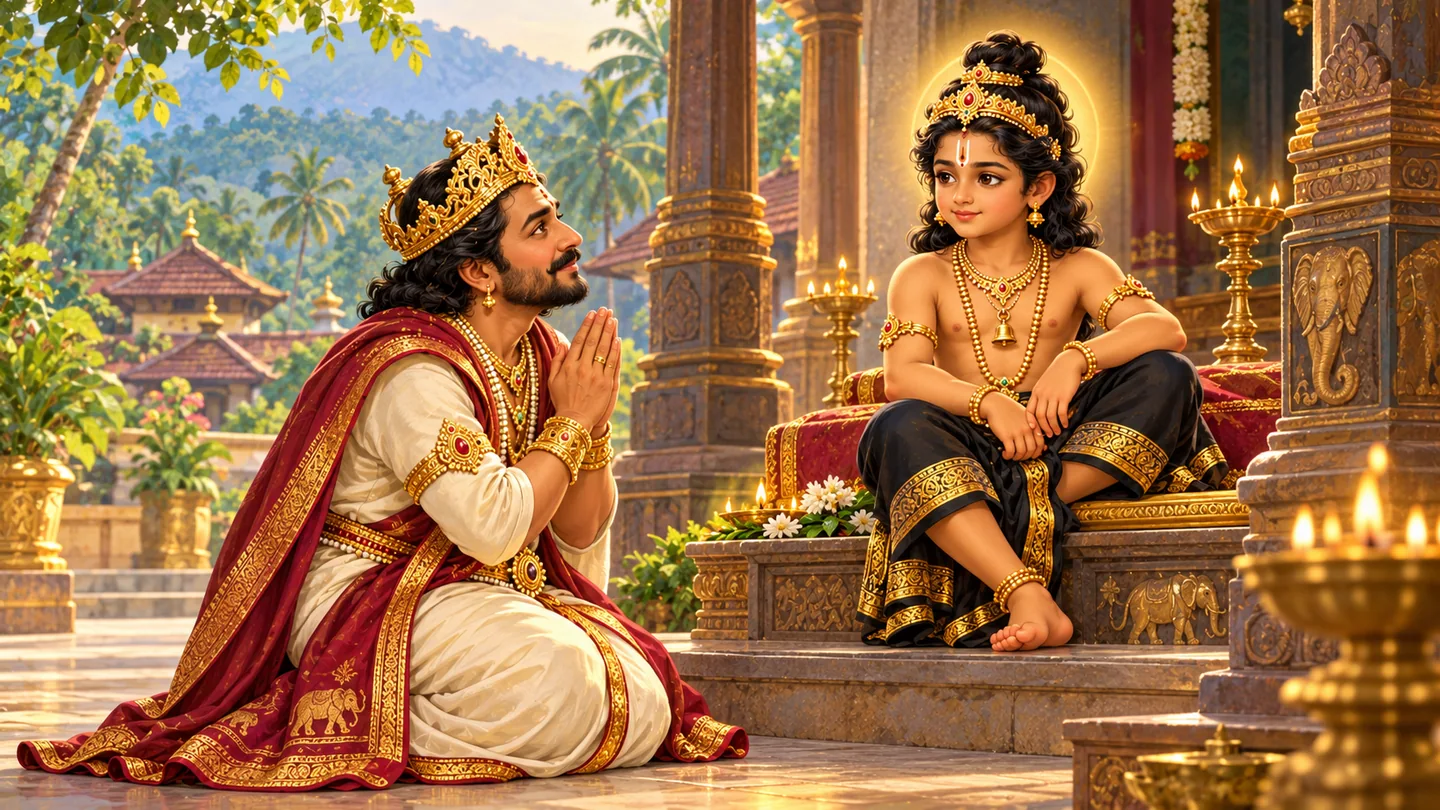
Rajasekhara had once hoped to see Manikandan succeed him as king. After the extraordinary return, he understood that the divine child’s purpose reached beyond the palace. The traditional story now gives the king a wish. He asks for a place where Ayyappa can be worshipped.
A wish can tell us what someone values. The king’s request was no longer about keeping a prince beside him or deciding who would sit on a throne. He wanted a place where his love could become worship. Others, too, would be able to come there in devotion. The story was turning from one family’s home towards a sacred home remembered by many generations.
Original illustration · artistic interpretation
02 / 04
A place for prayer
The king asks Ayyappa to choose a suitable place. In the familiar account, the answer is connected with the hill of Sabari. This is the sacred landscape of the foundation story. A forest, a mountain and a place of worship become joined in the memory of devotees.
Imagine the king listening carefully. The boy he had once carried home was now guiding him towards a new place of devotion. A forest, a mountain and a shrine would become joined in the memory of devotees. This was a different kind of royal task. It asked the king to make room for worship beyond the palace, allowing the love that had begun with one child to reach a much wider family of devotees.
Original illustration · artistic interpretation
03 / 04
The arrow and the hill
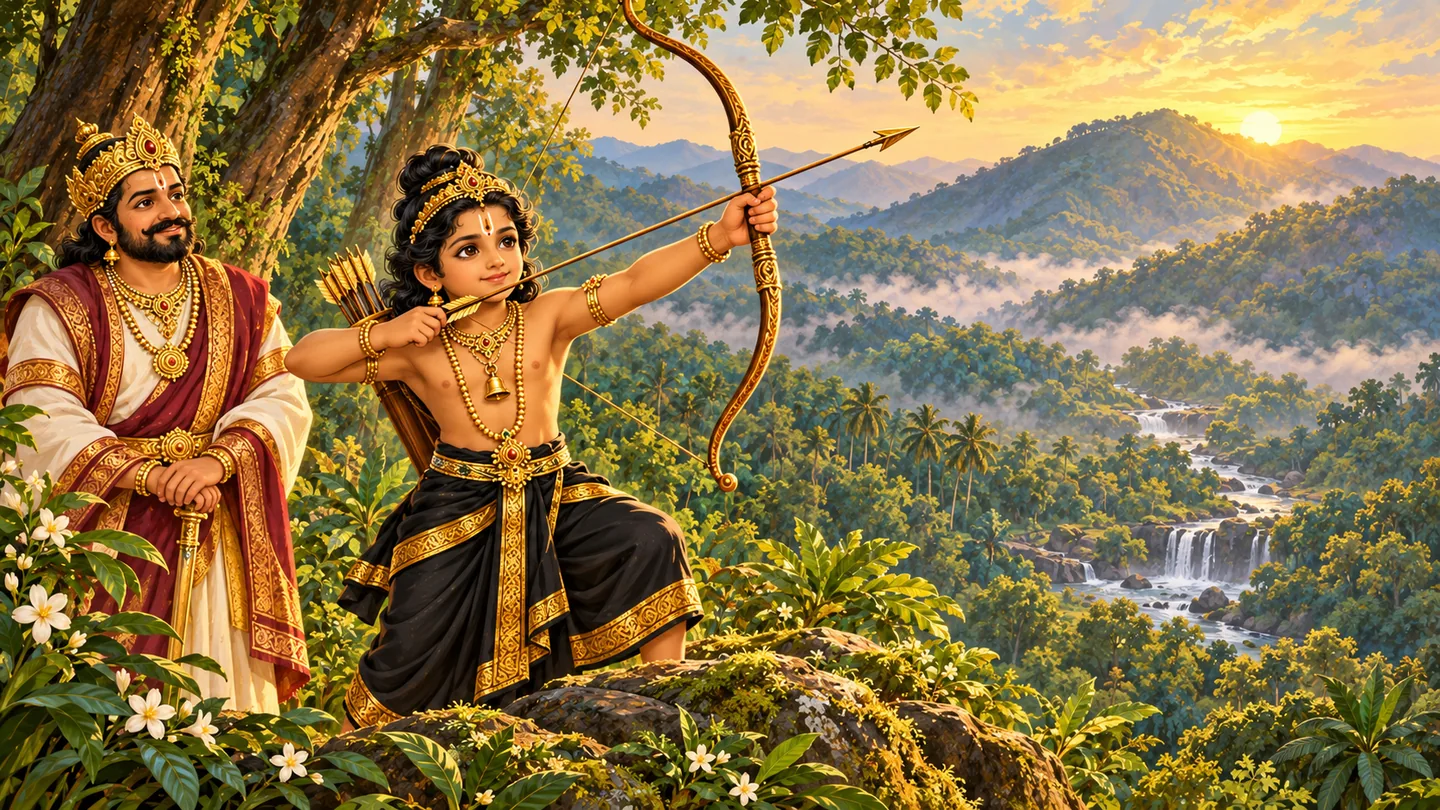
The story tells that Ayyappa shoots an arrow, which marks the hill chosen for his shrine. In our illustration, the arrow travels towards empty mountain slopes. No person or animal is its target. Here it belongs to a sacred foundation narrative, identifying a destination rather than beginning a battle.
Imagine following the arrow with your eyes until it disappears towards the distant hill. The forest stretches across the slopes, with trees gathering in the valleys. A place that seemed far away has become a destination. For the king, the task is now to honour Ayyappa’s wish. The movement from palace to mountain also changes what the story asks us to notice: away from a throne, towards a place for prayer.
Original illustration · artistic interpretation
04 / 04
A living place of devotion
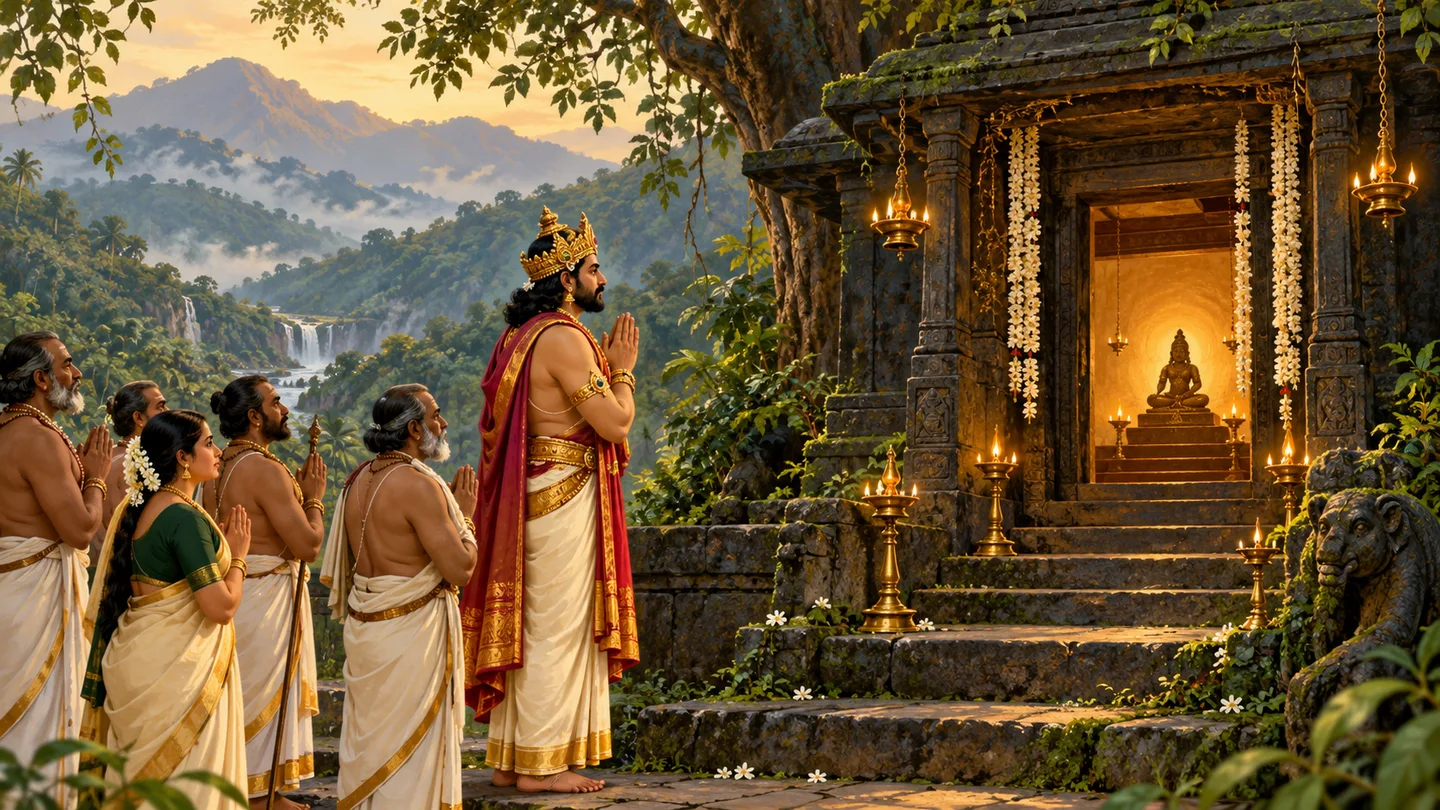
Under the king’s patronage, the tradition says, a shrine was established at Sabarimala. Our picture imagines the king and devotees standing quietly before it. A lamp glows within the doorway. The story has brought us from a forest discovery to a forest abode. Manikandan, the child with the bell, is remembered as Ayyappa, Lord of the sacred hill. The king’s request has become a place of devotion.
Today, Sabarimala is a centre of worship in Kerala’s Western Ghats. Many devotees prepare for a journey to its hill shrine. Their prayer and care continue the living tradition far beyond the ending of this chapter. A place can hold a story, and people can carry its meaning home with them. The king’s gratitude helps us think about our own: how can receiving love teach us to make space for others? The next chapter follows the pilgrims towards the sacred steps.
Meet the characters
Lord Ayyappa
King Rajasekhara
Devotees
Little words, big meanings
Abode
A dwelling place.
Shrine
A place set apart for worship.
Patronage
Support given to a place, activity or community.
Legend
A traditional account, distinct from a verified historical record.
READ WITH A GROWN-UP
Let’s talk together
What does the king ask for?
What marks the hill in the traditional story?
How is a sacred legend different from a dated building record?
Tradition, sources and a note for grown-ups
An original educational retelling of the cited tradition. Scenery, transitions and reflections are imaginative reading aids. No invented dialogue is presented as scripture. Illustrations are artistic interpretations.
The arrow and foundation narrative are religious tradition, not a verified date for the first building. The shrine illustrations are imagined and do not reconstruct an exact historical structure.
Traditional narrative motifs checked against the cited witnesses. Original AI-assisted prose; not a literal translation or a scholar-certified critical edition. Last reviewed: 2026-10-27.
Kerala Tourism: “Founding of Lord Ayyappa’s Sabarimala Temple”
An official presentation of religious tradition, not independent historical proof. DHIH retells traditional motifs in original language; source prose and art are not reproduced.