An original retelling of the Sabarimala tradition · 527 words
The story in 100 words
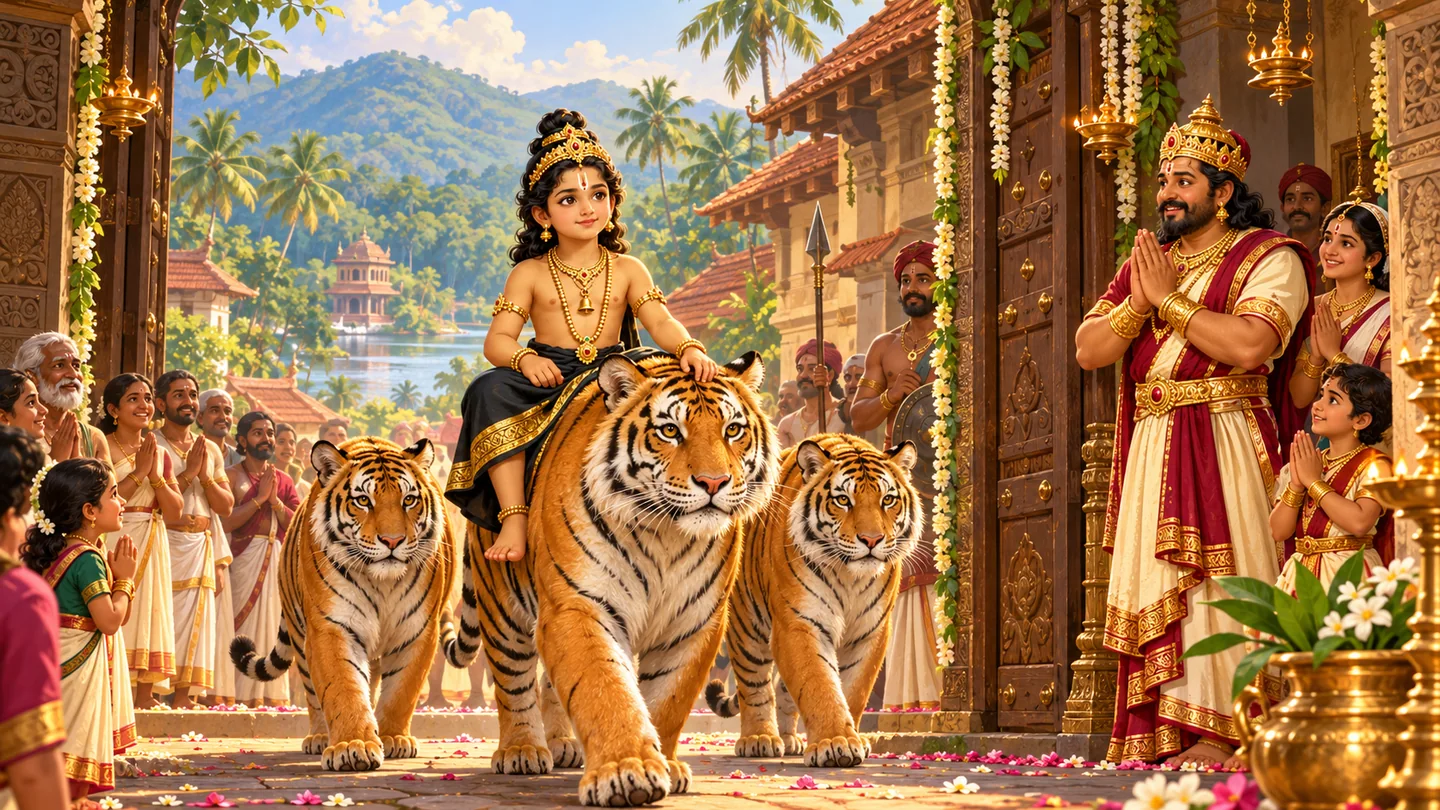
After Mahishi’s defeat, the tradition tells of divine help for Manikandan’s return. Indra takes the form of a tiger, and tigresses accompany him. Manikandan rides back towards Pandalam. The king sees his son returning with the animals and is filled with wonder. The child’s divine identity becomes clear. Manikandan is Ayyappa, whose purpose reaches beyond the throne. The story now turns from a palace scheme to recognition and devotion. Our reading reflection is that knowing we were wrong can begin a kind, honest change. The chapter leads towards the king’s request for a lasting place where people may worship Ayyappa.
Swipe left for the next page · swipe right to go back
Original illustration · artistic interpretation
01 / 04
An unexpected return
The palace had sent Manikandan towards the forest with a request for tigress’s milk. The people waiting there could not have imagined the return described in the tradition. The divine child would come back accompanied by the very animals that had made the request seem impossible.
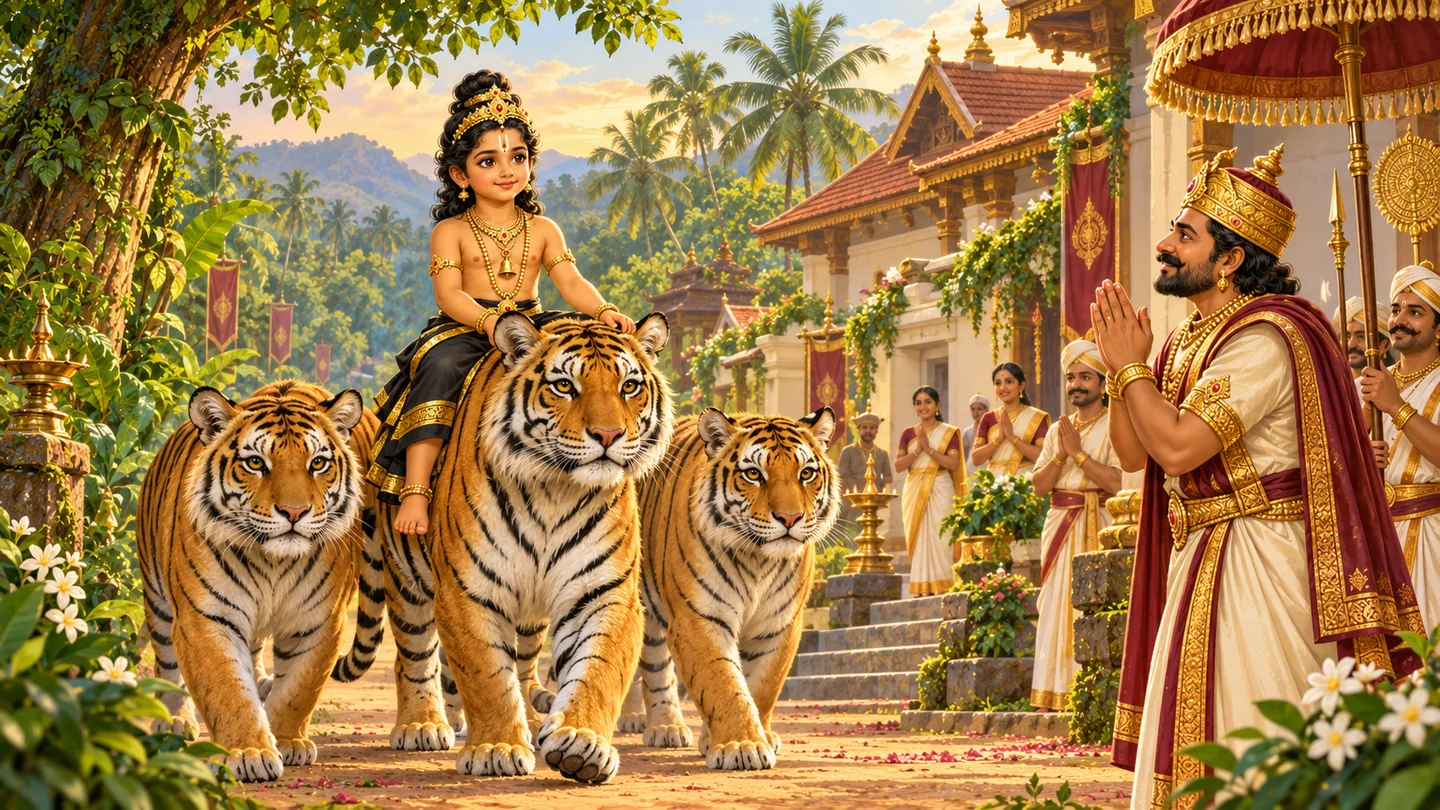
After Mahishi’s defeat, the devas helped Manikandan. Indra took the form of a tiger, and tigresses accompanied him. The child began the journey towards Pandalam with this extraordinary company. The request that had seemed impossible would be answered in a way that made his divine nature clear. The forest was no longer only the place to which he had been sent. It was the road along which wonder would arrive at the palace.
Original illustration · artistic interpretation
02 / 04
The forest companions
Picture the trees opening onto the road to Pandalam. The tiger moves steadily, and Manikandan sits without fear. Tigresses travel nearby. The party that approaches is unlike any ordinary royal procession. At its heart is the same child the king has loved through years of growing. He returns with neither an army nor a claim to a prize, but with a sign that his story is greater than anyone’s plan for him.
The boy who left the palace has not returned as the minister expected. The plan to remove him has failed. Yet our attention need not stay on the failure of a scheme. It can turn towards what the people are about to learn. Manikandan’s identity is greater than the royal role they had imagined for him. The little bell necklace is still there, linking this moment to the child discovered in the forest.
Original illustration · artistic interpretation
03 / 04
The king sees his son
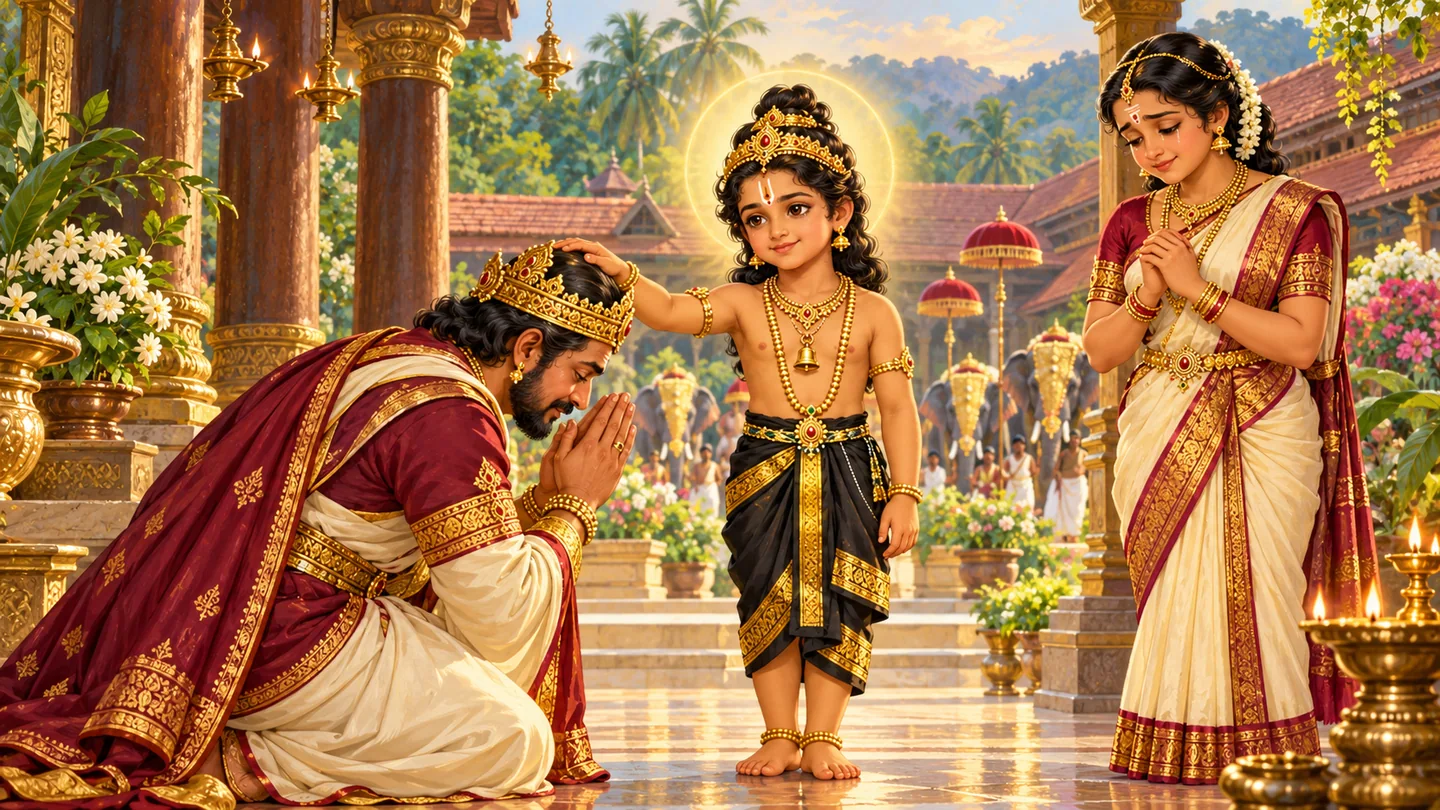
Rajasekhara saw the remarkable arrival. His son was safe, and the sight filled him with wonder. A holy person explained Manikandan’s divine identity to the king. The foster father began to recognise Ayyappa, the child of Hari and Hara, in the boy he had loved and raised. The child found beside a forest path had carried a mystery from the beginning. Now that mystery was becoming clear.
The king’s love remained an important part of the story. He had welcomed an infant, cared for a growing boy and worried when that boy entered the forest. Now he bowed in reverence. Affection and devotion belonged together in this meeting. Think of the little bell remembered at the beginning: it links the baby who needed a home with the Lord whom Rajasekhara now honours. Understanding has grown, but care has never lost its place.
Original illustration · artistic interpretation
04 / 04
Recognition and a new direction
The palace deception is exposed, and the story turns towards repentance and restraint. The official telling describes Ayyappa counselling the king against revenge on the minister. This detail makes room for reflection after all the wonder. Recognising a wrong should lead towards a wiser response, rather than another round of harm.
Ayyappa’s purpose is not to become an ordinary successor on the throne. His mission has been fulfilled, and the king will ask for a place where devotees can worship him. Our next chapter follows that request towards Sabarimala. For now, the palace has changed through understanding. The child once carried home by the king has returned as the Lord whom the king honours. The story moves from possession towards reverence.
Meet the characters
Manikandan
King Rajasekhara
The queen
Indra in tiger form
Little words, big meanings
Indra
A leading deva in Hindu tradition.
Reverence
Deep respect.
Repentance
Recognising a wrong and sincerely wishing to change.
READ WITH A GROWN-UP
Let’s talk together
What animals accompany Manikandan?
What does the king come to understand?
What can we do after realising that we made a mistake?
Tradition, sources and a note for grown-ups
An original educational retelling of the cited tradition. Scenery, transitions and reflections are imaginative reading aids. No invented dialogue is presented as scripture. Illustrations are artistic interpretations.
The peaceful tigers belong to a sacred account of divine assistance. They are not a suggestion that wild tigers can be approached or ridden.
Traditional narrative motifs checked against the cited witnesses. Original AI-assisted prose; not a literal translation or a scholar-certified critical edition. Last reviewed: 2026-10-27.
Kerala Tourism: “Lord Ayyappa’s Return with the Tigress”
An official presentation of religious tradition, not independent historical proof. DHIH retells traditional motifs in original language; source prose and art are not reproduced.
Official portal: return, recognition and restraint towards the minister
The narrative was available through the indexed official page; direct retrieval was intermittent. Childhood miracle is a traditional religious account, not a medical promise.