Two songs in one courtyard · 316-word learning story
About this story
The four-page story below is an original family reading inspired by this form’s meaning. Its people, conversations and events are imagined; it is not an ancient scripture, a temple legend, or a claim that the deity performed these events.
The traditional introduction and Sanskrit reading have their own source notes. Read aloud together with younger children.
Swipe left for next · swipe right to go back
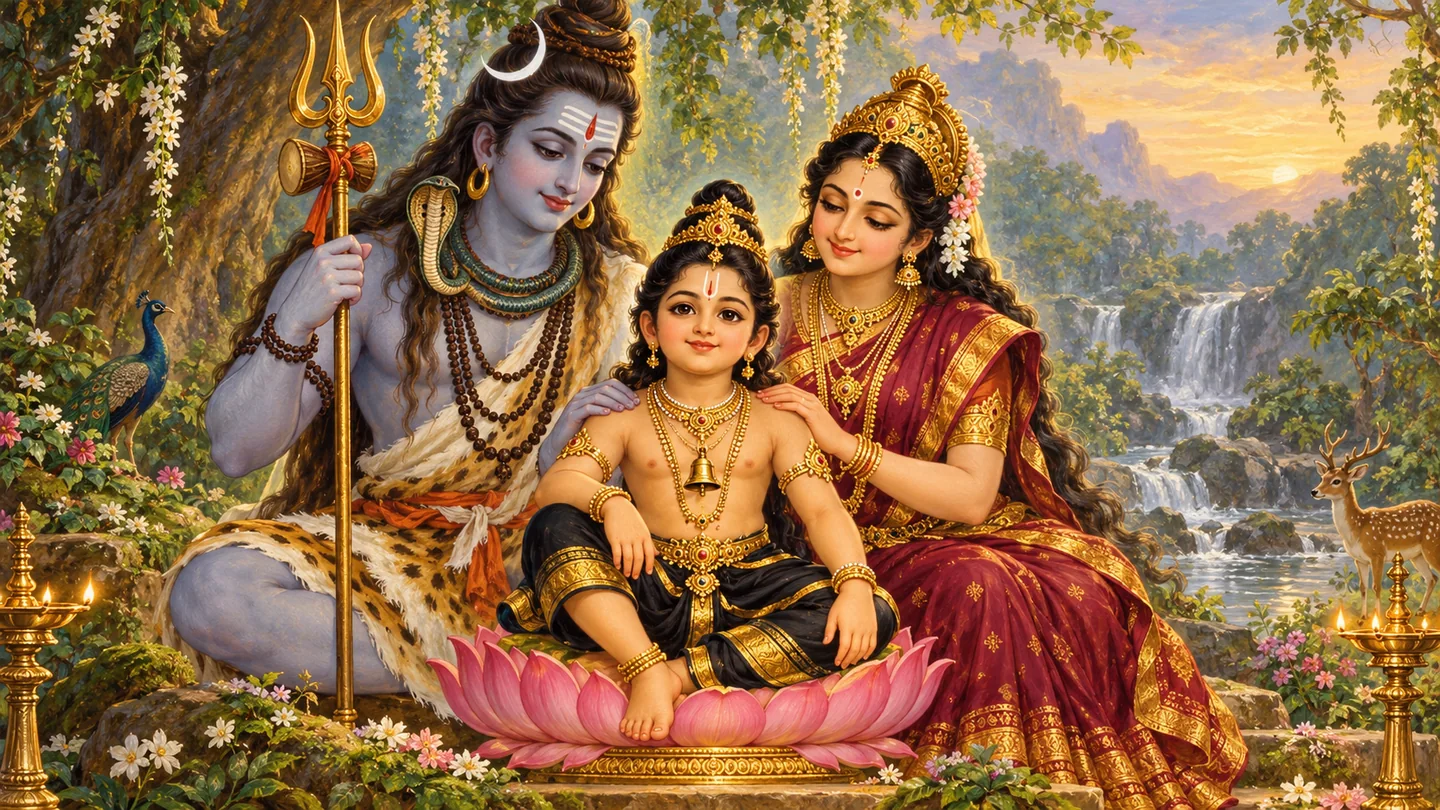
Original AI-assisted devotional illustration; a symbolic interpretation, not a photograph or prescribed temple icon.
1 / 6
Meet Hariharatmaja Sastha
Traditional background
हरिहरात्मजशास्ता
Hariharātmajaśāstā
Hari is Vishnu and Hara is Shiva; atmaja means child or son. The Sastha Sahasranama contains the name Hariharatmaja. In the Sabarimala tradition described by Kerala Tourism, the divine child is born of Shiva and Vishnu in the form of Mohini, and later grows up as Manikandan in Pandalam. This is religious narrative, not a historically dated birth record. The title brings Shaiva and Vaishnava devotion together. The illustration depicts that traditional parentage symbolically. The original story below reflects on respecting different family ways of worship.
Sanskrit headwords and IAST are editorially normalized. The source note distinguishes exact hymn wording from later devotional titles.
Next: Two songs in one courtyard, an original learning story inspired by this form.
Original AI-assisted devotional illustration; a symbolic interpretation, not a photograph or prescribed temple icon.
2 / 6
Whose song came first?
Original learning story · 1 of 4
During a family visit, Anu wanted to sing the Shiva prayer she had learned with her grandfather. Her cousin Hari wanted to sing a Vishnu prayer from his grandmother. They each insisted that their song should open the evening. Soon the argument was no longer about taking turns. Each child began to say that the other’s prayer mattered less. Their grandmother put down the flower basket and asked them to sit with her before they began the worship.
Original AI-assisted devotional illustration; a symbolic interpretation, not a photograph or prescribed temple icon.
3 / 6
A name that held two names
Original learning story · 2 of 4
She showed them the name Hariharatmaja and explained its parts. In Ayyappa’s divine-origin tradition, Hari and Hara were both present in the story of his parentage. She carefully distinguished that tradition from the cousins’ disagreement; a sacred story was not a scorecard for deciding which child should win. Anu noticed that one name could hold a relationship she had been trying to divide. Hari asked whether they could honour both prayers without changing either prayer’s words.
Original AI-assisted devotional illustration; a symbolic interpretation, not a photograph or prescribed temple icon.
4 / 6
Listening before joining
Original learning story · 3 of 4
They chose to sing Anu’s prayer first that evening and Hari’s first the following evening. Before singing, each cousin told the other one thing they loved about the prayer. Anu liked the sense of stillness. Hari liked the feeling of trust. They listened to the words they did not yet know rather than pretending to understand everything. When it was time for the familiar Ayyappa refuge chant, both could join. The courtyard sounded more welcoming after their argument had softened.
Original AI-assisted devotional illustration; a symbolic interpretation, not a photograph or prescribed temple icon.
5 / 6
A greeting at the doorway
Original learning story · 4 of 4
The next day another cousin arrived with a different family custom. This time Anu asked him to explain it. Hari found space for him on the mat. Neither child had to abandon a prayer they loved. They had learned to speak about it without making another person smaller. When Grandmother returned the image to its shelf, the children remembered Hariharatmaja as a name that invited relationship. Their little change was simple: begin with curiosity, listen carefully, and greet another devotee with respect.
Original AI-assisted devotional illustration; a symbolic interpretation, not a photograph or prescribed temple icon.
6 / 6
Meditation on the son of Hari and Hara
Sanskrit & English
Dharmashasta Sahasranama Stotram, opening dhyana, first two lines (excerpt).
ध्यायेदुमापतिरमापतिभाग्यपुत्रं
Meditate on the blessed son of Uma’s Lord (Shiva) and Rama’s Lord (Vishnu).
वेत्रोज्ज्वलत्करतलं भसिताभिरामम् ।
His hand shines with a staff, and sacred ash adorns him beautifully.
Short meaning
The meditation honours Sastha through his relationship to Shiva and Vishnu. Uma names Parvati, and Rama here names Lakshmi. The staff and sacred ash belong to this hymn’s description.
What changed for the child in “Two songs in one courtyard”?
Which small action from this story could we try together?
Tradition, Sanskrit sources & artwork
The four-page story below is an original family reading inspired by this form’s meaning. Its people, conversations and events are imagined; it is not an ancient scripture, a temple legend, or a claim that the deity performed these events.
Dharmashasta Sahasranama Stotram, opening dhyana, first two lines (excerpt).
English meanings are original DHIH readings, not borrowed translations. The portrait is a symbolic illustration of the form, reused through its reader; it is not a picture of the imagined children’s events. Last editorial source review: 2026-10-27. No human scholarly certification is claimed.
Sections: Divine Birth; Discovery; Queen’s Feigned Illness; Defeat of Mahishi; Return; Founding of the Temple
An official presentation of religious tradition, not independent historical proof. DHIH retells traditional motifs in original language; source prose and art are not reproduced.