The answer under the banyan · 328-word learning story
About this story
The four-page story below is an original family reading inspired by this form’s meaning. Its people, conversations and events are imagined; it is not an ancient scripture, a temple legend, or a claim that the deity performed these events.
The traditional introduction and Sanskrit reading have their own source notes. Read aloud together with younger children.
Swipe left for next · swipe right to go back
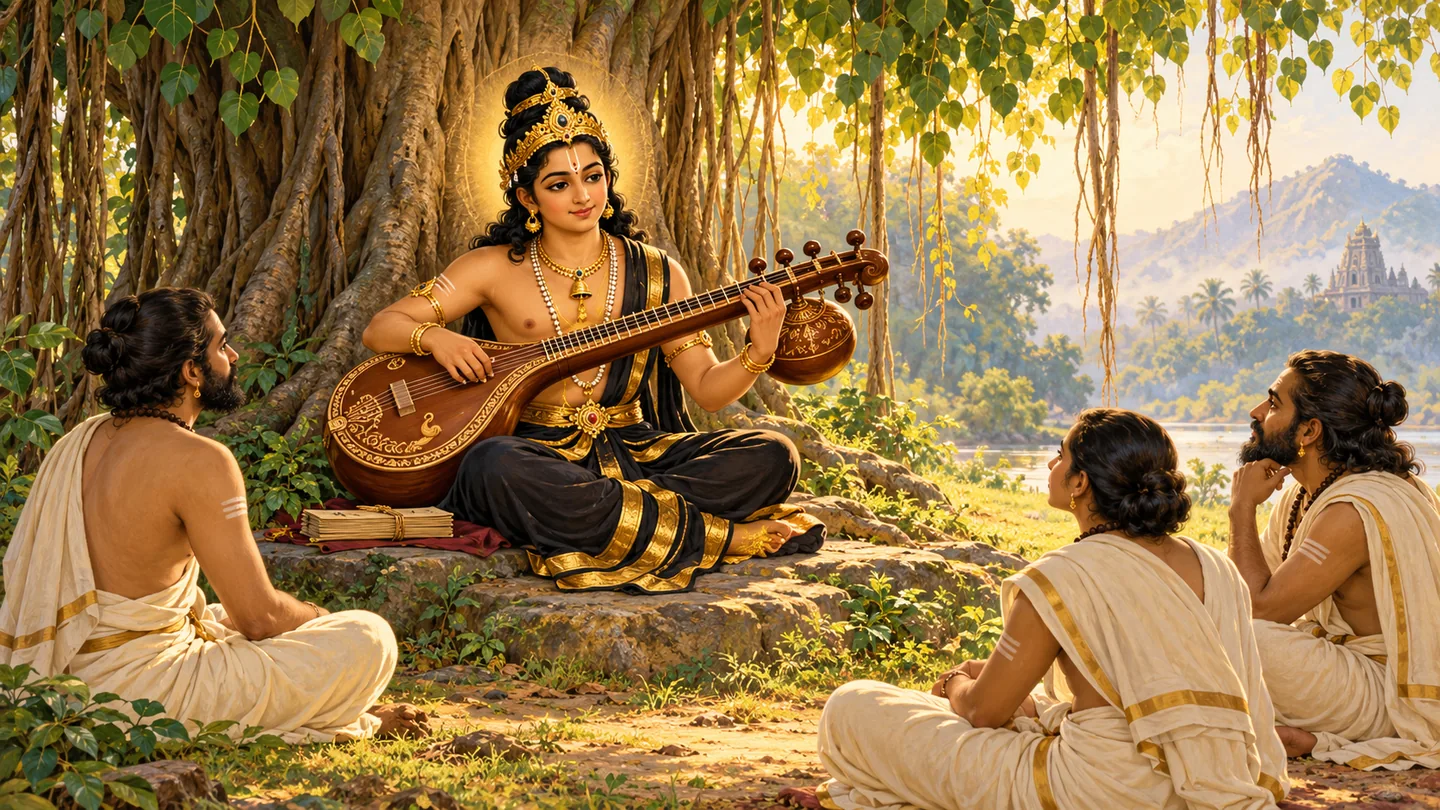
Original AI-assisted devotional illustration; a symbolic interpretation, not a photograph or prescribed temple icon.
1 / 6
Meet Jnana Sastha
Traditional background
ज्ञानशास्ता
Jñānaśāstā
Jnana means knowledge or insight. The 108-name hymn calls Sastha Mahajnani, greatly wise. The Ashta Sastha Temple’s account describes Gnana Sastha with a veena beneath a banyan tree; our illustration follows that temple-specific description without claiming it is every shrine’s image. Wisdom here is more than recalling an answer. The original story turns toward humility, careful observation and the courage to revise a mistake. It is an educational application of the name rather than a recovered scriptural episode.
Sanskrit headwords and IAST are editorially normalized. The source note distinguishes exact hymn wording from later devotional titles.
Next: The answer under the banyan, an original learning story inspired by this form.
Original AI-assisted devotional illustration; a symbolic interpretation, not a photograph or prescribed temple icon.
2 / 6
An answer given too quickly
Original learning story · 1 of 4
During a nature lesson, Diya saw two leaves that looked nearly alike. She confidently announced that both came from the same tree. Her younger friend wondered why one had a different edge. Diya dismissed the question because she had read more books. The teacher suggested looking at the trees before deciding. Diya felt annoyed. She wanted her first answer to be praised, not checked. Carrying the leaves outside, she began searching for a way to prove that she had been right.
Original AI-assisted devotional illustration; a symbolic interpretation, not a photograph or prescribed temple icon.
3 / 6
Listening beneath the shade
Original learning story · 2 of 4
The class rested beneath a banyan. The teacher asked everyone to describe what they could see without first naming it. Diya noticed the different veins and the way one leaf bent. She remembered an illustration of Jnana Sastha teaching beneath a tree, with a veena beside the listeners. Her grandmother had said that wisdom required attention. Diya realised she had been listening only for agreement. This time she asked her friend to show the edge he had noticed and looked closely with him.
Original AI-assisted devotional illustration; a symbolic interpretation, not a photograph or prescribed temple icon.
4 / 6
Learning to change an answer
Original learning story · 3 of 4
They found the two trees and compared fallen leaves from each. The first answer was wrong. Diya felt embarrassed, but the teacher thanked both children for testing the idea. They drew the shapes and added a question to the notebook instead of hiding the mistake. Diya asked how to tell the trees apart when neither had flowers. The teacher explained a few features and admitted that other questions would need a field guide. Nobody had to pretend to know everything to keep learning.
Original AI-assisted devotional illustration; a symbolic interpretation, not a photograph or prescribed temple icon.
5 / 6
A question worth keeping
Original learning story · 4 of 4
At home Diya showed both drawings, including the crossed-out first label. She told her grandmother that the lesson had become interesting after she stopped defending the wrong answer. On her next visit to the library she chose a tree guide and invited her friend to use it with her. Jnana Sastha now reminded her of a quiet strength: being ready to learn from someone younger, to check an idea, and to say, honestly, that a better answer might still be waiting.
Original AI-assisted devotional illustration; a symbolic interpretation, not a photograph or prescribed temple icon.
6 / 6
The steady knower
Sanskrit & English
Dharmashastuh Ashtottarashatanama Stotram, verse 8, second line (excerpt).
महायोगी महामायी महाज्ञानी महास्थिरः ॥
He is the great yogi, master of wondrous power, greatly wise and deeply steadfast.
Short meaning
Wisdom is pictured together with yoga and steadiness, rather than cleverness alone.
What changed for the child in “The answer under the banyan”?
Which small action from this story could we try together?
Tradition, Sanskrit sources & artwork
The four-page story below is an original family reading inspired by this form’s meaning. Its people, conversations and events are imagined; it is not an ancient scripture, a temple legend, or a claim that the deity performed these events.
Dharmashastuh Ashtottarashatanama Stotram, verse 8, second line (excerpt).
English meanings are original DHIH readings, not borrowed translations. The portrait is a symbolic illustration of the form, reused through its reader; it is not a picture of the imagined children’s events. Last editorial source review: 2026-10-27. No human scholarly certification is claimed.
Documents devotional names and attributes, not a sequence of incarnations. Underlying date and authorship are not established here. This edition is linked for study, not reproduced wholesale.