The angry word that waited · 318-word learning story
About this story
The four-page story below is an original family reading inspired by this form’s meaning. Its people, conversations and events are imagined; it is not an ancient scripture, a temple legend, or a claim that the deity performed these events.
The traditional introduction and Sanskrit reading have their own source notes. Read aloud together with younger children.
Swipe left for next · swipe right to go back
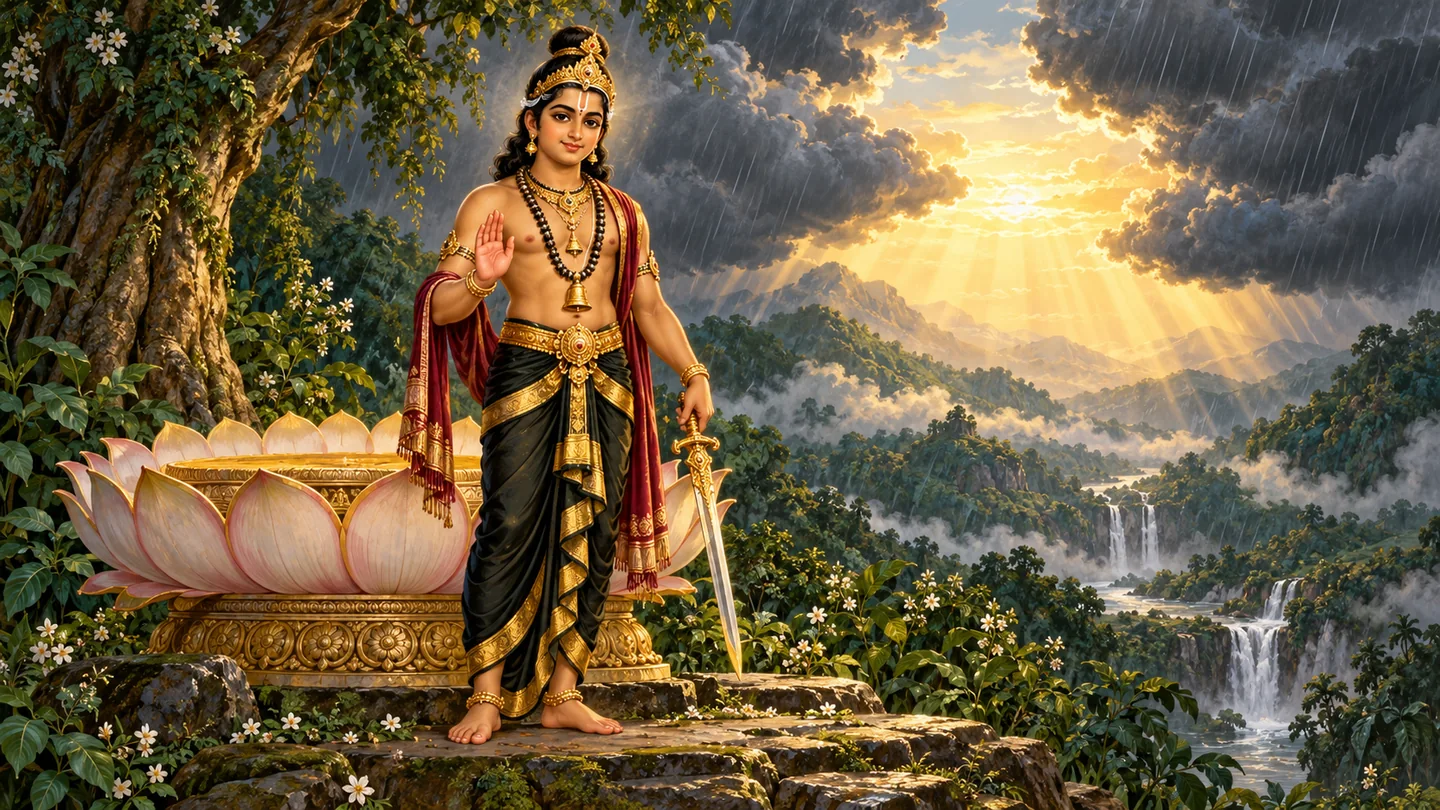
Original AI-assisted devotional illustration; a symbolic interpretation, not a photograph or prescribed temple icon.
1 / 6
Meet Shatru Vimardhana Sastha
Traditional background
शत्रुविमर्दनशास्ता
Śatru-vimardanaśāstā
The opening meditation of the 108-name hymn uses shatru-vimardana, overcoming or crushing foes, in praise of Maha Sastha. The traditional term has a protective and martial sense. Devotees may also apply it inwardly to anger, envy or pride, but that is an interpretation, not a replacement of the word’s literal meaning. The illustration holds a sword downward and avoids a violent scene. The following story explores mastering anger while seeking adult help against unfair behaviour; it never asks a child to tolerate harm silently.
Sanskrit headwords and IAST are editorially normalized. The source note distinguishes exact hymn wording from later devotional titles.
Next: The angry word that waited, an original learning story inspired by this form.
Original AI-assisted devotional illustration; a symbolic interpretation, not a photograph or prescribed temple icon.
2 / 6
The fallen tower
Original learning story · 1 of 4
Vikram had spent the morning building a tower from wooden blocks. When a classmate bumped the table, it fell. Another child laughed, and Vikram’s anger rushed up before he knew what to say. He reached for a block, wanting to throw it. His teacher stepped close and asked him to put it down. She made sure the children had space apart. Vikram’s hands were still tight, and he hated that everyone had seen how upset he was.
Original AI-assisted devotional illustration; a symbolic interpretation, not a photograph or prescribed temple icon.
3 / 6
Naming the real problem
Original learning story · 2 of 4
The teacher did not say that he must pretend nothing had happened. She helped him breathe slowly, then asked what he knew. The table had been bumped accidentally. The laughter had hurt. Throwing a block would create another harm. At home, his father had explained a devotional reading of Shatru Vimardhana: anger could become an inner opponent when it controlled his actions. Vikram could feel that struggle now. He needed help to respond, not a reason to call another child his enemy.
Original AI-assisted devotional illustration; a symbolic interpretation, not a photograph or prescribed temple icon.
4 / 6
Words instead of a weapon
Original learning story · 3 of 4
When he was ready, Vikram told the other children what had upset him. The child who bumped the table apologised. The teacher spoke with the child who laughed and helped the group agree on respectful behaviour. Vikram said he wanted a little quiet time before rebuilding. That choice felt different from either throwing the block or swallowing his feelings. Later, two classmates asked to help. He accepted, and they moved the table away from the busy doorway.
Original AI-assisted devotional illustration; a symbolic interpretation, not a photograph or prescribed temple icon.
5 / 6
A stronger foundation
Original learning story · 4 of 4
The second tower had a wider base. Vikram smiled at it, but remembered the moment he had set down the block even more clearly. He had not made anger disappear forever. He had learned one way to interrupt it: stop, move safely, ask for help and use clear words. The protective form of Sastha became a reminder of that practice. If someone kept hurting him, he would still tell a trusted adult. Inner discipline and protection from real harm could belong together.
Original AI-assisted devotional illustration; a symbolic interpretation, not a photograph or prescribed temple icon.
6 / 6
Meditation on the protector
Sanskrit & English
Dharmashastuh Ashtottarashatanama Stotram, opening dhyana, excerpt. Sandhi is retained.
शत्रुविमर्दनं हृदि महाशास्तारमाद्यं भजे ।
In my heart I worship the primordial Maha Sastha, who overcomes foes.
Short meaning
This excerpt praises divine protection. Reading the foes as anger and pride is a devotional application, not the only literal sense of the word.
What changed for the child in “The angry word that waited”?
Which small action from this story could we try together?
Tradition, Sanskrit sources & artwork
The four-page story below is an original family reading inspired by this form’s meaning. Its people, conversations and events are imagined; it is not an ancient scripture, a temple legend, or a claim that the deity performed these events.
Dharmashastuh Ashtottarashatanama Stotram, opening dhyana, excerpt. Sandhi is retained.
English meanings are original DHIH readings, not borrowed translations. The portrait is a symbolic illustration of the form, reused through its reader; it is not a picture of the imagined children’s events. Last editorial source review: 2026-10-27. No human scholarly certification is claimed.
Documents devotional names and attributes, not a sequence of incarnations. Underlying date and authorship are not established here. This edition is linked for study, not reproduced wholesale.