The path beside the nest · 333-word learning story
About this story
The four-page story below is an original family reading inspired by this form’s meaning. Its people, conversations and events are imagined; it is not an ancient scripture, a temple legend, or a claim that the deity performed these events.
The traditional introduction and Sanskrit reading have their own source notes. Read aloud together with younger children.
Swipe left for next · swipe right to go back
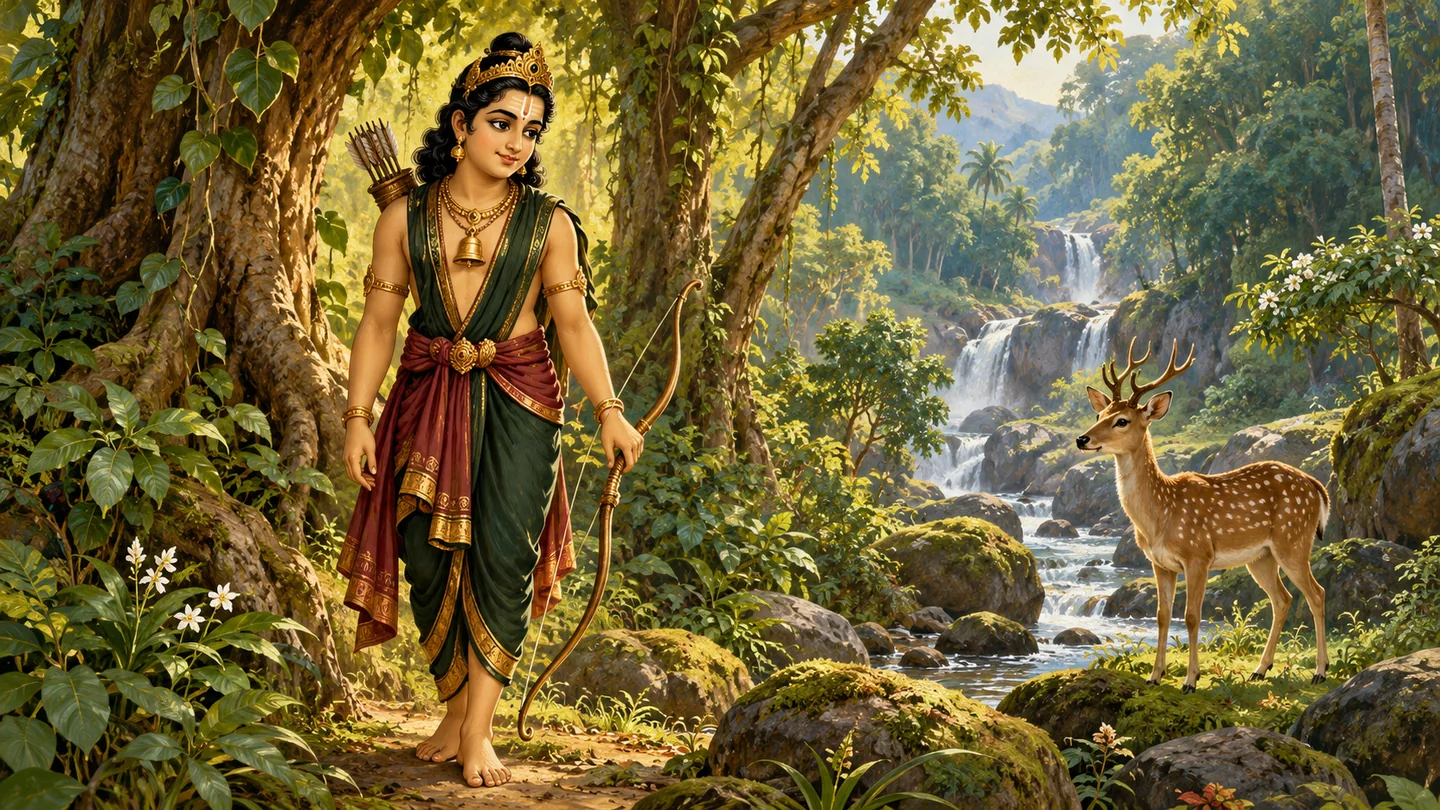
Original AI-assisted devotional illustration; a symbolic interpretation, not a photograph or prescribed temple icon.
1 / 6
Meet Kirata Sastha
Traditional background
किरातशास्ता
Kirātaśāstā
The Kiratashtakam invokes Sastha through hunter imagery, including the bow. Kirata can refer to a hunter or forest-dwelling figure in this literary context. It should not be used to stereotype living communities. This Sastha hymn is distinct from the famous Mahabharata episode in which Shiva appears as a hunter before Arjuna; that episode must not be silently transferred to Ayyappa. Our image places the bow at rest. The original nature story explores attentive care without inventing an undocumented hunting adventure for the deity.
Sanskrit headwords and IAST are editorially normalized. The source note distinguishes exact hymn wording from later devotional titles.
Next: The path beside the nest, an original learning story inspired by this form.
Original AI-assisted devotional illustration; a symbolic interpretation, not a photograph or prescribed temple icon.
2 / 6
A shortcut through the grass
Original learning story · 1 of 4
On a supervised nature walk, Manu noticed a narrow opening through tall grass. It looked like a quicker way to reach the stream. He began to step away from the marked path, excited to be the first to arrive. The guide called him back. A small bird had flown low across the opening, and another was calling from nearby. The group stood still. Manu had seen an empty patch of grass; the guide had noticed signs that the place might already be someone’s home.
Original AI-assisted devotional illustration; a symbolic interpretation, not a photograph or prescribed temple icon.
3 / 6
Looking without disturbing
Original learning story · 2 of 4
They watched from a distance and did not search through the grass for a nest. The guide explained that curiosity did not give them permission to disturb wildlife. Manu remembered his uncle’s explanation of Kirata Sastha, the deity in hunter imagery. His uncle had also warned him not to invent a tale about every object in a picture. Today Manu drew his own lesson from the watchful figure: noticing well could lead to restraint. The group returned to the path quietly and gave the birds space.
Original AI-assisted devotional illustration; a symbolic interpretation, not a photograph or prescribed temple icon.
4 / 6
A different discovery
Original learning story · 3 of 4
Farther along, the guide showed them tracks in the soft mud. Manu wanted to touch everything at once. Instead he asked which things could be examined safely and which should remain undisturbed. They observed a fallen seed pod and left an unfamiliar insect alone. At the stream they collected litter with the adults’ equipment, keeping clear of the water’s edge. Manu realised that a slower walk had given him more to remember than reaching the destination first would have done.
Original AI-assisted devotional illustration; a symbolic interpretation, not a photograph or prescribed temple icon.
5 / 6
What stayed in the forest
Original learning story · 4 of 4
Before leaving, Manu checked his bag. He had drawings, a few notes and his own lunch wrapper. He had not taken the seed pod or a handful of feathers. At home he placed his drawing beside the image of Kirata Sastha and explained that it represented his own reflection, not an ancient story. The forest had many lives that continued after visitors went away. Learning to enter it respectfully meant following guidance, taking only what was permitted, and leaving space for those lives.
Original AI-assisted devotional illustration; a symbolic interpretation, not a photograph or prescribed temple icon.
6 / 6
The guardian and his hosts
Sanskrit & English
Dharmashastuh Ashtottarashatanama Stotram, verse 2, first line (excerpt).
त्रिलोकरक्षको धन्वी तपस्वी भूतसैनिकः ।
He protects the three worlds, bears a bow, practises austerity, and has the bhutas as his host.
Short meaning
Sastha is praised as a disciplined protector accompanied by supernatural attendants.
What changed for the child in “The path beside the nest”?
Which small action from this story could we try together?
Tradition, Sanskrit sources & artwork
The four-page story below is an original family reading inspired by this form’s meaning. Its people, conversations and events are imagined; it is not an ancient scripture, a temple legend, or a claim that the deity performed these events.
Dharmashastuh Ashtottarashatanama Stotram, verse 2, first line (excerpt).
English meanings are original DHIH readings, not borrowed translations. The portrait is a symbolic illustration of the form, reused through its reader; it is not a picture of the imagined children’s events. Last editorial source review: 2026-10-27. No human scholarly certification is claimed.
Documents devotional names and attributes, not a sequence of incarnations. Underlying date and authorship are not established here. This edition is linked for study, not reproduced wholesale.