Knowledge grows brighter when it is joined with care.
An original retelling of the Sabarimala tradition · 506 words
The story in 100 words
Manikandan grows up in Pandalam and studies with a guru. The traditional account remembers his remarkable understanding and skill in martial arts. When his studies are complete, he offers heartfelt gratitude to his teacher. The guru recognises his divine nature and asks for a blessing for his son. The story tells that Manikandan grants the child sight and speech, then asks that the miracle remain private. This is a religious miracle account, not a promise about health. Our lesson is about humility: learning is valuable when it helps us care for others, listen carefully, and use our abilities with patience.
Swipe left for the next page · swipe right to go back
Original illustration · artistic interpretation
01 / 04
Learning begins with attention
The baby of the forest story grew into a young prince. Manikandan studied with a guru, a teacher who guided his learning. He was unusually gifted in sacred learning and martial arts. Lessons that demanded attention and practice revealed his remarkable abilities. His teacher began to understand that this was no ordinary pupil. Yet the story of his education is about more than being clever. It also leads us towards gratitude.
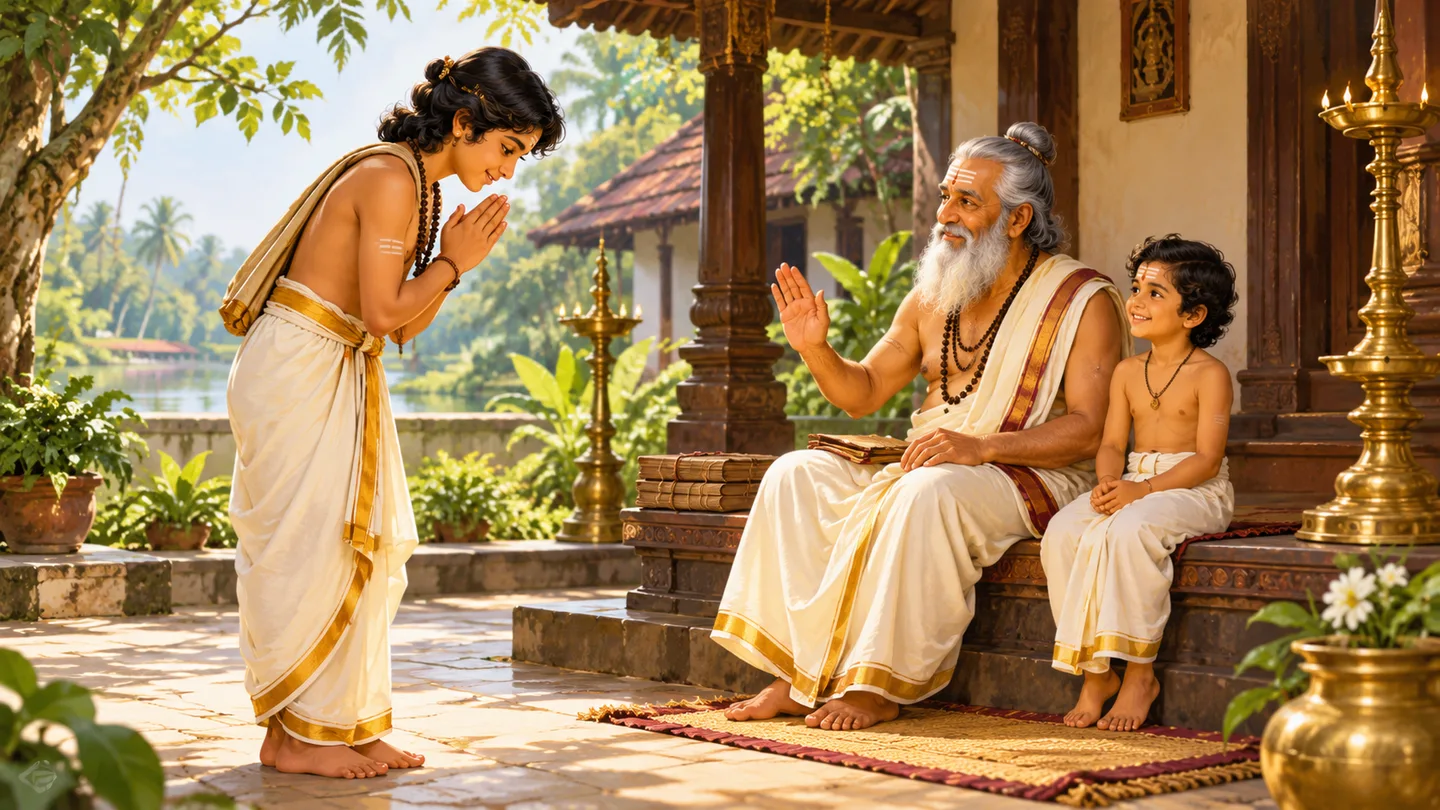
Imagine a shaded courtyard and a simple mat. A teacher and a pupil sit together, with time to listen and learn. A lesson is not a prize to snatch before anyone else. It is something to understand. Looking at Manikandan beside his guru, we can think about the people who patiently help us discover things we could not understand alone.
Original illustration · artistic interpretation
02 / 04
Wisdom is more than an answer
A quick answer can show that we remember something. Wisdom asks what we should do with what we know. Manikandan’s story gives us a chance to think about both. He was praised for his brilliance, but the next part of the account will turn from achievement to gratitude.
A difficult lesson can seem like a closed door. Listening carefully begins to open it. A question helps it open further. When we practise patiently, something that once felt strange becomes familiar. Manikandan’s extraordinary learning belongs to his divine story, but the joy of understanding is something we can recognise. We do not need to know everything at once. There is always another question to ask and another person from whom we can learn.
Original illustration · artistic interpretation
03 / 04
Strength with self-control
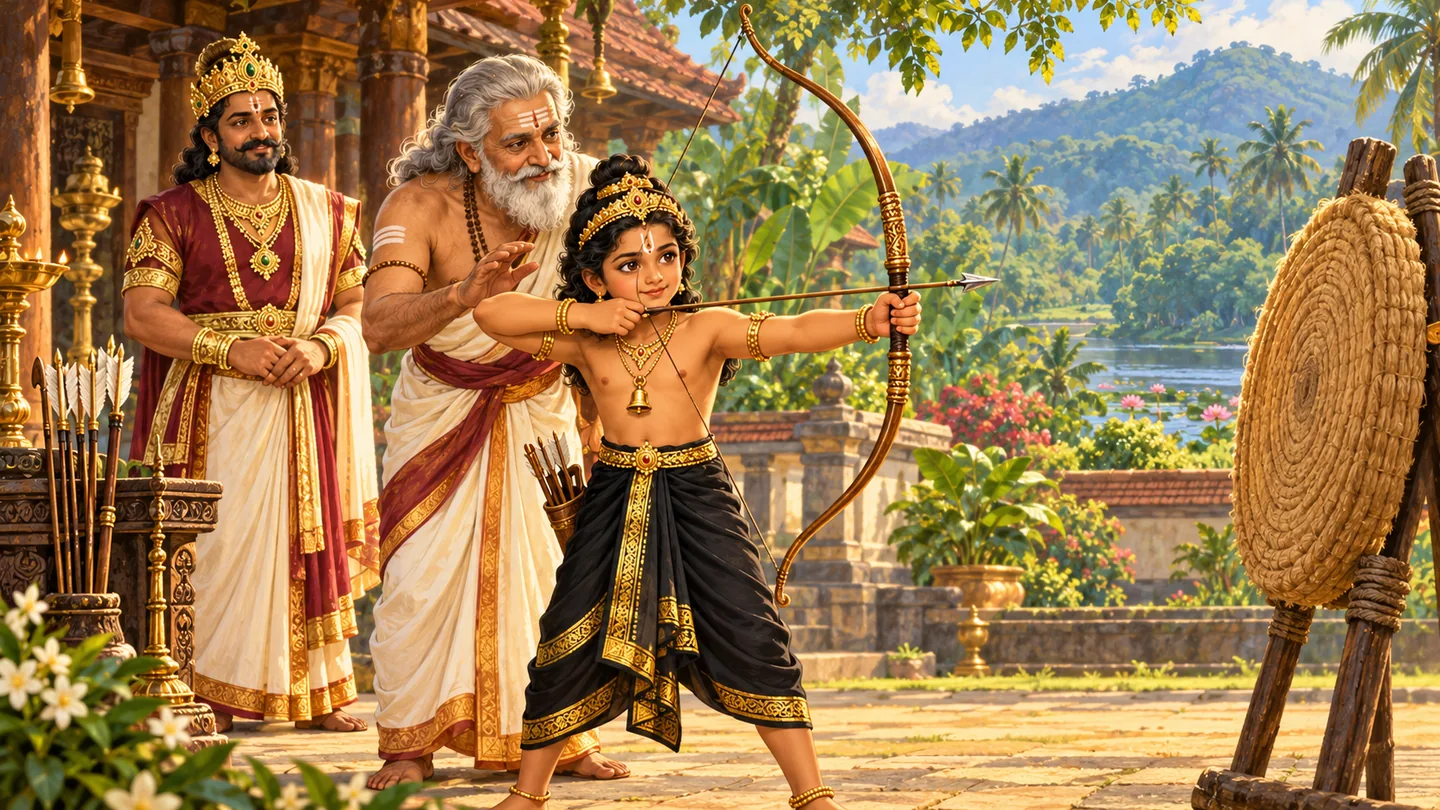
The tradition also remembers Manikandan’s martial skill. In our picture, he practises with a bow under a teacher’s guidance. A target stands apart from the people nearby. The scene helps us think about attention as well as strength. A movement must be controlled; a learner must know when to stop. The same patience that matters in a quiet lesson also matters when a skill uses the whole body.
Courage needs self-control. Being strong does not mean frightening someone smaller. It means knowing when to act, when to stop and when to listen. The learning story invites a question: what should we do with a growing ability? We might use a strong voice to tell the truth, or use what we understand to help a friend. Skill becomes more valuable when care guides it.
Original illustration · artistic interpretation
04 / 04
A gift of gratitude
When his studies were complete, Manikandan offered guru-dakshina, a gift of gratitude to his teacher. In the traditional account, the guru recognised his divinity and asked him to bless his son. The story says that Manikandan gave the child sight and speech, then asked that the miracle remain private.
The blessing is remembered as divine grace. Manikandan did not turn it into a proud display. He asked that it remain private and returned to the palace. His time with the guru ended with thanks rather than boasting. A person’s worth never depends on sight, speech or any other ability. The gentle lesson we can carry from this chapter is to honour our teachers and use what we learn with humility.
Meet the characters
Manikandan
His guru
The guru’s son
Little words, big meanings
Guru
A teacher or spiritual guide.
Dakshina
An offering of gratitude to a teacher.
Shastra
A body of teaching or learned text.
Humility
Being willing to learn without needing to show off.
READ WITH A GROWN-UP
Let’s talk together
Who guided Manikandan’s learning?
What is guru-dakshina?
What is one kind way to use something you have learned?
Tradition, sources and a note for grown-ups
An original educational retelling of the cited tradition. Scenery, transitions and reflections are imaginative reading aids. No invented dialogue is presented as scripture. Illustrations are artistic interpretations.
The blessing of the guru’s son is a miracle in the religious narrative, not a medical claim. Disability does not lessen a person’s worth. The illustrated lessons and courtyard are creative scenery.
Traditional narrative motifs checked against the cited witnesses. Original AI-assisted prose; not a literal translation or a scholar-certified critical edition. Last reviewed: 2026-10-27.
Official portal: “As a child, Manikandan…” through the guru-dakshina episode
The narrative was available through the indexed official page; direct retrieval was intermittent. Childhood miracle is a traditional religious account, not a medical promise.