An original retelling of the Sabarimala tradition · 472 words
The story in 100 words
The king wishes Manikandan to become his successor. A minister who wants power turns the queen against this choice. In the traditional account, she pretends to be ill, and a physician asks for tigress’s milk. The plan is meant to send Manikandan into danger. The loving king worries, but Manikandan volunteers for the journey. At last he receives permission and leaves for the forest. He is not an ordinary child in this story: he is Ayyappa with a divine purpose. Children can learn courage from the account while remembering that real danger should always be brought to a trusted adult.
Swipe left for the next page · swipe right to go back
Original illustration · artistic interpretation
01 / 04
A difficult change at the palace
Manikandan had grown in the palace as the king’s son. After another child was born to the royal couple, Rajasekhara still wished to choose Manikandan as his successor. A successor is the person who will take up a role after someone else. In this case, the role was the kingdom’s ruler.
The traditional story now becomes uneasy. A minister wanted power for himself. He feared that Manikandan would stand in his way. Instead of speaking honestly, he encouraged a plan built on deception. This part of the tale shows how envy can make a person forget the wellbeing of others. A wish for importance grew into a wish to harm.
Original illustration · artistic interpretation
02 / 04
The request for milk
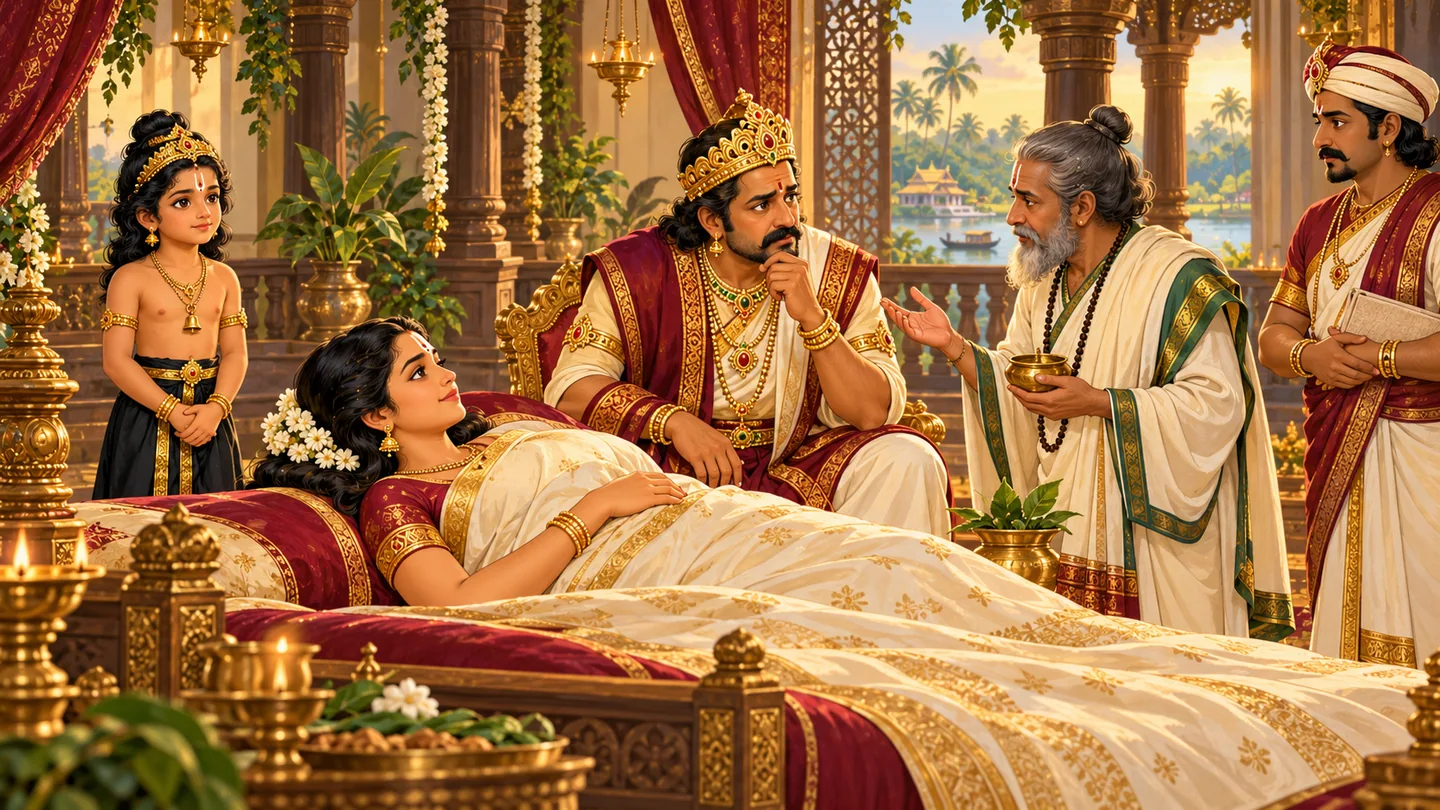
The minister influenced the queen, who wanted her own birth son to become king. In the familiar account, she pretended to be ill. A physician who took part in the scheme said that tigress’s milk was needed. The request was meant to send Manikandan on a journey from which he might not return.
The king was worried. A tiger is a wild animal, and the forest could be dangerous. Tigress’s milk was no ordinary thing to fetch. The request sounded like a cure for the queen, but it hid an unkind purpose. Behind the palace walls, love and fear stood beside envy and dishonesty. Manikandan was at the centre of a plan that others had made around him.
Original illustration · artistic interpretation
03 / 04
A father’s concern
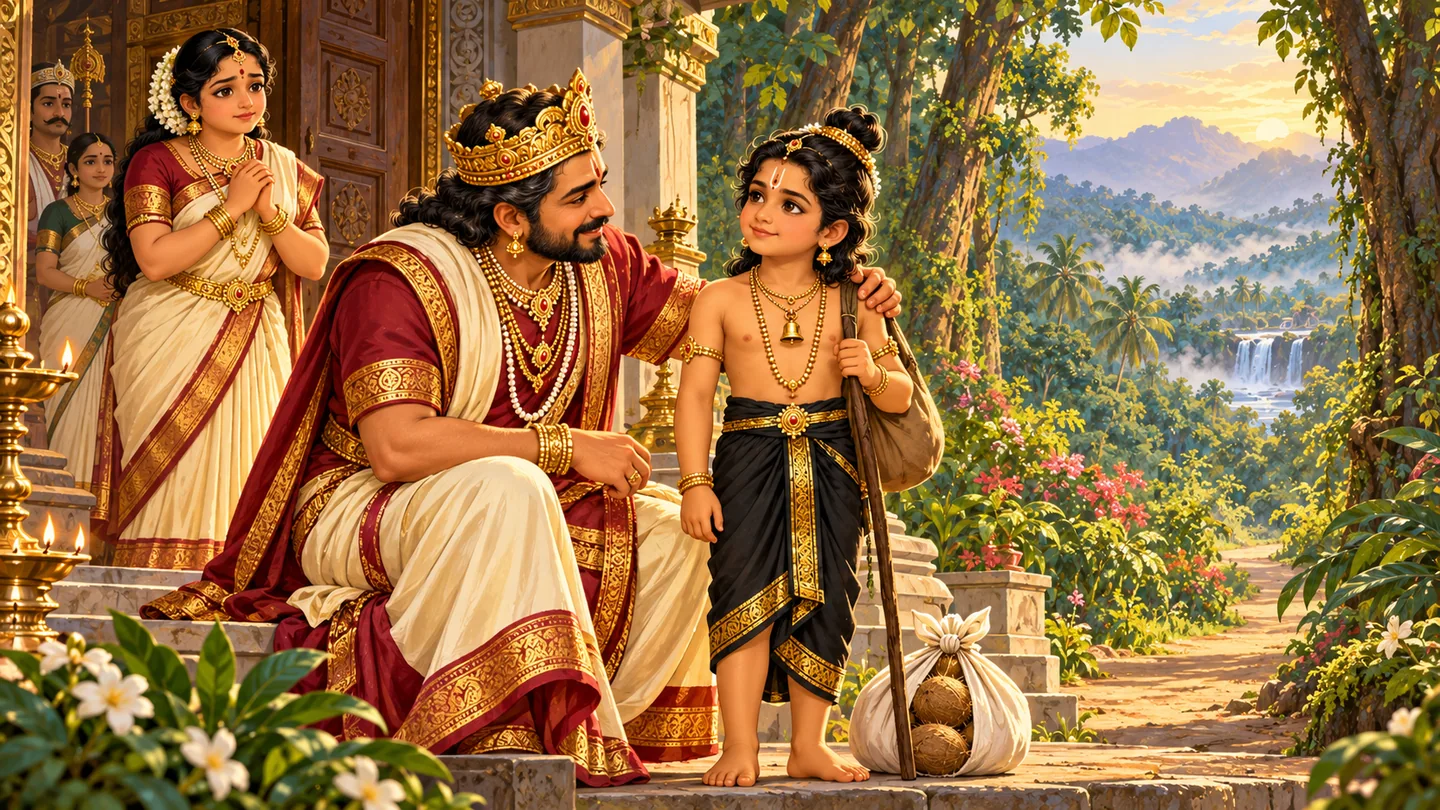
Manikandan offered to go. Rajasekhara was reluctant, because he loved his son and feared for his safety. Eventually, in the traditional narrative, the king gave permission. The official telling also remembers provisions and coconuts prepared for the journey. Our picture pauses at the farewell, showing the love behind the king’s concern.
For Rajasekhara, this was not simply a prince setting out on an errand. It was his son leaving the safety of home. He had once carried Manikandan out of a forest. Now he had to watch him go towards it again. Remembering that first meeting helps us understand the father’s concern. His love had not changed, even though the little child had grown.
Original illustration · artistic interpretation
04 / 04
Into the forest
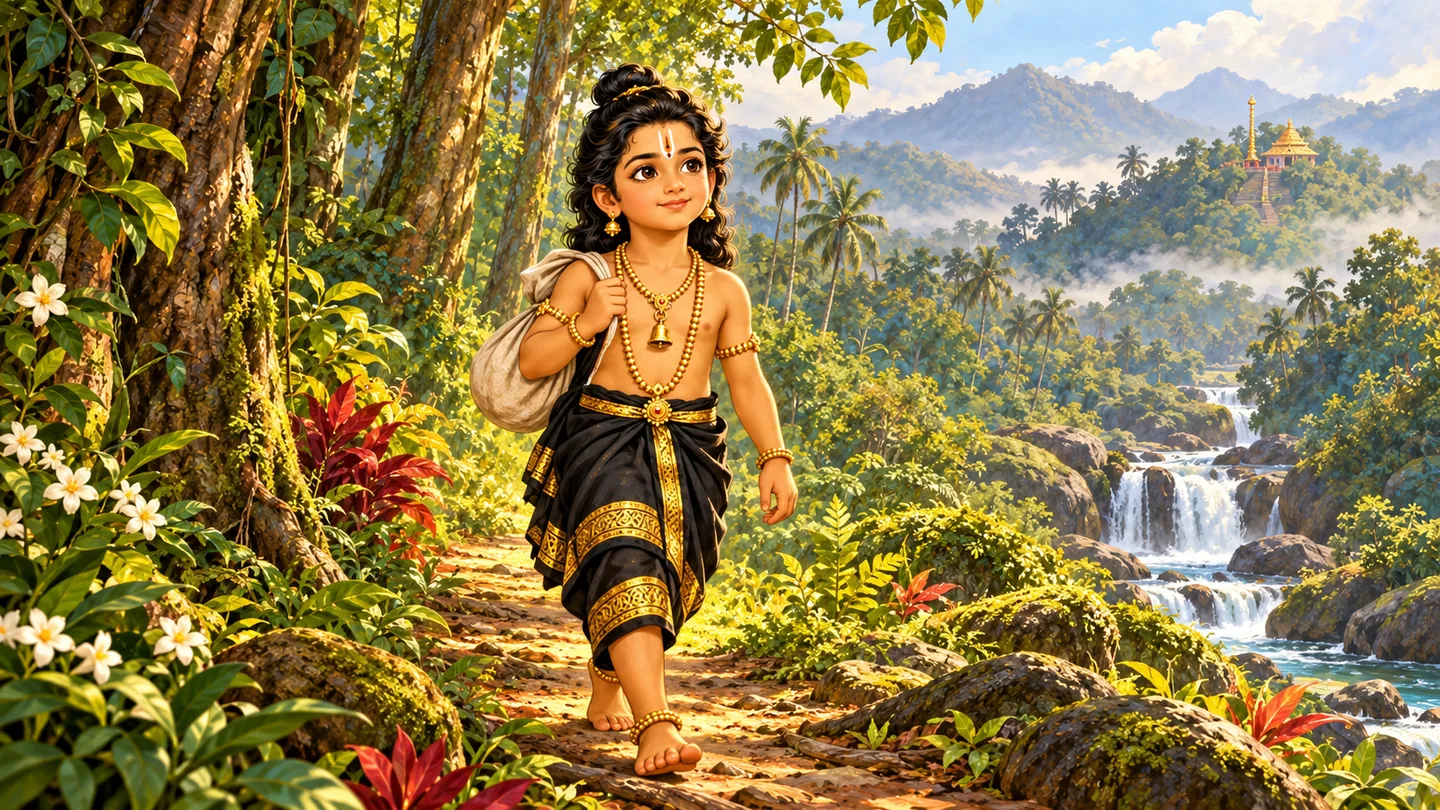
Manikandan left the palace and entered the forest. Imagine the rooms and gateways behind him, and a path opening between tall trees. The noise of the palace gives way to leaves and running water. Ahead lies the task that the people at home cannot yet understand. The milk quest has brought him away from Pandalam, but a much older purpose is drawing near.
The quest for milk will bring Manikandan into the episode of Mahishi. What looked like the minister’s plan will not determine the ending. The boy’s mission reaches beyond the quarrel over a throne. For now, he continues along the path. We leave him at the edge of the next chapter, carrying courage without boastfulness and moving towards the task for which the tradition says he was born.
Meet the characters
Manikandan
King Rajasekhara
The queen
The minister
The physician
Little words, big meanings
Successor
Someone who takes up a role after another person.
Deception
Trying to make someone believe something untrue.
Resolve
A steady determination to do what is needed.
READ WITH A GROWN-UP
Let’s talk together
Why was the king worried?
Was the request for milk an honest one?
How can a child show courage safely?
Tradition, sources and a note for grown-ups
An original educational retelling of the cited tradition. Scenery, transitions and reflections are imaginative reading aids. No invented dialogue is presented as scripture. Illustrations are artistic interpretations.
The forest quest belongs to a divine legend. Children should not enter forests alone or approach wild animals. A courageous everyday choice is to ask a trusted adult for help.
Traditional narrative motifs checked against the cited witnesses. Original AI-assisted prose; not a literal translation or a scholar-certified critical edition. Last reviewed: 2026-10-27.
Kerala Tourism: “The Queen’s Feigned Illness” and opening of “The Defeat of Mahishi”
An official presentation of religious tradition, not independent historical proof. DHIH retells traditional motifs in original language; source prose and art are not reproduced.
Official portal: permission for the forest journey and provisions
The narrative was available through the indexed official page; direct retrieval was intermittent. Childhood miracle is a traditional religious account, not a medical promise.