Manisha Panchakam
मनीषापञ्चकम्
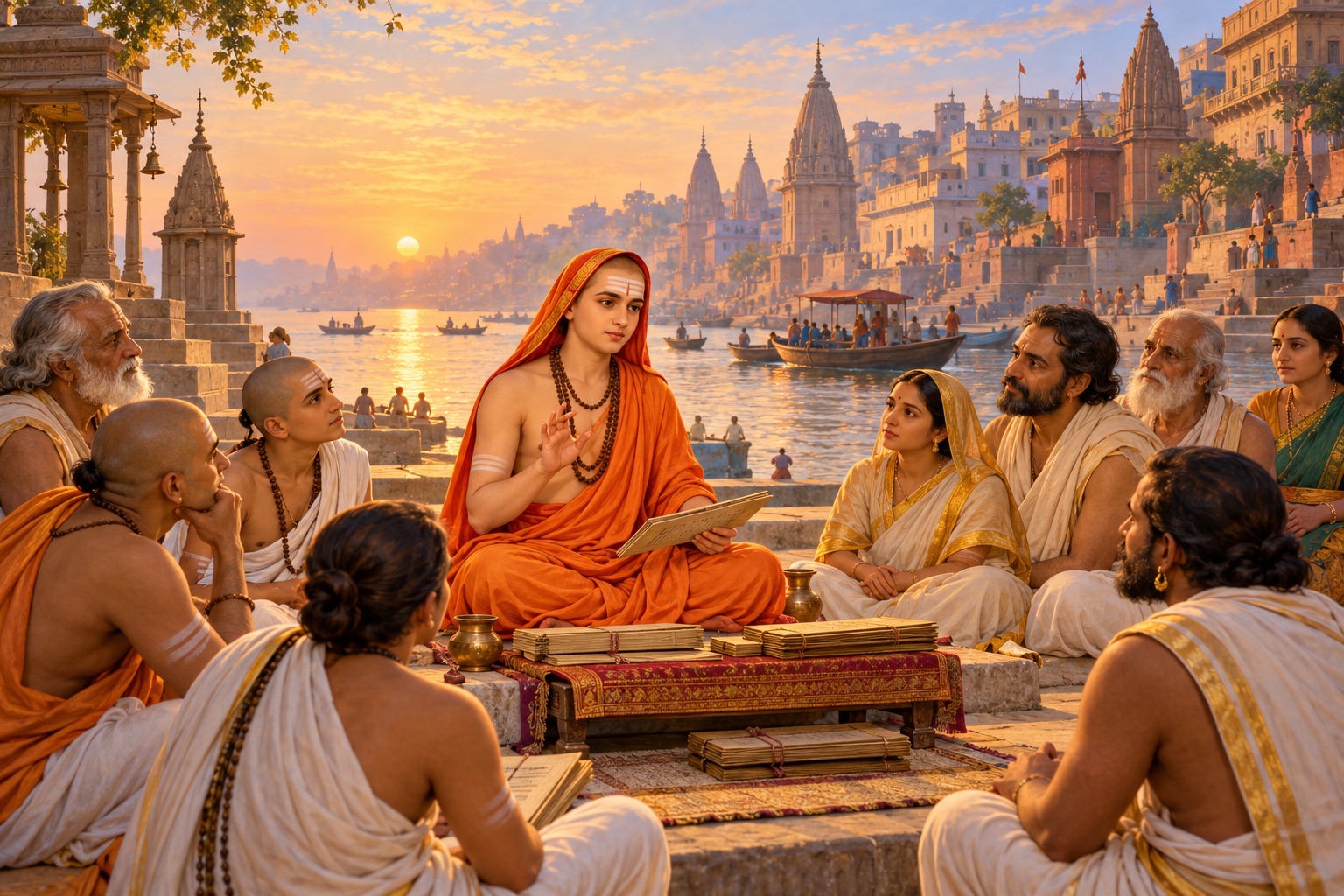
Opening question 1
अन्नमयादन्नमयमथवा चैतन्यमेव चैतन्यात् | यतिवर दूरीकर्तुं वाञ्छसि किं ब्रूहि गच्छ गच्छेति ||
English meaning
When you tell me to move away, revered ascetic, what do you wish to separate? Is it one body nourished by food from another, or consciousness itself from consciousness?
Opening question 2
प्रत्यग्वस्तुनि निस्तरङ्गसहजानन्दावबोधाम्बुधौ विप्रोऽयं श्वपचोऽयमित्यपि महान्कोऽयं विभेदभ्रमः | किं गङ्गाम्बुनि बिम्बितेऽम्बरमणौ चाण्डालवीथीपयः पूरे वाऽन्तरमस्ति काञ्चनघटीमृत्कुम्भयोर्वाऽम्बरे ||
English meaning
In the inward Self, a still ocean of awareness and natural joy, how can one person be set apart as a Brahmin and another as an outcaste? Is the sun reflected in the Ganges different from the sun reflected in water on an outcaste’s street? Does space differ inside a gold vessel and a clay pot?
Verse 1
जाग्रत्स्वप्नसुषुप्तिषु स्फुटतरा या संविदुज्जृम्भते या ब्रह्मादिपिपीलिकान्ततनुषु प्रोता जगत्साक्षिणी | सैवाहं न च दृश्यवस्त्विति दृढप्रज्ञापि यस्यास्ति चे- च्चाण्डालोऽस्तु स तु द्विजोऽस्तु गुरुरित्येषा मनीषा मम ||१||
English meaning
Awareness shines through waking, dreaming and deep sleep. It runs through every living body, from Brahma to the ant, and witnesses the world. Whoever knows with certainty “I am that awareness, distinct from the objects I see” is my teacher, whether an outcaste or twice-born. This is my conviction.
Verse 2
ब्रह्मैवाहमिदं जगच्च सकलं चिन्मात्रविस्तारितं सर्वं चैतदविद्यया त्रिगुणयाऽशेषं मया कल्पितम् | इत्थं यस्य दृढा मतिः सुखतरे नित्ये परे निर्मले चाण्डालोऽस्तु स तु द्विजोऽस्तु गुरुरित्येषा मनीषा मम ||२||
English meaning
I am Brahman. This entire world unfolds in consciousness alone. Through ignorance with its three qualities, I have imagined all these distinctions. Whoever stands firm in that pure, eternal joy is my teacher, whatever their birth. This is my conviction.
Verse 3
शश्वन्नश्वरमेव विश्वमखिलं निश्चित्य वाचा गुरो- र्नित्यं ब्रह्म निरन्तरं विमृशता निर्व्याजशान्तात्मना | भूतं भाति च दुष्कृतं प्रदहता संविन्मये पावके प्रारब्धाय समर्पितं स्ववपुरित्येषा मनीषा मम ||३||
English meaning
Trusting the teacher’s words, the seeker recognizes that everything in the changing world passes away. With a quiet and sincere mind, the seeker continually reflects on eternal Brahman. In the fire of awareness wrongdoing burns away, while the body follows the course of actions already bearing fruit. This is my conviction.
Verse 4
या तिर्यङ्नरदेवताभिरहमित्यन्तः स्फुटा गृह्यते यद्भासा हृदयाक्षदेहविषया भान्ति स्वतोऽचेतनाः | तां भास्यैः पिहितार्कमण्डलनिभां स्फूर्तिं सदा भावय- न्योगी निर्वृतमानसो हि गुरुरित्येषा मनीषा मम ||४||
English meaning
Animals, humans and gods alike experience within themselves the immediate sense of “I”. By its light the mind, senses, body and their objects appear, though they have no awareness of their own. Like the sun hidden by what it illuminates, that light can be overlooked. The yogi who attends to it with a contented mind is my teacher.
Verse 5
यत्सौख्याम्बुधिलेशलेशत इमे शक्रादयो निर्वृता यच्चित्ते नितरां प्रशान्तकलने लब्ध्वा मुनिर्निर्वृतः | यस्मिन्नित्यसुखाम्बुधौ गलितधीर्ब्रह्मैव न ब्रह्मविद् यः कश्चित्स सुरेन्द्रवन्दितपदो नूनं मनीषा मम ||५||
English meaning
Even Indra and the other gods draw their joy from the smallest drop of this ocean of bliss. A sage whose thoughts have grown still finds fulfilment in it. When the separate knower dissolves in that lasting joy, there is only Brahman. Whoever realizes this is worthy of homage even from the king of the gods.
Closing prayer
दासस्तेऽहं देहदृष्ट्याऽस्मि शंभो जातस्तेंऽशो जीवदृष्ट्या त्रिदृष्टे | सर्वस्याऽऽत्मन्नात्मदृष्ट्या त्वमेवे- त्येवं मे धीर्निश्चिता सर्वशास्त्रैः ||
English meaning
O Shiva, seen as a body I am your servant. Seen as an individual living being I am a part of you, three-eyed Lord. Seen as the Self of all, I am you alone. The scriptures have made this understanding firm in me.
Source and attribution
Traditionally attributed to Adi Shankara. This edition includes two introductory questions and a closing address to Shiva around the five numbered verses. Sanskrit from Sanskrit Wikisource contributors, selected revision. Paragraph breaks and editorial markup adapted. Transcription under CC BY-SA 4.0. English meanings prepared for DHIH.